The Five Negotiation Styles: Which One Do You Default To?
The 5 negotiation styles, from competing to accommodating: where the Thomas-Kilmann model comes from, a quick self-check, and when each style fits.

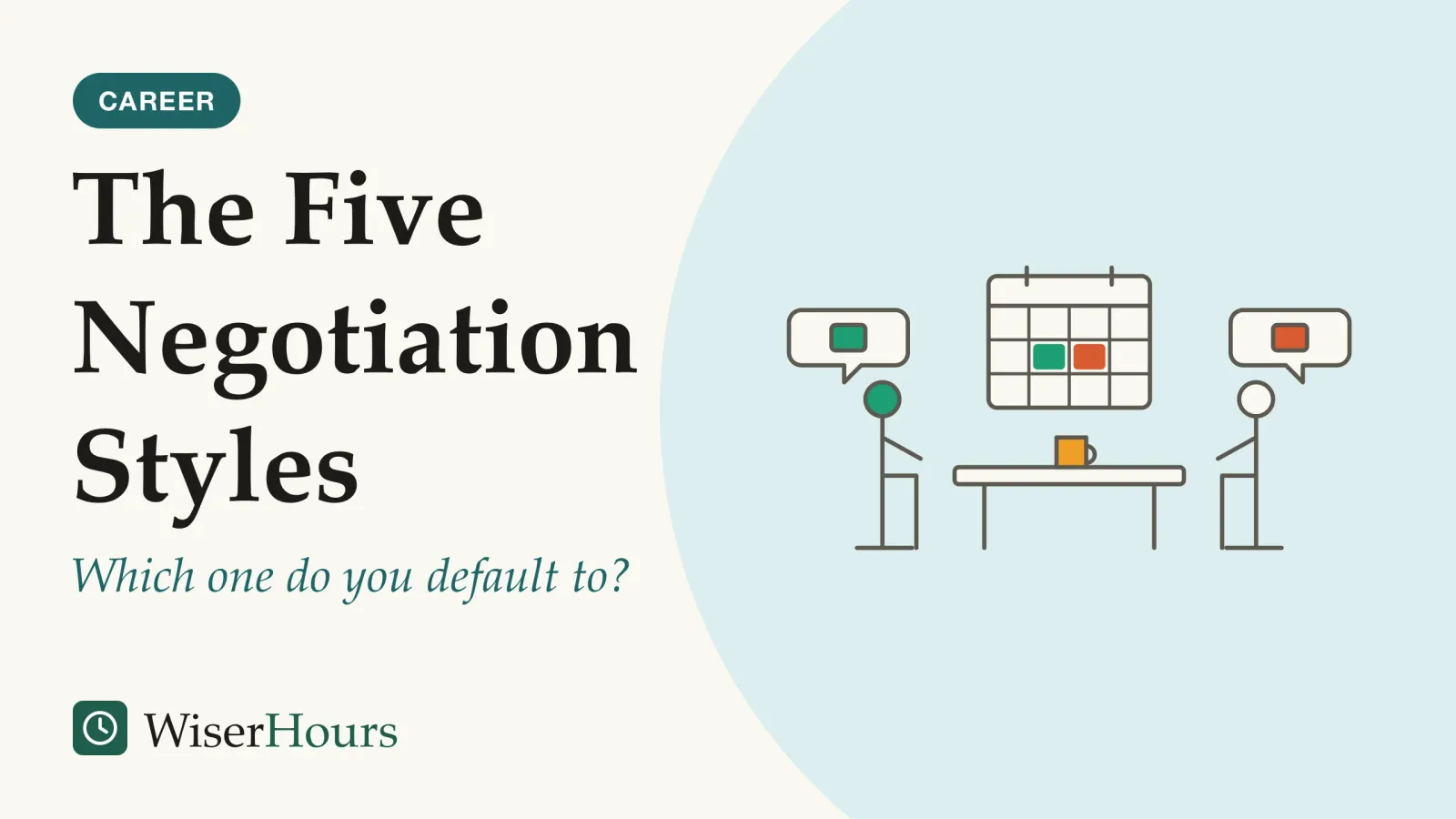
Being cooperative is only half of a good negotiating habit. Carsten De Dreu and two colleagues pooled 28 negotiation studies in a 2000 meta-analysismeta-analysis: A study that combines the results of earlier studies on the same question into one overall estimate. Pooling makes the estimate more precise, but it cannot repair the studies it pools: a meta-analysis of surveys is still survey evidence.Full entry in the glossary: negotiators who also wanted a good result for the other side did more problem solving and struck better joint deals, but not when they gave in easily.1 That finding sits on top of the best-known map of negotiation styles, which has five: competing, accommodating, avoiding, compromising and collaborating.
The map is the Thomas-Kilmann Conflict Mode Instrument, introduced by Kenneth Thomas and Ralph Kilmann in 1974.2 It places each style on two dimensions: how far you pursue your own concerns and how far you try to meet the other person’s. Everyone can use all five, the authors write, though people tend to lean on some more than others.3
The hub guide on how to negotiate in seven steps covers what to do once you are at the table. This page is about the habit you bring to it before you have thought about it at all.
The five negotiation styles on one map
Thomas and Kilmann build the five negotiation styles from two concerns: assertiveness, the extent to which you try to satisfy your own concerns, and cooperativeness, the extent to which you try to satisfy the other person’s. High on one and low on the other gives competing or accommodating; low on both gives avoiding, high on both collaborating, and the middle compromising.3
Two dimensions matter because caring about your own result and caring about theirs are separate questions. On this map you can care a great deal about both, and that corner is where collaboration sits.
Take an illustrative case: two colleagues who both want the same week off. Each style sounds different:
- Competing: “I asked first, so the week is mine.”
- Accommodating: “You take it, I’ll go another time,” said by someone who would rather have gone.
- Avoiding: neither raises it until the manager has to decide for them.
- Compromising: each takes half the week.
- Collaborating: they ask why the week matters. One has children off school that week; the other just wants a rest before a big deadline, which an earlier week would give just as well.
In the authors’ account, compromising is more direct than avoiding but shallower than collaborating: it finds a quick middle ground that partly satisfies both sides, where collaborating digs into the needs underneath to find something that fully satisfies both.3
In the holiday example, the half-week split was fair and fast. The collaborative answer was better for both, but it needed a question that the split never asked.
Up the side: more assertive, pursuing your own concerns. Along the bottom: more cooperative, meeting the other person’s.
- Competing: assertive and uncooperative: pursuing your own concerns at the other person’s expense
- Collaborating: assertive and cooperative: digging into the issue for a solution that fully meets both sides’ concerns
- Compromising: moderate on both: a quick, mutually acceptable middle ground that partly satisfies each side
- Avoiding: unassertive and uncooperative: sidestepping, postponing or withdrawing from the issue
- Accommodating: unassertive and cooperative: setting aside your own concerns to meet the other person’s
Read the five labels as descriptions of what you do in a given moment, not of who you are. The same person can compete over a parking space and accommodate a close friend in the same afternoon.
Find your default in five questions
This self-check is not the Thomas-Kilmann questionnaire and gives no score. It asks what you did, using the definitions above.
Self-check: your last three disagreements
Think back over your last three real disagreements, at work or at home, and answer honestly.
- Did I say what I wanted early, late or never?
- When the other person pushed, did I push back, give way or change the subject?
- Did I ask why they wanted what they wanted, or only what they wanted?
- How did it end: one of us got our way, we split the difference, it faded without a decision, or we found something that suited both?
- Afterwards, did I feel I had given up something that mattered to me?
If the answers keep pointing to “never”, “changed the subject” and “it faded”, avoiding is probably your default. “Pushed back” and “one of us got our way” suggest competing; “gave way” and a lingering sense of loss suggest accommodating; “split the difference” suggests compromising; and questions about why, ending in something that suited both, suggest collaborating.
Say you let a housemate’s late share of the bills slide, changed the subject when a colleague took credit for your idea, and gave in on where the team went for lunch. That pattern points to avoiding and accommodating, and the useful follow-up is whether any of those issues mattered more to you than you let on.
A second opinion helps. When De Dreu and colleagues tested a workplace conflict questionnaire in 2001, self-reportsself-report: A measure in which people describe their own behavior, feelings or circumstances, usually by answering a questionnaire. When the same person supplies both of the things being compared, shared habits of answering can make the link between them look stronger than it is.Full entry in the glossary matched ratings by the other negotiator and by observers well for problem solving, forcing and yielding, but not for avoiding.4 Ask someone who has disagreed with you which of your answers they would change.
The best joint deals pair goodwill with a firm goal
The strongest evidence for the two-concern map comes from negotiation studies, not from the questionnaire. Researchers call the idea dual concern theory, credited to Dean Pruitt and Jeffrey Rubin in 1986, and De Dreu and co-authors Laurie Weingart and Seungwoo Kwon tested it by comparing negotiators with a cooperative motive against self-interested ones.1
The study
Moderate evidence
Does goodwill help at the bargaining table?
Across 28 studies, negotiators with a prosocial motive were less contentious, worked more on problem solving and reached better combined results than those out for themselves. The advantage appeared when their resistance to yielding was high or not measured, and not when it was low, as dual concern theory predicts.1
Goodwill on its own was not enough. When giving in was easy, a cooperative motive brought neither the extra problem solving nor the better joint deals; it took caring and firmness together. Two caveats: the authors report that results varied with how participants were recruited, for instance through class exercises, and with whether a study was published, and only the abstract, not the paper itself, was open to this guide.1
A supplier you like asks for a price rise. With no budget target, you may just agree. With a capped budget, you are pushed to ask what else could move, such as order size or payment terms, and both sides can end up better off.
Which style fits which situation
Ralph Kilmann, co-author of the instrument, says each of the five styles fits some situations and advises choosing by the situation rather than by habit. He names eight things to weigh: stress, how simple or complex the issue is, how much it matters to each side, the time available, trust, the quality of communication, the organization’s culture and rewards, and how much the relationship matters.5 This is expert advice from someone who sells the instrument, not a tested rule.
| Style | When it tends to fit, in Kilmann’s account | What to watch for |
|---|---|---|
| Competing | A simple issue that matters more to you, with little time, where the relationship is not the priority | Acceptable now and then, Kilmann says, as long as the other side’s most important needs are not ignored in other conflicts5 |
| Collaborating | A complex issue that matters to everyone, with time, trust and a relationship you want to keep | It takes time and fails when people will not share their real needs5 |
| Compromising | A simple issue of moderate importance to all, with little time for discussion | If every conflict ends this way, people stay only partly satisfied5 |
| Avoiding | An unimportant issue, or stress so overwhelming that the talk is better postponed | Used again and again, it leaves people’s needs unmet and them disengaged5 |
| Accommodating | An issue that matters much more to the other side | If one person always gives way, they tend to disengage5 |
Two of Kilmann’s points carry into any negotiation. First, collaboration needs trust and time: people will not reveal what they really need if they think it will be used against them, so in a low-trust, rushed talk, a fair compromise may be the realistic best. Second, when stress is overwhelming, he suggests postponing the conversation until people are calm.5
You can also change the situation to make a better style possible. Kilmann’s own example is two people arguing over a meeting time: one wants three o’clock, the other five. Splitting it at four is a compromise. Adding the agenda, the place and who else attends turns one issue into several, and a trade that suits both becomes possible.5 When a talk feels stuck on one number, add issues before you give ground on it.
Before you choose a style
Download PDF
Where the two-concern map came from
The five styles descend from the managerial grid that Robert Blake and Jane Mouton published in 1964, which scored managers from 1 to 9 on concern for people and concern for production and named five leadership styles from the combinations.6
Thomas and Kilmann carried that logic over to conflict. Their questionnaire uses two axes modeled on the grid, called assertiveness and cooperativeness, and asks people to choose between thirty pairs of statements, each pair designed through a multi-stage research process to be equally socially desirable.2 Forcing a choice between two equally respectable answers was meant to control for the pull toward whatever makes a person look good.7
Wikipedia’s overview of conflict resolution notes that most earlier studies of organizational conflict treated it as a single line from cooperation to competition, and that Thomas and colleagues adapted the grid to capture behavior beyond that either-or.8
On a single line, every step toward the other person is a step away from your own goal. On two dimensions, you can move toward both at once, which is what the collaborating corner means in practice. A team arguing over one launch date sees only a line; add scope and staffing to the talk and it becomes a map with room to trade. So when you catch yourself thinking “whatever I give, I lose”, look for a second issue first.
How far to trust a style questionnaire
The evidence on the Thomas-Kilmann instrument itself is mixed. Checks since the late 1970s, including the authors’ own, found its reliability modest and its agreement with other conflict questionnaires limited, so a result is a starting point for reflection rather than a verdict.
Reliability is whether a questionnaire gives the same answer when nothing about you has changed. When it is modest, the label you get can shift from one sitting to the next.
The authors reported in 1977 that the paired format reduced the pull toward flattering answers across the group as a whole, compared with three other questionnaires, and that its external validity needed more research.7 Their 1978 comparison of four conflict questionnaires, in a small sample of management graduate students, found reliabilities in the low-to-moderate range.9 In 1988, Deanna Womack, who described it as the most widely used instrument in research and training, called for work to make its items more reliable and to test whether scores predict the communication strategies people use in conflicts.10 A 1992 study of business students in a team simulation found only moderately low agreement between it and another style questionnaire, the ROCI-II.11
The authors themselves describe styles as tendencies, not types:
Each of us is capable of using all five conflict-handling modes.
They add that people rely on some modes more than others because of temperament or practice, and that behavior depends on both personal leanings and the demands of the situation.3
So if a workshop quiz calls you an avoider, read it as “you may reach for avoiding more often than you realize”, then test it against last month: which disagreements did you let drop, and would a colleague agree?
Culture changes which style reads as polite
Which style looks respectful depends partly on culture. A 2005 meta-analysis by Jennifer Holt and Cynthia DeVore, pooling 36 studies that compared groups, found that people from individualistic cultures reported choosing forcing more often than people from collectivistic cultures, who preferred withdrawing, compromising and problem solving more.12 This guide could check the abstract only, and those two labels are broad groupings of countries that hide large differences within them.
Wikipedia’s overview of conflict resolution, drawing on a 1992 book on mediation across cultures, notes that in countries such as Canada and the United States, resolution usually means direct talk and problem solving, while in contexts such as Afghanistan, Vietnam and China, addressing the issue head-on can seem very rude; involving a respected third party, or making a point through a story, can make more sense.8
If you negotiate across borders or teams, do not read a quiet counterpart as weak or a blunt one as hostile. What looks like avoiding may be a way to keep the peace while the issue is handled another way, for instance through a trusted go-between. Watch how people around you handle disagreement, and ask a colleague who knows the setting before you choose your style. The four communication styles, from passive to assertive describe the same range in everyday speech, and for a dispute with a colleague rather than a deal, see how to resolve a conflict at work.
The bottom line
Nobody is stuck with one style: the five are habits you can choose between. Watch for the style you fall into first, then ask what the situation needs: how much the issue matters to each side, how much time and trust there is, and whether you will deal with this person again. When the stakes and the relationship both matter, aim for the hardest combination: care about the other side’s result while keeping a firm goal of your own.
Frequently asked questions
Is there a free version of the Thomas-Kilmann test?
No. The Thomas-Kilmann Conflict Mode Instrument is copyrighted and sold per person, as Wikipedia's entry on it notes, and its paired statements are not published freely. Free online quizzes that borrow the same five labels are not the published instrument, so their results are not TKI scores. A self-check like the one in this guide is a prompt for reflection, not a score.
Do other conflict questionnaires use different names for the five styles?
Yes. Holt and DeVore's 2005 meta-analysis reports that instruments built on Blake and Mouton's grid often call them forcing, problem-solving, compromising, withdrawing and smoothing. The test for conflict handling described by De Dreu and colleagues in 2001 uses forcing, problem solving, compromising, avoiding and yielding. The map underneath is the same.
Can you change your default negotiation style?
Possibly, with practice, though no study located for this guide has tested whether people can shift their default for good. Kenneth Thomas and Ralph Kilmann write that everyone can use all five modes and that people lean on some because of temperament or practice. Kilmann advises picking a mode to suit the situation rather than out of habit, so one place to start is trying a less familiar style on a low-stakes disagreement.
Sources
- Influence of social motives on integrative negotiation: A meta-analytic review and test of two theories. De Dreu, C. K. W., Weingart, L. R. & Kwon, S. (2000). Journal of Personality and Social Psychology, 78(5), 889-905
- Thomas-Kilmann Conflict Mode Instrument. Wikipedia (accessed 2026-09-28)
- A Brief Overview of the Thomas-Kilmann Instrument (TKI). Kilmann Diagnostics (2026), text by Kenneth W. Thomas and Ralph H. Kilmann; the company sells the TKI (accessed 2026-09-28)
- A theory-based measure of conflict management strategies in the workplace. De Dreu, C. K. W., Evers, A., Beersma, B., Kluwer, E. S. & Nauta, A. (2001). Journal of Organizational Behavior, 22(6), 645-668
- The Eight Key Attributes of a Conflict Situation: When to Use Each Conflict-Handling Mode Most Effectively. Kilmann, R. H. (2022). Kilmann Diagnostics, 9 September 2022 (accessed 2026-09-28)
- Managerial grid model. Wikipedia, on Blake, R. R. and Mouton, J. S., The Managerial Grid (1964) (accessed 2026-09-28)
- Developing a forced-choice measure of conflict-handling behavior: The "MODE" instrument. Kilmann, R. H. & Thomas, K. W. (1977). Educational and Psychological Measurement, 37(2), 309-325
- Conflict resolution. Wikipedia, sections on modes, dual concern and cultural issues (accessed 2026-09-28)
- Comparison of four instruments measuring conflict behavior. Thomas, K. W. & Kilmann, R. H. (1978). Psychological Reports, 42(3 suppl.), 1139-1145
- Assessing the Thomas-Kilmann Conflict Mode Survey. Womack, D. F. (1988). Management Communication Quarterly, 1(3), 321-349
- Measuring conflict management styles: A comparison between the MODE and ROCI-II instruments using self and peer ratings. Ben-Yoav, O. & Banai, M. (1992). International Journal of Conflict Management, 3(3), 237-247
- Culture, gender, organizational role, and styles of conflict resolution: A meta-analysis. Holt, J. L. & DeVore, C. J. (2005). International Journal of Intercultural Relations, 29(2), 165-196
How we researched this
The sources, read in September 2026, are Wikipedia's entries on the Thomas-Kilmann instrument, the managerial grid and conflict resolution, two articles on Kilmann Diagnostics' own site, and the abstracts of seven papers from 1977 to 2005 on dual-concern theory, conflict questionnaires and culture, found through Crossref, PubMed and Semantic Scholar. No full paper could be read, so every study finding here rests on its abstract.
Keep reading
Your Walk-Away Point: How to Know When a Deal Isn't Worth Taking
Work out your walk-away point in 4 steps: list your alternatives, pick the best real one, turn it into a number, and write it down before you talk.
Interests vs. Positions: The Idea That Changes Most Negotiations
Positions are what people ask for; interests are why. How 2 kinds of question, why and what if, uncover interests and turn them into better deals.
How to Negotiate: A Research-Backed Guide for Everyday Life
How to negotiate rent, prices, fees and deadlines in 7 steps, from knowing your walk-away point to opening offers, fair trades and when to just pay.
How to Respond to a Lowball Offer Without Losing the Deal
A lowball offer is an opening move, not an insult. 5 steps and sample wording to reply without countering off their number or losing the buyer.