Your Walk-Away Point: How to Know When a Deal Isn't Worth Taking
Work out your walk-away point in 4 steps: list your alternatives, pick the best real one, turn it into a number, and write it down before you talk.

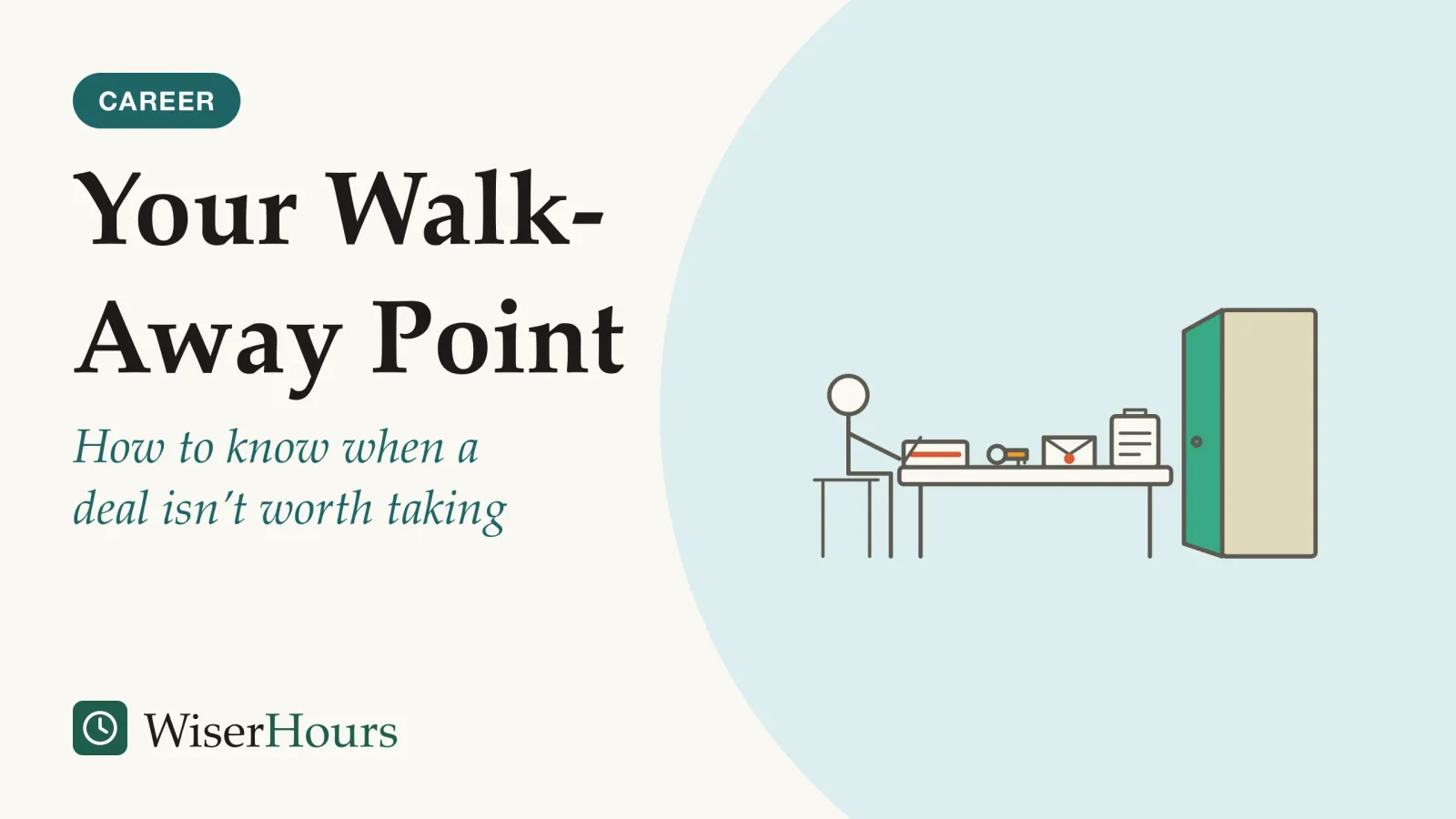
Say a seller wants 10,000 for a used car you like, and a similar car across town is listed at 9,000. How far you should go on this one depends less on the car than on that other listing: if it is available, this deal is worth taking only below roughly 9,000 plus the cost of getting there.
Your walk-away point is the worst deal you would still accept, and it is set by the best alternative to the deal in front of you. Advice on walk away point negotiation comes down to fixing that line before you talk, in four steps:
- List what you would do if this deal fell through
- Pick the best one, and check it is real
- Turn it into a number or a set of terms
- Write it down before you talk
The number is a floor, and your target sits above it. A 2002 set of three experiments by Adam Galinsky, Thomas Mussweiler and Victoria Medvec showed that people who kept their target in mind reached objectively better deals than people fixed on their walk-away point, though they were less satisfied with them.1
BATNA, reservation price and ZOPA, in plain words
Three terms carry the whole idea, and each answers a different question. The general guide on how to negotiate well introduces them in its second step; this page puts them to work on real decisions. Your BATNA, short for best alternative to a negotiated agreement, is the course you will take if this deal fails. The term comes from Roger Fisher and William Ury’s 1981 book Getting to Yes, which describes it as the results you can get without negotiating.2
Your reservation price is the worst deal you would still accept: the highest price you would pay when buying, or the lowest you would take when selling. It is your walk-away point, and you calculate it once you know your BATNA.3 Wikipedia’s entry on BATNA gives a simple case. When you buy a bike, your alternative may be another shop, and the most you would pay at this one depends on what it would cost you to go and find the other.4
The zone of possible agreement, or ZOPA, is the overlap between the two sides’ walk-away points. Inside it, any deal is sensible for both sides. If the seller’s lowest acceptable price sits above the most you would pay, there is no overlap, and no amount of talking should produce a deal.5
- Myth
- Your walk-away point is the price you hope to get.
- Fact
- Your walk-away point is the worst deal you would accept, set by your best alternative. The price you hope for is your target, a separate and more ambitious number.
An alternative is an action; a walk-away point is a line. “I’ll keep my current job” is a BATNA. “I’ll move only for a package at least as good as my current job” is a walk-away point, and when several things are at stake, as in a job offer, it is a package of terms rather than one number.3 Name the action first, and the line follows from it.
Walk away point negotiation prep in four steps
Wikipedia’s entry on BATNA sets out the sequence: list every alternative, estimate what each is worth, pick the best, then calculate the least favorable deal you would accept.4 Each step has a trap that is easier to avoid on paper than at the table.
- List your alternatives: everything you could do if this deal fails, including doing nothing
- Pick the best, and check it is real: your best alternative to a negotiated agreement, or BATNA
- Turn it into a number or terms: your reservation price, or walk-away point, after the costs of taking the alternative
- Write it down before you talk: so pressure in the room cannot move it without a reason
1. List what you would do if this deal fell through
Write down every course of action open to you if the talk ends without agreement, including doing nothing. For a job offer, Harvard Law School’s Program on Negotiation, summarizing Deepak Malhotra and Max Bazerman’s book Negotiation Genius, lists other openings, staying put and graduate school.6
Buying a used car, the list might hold similar cars listed elsewhere, keeping your old car another year, or taking the bus. Hiring a builder to fix a roof, it might hold a second quote, a smaller repair now, or waiting until the dry season. The method works the same in São Paulo, Warsaw or Nairobi, because it depends on your options, not on local custom. A list with a single entry is a warning sign: go and find another option before you talk.
2. Pick the best one, and check it is real
Your BATNA is the best item on that list, but only if it is available. Wikipedia’s entry notes that an option counts only if it is real and actionable, and that the time needed to check which option is really best often goes unspent.4
In experiments by Robin Pinkley and colleagues, as the Program on Negotiation summarizes them, people playing job candidates had a possible second offer, a certain one or none. Those with a possible or certain offer felt more powerful and did better on salary, but people were often overconfident that an uncertain offer would come through and turned down deals they should have taken.7 The paper’s own abstract confirms the core: how likely the alternative was shaped settlements through how powerful people felt.8
An alternative must also be comparable. One Program on Negotiation article recounts a homeowner who found a policy about 30 percent cheaper than his insurer’s renewal quote, then found in the fine print that the two policies differed in coverage and terms, and that his current insurer was the better deal. For uncertain alternatives, the same article advises weighing each outcome by its likelihood rather than planning around the worst case.9 Before you count an alternative, ask two questions: will it be there, and is it the same thing?
3. Turn it into a number or a set of terms
Next, translate your best alternative into the currency of this deal. The Program on Negotiation’s classic example is a rug in a bazaar: if an identical rug is for sale at a nearby stall for 100 dollars and you want only one, you will not pay more than that here.9
Real alternatives rarely line up so neatly, so adjust for extra travel or waiting, the chance the alternative falls through, and anything this deal includes that the other lacks. For a job offer, the result is a package, such as the lowest salary, benefits and responsibilities you would accept.6 Here is the whole calculation for a used car, with illustrative figures in any currency:
| Step | Used car (illustrative) |
|---|---|
| List the alternatives | A similar car listed across town at 9,000; keeping the old car a year; taking the bus |
| Pick the best, check it is real | The car across town: still listed, seller replies, service history available |
| Turn it into a number | 9,000 plus about 300 for a day off work and the trip there: about 9,300 |
| Write it down | Walk-away 9,300, because that is what the other car really costs me; target lower, from recent sale prices |
4. Write it down before you talk
Put the figure on paper, with one line on why, before the first conversation. The Program on Negotiation’s guide to single-issue bargaining gives the reason: without a limit set in advance, pressure tactics, emotional appeals or the plain wish to win can carry you past it.10
Money you have already spent can creep into the number too. In a negotiation simulation by Kristina Diekmann and colleagues, as the Program on Negotiation reports it, the price a seller had originally paid for a property shifted both buyers’ and sellers’ walk-away points, although it did not change what they thought the property was worth.11 That is the sunk-cost effectsunk-cost effect: The pull to keep putting time, money or effort into something because of what has already been spent on it, rather than because of what it will bring from now on.Full entry in the glossary at work: what you paid last year says little about what a deal is worth today.
The written reason also lets you change the number honestly. A newly found fault in the car is a reason to revise it; a change in the mood of the room is not.
Before the conversation
Download PDF
The walk-away point is a floor for the talk
A walk-away point tells you when to stop, not what to ask for. The clearest test of that distinction comes from Galinsky, Mussweiler and Medvec, who compared negotiators keeping different numbers in mind while they bargained.
The study
Limited evidence
Eyes on the target or on the floor? Three experiments, 2002
Across three experiments, negotiators whose attention was on their target price, the best outcome they could hope for, reached objectively better deals than those whose attention rested on their lower bound, such as their reservation price. Yet the target-focused negotiators were less satisfied with those better deals. In the final experiment, reminding them of their lower bound after the negotiation raised their satisfaction.1
These were research experiments, not real purchases, and the full paper was out of reach, leaving just its abstract, so take the result as a strong hint rather than a settled rule. Set two numbers: a target you aim for and a walk-away point you will not cross. Afterwards, judge the result against the walk-away point, which is what restored satisfaction in the final experiment.
How to strengthen a weak alternative before you talk
Wikipedia’s BATNA entry notes that negotiators and researchers regard the alternative you can walk away to as the main source of bargaining power.4 So the most useful preparation is often to improve it before the first meeting, which is what Getting to Yes advises when the other side is more powerful.2 The Program on Negotiation’s practical versions include pursuing several job leads, interviewing several suppliers or negotiating for several houses rather than one.7
Experiments point the same way. Across five experiments published in 2007, Joe Magee, Adam Galinsky and Deborah Gruenfeld linked power to moving first: in one, negotiators given strong alternatives were far more likely than those with none to say they would open, and in another, making the first offer brought a bargaining advantage.12
In daily life this is ordinary legwork: a second quote from another builder, viewings of other apartments, one more job application.
One trap needs care. In experiments published in 2015, Michael Schaerer, Roderick Swaab and Adam Galinsky found that negotiators with a weak alternative made lower first offers and ended with worse deals than negotiators with no alternative at all, because the weak option acted as a low anchor. The harm disappeared when negotiators focused on a different anchor (the abstract is all that could be obtained of this paper).13
So a weak alternative sets where to stop. Build your opening from market prices and your target, and keep the weak fallback in your notes.
Why you should rarely reveal your exact bottom line
Telling the other side your walk-away point invites the least attractive deal you could accept: one priced right at your limit. Wikipedia’s entry on reservation prices notes that when one side knows the other’s limit but not the reverse, the less-informed side is at a disadvantage.3
Car buying shows the imbalance. In markets where dealers’ invoice prices are published online, the Program on Negotiation notes, buyers can often find a dealer’s cost, close to the dealer’s walk-away point, while the salesperson can only estimate how much the buyer will pay.14
The same institution’s advice on revealing your alternative adds three cautions. Do not reveal a weak one, and avoid seeming rushed or stressed. Do not bluff: if asked, say truthfully that you are exploring other possibilities but want to focus on this deal. And hold back even a strong alternative early on, because it can sound like a threat, and the other side may try to worsen it, for example by stalling until a competing offer expires.15
Keeping your limit private is not lying; inventing an alternative is. The same article warns that exaggerating a BATNA risks your reputation if you are caught, and that a counterpart who runs down your alternative has every reason to do so.15 Check any fair point they make, then decide on the facts. When and how to leave the table is a subject for a later guide.
How far the experiments go
The experiments below support pieces of the method. Each row describes a pattern in short role-plays; none predicts your own next deal.
| Idea | What the experiments found | Evidence |
|---|---|---|
| Focusing on target versus limit | Target focus brought better deals but less satisfaction | Three experiments; abstract read1 |
| Having a strong alternative | More willingness to open first, and an edge from opening | Five experiments; abstract read12 |
| Uncertain alternatives | Likelihood of the alternative shaped settlements through felt power | Three studies; abstract read8 |
| Weak versus no alternative | Weak alternatives anchored first offers low and led to worse deals | Experiments; abstract read13 |
None of these studies tested everyday deals such as rent or a roof repair, and the abstracts do not say where participants were recruited. The logic of the walk-away point holds anywhere, from a market stall to a salary talk, but the size of the benefit in real life has not been measured. Use the method as preparation, not a guarantee of a better price.
The bottom line
Settle, before you negotiate, what you would do if the talks broke down, turn that into the worst deal you would accept, and write it down with the reason. Then aim well above it, keep it to yourself, and spend your preparation time making your alternative stronger. A deal that does not beat your written line is not worth taking, however good the conversation felt.
Frequently asked questions
Can my walk-away point change during a negotiation?
Yes, when the facts change. Wikipedia's entry on the zone of possible agreement advises refining your figures as talks go on and you learn more. A hidden fault in a car or an extra cost in a quote is a fair reason to move it; what should not move it is pressure, charm or tiredness. Writing the reason next to your number makes it easier to tell a new fact from a new mood.
Is a walk-away point the same as a reserve price at an auction?
They are close relatives. Wikipedia's entry on reservation prices uses the same idea for both: the lowest price a seller will accept, or the highest a buyer will pay. At an auction the seller may or may not announce the reserve, and bidders often keep a private limit too. In a face-to-face deal the same logic applies, only with more room to trade other terms.
How can I guess the other side's walk-away point?
Estimate their best alternative, as you did yours. For a used car, Harvard Law School's Program on Negotiation suggests checking prices of similar cars nearby, how long the car has been listed and how urgently the seller seems to need a sale. Treat the result as a rough range, not a fact, and let questions during the talk refine it.
Sources
- Disconnecting outcomes and evaluations: The role of negotiator focus. Galinsky, A. D., Mussweiler, T. & Medvec, V. H. (2002). Journal of Personality and Social Psychology, 83(5), 1131-1140
- Getting to Yes. Wikipedia, on Fisher, R., Ury, W. and Patton, B., Getting to Yes (1981; 3rd ed. 2011) (accessed 2026-09-28)
- Reservation price. Wikipedia (accessed 2026-09-28)
- Best alternative to a negotiated agreement. Wikipedia (accessed 2026-09-28)
- Zone of possible agreement. Wikipedia (accessed 2026-09-28)
- Negotiation Preparation Strategies. Shonk, K. (2026). Program on Negotiation at Harvard Law School, 9 June 2026, drawing on Malhotra and Bazerman's Negotiation Genius (accessed 2026-09-28)
- Learning from BATNA Examples in Negotiation. PON Staff (2026). Program on Negotiation at Harvard Law School, 8 July 2026 (accessed 2026-09-28)
- The power of phantom alternatives in negotiation: How what could be haunts what is. Pinkley, R. L., Conlon, D. E., Sawyer, J. E., Sleesman, D. J., Vandewalle, D. & Kuenzi, M. (2019). Organizational Behavior and Human Decision Processes, 151, 34-48
- Take your BATNA to the Next Level. Shonk, K. (2026). Program on Negotiation at Harvard Law School, 8 July 2026, adapted from an article by Guhan Subramanian (accessed 2026-09-28)
- What Is Distributive Negotiation? Shonk, K. (2026). Program on Negotiation at Harvard Law School, 23 September 2026 (accessed 2026-09-28)
- Negotiation in Business: Ignore Sunk Costs. PON Staff (2020). Program on Negotiation at Harvard Law School, 12 November 2020, adapted from an article by Max Bazerman (accessed 2026-09-28)
- Power, Propensity to Negotiate, and Moving First in Competitive Interactions. Magee, J. C., Galinsky, A. D. & Gruenfeld, D. H. (2007). Personality and Social Psychology Bulletin, 33(2), 200-212
- Anchors Weigh More Than Power: Why Absolute Powerlessness Liberates Negotiators to Achieve Better Outcomes. Schaerer, M., Swaab, R. I. & Galinsky, A. D. (2015). Psychological Science, 26(2), 170-181
- Negotiation Advice for Buying a Car: Tips for Improving Your Negotiating Position. Zapata, K. (2026). Program on Negotiation at Harvard Law School, 1 September 2026, adapted from an article by Guhan Subramanian (accessed 2026-09-28)
- BATNA Strategy: Should You Reveal Your BATNA? PON Staff (2026). Program on Negotiation at Harvard Law School, 17 September 2026 (accessed 2026-09-28)
How we researched this
Every source here was read in September 2026: Wikipedia's entries on BATNA, reservation prices, the zone of possible agreement and Getting to Yes; seven practitioner pieces published by Harvard Law School's Program on Negotiation; and the abstracts of four negotiation experiments from 2002 to 2019. Its chief weakness: the experiments are short role-plays rather than real deals, and their full papers could not be obtained, so nothing beyond each abstract is used.
Keep reading
The Five Negotiation Styles: Which One Do You Default To?
The 5 negotiation styles, from competing to accommodating: where the Thomas-Kilmann model comes from, a quick self-check, and when each style fits.
Interests vs. Positions: The Idea That Changes Most Negotiations
Positions are what people ask for; interests are why. How 2 kinds of question, why and what if, uncover interests and turn them into better deals.
How to Negotiate: A Research-Backed Guide for Everyday Life
How to negotiate rent, prices, fees and deadlines in 7 steps, from knowing your walk-away point to opening offers, fair trades and when to just pay.
How to Respond to a Lowball Offer Without Losing the Deal
A lowball offer is an opening move, not an insult. 5 steps and sample wording to reply without countering off their number or losing the buyer.