Interests vs. Positions: The Idea That Changes Most Negotiations
Positions are what people ask for; interests are why. How 2 kinds of question, why and what if, uncover interests and turn them into better deals.

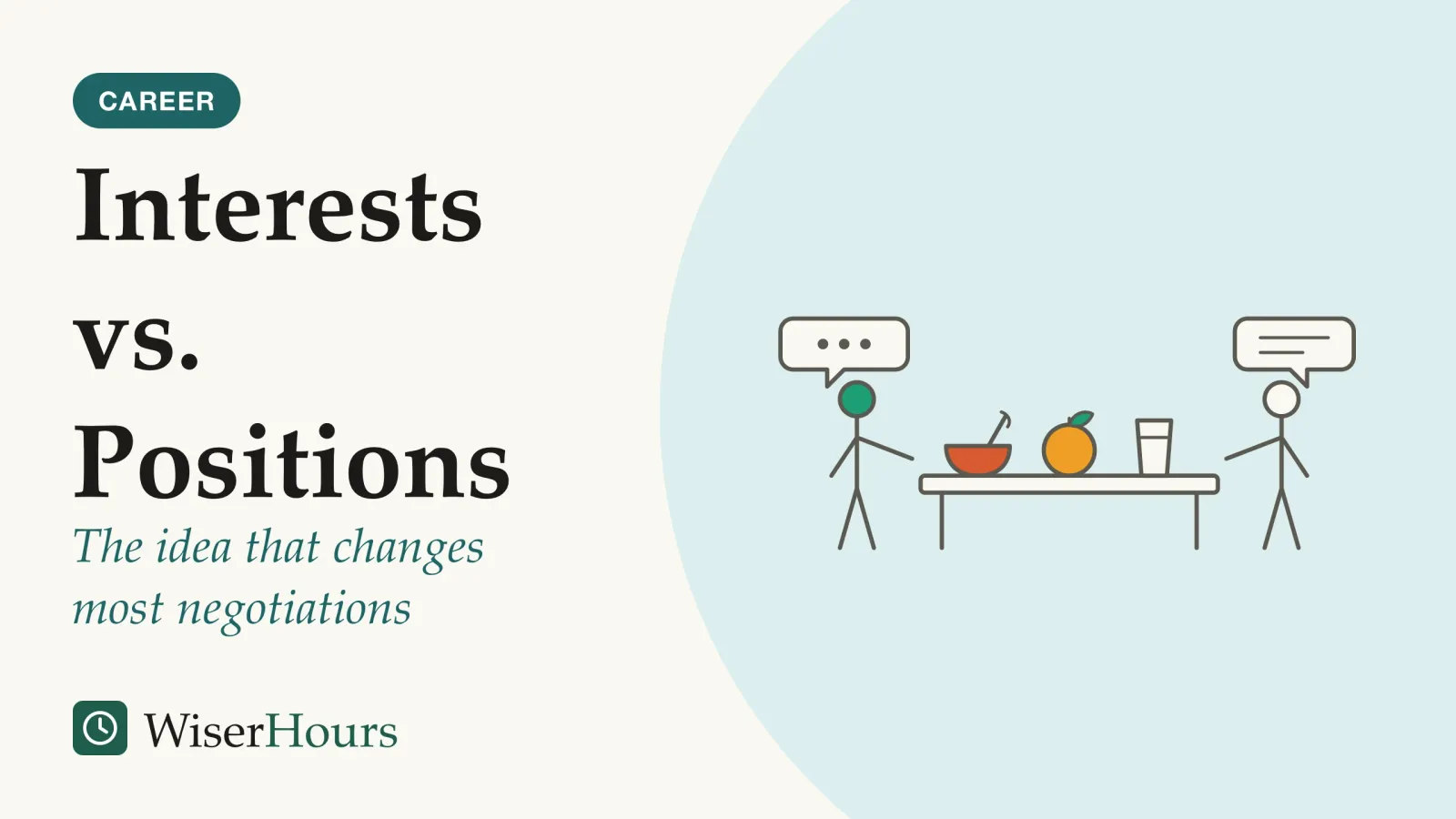
In a teaching story that negotiation courses never tire of, two sisters quarrel over a single orange. Each insists she needs it, so they settle it the obvious way and cut it in half. Yet one wanted only the rind, for a cake, and the other only the fruit, for juice: each went home with half of what she needed when she could have had all of it.1
That story holds the whole idea of interests vs positions. A position is the demand someone puts on the table (“I want the orange”). An interest is the reason underneath: juice, or peel for a cake. Positions often clash while the interests beneath them fit together, so people who find the reasons behind demands can reach deals both sides like better than a split.
In three studies published in 2008 by Adam Galinsky and colleagues, negotiators who worked out what the other side wanted were better at finding hidden agreements, while those who focused on feeling for the other side gained much less.2 In practice that comes down to three moves: ask why a demand matters, test possible solutions with what-if questions, and choose among them by a standard both sides accept. The seven-step guide to negotiating in daily life covers this ground in a single step; this guide takes it further.
Interests vs positions: what is asked for, and why
The distinction comes from Getting to Yes, which Roger Fisher and William Ury published in 1981: a position is the demand or solution a negotiator puts forward, and an interest is the need, worry or goal that makes them want it. “Focus on interests, not positions” is the second of the book’s four principles.3
Harvard Law School’s Program on Negotiation, in the US, gives a simple pair: a seller’s position is a set price for a used car, while the interest behind it might be needing money quickly for a move.4 Getting to Yes also points to basic human needs, such as economic well-being and control over one’s life, as interests worth looking for.3
Why does the difference matter so much? A position is one answer to a problem, while an interest is the problem itself, and a problem usually admits several answers. Two colleagues in a small office in Manila both ask for the last week of December off. As positions, the requests are identical and only one can win. Ask why, and one wants to be with family on Christmas Eve while the other has a friend’s wedding just before New Year. Now the week can be divided around the dates that matter. (This and the other everyday cases in this guide are illustrations, not documented events.)
The idea predates the book: the management writer Mary Parker Follett described a process she called integration in her 1924 book Creative Experience, which Wikipedia’s entry on win-win games calls the basis of win-win conflict resolution.5
A quick self-test follows from all this: take any demand, your own included, and try to finish it with “because”. If nothing comes, you are holding a position you have not yet examined.
Why arguing over positions leaves value on the table
Arguing over positions turns a problem with several dimensions into a tug of war along one line, where the only moves left are holding firm or giving ground. Getting to Yes opens with this warning: bargaining over positions produces unwise outcomes, wastes time and puts the relationship at risk.3
Harvard’s Program on Negotiation traces the damage: people who have staked out a position become reluctant to back down because they want to save face; extreme openings followed by small concessions drag the talk out; and the exchange becomes a contest of wills that can leave anger and resentment in whoever feels they gave up too much.1
The value that position-bargaining misses often sits in differences rather than common ground. In an account published by the Program on Negotiation, an English property developer needed one last plot of land outside London to build a hospital. The owner, an older woman, turned down generous offers. Visiting her, the chief executive learned that her dog was buried in the garden, and asked whether a well-kept memorial would help. She sold for close to the land’s appraised value and found a flat near the memorial.6 The memorial cost the developer little and meant a great deal to her.
That is the engine of what researchers call integrative negotiation: sides value outcomes differently, so one side can give up something it cares little about in exchange for something it cares about more, a trade known as logrolling.7 Whether a particular deal can grow like this or can only be divided deserves a separate answer, which a later guide on telling win-win negotiations from win-lose ones will give.
- Bargaining over positions: each sister says “I want the orange”, so the obvious compromise is to cut it in half, and each gets half of what she needed
- Talking about interests: one sister wants the peel for a cake and the other wants the juice, so each can have all of the part she needs from the same orange
So when you prepare, make two short lists: what the other side might value that costs you little, and what you value that might cost them little. Those lists are where trades come from.
How to uncover interests with why and what-if questions
Interests rarely arrive on their own; you usually have to ask for them. Why-questions bring out the reasons behind a demand, and what-if questions test possible solutions without committing anyone. Harvard’s Program on Negotiation suggests asking why an issue matters to the other side and what constraints they face.4
Ask why, and ask it gently
One question can reframe a whole dispute. A Program on Negotiation piece describes two sisters deadlocked over their late father’s diamond ring until one asked the other why she wanted it. One wanted the diamond for a pendant; the other wanted the ring because it reminded her of their father. The first took the diamond after paying to replace it with her sister’s birthstone, and the second kept the ring.8
A bare “Why?” can sound like a challenge, though, and the wrong questions make things worse. Another Program on Negotiation article warns against leading questions (“Don’t you think…?”) and loaded ones that use charged words to corner someone, because both put people on the defensive; it recommends open, neutral questions aimed at learning priorities.9 Softer forms of “why” work better: “What matters most to you about this?”, “What are you up against?”, or “What would go wrong for you if we did it the other way?”
Put the same questions to yourself first. You cannot trade on an interest you have not named, and people often discover while preparing that their stated demand is only one way to get what they need.
Ask what if, to test options
A what-if question puts a possible solution on the table as a question, so the other side can adjust it instead of rejecting it. A Program on Negotiation article describes contingent concessions, a term it credits to Deepak Malhotra and Max Bazerman: offers tied to a specific action by the other side. Its example is a group of diners who pass on the wine list and ask for a discount if three of them order a pricey dish.10
Take a tenant in Nairobi whose landlord announces a rent increase. Arguing “no increase” against “increase” leaves one line to fight over. Asking what lies behind it might reveal rising costs, or a fear of the flat standing empty between tenants. Then the what-if questions write themselves: “What if I sign a longer lease for a smaller rise?” or “What if I take care of minor repairs myself?” Rent rules vary between countries and even between cities, so look up the ones that cover your home, or ask a local tenants’ advice service, before the conversation.

Turning interests into options both sides prefer
Once the interests are known, Getting to Yes advises inventing several options before judging any of them, brainstorming separately and then together, and looking for options that either serve shared interests or dovetail different ones, like the nursery rhyme couple Jack Sprat, who could eat no fat, and his wife, who could eat no lean.3
A team in Bengaluru has a manager who insists the full quarterly report arrive by Friday. The position leaves only yes or no. Asking why reveals that a client meeting on Monday needs only the cost section. A what-if question finds the deal: the cost section by Thursday, the full report the following Wednesday. The holiday clash in Manila resolves the same way, with one colleague taking the days around Christmas and the other those around New Year.
- 1Hear the positionwhat is being asked for
- 2Ask whythe needs and worries behind it, yours too
- 3Ask what ifseveral options, before judging any
- 4Choose by a fair standardmarket prices, precedent, a rule both accept
To choose between options, the book’s fourth principle applies: agree on a yardstick that neither side controls, like the going market value or an accepted precedent.3 Keep your fallback in view, too: an option deserves a yes only when it is better than your best course without any agreement, the subject of a later guide on walk-away points. Tabling several options at once is a technique of its own, with a later guide on package offers.
The same moves work when no money is involved. For disagreements between colleagues over roles, workload or credit, resolving conflict at work applies them in that setting.
Does focusing on interests lead to better deals?
Experiments broadly support the idea, and the clearest evidence concerns its core skill: working out what the other party needs. A 2008 paper by Adam Galinsky and colleagues compared that thinking, called perspective taking, with empathy, connecting emotionally with the other side.2
The study
Moderate evidence
Head versus heart at the bargaining table (2008)
Negotiators who took the other side’s perspective, whether measured as a trait or prompted by the researchers, were better at discovering hidden agreements and at both creating and claiming value. Empathy was far less useful and at times worked against finding a deal and against the negotiator’s own gains. The pattern held in a negotiation where, at first sight, no deal seemed possible and in one with several issues that called for trade-offs.2
The practical difference is easy to picture. Perspective taking asks what the other side is trying to achieve and what stands in their way; empathy asks how they feel. Before a talk with a supplier in Lagos who wants a price rise, perspective taking means listing what might be driving the request, such as a cash-flow gap or a minimum order size. Empathy still matters for working relationships, as how empathy works at work explains, but in these studies the analytical habit did more for the deal. Only the abstract was available for this guide, and it reports no sample sizes, so how large the advantage was cannot be said here.
Other research adds a condition: care has to come with firmness. Carsten De Dreu, Laurie Weingart and Seungwoo Kwon pooled 28 studies for a meta-analysismeta-analysis: A study that combines the results of earlier studies on the same question into one overall estimate. Pooling makes the estimate more precise, but it cannot repair the studies it pools: a meta-analysis of surveys is still survey evidence.Full entry in the glossary in 2000 and linked concern for the other side’s outcome to better joint deals, but only when negotiators were also reluctant to give way; results varied with how studies recruited participants.11 Wikipedia’s summary of the research also notes that people who give ground quickly tend to explore fewer solutions that could help both sides.7
Taking the other side’s view seems to help with trades, too. In 2011 a team at German universities, funded by the German Research Foundation, reported that taking the other side’s perspective went with less deadlock on part of the issues, achieved through logrolling where the task allowed trades; the benefit did not appear in a purely distributive task.12 Only the abstracts of the 2000 and 2011 papers were checked.
Where the interests idea falls short
Focusing on interests does not fit every negotiation, and its critics say it underplays plain bargaining over a fixed amount. One sharp critique came in 1984 from James J. White, a law professor at the University of Michigan in the US, who called Getting to Yes unscholarly and anecdotal and said it gave too little attention to distributive bargaining, in which whatever one side wins the other loses; Fisher replied that the book offers advice and that such problems can often be recast as shared ones. In a 1985 reply to another critic, Fisher granted that the book probably overstates the case against positional bargaining.3 When you are selling a used phone to a stranger online and price is the only issue, there may be no hidden orange peel to find.
Sharing interests also carries a risk. The Program on Negotiation warns that revealing too much to someone who only wants to claim value can weaken your position, and that interest-based bargaining works best when several issues are in play, a relationship may continue and both sides have reasons to cooperate.4 Share one interest, ask about theirs, and see whether the other side answers in kind before you reveal more.
The evidence has its own limits. Most negotiation research consists of lab experimentslaboratory experiment: An experiment run under conditions the researchers set up and control, often with students doing short tasks. Control makes cause and effect easier to pin down, but the tasks are simpler than real life, so results do not always carry over to work or home.Full entry in the glossary, where people do not choose which negotiations to enter and emotions run cooler than in real talks.7 Read the research as backing for a habit worth building, not as a prediction about any single deal you face.
The bottom line
Find out what a demand is for, starting with your own, then test solutions with what-if questions, trading what costs you little for what you value most. Stay firm on your needs, stay flexible on the route, and share your reasons a step at a time.
Frequently asked questions
Is it risky to tell the other side my interests?
It can be. Harvard's Program on Negotiation cautions that over-sharing with someone who only wants to claim value can weaken your position, and it recommends selective, strategic sharing rather than full transparency. Share one interest, ask about theirs, and see whether the other side answers in kind before you reveal more.
What can I do when the other side sticks to its demands?
Getting to Yes calls its answer negotiation jujitsu. One method the book describes is bringing in a third party who explores both sides' interests and develops a single draft with them, as the United States did between Egypt and Israel at Camp David in 1978. Short of that, keep asking about the reasons behind their positions instead of attacking them.
Does focusing on interests work across cultures?
Mostly, with adjustments. According to Wikipedia's summary, a 2008 literature review concluded that Getting to Yes can be applied across cultures if interests are defined to include cultural interests, while a 2022 review argued that the method's Western perspective often hinders it. Treat things like face and the relationship as interests worth asking about.
Where does the orange story come from?
It is a teaching story, retold so often that Harvard's Program on Negotiation calls it the classic example of positions and interests. This guide could not trace who first told it, so read it as a parable, not a documented case. The same article adds a twist: the sisters could also look for ways to get more oranges.
Sources
- Positional Bargaining Pitfalls. Shonk, K. (2026). Program on Negotiation at Harvard Law School, 21 July 2026 (accessed 2026-09-28)
- Why It Pays to Get Inside the Head of Your Opponent: The Differential Effects of Perspective Taking and Empathy in Negotiations. Galinsky, A. D., Maddux, W. W., Gilin, D. & White, J. B. (2008). Psychological Science, 19(4), 378-384
- Getting to Yes. Wikipedia, on Fisher, R., Ury, W. and Patton, B., Getting to Yes (1981; 3rd ed. 2011) (accessed 2026-09-28)
- Expanding the Pie: Integrative versus Distributive Bargaining Negotiation Strategies. PON Staff (2026). Program on Negotiation at Harvard Law School, 15 June 2026 (accessed 2026-09-28)
- Win–win game. Wikipedia, including Mary Parker Follett, Creative Experience (1924) (accessed 2026-09-28)
- Value Creating Differences. PON Staff (2008). Program on Negotiation at Harvard Law School, 4 June 2008 (accessed 2026-09-28)
- Negotiation. Wikipedia, sections on integrative negotiation and problems with laboratory studies (accessed 2026-09-28)
- Are you asking enough questions? PON Staff (2011). Program on Negotiation at Harvard Law School, 8 November 2011, adapted from Jeswald W. Salacuse in Negotiation (accessed 2026-09-28)
- Reservation Point in Negotiation: Reach Negotiated Agreements by Asking the Right Questions. PON Staff (2026). Program on Negotiation at Harvard Law School, 25 May 2026, first published 2012 (accessed 2026-09-28)
- Dealmaking: Haggling and Exploring Interests in Negotiation. PON Staff (2014). Program on Negotiation at Harvard Law School, 18 July 2014 (accessed 2026-09-28)
- Influence of social motives on integrative negotiation: A meta-analytic review and test of two theories. De Dreu, C. K. W., Weingart, L. R. & Kwon, S. (2000). Journal of Personality and Social Psychology, 78(5), 889-905
- Perspective taking as a means to overcome motivational barriers in negotiations: When putting oneself into the opponent's shoes helps to walk toward agreements. Trötschel, R., Hüffmeier, J., Loschelder, D. D., Schwartz, K. & Gollwitzer, P. M. (2011). Journal of Personality and Social Psychology, 101(4), 771-790
How we researched this
This guide rests on sources read in September 2026: Wikipedia's articles on Getting to Yes, negotiation and win-win games; six pieces from Harvard Law School's Program on Negotiation dated 2008 to 2026; and the abstracts of three negotiation studies from 2000 to 2011, one of them a meta-analysis. The main limitation is that research on interest-based negotiation relies mostly on laboratory studies, and none of the three studies was available in full text.
Keep reading

Your Walk-Away Point: How to Know When a Deal Isn't Worth Taking
Work out your walk-away point in 4 steps: list your alternatives, pick the best real one, turn it into a number, and write it down before you talk.

The Five Negotiation Styles: Which One Do You Default To?
The 5 negotiation styles, from competing to accommodating: where the Thomas-Kilmann model comes from, a quick self-check, and when each style fits.
How to Negotiate: A Research-Backed Guide for Everyday Life
How to negotiate rent, prices, fees and deadlines in 7 steps, from knowing your walk-away point to opening offers, fair trades and when to just pay.

How to Respond to a Lowball Offer Without Losing the Deal
A lowball offer is an opening move, not an insult. 5 steps and sample wording to reply without countering off their number or losing the buyer.