Planning Poker: How It Works and Why Teams Use It
Planning poker in 5 steps: pick a card in private, reveal together, hear the extremes. Why the hidden reveal matters and what the studies found.

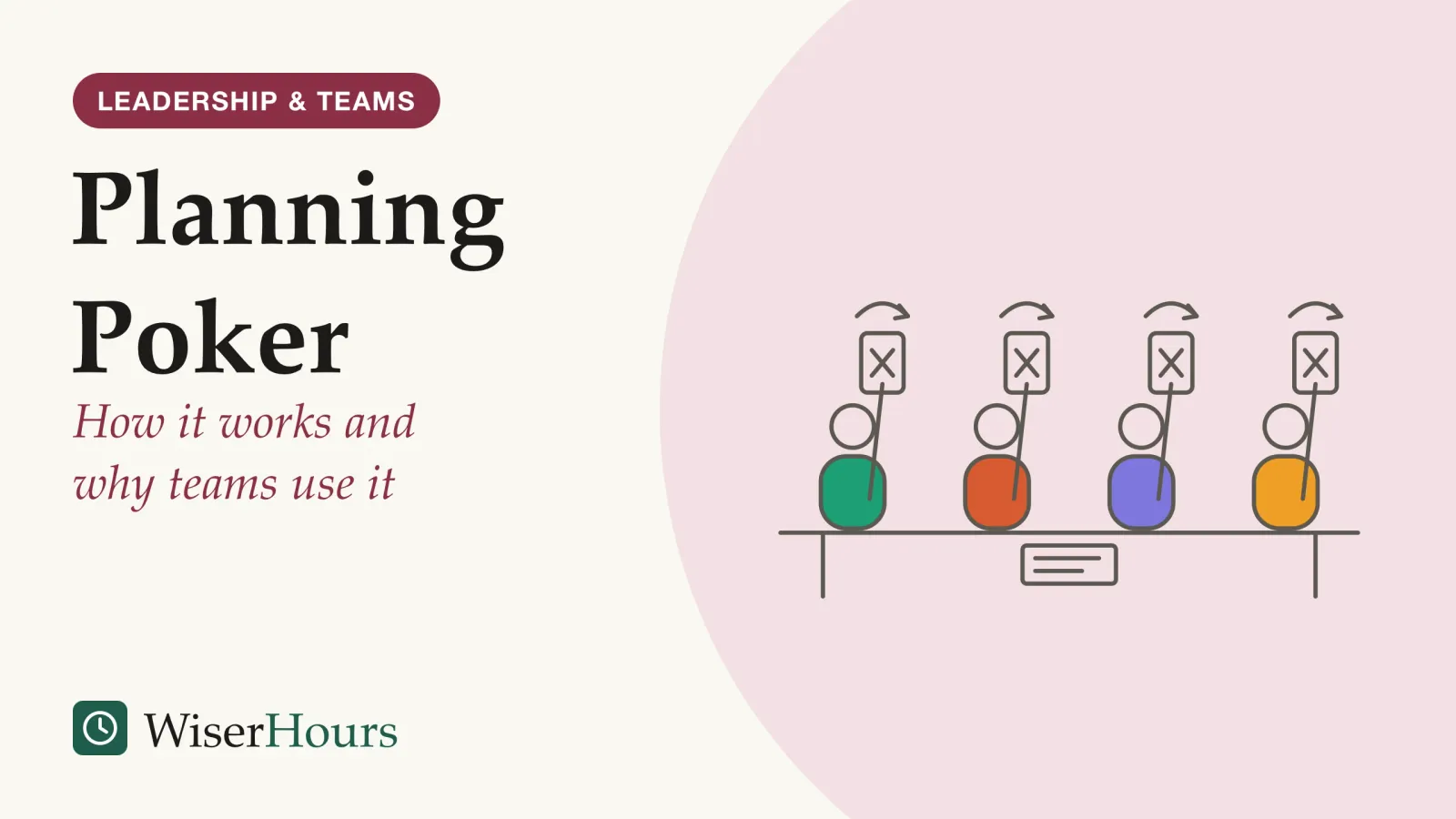
Planning poker exists to stop the first number said aloud in an estimating meeting from becoming the team’s answer. Each estimator chooses a card in private, everyone turns their card over at the same moment, and the people holding the highest and lowest cards explain their thinking before the team plays again. James Grenning, a software consultant, described and named the game in 2002.1 Mike Cohn then spread it through his book Agile Estimating and Planning, published in 2005.2 The research behind it is thin but useful: in a 2008 study of one software project, planning poker estimates came out less optimistic than the average of the same people’s private guesses.3
To play a round of planning poker:
- Present the item
- Estimate privately
- Reveal together
- Discuss the extremes
- Re-vote
Sizing work is a routine part of project management, and agile teams often reach for planning poker when the pieces are small but their shape is still uncertain.
How planning poker works, step by step
Every backlog item goes through the same five moves, and only two of them are unusual: each person commits to a number alone, and all the numbers appear at once. Grenning’s original 2002 paper describes exactly this loop, with each programmer writing an estimate on a note card.1
1. Present the item
The Product Owner, or whoever speaks for the customer, reads out one item, usually a user story. The team asks questions until it understands what done means. Nobody mentions a size yet, because a number dropped into this conversation would sit in everyone’s head when they choose a card.
2. Estimate privately
Each estimator picks the card that matches their own sense of the work and lays it face down. This is the step that makes the game different from a discussion, because every person has to commit to a view before hearing anyone else’s.
3. Reveal together
On a count, everyone turns their card over. If the cards agree, the team records the number and moves straight to the next item.
4. Discuss the extremes
When the cards differ, the people with the highest and lowest cards speak first. Cohn’s guidance explains why: a high card often points to hidden work or risk, and a low card to a simpler design, an existing component or a safe shortcut.4
5. Re-vote
With the new information on the table, everyone picks again in private and reveals again. Keep the second round as private as the first; a re-vote taken out loud gives the loudest voice its anchor back.
A round of planning poker, played out
A single round shows why the discussion matters more than the final card. In this illustrative round, a product team estimates one user story with a modified Fibonacci deck, and the gap between the first cards exposes a scope question nobody had asked.
The Product Owner reads the story: “As a returning customer, I want to download all my past invoices in one file, so that I can send them to my accountant.” The team asks two quick questions about file format and then plays.
- 1First reveal2, 3, 3, 8 and 13
- 2Lowest explainsa developer: single-invoice download already exists, so this is a loop
- 3Highest explainsthe tester: invoices from before last year sit in the old billing system
- 4Scope settledthe Product Owner: accountants only need the current and last tax year
- 5Second reveal3, 5, 5, 5 and 5; the team records 5
Without the hidden cards, the developer’s quick “it’s basically a loop” might have been the first thing said, and the table would probably have settled near the low end. The tester’s knowledge of the old billing system came out because the card forced a commitment first, and the Product Owner could then cut the work rather than pay for it.
Why the cards stay hidden: anchoring and deference to seniors
The cards stay hidden until everyone has chosen so that neither the first number spoken nor the most senior person’s opinion sets the estimate for everyone else. Wikipedia’s entry names anchoringanchoring: The tendency for an estimate or decision to be pulled toward a number seen beforehand, even an irrelevant one. It is one of the effects that held up when large teams ran the original experiments again.Full entry in the glossary as the bias the reveal avoids.2
Software estimators are not immune to anchoring. In a 2005 Canadian experiment, Jorge Aranda of the University of Toronto gave 23 volunteers, mostly computer science graduate students, the same project documents to estimate; the only difference was one remark from a client manager who admitted having no experience with software projects. People who read a guess of 20 months gave estimates about twice as long, on average, as people who read no guess at all; a guess of 2 months made no clear difference.5 Twenty-three people on a paper exercise is a small test, yet a guess from someone with no claim to expertise still moved the estimates.
Seniority adds a second pull. A note on Grenning’s company site says the meeting that led to the game stalled with the two most senior people debating while the others got a virtual nap, and Grenning writes there that the idea came from a quality-management technique of writing ideas down silently, so the most dominant or senior person could not sway the rest.6
The whole team plays the game, not just the most vocal, or most senior.
A new tester on a team of experienced developers is the person this protects. Asked aloud after the lead developer has said “this is a small one”, a newcomer may simply nod; asked to commit to a card first, the tester may be the one who remembers that the change touches the payments screen.
- Said aloud first: the first number heard pulls the other estimates toward it, an effect called anchoring
- Chosen in private, shown together: the real spread stays visible, and the highest and lowest estimators explain first
The protection ends at the reveal. Cohn notes that a strong personality can still dominate the discussion that follows, and suggests the facilitator ask the high and low estimators to speak first, especially when they are usually quiet.4 Senior people help most by keeping their own sizes to themselves until the cards are down.
Is planning poker more accurate? What the studies found
Few published studies have tested planning poker, the ones we found are small, and their results point in different directions. In one Norwegian team, group estimates were less optimistic than the average of private ones and about as accurate as a single expert’s.3 With student teams in Slovenia, estimates grew more optimistic after the group discussion.7
The study
Limited evidence
Half the tasks by poker, half by solo experts: one team's project
Researchers introduced planning poker for half the tasks in one software project and left the rest to individual experts. The team’s consensus estimates were less optimistic, and more accurate, than the mean of the same people’s private estimates for the same tasks. Tasks estimated by individual experts reached similar accuracy, and both groups’ typical task was on target. A code analysis linked the extra effort on the planning poker tasks to more complex changes, which the authors suggest may have come from what the group discussion brought to light.3
The authors first reported the project at a 2007 conference.8 Their slides from the time describe a small Scrum team of consultants in Norway working in two-week sprints, which is a narrow base for any general claim.9 If the authors’ explanation of the extra effort holds, the discussion may have changed what the team built as well as what it predicted.
The second study complicates the picture. Viljan Mahnič and Tomaž Hovelja at the University of Ljubljana in Slovenia had 13 student teams build the same records system from the same user stories. The students’ estimates were over-optimistic, and the authors report that planning poker added to that optimism; a group of experts using the same method produced estimates much closer to the effort spent. The authors conclude that the optimism caused by group discussion fades as the expertise of the estimators grows.7
Treat planning poker as a way to find work that one person would miss, and check whether it does that for your team. Before using the numbers in promises to stakeholders, check a few sprints of estimates against the effort the work took.
| Claim | What the best evidence found | Evidence |
|---|---|---|
| A number heard first pulls estimates toward it | A manager’s offhand guess shifted software estimates in a 2005 experiment | Experiment, 23 volunteers; limited5 |
| Group estimates beat private ones | Less optimistic than the average of private estimates, but no more accurate than one expert, in one professional team | Field study, one team; limited3 |
| Planning poker helps any team | Students grew more optimistic; experts’ poker estimates came closer to the effort spent | Study with 13 student teams; limited7 |
Why does planning poker use Fibonacci numbers?
Planning poker decks leave out most numbers because bigger estimates are less certain, so the gaps between cards widen as the values grow. A team can tell a one-day job from a two-day job, but not a twenty-day job from a twenty-one-day one, and the widening gaps stop it arguing over differences nobody can judge. Mike Cohn ties this to Weber’s law, the finding that people notice differences in proportion to size, and says each Fibonacci value is roughly 60 percent larger than the one before. His modified series runs 1, 2, 3, 5, 8, 13, 20, 40 and 100: he replaced 21 with 20 because stakeholders read precision into the odd number, then added 40 and 100 for very large items. Until 2007 his teams also tried a doubling deck, and he found no clear evidence that either sequence worked better.10
Grenning’s original deck made the same point with fewer cards: 1, 2, 3, 5, 7 and 10, plus infinity for a story too big to estimate. Players who wanted a value in a gap could play two cards, though he bet the extra precision would not help much.1
In Cohn’s guidance the cards usually stand for story points, a relative size rather than hours, though teams can also play in ideal days, and many decks add a question mark and a coffee cup.4 Whatever the unit, keep to one deck for a while, so that a 5 means the same thing this month as last.
The cards that are not numbers
A question mark means the estimator does not understand the item well enough to estimate it. An infinity or very large card says the item is too big to estimate usefully, often a sign to split it. A coffee cup means the team needs a break, which Cohn treats as real information, because tired estimators make poor estimates.4
Who should take part in planning poker?
The people who will do the work hold the cards. The 2020 Scrum Guide makes the Developers who will do the work responsible for sizing backlog items, with the Product Owner helping them understand trade-offs.11
Mike Cohn spells out what that means at the table: everyone whose effort goes into finishing the item estimates, testers, designers and database specialists included. The Product Owner explains and answers questions without estimating. A Scrum Master or coach often facilitates and plays a card only if they also contribute to the work. Stakeholders may sit in when their knowledge helps, but Cohn’s warning is direct: they should not pressure the estimate.4
The sizes settled this way feed sprint planning, where the team decides how much fits into the next sprint. When the Product Owner hears a size bigger than expected, the useful answer is a scope trade-off, the same move as in the invoice example, rather than a request for a smaller card.
Keeping sessions short, in a room or on a call
A planning poker session stays short when each item gets a time limit and the team stops playing items it cannot yet estimate. A timer on the table or a countdown in the app, set to a few minutes per item, makes the limit real instead of polite. Grenning reported that once his teams played the game, most stories took about a minute instead of 10 to 30 minutes of debate, with matching cards needing no discussion at all. That was an observation from his own coaching rather than a measured result.1
Cohn suggests one to three rounds per item is usually enough; more often means the item needs clarifying, splitting or a decision from the Product Owner, so write down the open question and move on. Remote sessions follow the same rules. Cohn recommends a tool that hides every estimate until everyone has chosen, keeping the item on screen during discussion, asking the high and low estimators to speak first, and recording assumptions as they are agreed. He names the two usual failures: people multitasking, and one person talking the team into a number before others have thought it through.4
Before the next planning poker session
When to skip planning poker
Skip planning poker when nobody will use the number, or when a quicker rough sort is enough. The 2020 Scrum Guide never mentions estimates or any estimating technique; it asks only that backlog items carry a size and leaves the method to the team.11
Grenning himself is wary of overdoing it. In the same note, he still sees estimation as important in many settings, but says he cringes at days-long planning poker meetings and agrees with the No Estimates movement that they waste time.6 Cohn draws a similar line: planning poker is usually overkill for distant ideas in a large backlog, where a faster grouping method such as affinity estimation can sort many items first.4
Teams that pull work continuously instead of planning fixed sprints, the main difference covered in how Scrum and Kanban compare, should ask what decision each estimate supports. If the answer is none, the conversation may still be worth having, and the card can be dropped.
The bottom line
The value of planning poker is the moment everyone commits to a view before hearing anyone else, and the minute after, when the highest and lowest cards explain. Keep the cards hidden until the reveal, let the people who will do the work hold them, and limit each item to a few rounds. Then compare your estimates with what the work took before you lean on them.
Frequently asked questions
Is planning poker the same as Wideband Delphi?
Not quite. Wikipedia describes planning poker as a variation of Wideband Delphi, an older method for combining expert estimates. In 2006 slides, researchers Kjetil Moløkken-Østvold and Nils Christian Haugen classed Wideband Delphi as moderately structured with limited anonymity, and planning poker as light, face to face and not anonymous. James Grenning, who named planning poker, wrote that he had forgotten about Delphi by 2002.
Can you play planning poker with ordinary playing cards?
Yes. Wikipedia notes that teams can use an ordinary deck, playing ace, 2, 3, 5, 8 and king, where the king means the item is too big or too complicated to estimate. What matters is that every estimator holds the same values and nobody shows a card before the others are ready.
What should a team do if it still disagrees after several rounds?
Stop playing that item for now. Mike Cohn of Mountain Goat Software advises against averaging the cards, and James Grenning's 2002 paper suggests deferring the story, splitting it or taking the low estimate, since it is one story out of many. Either way, write down the question that kept the cards apart so someone can answer it before the next session.
Who owns the name Planning Poker?
Mike Cohn's company, Mountain Goat Software, registered Planning Poker as a trademark in the US, according to Wikipedia, and it also offers an online tool. The technique itself is free to use: teams play it with printed decks, ordinary cards or any of the many estimation apps that hide each estimate until everyone has chosen.
Sources
- Planning Poker or How to avoid analysis paralysis while release planning. Grenning, J. W. (April 2002). Wingman Software
- Planning poker. Wikipedia (accessed October 2026)
- Using planning poker for combining expert estimates in software projects. Moløkken-Østvold, K., Haugen, N. C. & Benestad, H. C. (2008). Journal of Systems and Software, 81(12)
- Planning Poker: How Agile Teams Estimate with Story Points. Cohn, M. (updated August 2026). Mountain Goat Software
- Anchoring and Adjustment in Software Estimation (MSc thesis). Aranda, J. (2005). University of Toronto
- Planning Poker: The Original Paper (author's note). Grenning, J. W. (accessed October 2026). Wingman Software
- On using planning poker for estimating user stories. Mahnič, V. & Hovelja, T. (2012). Journal of Systems and Software, 85(9)
- Combining Estimates with Planning Poker: An Empirical Study. Moløkken-Østvold, K. & Haugen, N. C. (2007). Australian Software Engineering Conference (ASWEC'07)
- Know when to hold 'em, know when to fold 'em: Combining estimates with planning poker (presentation slides). Moløkken-Østvold, K. & Haugen, N. C. (2006). Simula Research Laboratory
- Why the Fibonacci Sequence Works Well for Estimating. Cohn, M. (updated June 2024). Mountain Goat Software
- The Scrum Guide: The Definitive Guide to Scrum: The Rules of the Game. Schwaber, K. & Sutherland, J. (November 2020). Scrum Guides
How we researched this
We read James Grenning's 2002 paper and his later note on it, Mike Cohn's published guidance, the 2020 Scrum Guide and Wikipedia's entry, then searched Crossref, OpenAlex and Semantic Scholar in October 2026 for empirical studies of planning poker and of anchoring in software estimation. Sources date from 2002 to 2026. Main limitation: the planning poker studies are few and small, and we could read only the abstracts of the three peer-reviewed ones.
Keep reading
Sprint Planning: How to Run It Without Wasting Half a Day
The Scrum Guide caps sprint planning at 8 hours for a one-month sprint. How to set a sprint goal, size the work and finish well inside that limit.
How to Become a Project Manager: Paths In From Any Background
How to become a project manager from any job: 5 steps, the entry roles that lead there, and the evidence US, UK and Australian bodies ask you to show.
What Does a Project Manager Actually Do All Day?
What does a project manager do? Plan, coordinate and talk: a 2008 study of 10 construction site managers found most of their working time went on talking.
Work Breakdown Structure: How to Build One With Examples
A work breakdown structure splits a project into parts that add up to 100 percent of the work. Five steps, a worked example and a WBS dictionary.