The Project Life Cycle Explained: Initiation to Closure
Most guides split the project life cycle into 5 phases, from initiation to closure. What happens in each, who is involved, and how agile repeats the middle.

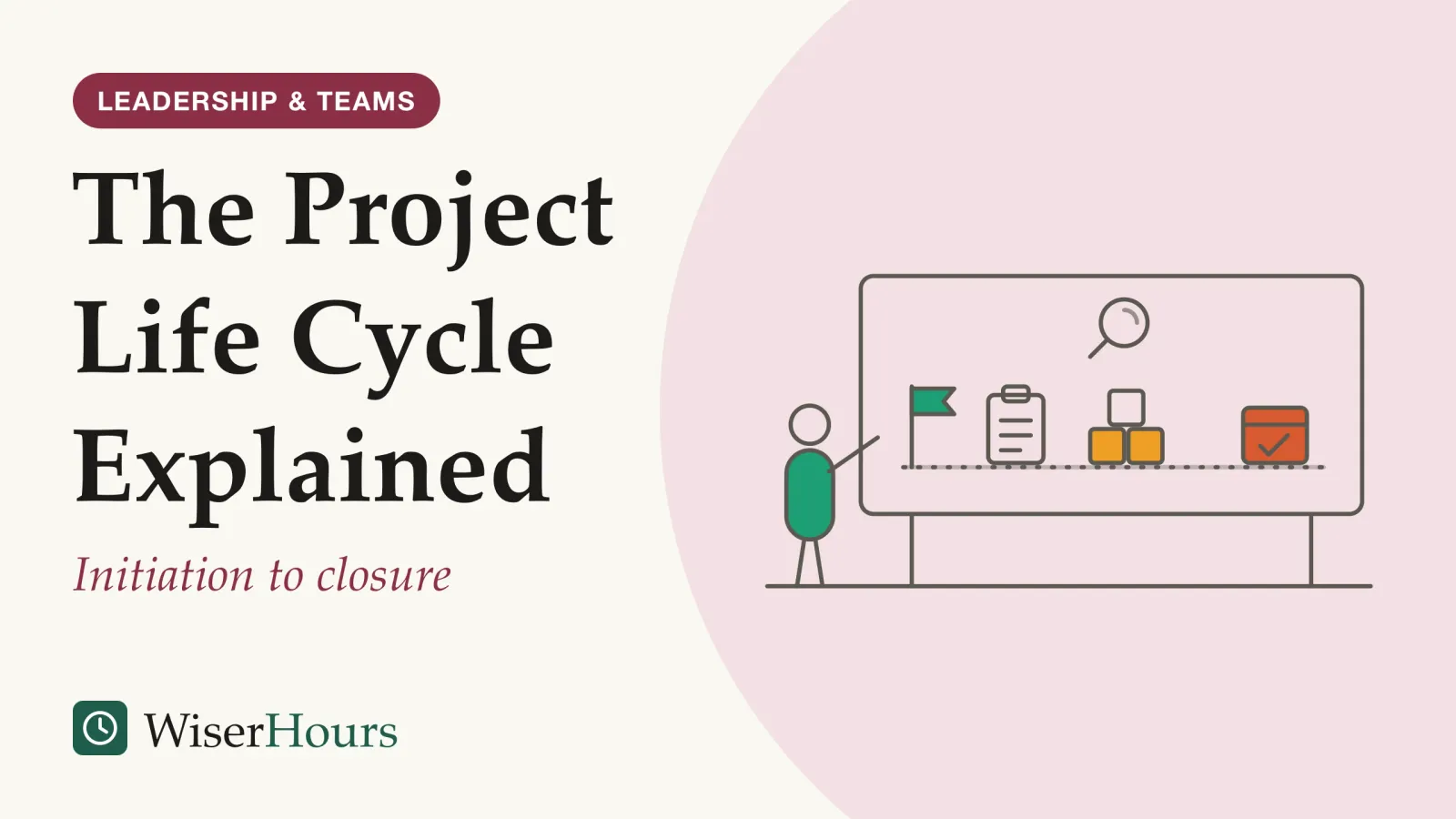
A small architecture practice wants a new website live before a spring trade fair. Before anyone designs a page, somebody has to decide whether it is worth the money, who has the final say and what “finished” will mean. Those decisions, and the work between them until the site is handed over, make up the project life cycle. PMI (the Project Management Institute), a professional body based in the US, defines it as the series of phases a project passes through from its start to its completion.1 Most guides name five:
- Initiation: agree why the project exists and who decides (the partners approve a goal, a budget ceiling and a date).
- Planning: work out what will be delivered, when, by whom and at what cost (the page list, photos and schedule).
- Execution: do the work and produce the deliverables (design, copy, build).
- Monitoring and controlling: compare progress with the plan and correct course, alongside execution (a weekly check on dates and spending).
- Closure: get the result accepted, hand it over and record the lessons (sign-off, handover, a short review).
The website is an illustrative example, and it runs through every section below. The phases describe the management work around a project, so the same five fit software, buildings and events; the basics of project management, from definitions to the main approaches, sit one level up from this guide. One question about the phases has useful research behind it: how much effort the second one deserves. A 2015 global survey by Pedro Serrador and Rodney Turner linked more planning effort to better project results, up to a point, and found that projects typically planned less than that.2
The project life cycle in five phases, and what PMI and PRINCE2 call them
The five phase names come mainly from PMI, whose process groups are called initiating, planning, executing, monitoring and controlling, and closing. PMI’s Process Groups practice guide, published in November 2022, sorts 49 processes into those five groups and presents them as guidance for a predictive, traditional way of working.3
PRINCE2, another established method, divides the same ground differently. Its current edition, PRINCE2 7, names seven processes, from starting up a project through controlling a stage and managing a stage boundary to closing a project, and it plans, monitors and controls a project stage by stage.4
Which vocabulary you meet depends partly on where you work. PRINCE2 began as a UK government standard. Wikipedia’s summary says it has been adopted in many countries, including the UK, Western European countries and Australia, and has become a de facto standard across the United Nations system.5 Sectors rename the stages too: a building project may move through conceptual design, design development and construction administration rather than “execution”.6
- 1Initiationwhy, who decides, go or no go
- 2Planningwhat, when, who, what it costs
- 3Executionbuild the deliverables
- 4Monitoring and controllingruns alongside execution
- 5Closureaccept, hand over, learn
Each phase leaves something behind, and each has people who carry most of it.
| Phase | The question it answers | What it typically produces | Who is mostly involved |
|---|---|---|---|
| Initiation | Is this project worth doing, and who has authority over it? | An outline business case and a project brief | Sponsor or project board, the future project manager4 |
| Planning | What will we deliver, how, when and at what cost? | A plan with scope, schedule, cost, quality approach and baselines | Project manager with the team, approved by the sponsor or board4 |
| Execution | Are we building what the plan says? | The deliverables themselves | The team, led by the project manager7 |
| Monitoring and controlling | Are we on track, and what needs changing? | Progress reports, issue and change decisions, corrective actions | Project manager, reporting to the sponsor or board4 |
| Closure | Is the result accepted, and can the organization run it? | Acceptance, handover, a performance review and follow-on actions | Sponsor or board, users, project manager4 |
Before your first project meeting, ask which framework and stage names your organization, client or public body uses, and map them onto these five. The work underneath barely changes, and the map saves a lot of talking at cross purposes.
Initiation: agree why the project exists and who decides
Initiation turns an idea into an authorized project. In PRINCE2’s words, starting up answers one question, whether there is a viable and worthwhile project, and the decision to go ahead must be explicit. It lists what starting up should establish: a business justification, the authority to assign people and secure resources, and enough information to define the scope, captured in a project brief.4
The logic of a separate first phase is simple: questions about purpose, money and authority are easiest to settle before anyone is hired or anything bought. Settled late, they turn into arguments halfway through the work.
The key person at this point is the sponsor: in PMI’s glossary, the person or group who supplies the project’s resources and backing and is answerable for making success possible. PMI calls the document that formally authorizes a project its charter, and a kickoff meeting then brings the team and key stakeholdersstakeholder: In project management, anyone who can affect a project, be affected by it, or believe they are affected by it: an individual, a group or an organization. That includes users, suppliers and colleagues whose work changes, not only the people paying.Full entry in the glossary together to set expectations and gain a common understanding.1
Initiation for the website
At the architecture practice, initiation might take a week. The managing partner agrees to sponsor the site and names the office manager as project manager. Together they sign off one page stating the goal (a site that shows recent work and brings in enquiries), a budget ceiling and the trade-fair deadline.
A useful test for any project: if you cannot name the sponsor and state the goal in one sentence, it is not ready to plan.
Planning: how much is enough?
Planning works out the route: scope, schedule, budget, risks and how quality will be checked. PRINCE2’s initiation aims for a shared understanding of what will be delivered, how and when, at what cost, and how baselines will be set and controlled, all before the business commits significant money or people.4
The point is to get everyone committed to the same picture of the result before real money moves, and to give the later phases something to measure against. Planning usually starts by splitting the result into deliverables, which is the job of a work breakdown structure. The approved plan then becomes the baseline: in PMI’s definition, the approved version of a work product that changes only through formal change control and is the basis for comparison with actual results.1
The study
Limited evidence
How much planning went with the best results? A 2015 survey of 1,386 projects
Pedro Serrador and Rodney Turner collected data on 1,386 projects from 859 respondents in a global survey. Planning effort had an inverted-U relationship with success: the share of effort linked to the best results was about 25 percent of total project effort, well above the 15 percent average respondents reported. The link was strongest for broad measures of success and weaker for time, budget and scope.2
So the typical project in the survey planned less than the level that went with the best results, and past a certain point extra planning stopped helping. Treat that as a signpost rather than a target: the figures are practitioners’ own survey answers, a survey can show a link but cannot prove that planning produced the success, and the full paper is paywalled, so this summary rests on its abstract. An earlier literature review by Serrador, presented at PMI’s 2012 Global Congress, reported the same general link across construction, software and general projects, and noted pressure in organizations to cut planning short.8
One way to plan enough without planning forever is rolling wave planning, which PMI describes as planning near-term work in detail and later work at a higher level.1 For the website, that means a detailed plan for the page list, photography and design sign-off, and an outline for building, testing and launch, filled in as the design settles.
Execution and monitoring happen at the same time
Execution is where the deliverables get made, and monitoring and controlling runs alongside it the whole time. PMI’s executing processes complete the work defined in the project management plan; its monitoring and controlling processes track, review and regulate progress and start any changes the plan needs.7
They run together so that problems show up while they are still cheap to fix. PRINCE2 builds the check into each stage: the project manager assigns and monitors work, handles issues, reports progress to the project board and takes corrective action so the stage stays within the tolerances the board has set, the agreed limits of delegated authority.4
- Myth
- The phases happen one after another, like steps on a staircase.
- Fact
- Monitoring and controlling runs alongside execution, and in PMI's model initiating and closing can apply to each phase of a larger project, so the cycle can repeat inside it.
Larger projects add formal decision points between phases. PMI’s glossary calls one a phase gate: a review at the end of a phase that decides whether to continue, continue with changes, or end the project.1 PRINCE2 does the same at each stage boundary, where the board reviews the stage just finished, the plan for the next one and whether the project is still justified.4
Much of controlling is about change. A request to add work should pass a check on its time and cost before it alters the baseline, the routine described in how to keep scope creep under control.
Back at the practice, the photographer falls ill in week three and the project photos will arrive two weeks late. The weekly check spots the slip; controlling decides what to do about it. The office manager could launch with older photos and add new ones later, or move the launch, and because the trade-fair date is at stake, that choice goes to the sponsor. Our suggestion for small projects is a short weekly check that compares dates, spending and scope with the baseline, so slips surface while there are still options.
Closing on purpose: accept, hand over, write down what you learned
Closure is the formal end of a project: the result is accepted, handed over to the people who will use and maintain it, and the lessons are recorded. A project that is never formally closed leaves questions hanging, such as who fixes the contact form when it breaks or whose card pays the hosting bill.
PRINCE2 describes closing a project as a fixed point at which acceptance of the project’s product is confirmed, and its objectives for this phase make a good outline. Check that users accept the product, make sure the business can support it after the project closes, review performance against the baselines, assess any benefits already realized and plan later benefit reviews, and give every open issue and risk a follow-on action. If a project is stopped early, the same process makes sure it is closed in an orderly way rather than simply abandoned.4
Learning is the part of closure most easily lost. In a 2008 paper combining a literature review with a survey of project managers, Terry Williams argued that learning from one project to the next is important but often neglected, and that the temporary nature of project organizations works against it.9 PMI’s answer is a lessons learned register, a record of knowledge gained during a project, phase or iteration kept so it can improve future performance.1
For the website, closure means the managing partner signing off the site against the one-page goal, the office manager learning to update it, the agency’s hosting account moving into the practice’s name, and a short review. Perhaps the early photo list worked and late text from the partners did not, so next time the copy is collected during planning.
Closure checklist, with a lessons-learned review
Download PDF
Once through or in repeated loops: how agile projects change the cycle
The five phases describe what any project has to do; the life cycle model describes how often it does them. PMI ties the choice to how stable the requirements are. Predictive work suits requirements that are well defined and stable at the start, and each phase is completed before the next begins. Adaptive work suits requirements that are uncertain and likely to change, and uses an iterative and incremental approach. A hybrid approach combines the two, keeping some elements fixed while others change.10
The sequential model is commonly called waterfall. Its first formal diagram is often traced to a 1970 article by Winston Royce, who himself warned that leaving testing until the end was risky.11
Agileagile: A way of running projects that delivers work in short cycles and changes the plan as people learn, rather than fixing everything up front. It comes from software, from the Manifesto for Agile Software Development, and Scrum is its best-known framework.Full entry in the glossary frameworks repeat the middle of the cycle. In ScrumScrum: A framework in which a small team works in fixed cycles called sprints, each lasting a month or less, with set events such as sprint planning and a short daily check-in. Its rules are written down in the Scrum Guide.Full entry in the glossary, work happens in sprints, fixed-length cycles that last a month at most. Planning, daily check-ins, a review and a retrospective all happen inside each sprint, and the next sprint starts as soon as one ends. The retrospective, where the team discusses what went well and what problems it hit, works like a lessons-learned review held every few weeks rather than once at the end.12
- Predictive: the project passes through the phases once, in order, and the full result arrives near the end
- Iterative or agile: the team repeats short cycles of planning, building and review, and each cycle adds a usable piece
- The same start and finish: either way, someone authorizes the work at the start and someone accepts and closes it at the end
The practice’s website could run either way. Run with agile methods, it could start bringing in enquiries sooner, while the full scope is settled along the way.
Either way, someone still authorizes the work at the start and accepts it at the end.
Choose by how settled the requirements are. If the practice already knows exactly which pages it wants, a single pass is simpler to plan and budget; if it expects to learn from what visitors do, plan in short cycles.
The bottom line
Each phase of a project should end in a decision: go ahead, commit to the plan, change course or accept the result. Whatever your organization calls the phases, make sure someone makes each of those decisions, plan enough to commit without planning forever, and close by writing the lessons where the next project team will find them.
Frequently asked questions
Is a project life cycle the same as a product life cycle?
No: a project life cycle ends when the project closes, while a product life cycle lasts as long as the product does. PMI's lexicon defines the product life cycle as the phases a product goes through from concept through delivery, growth and maturity to retirement. One product, such as a website, may be built and then changed by several separate projects over its life.
Are PMI's process groups the same as project phases?
Not exactly. PMI's five process groups are groups of management processes, and it describes initiating and closing as applying to a whole project or to one phase of it, as Wikipedia's summary of the PMBOK Guide sets out. A large project split into phases can therefore run through initiating, planning, executing, monitoring and controlling, and closing inside each phase.
Does every project need all five phases?
Every project needs each kind of work, but not the same amount of formality. PRINCE2 7 makes tailoring one of its principles, adapting the method to a project's size, complexity, importance and level of risk. A two-week task might cover initiation in one agreed email and closure in a short review, while a multi-year program uses formal gates.
Sources
- PMI Lexicon of Project Management Terms, Version 4.0. Project Management Institute (2024). PMI Lexicon of Project Management Terms, Version 4.0 (archived copy)
- What is Enough Planning? Results From a Global Quantitative Study. Serrador, P. & Turner, R. (2015). IEEE Transactions on Engineering Management, 62(4)
- Process Groups: A Practice Guide. Project Management Institute (November 2022). Product page, PMI bookstore
- PRINCE2 7 Foundation Quick Reference Guide (Official Training Materials). PeopleCert International (undated). Hosted by a training provider
- PRINCE2. Wikipedia (accessed 28 September 2026)
- Project management. Wikipedia (accessed 28 September 2026)
- Project Management Body of Knowledge. Wikipedia (accessed 28 September 2026)
- The importance of the planning phase to project success. Serrador, P. (2012). Paper presented at PMI Global Congress 2012, North America, Vancouver
- How Do Organizations Learn Lessons From Projects—And Do They? Williams, T. (2008). IEEE Transactions on Engineering Management, 55(2)
- What is project management? Project Management Institute (accessed 2026)
- Waterfall model. Wikipedia (accessed 28 September 2026)
- The Scrum Guide (2020). Schwaber, K. & Sutherland, J. (November 2020)
How we researched this
The main sources are PMI's Lexicon of Project Management Terms (version 4.0, archived copy), PMI's pages on the Process Groups practice guide and project approaches, the PRINCE2 7 quick reference guide, the 2020 Scrum Guide and Wikipedia's summaries. Research on planning effort and project learning came from Crossref, OpenAlex and PMI's library, searched in September 2026; two of those papers are summarized from their abstracts alone. Main limitation: the evidence linking phases to results is survey-based and correlational.
Keep reading
What Does a Project Manager Actually Do All Day?
What does a project manager do? Plan, coordinate and talk: a 2008 study of 10 construction site managers found most of their working time went on talking.
What Is Project Management? A Plain-English Guide for Beginners
What is project management? Plain definitions from PMI, ISO and PRINCE2, and a study of 258 projects that found costs underestimated in almost 9 in 10.
Planning Poker: How It Works and Why Teams Use It
Planning poker in 5 steps: pick a card in private, reveal together, hear the extremes. Why the hidden reveal matters and what the studies found.
How to Become a Project Manager: Paths In From Any Background
How to become a project manager from any job: 5 steps, the entry roles that lead there, and the evidence US, UK and Australian bodies ask you to show.