Filler Words: Why We Say "Um" and How to Cut Back
Filler words are normal: in one study, people made about 6 slips per 100 words, most often fillers like um. What they signal, when they hurt, how to cut back.

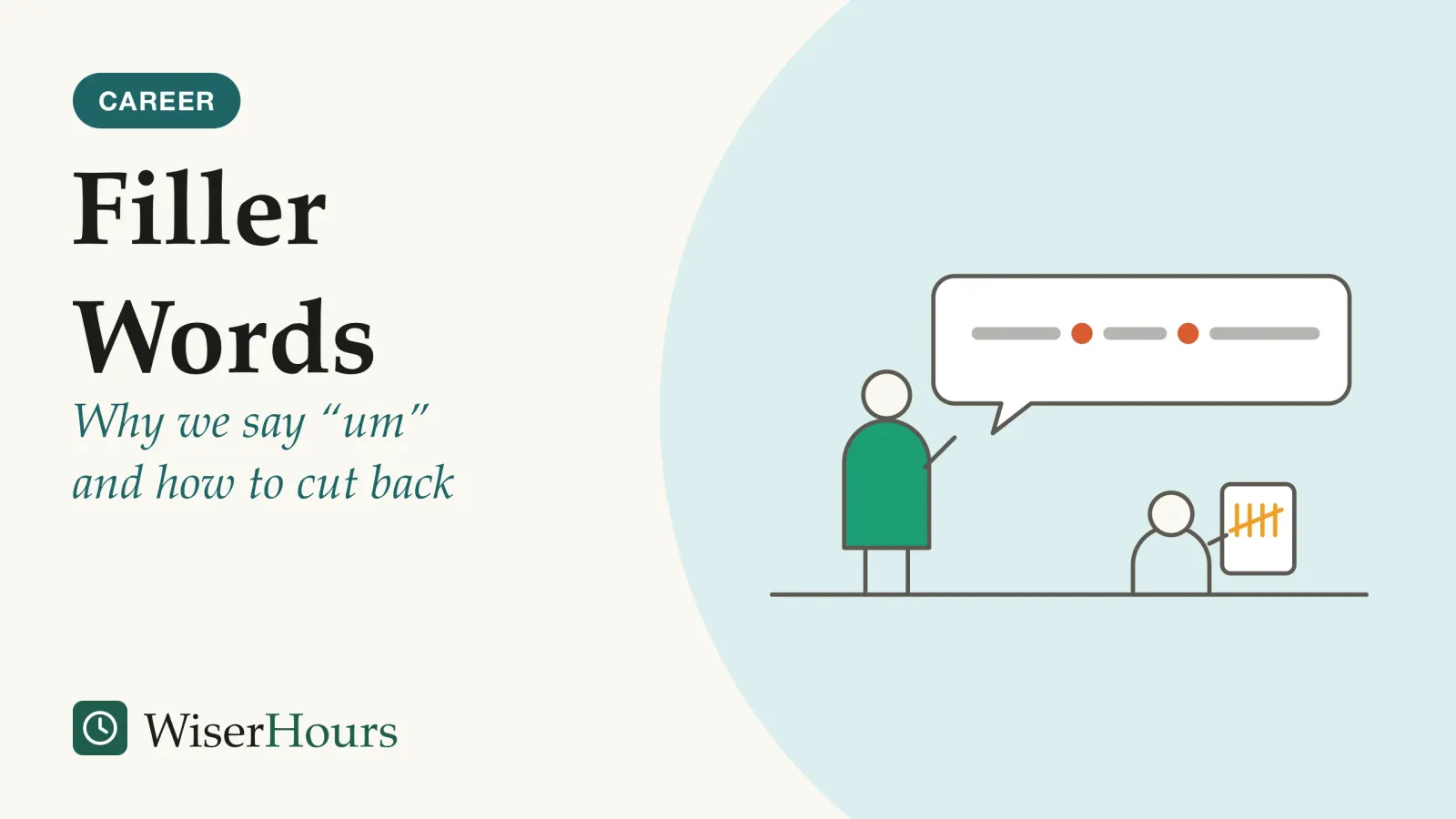
An um is not a malfunction. Filler words such as um and uh are a normal part of speech, and cutting back on them is a habit you can train rather than a flaw to hide. Fillers are the most common slip in conversation: in a 2001 study of conversations between 48 pairs of adults, speakers produced about 6 disfluencies every 100 words, and fillers such as uh and um made up the largest share.1 The realistic goal is fewer, not zero. Small training studies, plus a speaking-club habit, point to four steps:
- Record yourself and name your fillers
- Catch each filler as it happens
- Close your mouth and pause instead
- Have a listener count, and aim for fewer
You can start the first step today with a phone: record a two-minute explanation of something you know well, play it back and note which fillers you use and where they fall.
Stage fright is a separate problem, and the beginner’s plan for speaking in public deals with it. This page stays with the small word itself.
Um and uh are words that announce a wait
Um and uh are not noise that leaks out when speech breaks down, according to psychologists Herbert Clark and Jean Fox Tree. In a 2002 analysis of recorded conversation, they argued that both are ordinary English words that speakers choose, using uh to warn of a short delay and um to warn of a longer one.2
The reason starts with how speech is made. People plan what to say while they are already saying it, and sometimes the next word or idea is not ready. At that moment a speaker has two options: go silent, or say something that means “wait, more is coming.” Clark and Fox Tree list the uses they found: signalling a search for a word, deciding what to say next, and keeping or giving up the floor.2
Picture being asked in a meeting when a project will ship. “Uh, Thursday” tells the room the answer is a beat away; “Um, let me think about the last test run” tells them to expect a longer gap. In both cases the filler holds your turn while you think.
The study
Moderate evidence
How long speakers go quiet after um versus uh: Clark and Fox Tree's 2002 corpus count
Um was followed by a pause far more often than uh, 61 versus 29 percent of the time, and the pauses after um were longer. Speakers who paused more also used more fillers. The authors conclude that uh and um are conventional English words that speakers plan and produce much as they do any other word.2
For a speaker, that makes an um a piece of information: it tells the room you have not finished and that the next part is taking some finding. The weak point is who was recorded. The core conversations came from British academics decades ago, and a corpus shows how people use fillers, not what listeners make of them.
So stop treating every um as an error. One before a genuinely hard answer signals that you are still working; the ones worth cutting are the reflexive ones that open sentence after sentence.
Occasional fillers can help the people listening
Occasional fillers can help listeners rather than distract them, at least in lab tests. In 2001, Jean Fox Tree found that people recognized an upcoming word faster when an uh preceded it than when the uh had been cut from the recording, while um made no measurable difference either way.3
Listeners heard short stretches of real, unscripted speech and pressed a button when they heard a target word, and the result held in two small experiments, one in English and one in Dutch. Fox Tree’s explanation is that an uh warns that speech will resume soon, so paying closer attention pays off; after um, the wait may be too long to hold that attention. She also notes earlier research finding that people have a hard time noticing ums in talk, although they can pick them out when they listen for them.3
- Uh: announces a short wait; the words usually resume soon
- Um: announces a longer wait; a pause follows more often, and it lasts longer
Schematic, not to scale: bars are words, dots are silence. Based on recorded British conversations analyzed by Clark and Fox Tree, 2002.
A brain-recording experiment points the same way. Corley and colleagues reported in 2007 that listeners’ brain responses suggested an unexpected word was easier to fit into a sentence when “er” came before it, and that words after a hesitation were more likely to be remembered later.4
In a meeting, this is the colleague who says “the person to ask is, uh, Priya”: on Fox Tree’s account, the uh flags that the next word is coming and gives listeners a moment to get ready for it. It also suggests the room notices fewer of your fillers than you might fear, while a colleague asked to count will catch more.
None of this is a reason to add ums. It does mean that an occasional filler before a hard word or a new point costs listeners little. These lab studies did not test a filler every few seconds, the pattern speakers actually worry about.
Why some talks fill up with ums
Fillers tend to rise with planning load: the more of the talking a speaker has to plan, the more of them they produce. In Bortfeld and colleagues’ 2001 study, speakers who had to describe pictures so a partner could pick them out used almost twice as many fillers as partners whose job was to follow. Fillers did not track difficulty perfectly, though: they were slightly more common when people described photos of children than abstract shapes, and the authors read that as a hint that fillers also help speakers coordinate with a listener.1
Nerves are not the whole story either. The same study found that people were no more disfluent with strangers than with their own spouses; it had no direct measure of anxiety, but the authors note that anxiety by itself did not seem to drive the rates. Earlier studies they summarize found disfluencies clustered near the beginnings of turns and sentences, where planning effort is presumably highest, and a 1991 study of university lectures suggested that speakers say more fillers when they must choose among more ways of saying something.1
In everyday work this looks familiar. The same person who glides through a rehearsed status update can stall on a question about next year’s strategy, because the update was planned in advance and the answer has to be built on the spot. The ums arrive where the planning happens.
That points to the cheapest fix: prepare the parts that are hardest to plan live. Write out your first sentence, decide how you will move between sections, and have a short answer ready for the question you most expect.
Do filler words hurt your credibility?
A few filler sounds do not seem to hurt how a speaker is judged, but a steady stream does, according to one online rating study. In 2024, Laske and DiGennaro Reed had online raters judge speeches built to contain filler sounds or filler words at set rates. More fillers, and filler sounds in particular, drew lower ratings in most categories, most clearly at 12 filler sounds a minute, while 5 disfluencies a minute did no measurable harm.5
To put those rates in time: 5 a minute is one filler about every 12 seconds, and 12 a minute is one every 5 seconds. The authors conclude that a low but nonzero rate may be acceptable, and that filler sounds such as um and uh mattered more than filler words such as so or like.5
The high end is easy to recognize. A project lead finishes a two-minute update, and the colleague she asked for feedback mentions only one thing: she said um before almost every sentence. She had not heard a single one, and her facts were right, but for that listener the ums had become the rhythm of the talk.
The evidence here is thin. This is one study, the raters were crowdsourced participants judging speeches made for the study rather than colleagues in a live meeting, and only the paper’s abstract was available to us. No study we found measured whether fillers change real outcomes at work, such as whether a proposal gets approved.
- Myth
- Any um makes a speaker sound unprepared.
- Fact
- Listeners often fail to notice fillers, and in one 2024 rating study a low rate did not lower ratings of the speaker. A high rate did.
Count before you worry. If a recording shows a filler in nearly every sentence, cutting back is worth the effort; if it shows a few per minute, your time may be better spent on the content.
How to cut back on filler words, step by step
The best-tested method is a short form of habit reversal: learning to notice each filler as it happens, then replacing it with something else, such as a silent pause. Between 2016 and 2022 the Journal of Applied Behavior Analysis published 7 studies of this training with public speakers, which Luiselli reviewed in 2022.6
Clinicians use habit reversal to treat tics and other repetitive behaviors, as the guide to breaking a bad habit explains. The public speaking studies are small, several of them with college students, and compare each person’s speeches after training with their own speeches before it. They show consistent drops, not proof that the method works for everyone.
- 1Describewhich fillers you use, and where
- 2Detectspot each one, on video, then live
- 3Replacea silent pause instead of the sound
- 4Counta listener tallies; compare with last time
1. Record yourself and name your fillers
Start by describing your own fillers. In a 2016 study by Mancuso and Miltenberger, 6 participants were trained to recognize their filled pauses (um, uh, er, clicks and the misused “like”) and to practice a competing response, and all 6 used fewer immediately afterward.7 A 2022 study of 9 speakers by Ortiz and colleagues found that simply describing the habit in detail was enough for 4 of them.8
In practice: play back your two-minute recording and write down each filler and what came just before it, such as a sentence start, a new point or an unexpected question.
2. Catch each filler as it happens
Once you know your fillers, the next step is spotting them in the moment. In a 2017 study by Spieler and Miltenberger, 4 university students used meaningfully fewer fillers, tongue clicks and misused “like” after awareness training alone, though each needed booster sessions for further gains; the effects generally held in front of a small audience.9 Montes and colleagues reported in 2019 that awareness training alone was effective for every participant, without boosters.10
In the 2022 component study, the speakers for whom description was not enough practiced detecting their fillers on video and, for some, then live.8 You can do the same: replay a recording and tap the table at each filler, then ask a colleague to raise a finger whenever they hear one during a practice run.
3. Close your mouth and pause instead
One replacement that has been tested directly is a short silent pause. In a 2020 study by Pawlik and Perrin, 4 speakers were taught to notice fillers and to pause silently instead, and all 4 used fewer fillers afterward.11 A 2025 replicationreplication: Running a study again with fresh data and the same method, to see whether the original result comes back. A finding that fails to replicate is not automatically wrong, but it stops being something you can lean on.Full entry in the glossary of brief habit reversal, which pairs noticing with a replacement response, with 9 social work students found fewer fillers for everyone during training; weeks later, 6 of the 9 were still at least 80 percent below where they started.12
A silent pause buys the same time as an um without the sound, and the time is what you need to find the next words. At a transition, close your mouth, take a breath and start the next sentence.
4. Have a listener count, and aim for fewer
Counting keeps the habit visible. Toastmasters clubs give one member, the Ah-Counter, the job of recording overlong pauses, overused words and filler sounds (for example and, but, so, you know, ah and um) during a meeting and reporting them in the evaluation portion.13 A colleague can do the same for one practice talk; the total gives you a number to beat next time.
Ah-Counter tally
Play back a recording, or ask a colleague to hold the phone during a practice run, and tap a button each time a filler comes up.
Press Start, then tap a button each time you hear a filler.
- Fillers this run
- 0
- All fillers a minute
- —
- Um and uh a minute
- —
- Last run, the number to beat
- —
The marks come from one online rating study (Laske and DiGennaro Reed, 2024): at 5 disfluencies a minute, ratings of the speaker showed no measurable harm; lower ratings showed most clearly at 12 filler sounds, such as um and uh, a minute. The raters were crowdsourced and judged speeches made for the study, and only the abstract was available to us.
Fewer, not zero. 5 a minute is not a pass mark, and 12 is not a fail mark. The authors suggest a low rate may be acceptable, so a count that falls from one run to the next matters more than a perfect one.
Nothing is saved: the counts disappear when you leave the page.
Keep the target realistic. The authors of the 2024 rating study suggest a low rate may be acceptable, so a falling count matters more than a perfect one.5
A practice run with a filler count
How much weight each finding about fillers can bear
The evidence is strongest that fillers are common and tend to signal a pause; the evidence that they hurt credibility, and that drills reduce them for good, comes from a handful of small studies.
| What it is | What the best evidence found | Evidence |
|---|---|---|
| How common fillers are | About 6 disfluencies per 100 words in conversation; fillers the largest share | Observational, moderate (48 pairs, one task)1 |
| What um and uh signal | Um followed by delays more often, and by longer ones, than uh | Observational, moderate (British conversation corpus)2 |
| Effect on listeners | Faster recognition of the next word after uh; no effect of um | Experiment, limited (two small lab experiments)3 |
| Effect on ratings of the speaker | High rate of filler sounds rated worse; low rate no measurable harm | Experiment, limited (one online rating study)5 |
| Noticing and pausing drills | Fewer fillers for every participant after training | Small before-and-after studies, limited (6 and 9 people)712 |
The gaps matter. We found no randomized trialrandomized controlled trial: A study that assigns participants to the treatment or the comparison group at random, so the groups start out alike and a difference in what happens next can be put down to the treatment. Random assignment makes the two groups comparable; it does not make the people in the trial representative of anyone else.Full entry in the glossary of filler training, no study of workplace audiences and little follow-up beyond a few weeks. And the claim that fillers make a speaker seem less credible rests on rating studies of speeches made for the purpose, such as the 2024 one.
So treat the drills as a cheap trial on yourself, not a sure cure: record a baseline, practice, and let the next count show whether they work.
The bottom line
An um costs little in small doses: it is a word that tells listeners to wait. Fillers pile up where speech is hardest to plan, so the first fix is preparation: know your opening and your transitions. If a recording shows a filler in nearly every sentence, learn to hear your own and practice closing your mouth for a silent pause instead; the aim is fewer, not none.
Frequently asked questions
Is saying "like" or "you know" the same as saying "um"?
Not quite. Some researchers separate filler sounds such as um and uh from filler words such as like, so or you know. In a 2024 rating study by Laske and DiGennaro Reed, filler sounds in particular drove the lower ratings of speakers. The training studies often counted both kinds, along with tongue clicks, and fewer of both followed the same noticing drills.
Do people in other languages say um?
Yes. Herbert Clark and Jean Fox Tree reported in 2002 that every language they examined had at least two fillers, like English uh and um, and Fox Tree found the same listener effects in Dutch as in English. Clark and Fox Tree also note that people speaking English as a second language often carry over the fillers of their first language.
Do men say um more than women?
In one study they did. In Bortfeld and colleagues' 2001 analysis of conversations between 48 pairs, each a man and a woman, men produced more fillers than women. The authors had not predicted the difference, called their explanations post hoc, and asked for it to be replicated in other samples before anyone draws conclusions from it.
Sources
- Disfluency Rates in Conversation: Effects of Age, Relationship, Topic, Role, and Gender. Bortfeld, H., Leon, S. D., Bloom, J. E., Schober, M. F. & Brennan, S. E. (2001). Language and Speech, 44(2), 123-147
- Using uh and um in spontaneous speaking. Clark, H. H. & Fox Tree, J. E. (2002). Cognition, 84(1), 73-111
- Listeners' uses of um and uh in speech comprehension. Fox Tree, J. E. (2001). Memory & Cognition, 29(2), 320-326
- It's the way that you, er, say it: Hesitations in speech affect language comprehension. Corley, M., MacGregor, L. J. & Donaldson, D. I. (2007). Cognition, 105(3), 658-668
- Um, so, like, do speech disfluencies matter? A parametric evaluation of filler sounds and words. Laske, M. M. & DiGennaro Reed, F. D. (2024). Journal of Applied Behavior Analysis, 57(3), 574-583
- Public speaking disfluencies: A review of habit reversal training and research. Luiselli, J. K. (2022). Journal of Applied Behavior Analysis, 55(4), 1342-1348
- Using habit reversal to decrease filled pauses in public speaking. Mancuso, C. & Miltenberger, R. G. (2016). Journal of Applied Behavior Analysis, 49(1), 188-192
- Decreasing nervous habits during public speaking: A component analysis of awareness training. Ortiz, S. M., Deshais, M. A., Miltenberger, R. G. & Reeve, K. F. (2022). Journal of Applied Behavior Analysis, 55(1), 230-248
- Using awareness training to decrease nervous habits during public speaking. Spieler, C. & Miltenberger, R. (2017). Journal of Applied Behavior Analysis, 50(1), 38-47
- Awareness training reduces college students' speech disfluencies in public speaking. Montes, C. C., Heinicke, M. R. & Geierman, D. M. (2019). Journal of Applied Behavior Analysis, 52(3), 746-755
- Reducing speech disfluencies during public speaking using brief habit reversal. Pawlik, B. & Perrin, C. J. (2020). Journal of Applied Behavior Analysis, 53(2), 1080-1088
- Using Brief Habit Reversal to Decrease Speech Disfluencies in Public Speaking. A Systematic Replication. Göhring, A. & Bördlein, C. (2025; online 2024). Research on Social Work Practice, 35(5), 514-523
- Ah-Counter. Toastmasters International, club meeting roles (accessed 24 September 2026)
How we researched this
We searched PubMed, Europe PMC, Crossref and the web in September 2026 for studies of fillers in conversation, listeners' comprehension, ratings of speakers and training to reduce fillers, and read the Toastmasters description of its Ah-Counter role. Sources date from 2001 to 2025. Main limitation: the training studies are small, several of them with college students, and several papers were read at abstract level only.
Keep reading
Body Language for Presenters: What to Do With Your Hands
Gestures gave listeners a moderate boost in understanding in a 2019 meta-analysis of 83 samples. Where to rest your hands, what to show and what to skip.
Slide Design for Non-Designers: The Basic Principles
Slide design for non-designers: 6 principles from learning research, from cutting decoration to labeling charts directly, and where the evidence is thin.
Public Speaking for Beginners: A Realistic Starting Plan
Public speaking for beginners: a 6-step plan and its evidence, from small repeated talks to the myth that people fear speaking more than death.