How to Break a Bad Habit: What Science Recommends
A 2005 study of 115 transferring students found habits survived a move only when their setting did. How to break a bad habit: change the cue, plan a swap.

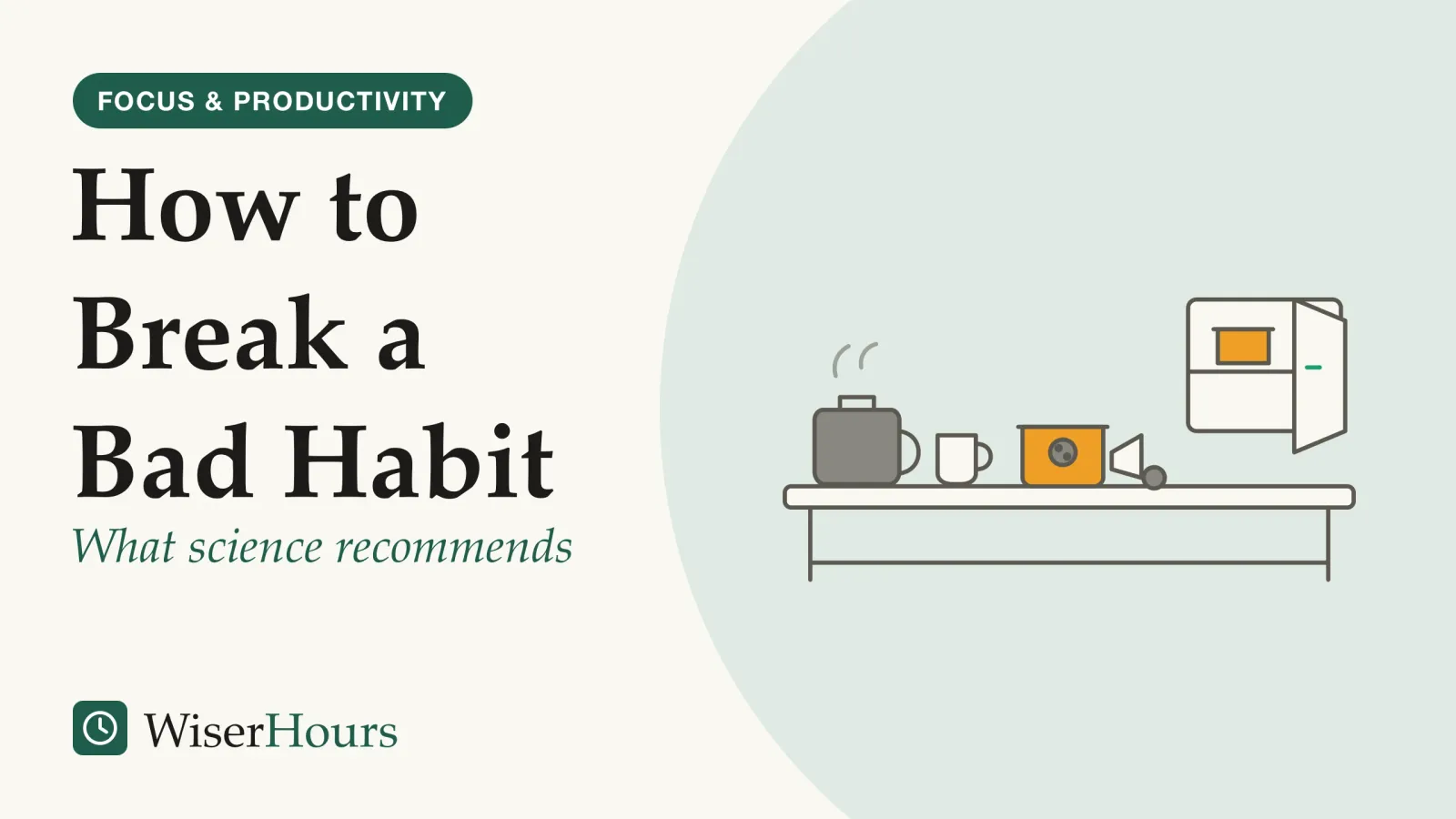
Breaking a bad habit is usually treated as a test of character. It is closer to a problem of furniture: at four o’clock the kettle goes on, the biscuit tin sits beside it, and your hand is in the tin before you have decided anything at all.
Most advice on how to break a bad habit aims at the wanting. Habit research points somewhere less flattering and more useful: the action is set off by the situation around it, and that is where the work is. In a 2016 Annual Review of Psychology article, Wendy Wood and Dennis Rünger argue that the difficulty of changing an established habit is not a failure of willpower but that the old behavior keeps being triggered automatically by the cues around it.1 Four moves follow from that:
- Write down when the habit happens
- Take the cue out of reach
- Write one if-then sentence that names the replacement
- Plan for the slip, and for the return of old cues
Why willpower alone rarely breaks a bad habit
Willpower arrives too late. A habit is a link, learned by repetition, between a situation and an action, so by the time you are resisting, the situation has already brought the action to mind. Wood and Rünger’s review puts the difficulty there rather than in weak resolve or a fondness for the old behavior.1
Deciding harder is not the answer, then. Their review summarizes Webb and Sheeran’s 2006 meta-analysis of 47 studies that changed what people intended to do: the new intentions moved behaviors people perform only now and then, such as enrolling on a course, and left behaviors that could be repeated into habits, such as seat belt use, roughly where they were. Even if-then plans, the best-tested planning tool here, fail to control many strong habits.1
The biscuit tin makes the point every afternoon. Your intentions have not changed since breakfast, when you meant to stop; what changed is that you walked into the room where the habit lives. If the mechanics are new to you, start with how repetition turns an action into a habit.
One check before you start, because the two problems people call bad habits need opposite tactics. In diary studies run by Jeffrey Quinn and colleagues, only a small minority of what students were trying not to do were strong habits; far more were temptations, promising an immediate good feeling.2
Habit or temptation?
Write the thing down as a situation plus an action: four o’clock, kettle on, hand in the tin. If that situation repeats, treat it as a habit and spend your effort on the situation. If what pulls at you is instead the promise of an immediate good feeling, it is closer to a temptation, and against strong temptations stepping away from the situation was rated more successful in the same diary studies.2
The cheapest change is to the room, not to you
The strongest lever on an old habit is the setting that triggers it. Take the cue away and the habit has nothing to start it, which is why habits often fail to survive a move unless part of the old surroundings moves too.
Wendy Wood, Leona Tam and Melissa Guerrero Witt tested that on people who were moving anyway: 115 students transferring to Texas A&M University, surveyed a month before the move and a month after. Strong habits carried over only where a piece of the old context came too: students kept exercising where the kind of place stayed the same, at home or at a gym, and kept reading the newspaper where they still read it with others around. Where the context changed, behavior in some cases came back under intentional control and followed what people currently intended.3 Nobody was assigned to move and the behavior was self-reported, so this shows a pattern rather than a proven cause.
Researchers have tried to use that moment. In a field experiment by Bas Verplanken and Deborah Roy, a program encouraging greener household behaviors was more effective among participants who had recently moved house than among matched households that had stayed put, and the authors put the window of opportunity at three months after a move.4 Those behaviors were self-reported, and we read only the abstract of that paper.
You do not have to move house to use this. The everyday version is making the cue harder to meet: the tin goes in a cupboard in another room, the phone charges in the hall, the app comes off the home screen. That is not willpower, it is an afternoon of moving objects, and it works when you are tired.
There is a timing lesson too. If a move, a new job or a changed shift pattern is coming, that is the cheapest moment to drop a habit, because many of its cues disappear without any effort from you.
Name the replacement, because a refusal can rebound
If-then plans are the best-tested planning tool here, and the wording decides whether they help. A plan that names a replacement action at the moment of the cue has good evidence behind it; a plan phrased as a refusal can leave you worse off than no plan at all. Peter Gollwitzer and Paschal Sheeran pooled 94 independent tests of if-then plans in 2006 and found a medium-to-large benefit for reaching goals. They also report why the structure works: forming the plan made the named opportunity easier to notice and made the planned response more automatic.5
Marieke Adriaanse and colleagues at Utrecht University then asked what happens when the plan is a negation, as in: if I feel like a snack, then I will not eat one. Across their experiments, negation plans produced an ironic rebound in thought and in behavior, compared with both a replacement plan and the intention alone, and the rebound was likeliest when the negated habit was strong.6 We read only the abstract of that paper.
- Myth
- Breaking a habit starts with a firm rule: from now on, no biscuits at four.
- Fact
- In Utrecht University experiments, if-then plans phrased as a refusal rebounded, especially for strong habits. Plans naming a replacement action did not.
The same group’s meta-analysis of 23 studies of if-then plans and eating found the tool somewhat stronger at adding healthy foods to a diet than at cutting unhealthy ones, and cautioned that some of those adding effects may have been inflated by weak comparison conditions.7 So a replacement plan helps rather than guarantees, and it is weaker at subtraction than at addition. In practice it has to name something you will do at four o’clock, such as carrying the mug to the window, rather than a rule about the tin.
- The cue: the moment the habit starts; Wood and Rünger list features of the physical setting, other people and the action just before
- A plan that only says no: in Utrecht University experiments, plans phrased as a refusal produced an ironic rebound in thought and in behavior, most of all when the habit was strong
- A plan that names a replacement: the same cue now has somewhere else to go; the old route is drawn faded, not gone, because old habit memories can persist
Clinical practice rests on the same principle. Habit reversal therapy, used for repetitive behaviors such as tics and nail biting, teaches what the UK’s NHS describes as intentional movements that compete with the tic, so the two cannot happen at the same time.8 A 2011 meta-analysis of 18 studies with 575 participants found a large average benefit against control conditions.9 The NHS lists it among the main therapies for more severe tics and says to see a GP about tics, so it is a treatment to arrange with a clinician, not a home routine.8
Further reading
Good Habits, Bad Habits: The Science of Making Positive Changes That Stick
Wood's book on changing the settings that trigger a habit, the approach this guide builds on.
As an Amazon Associate WiserHours earns from qualifying purchases.
What to do once the cue has already fired
When the urge is already there, the best-supported move is the least appealing one: think do not do it, and watch yourself for slips. In two diary studies of US students, run by Jeffrey Quinn and colleagues, that was rated more successful against strong habits than stepping away from the situation, though stepping away was rated the better tool against strong temptations.
The study
Limited evidence
A week of pocket booklets: what students did about their own bad habits (Quinn and colleagues, 2010)
Students carried booklets for a week or two, noting within minutes each attempt not to do something and the strategy used. About one in ten of those unwanted acts were strong habits, done almost daily and mostly in one setting; a third or more were temptations promising an immediate good feeling. For the strong habits, vigilant monitoring, meaning thinking “don’t do it” and watching for slip-ups, was rated more successful than removing themselves from the situation; for strong temptations the order reversed. A follow-up word-pair experiment pinned down why: monitoring strengthened control over the response rather than reducing habit strength.2
Two things are worth keeping from that. The strategies swap places depending on what you are fighting, which is part of why generic self-control advice disappoints. And in the lab it was a holding action rather than a cure: control strengthened, habit strength did not shrink.2
The caveats are real: US students, self-chosen strategies, self-rated success, and word pairs standing in for real habits in the lab. So treat monitoring as what you do at four o’clock while the moved tin and the replacement plan do the slower work.
How to break a bad habit, move by move
Here is the whole thing as a fortnight of work. The record comes first, because everything after it is built on what it shows.
1. Write down when the habit happens
For one week, note each time it happens: the time, the place, who was there, what you were doing just before. Across 138 randomized studies pooled by Benjamin Harkin’s team in 2016, keeping track of progress toward a goal raised the chance of reaching it, more so where the record was written down.10 Those studies were about pursuing goals rather than about dropping habits, so the fit here is approximate.
Try it: a week of one-line notes
This week, do only step one. Keep a card in your pocket and write a line every time the habit fires. By Sunday you will usually find two or three situations doing most of the work.
2. Take the cue out of reach
Move the thing, not yourself: another room, behind a door, off the home screen, out of the drawer you open every morning. The aim is not to make the habit impossible but to make the old cue miss you. If the habit is phone-shaped, the same principle drives a practical reset of your phone and apps.
3. Write one if-then sentence that names the replacement
Give it a time, a place and an action you will actually do: if it is four o’clock and the kettle is on, then I will take the mug to the window and drink it there. Name the action, not the refusal.
4. Plan for the slip, and for the return of old cues
Slips are not a verdict, and old habits are not deleted. Wood and Rünger report that learning a new behavior does not necessarily replace the old memory traces, so the habit can come back when its old cues do.1 Keep the record going for a few weeks after it seems gone, and expect the old room, the old company and the old hour to make a fresh bid.
A two-week plan
How strong the evidence is behind each move
The four moves do not rest on equally solid ground, and the move most guides recommend rests on none. Each row pairs a move with the strongest evidence we found for it.
| Move | What the best evidence found | Evidence |
|---|---|---|
| Change the setting that triggers it | Habits survived a university transfer only where part of the old context did; a program was more effective among recent movers | Survey plus field experiment, limited34 |
| Plan an if-then replacement | A medium-to-large benefit for goals; for eating, somewhat stronger at adding than at cutting | Meta-analyses, moderate57 |
| Plan a refusal instead | An ironic rebound compared with replacement plans, most of all for strong habits | Experiments, limited6 |
| Monitor yourself at the moment | Rated most successful for strong habits; it strengthened control instead of reducing habit strength | Diary studies and a lab experiment, limited2 |
| Keep a written record | Tracking progress raised goal attainment across 138 randomized studies | Meta-analysis, moderate10 |
| Rely on willpower alone | Changed intentions moved occasional behaviors, not those that could be repeated into habits | Review summarizing a meta-analysis, moderate1 |
When a habit needs more than a plan
Some habits are not a self-help problem. Where smoking, alcohol or other drugs, gambling, or eating that feels out of control are involved, the route is a doctor or a specialist service rather than a cue-and-replacement plan, and this guide does not cover them. The US National Institute of Mental Health points people to a primary care provider first, and to federal treatment locators and professional directories from there.11 The three levels of urgency are our grouping.
- Now: for thoughts of suicide or self-harm, NIMH points to the 988 Suicide and Crisis Lifeline, which takes calls, texts and online chat, and to 911 or the nearest emergency room where life is in danger.11 For the UK, the NHS gives 999 or A&E where a life is at risk; short of an emergency, an urgent GP appointment, or 111 online or by phone, choosing the mental health option; plus the free Samaritans listening line on 116 123.12 Anywhere else, your local emergency number.
- Soon, in the next days or weeks: a habit that is harming your health, or one you have tried and failed to change several times and that is getting worse, is worth a doctor’s appointment rather than another plan.
- Routine: mention it at your next appointment if the habit is costing you money, sleep or relationships, or damaging skin, nails or teeth.
The bottom line
Breaking a habit is closer to rearranging a room than to passing a test of character. Find the situation that starts it, make it harder to meet, settle beforehand on what you will do at that moment instead, and expect to watch for slips a while after it seems finished. If a habit involves substance use, gambling, or eating that feels out of control, or is causing real distress, the next step is a doctor, not a better plan.
This article is general information, not medical advice. If you're worried about your health, talk to a doctor or another qualified professional.
Frequently asked questions
Can I just remove the cue and skip the replacement?
Often yes. Wendy Wood and Dennis Rünger's 2016 review of habit research describes two separate routes to change: impeding the automatic cueing of the old habit, and repeating a new behavior until it becomes habitual. Removing the cue is a route in its own right. A replacement matters most where the cue cannot be removed, such as the end of a working day.
Does telling someone else about it help?
The evidence points that way, though it comes from goals in general rather than from habits. Benjamin Harkin and colleagues pooled 138 randomized studies in 2016. Prompting people to keep track of progress toward a goal raised the chance of reaching it, and the benefit was larger where the record was written down and where someone else saw the results.
Why does an old habit come back when I return to an old place?
Because the old link was never erased. Wood and Rünger's review reports that learning a new behavior does not necessarily replace the old memory traces, so an unwanted habit can return when its old cues reappear. That is also why the university transfer study found habits surviving a move whenever a piece of the old setting moved too.
Is biting your nails a habit in the same sense?
Partly, and it is treated differently. Repetitive behaviors such as nail biting and tics are handled clinically with habit reversal therapy, a treatment the UK's NHS describes as learning intentional movements that compete with the tic so the two cannot happen at the same time. A 2011 meta-analysis of 18 studies found a large average benefit against control conditions.
Sources
- Psychology of Habit. Wood, W. & Rünger, D. (2016). Annual Review of Psychology, 67
- Can't Control Yourself? Monitor Those Bad Habits. Quinn, J. M., Pascoe, A., Wood, W. & Neal, D. T. (2010). Personality and Social Psychology Bulletin, 36(4)
- Changing circumstances, disrupting habits. Wood, W., Tam, L. & Guerrero Witt, M. (2005). Journal of Personality and Social Psychology, 88(6)
- Empowering interventions to promote sustainable lifestyles: Testing the habit discontinuity hypothesis in a field experiment. Verplanken, B. & Roy, D. (2016). Journal of Environmental Psychology, 45
- Implementation intentions and goal achievement: A meta-analysis of effects and processes. Gollwitzer, P. M. & Sheeran, P. (2006). Advances in Experimental Social Psychology, 38
- Planning What Not to Eat: Ironic Effects of Implementation Intentions Negating Unhealthy Habits. Adriaanse, M. A., van Oosten, J. M. F., de Ridder, D. T. D., de Wit, J. B. F. & Evers, C. (2011). Personality and Social Psychology Bulletin, 37(1)
- Do implementation intentions help to eat a healthy diet? A systematic review and meta-analysis of the empirical evidence. Adriaanse, M. A., Vinkers, C. D. W., De Ridder, D. T. D., Hox, J. J. & De Wit, J. B. F. (2011). Appetite, 56(1)
- Tics. National Health Service (last reviewed 2023). NHS.uk
- The efficacy of habit reversal therapy for tics, habit disorders, and stuttering: A meta-analytic review. Bate, K. S., Malouff, J. M., Thorsteinsson, E. T. & Bhullar, N. (2011). Clinical Psychology Review, 31(5)
- Does monitoring goal progress promote goal attainment? A meta-analysis of the experimental evidence. Harkin, B., Webb, T. L., Chang, B. P. I., Prestwich, A., Conner, M., Kellar, I., Benn, Y. & Sheeran, P. (2016). Psychological Bulletin, 142(2)
- Help for Mental Illnesses. National Institute of Mental Health (last reviewed 2026). NIMH, US
- Where to get urgent help for mental health. National Health Service (last reviewed 2023). NHS.uk
How we researched this
We searched the web, PubMed and Crossref in September 2026 for experiments, meta-analyses and reviews on changing established habits, preferring pooled and randomized evidence to single studies. We read the full text of Wood and Rünger's review and of the Quinn and Wood studies, and checked every DOI on Crossref for corrections and retractions. Six of the twelve sources were read in abstract only; nothing is claimed from them beyond what their abstracts state. Main limitation: much of this research relies on self-reported habit measures and on US university students.
Keep reading
How to Build a Reading Habit: 20 Pages a Day
How to build a reading habit: 20 pages a day takes about 20 to 25 minutes. Tie it to a fixed moment, keep the phone away, and read hard books on paper.
Habit Trackers: Do They Work, and Which Kind Should You Use?
A habit tracker helps you repeat an action, yet use fades: in one French study, 16% still used a tracker after 320 days. What works, and which kind to pick.
How to Build a Morning Routine You'll Actually Keep
How to build a morning routine you'll keep: 5 steps from habit research, and why the kind of cue you pick matters less than meeting it every day.
How to Build a New Habit: A Step-by-Step Guide
How to build a new habit in 6 steps from habit trials: one wanted action, a daily cue, a small start, a written record, loose timing and a restart plan.