Remote, Hybrid, and Distributed Work: What the Terms Actually Mean
Remote vs hybrid work, defined. In the year to August 2026, 26% of US full-time employees were hybrid and 12% fully remote. Why surveys count differently.

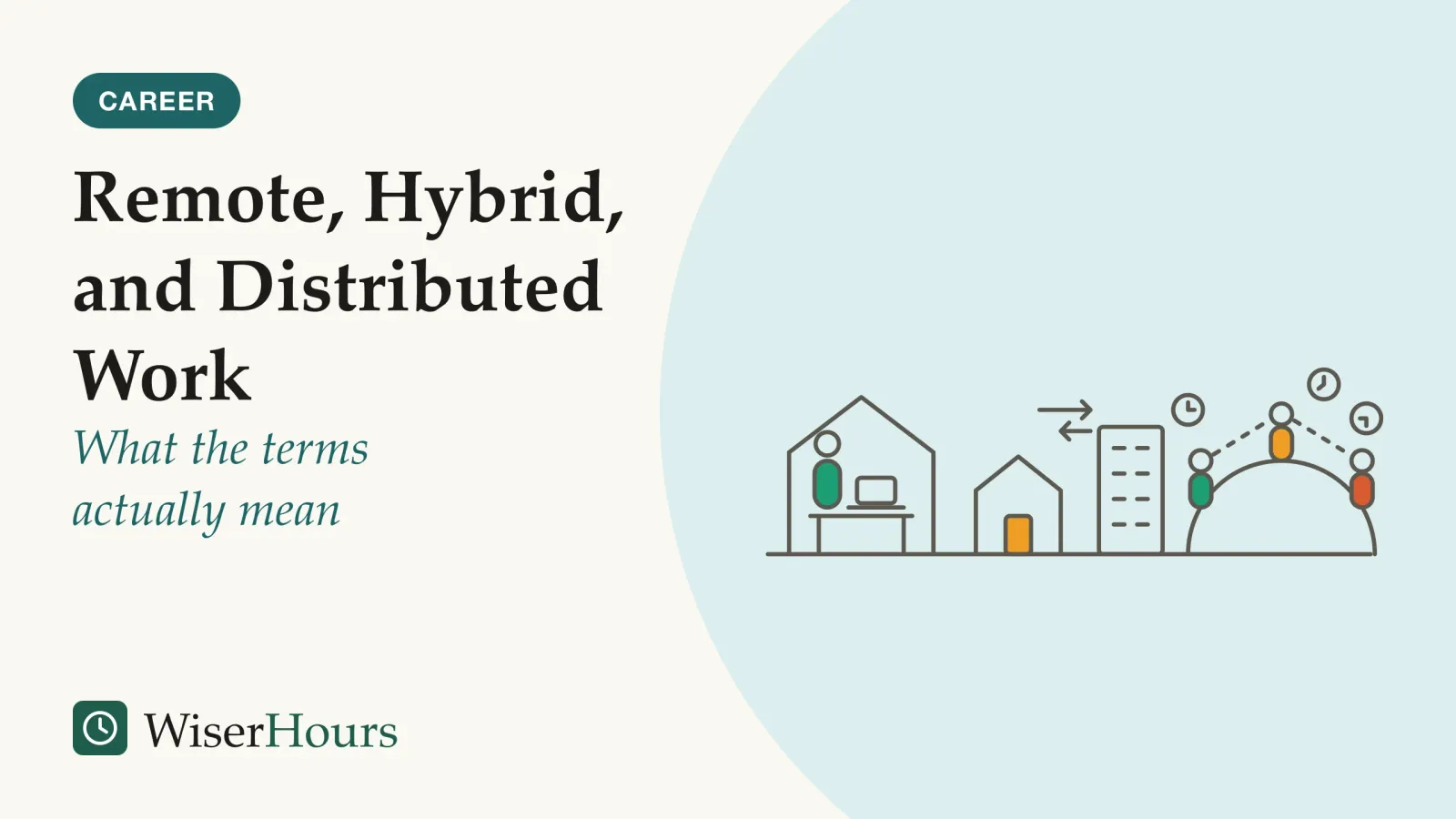
Remote vs hybrid work is a question about your own week, and distributed work is a question about your team. Remote work is done away from the place a job would normally be done; hybrid work splits the week between home and an employer’s site; a distributed team has members spread across different places.
None of the three is an official category everywhere. The International Labour Organization (ILO) noted in 2020 that no international statistical definition of remote work exists, which is why each survey draws its own line.1 In one large monthly US survey, splitting the week is the more common arrangement: from September 2025 to August 2026, 26 percent of US full-time employees were hybrid and 12 percent fully remote, according to the Survey of Working Arrangements and Attitudes.2
What remote work means, and where telework fits
Remote work, in the International Labour Organization’s 2020 description, covers work done fully or partly at a site other than the default place of work, meaning the place the job would typically be expected to happen. For an employee, the default is usually the employer’s premises, such as an office, a construction site or a workshop.1
Definition
The ILO note separates four overlapping ideas. Telework is the part of remote work done with personal electronic devices such as a computer, tablet or phone. Work at home is defined by place alone: work done fully or partly in your own home, whatever your default workplace is. Home-based workers are those whose main place of work is their own home. In the note’s description of remote work, an employee’s alternative site has to be approved by the employer.1
The distinctions matter at the edges. A self-employed designer who works mainly at home works at home and is home-based, but by the ILO’s reasoning is not working remotely, because the note treats that home as the worker’s own premises. An employee working on a laptop in a café is teleworking without working at home.1
- Myth
- Telework, remote work and working from home all mean the same thing.
- Fact
- In the ILO's 2020 framework, telework is the part of remote work done with electronic devices, and working at home is defined by place alone. A freelancer whose home is their normal workplace works at home without working remotely.
A newer variant, work from anywhere, adds a choice of where to live, not only whether to come in. At the US Patent and Trademark Office, Prithwiraj Choudhury and colleagues studied examiners who moved from a work-from-home program to a work-from-anywhere one, with the timing set by negotiations between managers and the examiners’ union. The switch was followed by a 4.4 percent rise in output with no increase in rework, which the authors attribute to the new program; it is one agency, one kind of job, and a natural experiment rather than a randomized trial.4
What counts as hybrid work
Hybrid work means spending part of the working week at home and part at an employer’s site. The UK’s Office for National Statistics (ONS) describes it as travelling to work part of the time and working at home part of the time.3 No single threshold defines it, so two surveys can count the same person differently.
The ONS counts you as a hybrid worker if you answer yes to two questions: whether you worked from home in the past seven days and whether you travelled to work in the past seven days.3 The US Survey of Working Arrangements and Attitudes, run by the economists Jose Maria Barrero, Nicholas Bloom, Shelby Buckman and Steven Davis, counts full days of 6 or more hours instead: a full-time employee is hybrid if they worked some days on business premises and some at home in the prior week.2
Hybrid is also a schedule, and schedules vary. Bloom and colleagues write that the most common pattern is three days in the office and two at home; the Trip.com experiment they ran used Wednesday and Friday as the home days.5 Some hybrid jobs fix the days and others leave them to the employee. The word “hybrid” in a job advert does not say which on its own, so it is worth asking early when you are starting a job search.
- Fully on site: every full workday of the week on business premises
- Hybrid: some full days on business premises and some at home; shown here, home on Wednesday and Friday, the schedule tested at Trip.com
- Fully remote: every full workday at home
Distributed work describes the team, not your week
Distributed work describes how a team or company is spread out, not where one person sits on a given day. Michael O’Leary and Jonathon Cummings argued in a 2007 essay in MIS Quarterly that a team’s dispersion is a matter of degree rather than a yes-or-no, with three dimensions, spatial, temporal and configurational, each linked in theory to different team outcomes.6
Read that way, the labels stop competing. By our reading, a team can be distributed even if everyone works in an office, when the offices are in different cities, and a fully remote employee can sit on a team whose other members share one building. The matrix below crosses the two questions.
As we use the terms, company labels such as remote-first or all-remote are policies built on top of these words, and none of the surveys in this article counts them. Neither label tells you whether a team works well together; that is a separate question, with its own research on what makes a team effective.
Remote vs hybrid work: why the numbers disagree
Official and research surveys disagree on how many people work remotely because they ask different questions about different people over different periods. A 2025 working paper by Shelby Buckman and colleagues found that headline US estimates differ widely across surveys, and that the gaps shrink greatly once the concept, the population and the question wording are harmonized.7 The table shows how four major surveys draw the line.
| Survey | Who and when | Where it draws the line | Latest figures |
|---|---|---|---|
| US Bureau of Labor Statistics, Current Population Survey | People aged 16 and over at work in the US, August 2026 | Teleworked or worked at home for pay at any time in the survey week | 21.6% teleworked: 10.6% all hours, 11.0% some hours89 |
| Survey of Working Arrangements and Attitudes | US full-time wage and salary employees aged 20 to 64, September 2025 to August 2026 | Full days of 6 or more hours at home or on site in the prior week | 26% hybrid, 12% fully remote, 62% fully on site2 |
| UK Office for National Statistics, Opinions and Lifestyle Survey | Working adults aged 16 and over in Great Britain, including unpaid or voluntary work, 5 to 30 August 2026 | Worked from home, travelled to work, or both, in the past seven days | 24% both, 13% home only, 38% travelled only10 |
| Eurostat, EU Labour Force Survey | Employed people aged 15 to 64 in the EU, 2025 | Usually (at least half of days worked over four weeks) or sometimes works from home | 8.8% usually, 14.2% sometimes1112 |
The details explain most of the gaps. The US Bureau of Labor Statistics (BLS) counts anyone who teleworked or worked at home for pay at any time during the survey week, so even a short spell of work at home counts.8 Its “some hours” group includes people who teleworked for some but not all of their work hours, which is close to, but not the same as, hybrid.9 The Survey of Working Arrangements and Attitudes counts only full days and only full-time employees, and it is a monthly online survey run through market research firms, reweighted to match the Current Population Survey, rather than an official survey.2
The ONS figures cover a summer month: another 25 percent of working adults in August 2026 neither worked from home nor travelled to work that week, for reasons such as annual leave or sick leave.10 Earlier in the same survey, 28 percent of working adults in Great Britain were hybrid between January and March 2025.3 Eurostat defines usually working from home as doing so on at least half of the days worked in a four-week reference period.12 On that measure, the EU share usually working from home rose from 5.4 percent in 2019 to 13.3 percent in 2021, then fell back to 8.8 percent in 2025, while the share sometimes working from home climbed from 9.0 percent to 14.2 percent over the same years.11 The ONS reports a similar shift in Great Britain: since 2022 the hybrid share has risen, the travel-only share has fallen, and the home-only share has stayed broadly constant.3
Most workers still do not work from home at all. In the EU, 77.0 percent of employed people aged 15 to 64 never worked from home in 2025.11 In the US, 78.4 percent of people at work did not telework in August 2026.9
Measured as days rather than people, the same economists’ preferred estimate is that working from home accounted for about a quarter of paid workdays among Americans aged 20 to 64 as of 2025.7
Two field experiments found no difference in hybrid staff’s performance ratings
In a randomized trial published in Nature in 2024 by Nicholas Bloom, Ruobing Han and James Liang, at the Chinese travel company Trip.com, an option to work from home two days a week cut quitting by a third, with no detectable change in performance grades or promotions over two years.5
The study
Moderate evidence
Two home days a week at Trip.com: a randomized trial, 2021-22
Graduate employees in software engineering, marketing, accounting and finance with odd-numbered birthdays were offered the option to work from home on Wednesdays and Fridays; the rest stayed in the office five days a week. Over six months, quit rates were 4.8 percent in the hybrid group and 7.2 percent in the office group, a one-third reduction, and job satisfaction scores were higher. Equivalence tests found no effect on performance grades over the next two years, and there was no evidence of a difference in promotions.5
The option was not a rule: take-up was about 55 percent among employees who had volunteered for the trial and 40 percent among those who had not, which the authors read as people tending to work from home one day a week rather than two. The drop in quitting was statistically significant for non-managers and women but not for managers or men. Co-author James Liang is co-founder and chairman of Trip.com and holds equity in it; the paper states that Trip.com provided no funding and that no one pre-screened the results.5
A second field experiment points the same way. In a study published in 2026 in the Review of Economics and Statistics, Prithwiraj Choudhury and colleagues found that workers who spent around two days a week in the office self-reported better work-life balance, more job satisfaction and less isolation than those with more or fewer office days, and received no different performance ratings. Its abstract, the only part we read, does not give the setting or sample size.13
Fully remote work has a less favorable record, by Bloom and colleagues’ account: they describe earlier causal studies, mostly of fully remote staff in call-center, data-entry and helpdesk jobs, as often finding negative effects on productivity.5 A 2026 meta-analysis in the ILR Review, pooling 3,574 estimates from 82 studies of mixed designs, is less clear-cut: it found a small positive average effect of working from home on productivity, with gains concentrated among hybrid workers before the pandemic but seen in both hybrid and remote workers during it, and results depending on context.14 In our view, that makes the difference between remote and hybrid more than a matter of vocabulary, because the two arrangements have mostly been studied in different jobs, and the results have differed.
Your right to request remote or hybrid work in Great Britain
In Great Britain, as of September 2026, every employee has a legal right to request flexible working, including a change to where they work, from their first day in a job, according to GOV.UK. It is a right to ask, not a right to be granted: an employer can refuse for a good business reason, and the rules are different in Northern Ireland.15 The day-one right took effect on 6 April 2024 under the Flexible Working (Amendment) Regulations 2023, which apply in England, Wales and Scotland.16 The UK government estimated it would extend the right to about 2.2 million more employees, Acas reported.17
GOV.UK sets out the process. The request must be in writing and say it is a statutory request; the employer must discuss it with the employee before refusing and decide within 2 months unless both agree to longer; and employees can make 2 requests in any 12-month period.18 Acas, the Advisory, Conciliation and Arbitration Service, says the employer must accept a request unless there is a genuine business reason not to, and that the right applies to people with the legal status of employee, which agency workers, casual workers and people on zero-hours contracts are unlikely to have.19
The rules are due to change again. Under the current rules, GOV.UK lists 8 business reasons for which an employer can refuse a request.20 Under the Employment Rights Act 2025, an employer that refuses will also have to explain why it believes the refusal is reasonable. As of September 2026, Acas says this change will come in 2027 and is not yet in force, and that the government has not announced when in 2027 most such changes will happen.21
These rules cover Great Britain only; the 2023 regulations extend to England, Wales and Scotland.16 Readers in Northern Ireland, the US, the EU or elsewhere should check their own government’s employment rules or labor authority rather than assume a similar right exists. In Great Britain, Acas runs a helpline for questions about individual circumstances.19 If a request is refused or turns into a dispute, a union representative or an employment lawyer can advise on your own case.
Before you accept a job labeled remote or hybrid
Ask how many days on site are expected, and whether the days are fixed or yours to choose. Ask whether remote means anywhere, or within one country or time zone. Ask which days the rest of the team comes in. In Great Britain, if an employer agrees to a statutory flexible working request, the change goes into your contract.18
The bottom line
Before you compare remote-work statistics or job offers, check the definition behind the word: who was counted, over which week, and whether an hour at home or a full day was the threshold. Remote and hybrid describe your week, with none of it or some of it at your employer’s site. Distributed describes your team and how spread out its members are.
This article is general information, not legal advice. Rules differ by country and change over time; for your own situation, speak to a qualified lawyer or an official advice service where you live.
Frequently asked questions
Is hybrid working the same as flexible working?
No. Hybrid working is one kind of flexible working. GOV.UK describes flexible working as a way of working that suits an employee's needs, such as flexible start and finish times or working from home, and employees in Great Britain can ask to change their hours, their start and finish times, their working days or where they work. Hybrid working changes only the where: part of the week at home, part at the workplace.
If I work from home one day a month, am I a hybrid worker?
It depends on who is counting. The UK's Office for National Statistics counts you as hybrid only if you both worked from home and travelled to work in the seven days before the survey, so a monthly home day shows up only in that week. Eurostat would place you among people who sometimes work from home, because it reserves the label 'usually' for those working at home on at least half of the days they worked over four weeks.
Do freelancers who work from home count as remote workers?
Usually not, in the International Labour Organization's 2020 framework. For a self-employed person who works mainly at home, home counts as their own premises, so they are working at home and are home-based, not remote. Work at a client's site does not count as remote either. They work remotely only when they work somewhere else, such as a café or a coworking space.
Sources
- COVID-19: Guidance for labour statistics data collection. Defining and measuring remote work, telework, work at home and home-based work. International Labour Organization (5 June 2020). ILO technical note
- SWAA September 2026 Updates. Barrero, J. M., Bloom, N., Buckman, S. & Davis, S. J. (1 September 2026). WFH Research, Survey of Working Arrangements and Attitudes, waves to August 2026
- Who has access to hybrid work in Great Britain? Office for National Statistics (11 June 2025). Opinions and Lifestyle Survey, January to March 2025
- Work-from-anywhere: The productivity effects of geographic flexibility. Choudhury, P., Foroughi, C. & Larson, B. (2021). Strategic Management Journal, 42(4)
- Hybrid working from home improves retention without damaging performance. Bloom, N., Han, R. & Liang, J. (2024). Nature, 630(8018)
- The spatial, temporal, and configurational characteristics of geographic dispersion in teams. O'Leary, M. B. & Cummings, J. N. (2007). MIS Quarterly, 31(3)
- Measuring work from home. Buckman, S. R., Barrero, J. M., Bloom, N. & Davis, S. J. (2025). NBER Working Paper 33508
- Telework or work at home for pay. US Bureau of Labor Statistics, Current Population Survey
- Table A-41. People at work by telework status and selected characteristics. US Bureau of Labor Statistics, Current Population Survey, August 2026 data, not seasonally adjusted
- Public opinions and social trends, Great Britain: working arrangements. Office for National Statistics (18 September 2026). Opinions and Lifestyle Survey, 5 to 30 August 2026, Table 2
- Employed persons working from home by professional status (lfsa_ehomp). Eurostat, EU Labour Force Survey, 2025 data, accessed 22 September 2026
- Rise in EU population working from home. Eurostat (8 November 2022). Eurostat News
- Is hybrid work the best of both worlds? Evidence from a field experiment. Choudhury, P., Makridis, C. A., Khanna, T. & Schirmann, K. (2026). Review of Economics and Statistics, 108(4)
- Does working from home improve employees' productivity? Empirical evidence from a meta-analysis. Mang, C. F. & Anwar, A. (2026). ILR Review, 79(5)
- Flexible working: Overview. GOV.UK, UK government (checked 22 September 2026)
- The Flexible Working (Amendment) Regulations 2023 (SI 2023/1328). UK Parliament, legislation.gov.uk (made 5 December 2023; in force 6 April 2024)
- Introducing the new Acas Code of Practice on requests for flexible working. Cheng, S., Acas (8 April 2024)
- Flexible working: Applying for flexible working. GOV.UK, UK government (checked 22 September 2026)
- The right to request: Statutory flexible working requests. Acas, Advisory, Conciliation and Arbitration Service (last updated 14 January 2026; checked 22 September 2026)
- Flexible working: After the application. GOV.UK, UK government (checked 22 September 2026)
- Employment Rights Act 2025. Acas, Advisory, Conciliation and Arbitration Service (last updated 14 September 2026; checked 22 September 2026)
How we researched this
We searched the International Labour Organization's statistical guidance, official statistics from the BLS, ONS and Eurostat, WFH Research's survey releases, Crossref and publisher pages, and GOV.UK, legislation.gov.uk and Acas for rules in Great Britain, in September 2026. Sources date from 2007 to September 2026. Main limitation: definitions and figures differ by survey and change monthly; where we read only an abstract, we report only what it states.
Keep reading
Return-to-Office Mandates: What the Research Says About Productivity and Retention
Studies find no clear gain in firm performance after return to office mandates; a 2024 trial found two home days a week cut resignations by a third.
Asynchronous Communication Explained: Working Together Without Being Online Together
Asynchronous communication means replies can wait. Remote work shifted over 61,000 US Microsoft staff toward it, a study estimated. When to write or talk.
Proximity Bias Explained: Why Out of Sight Can Mean Out of Mind
Proximity bias favors the people a manager sees. In a Chinese trial published in 2015, home workers were promoted less for equal performance. Here is why.