Zoom Fatigue Explained: What the Research Says Causes It
Zoom fatigue is tied to feeling watched, seeing your own face and being stuck in frame. A 2021 field experiment linked camera-on days to more fatigue.

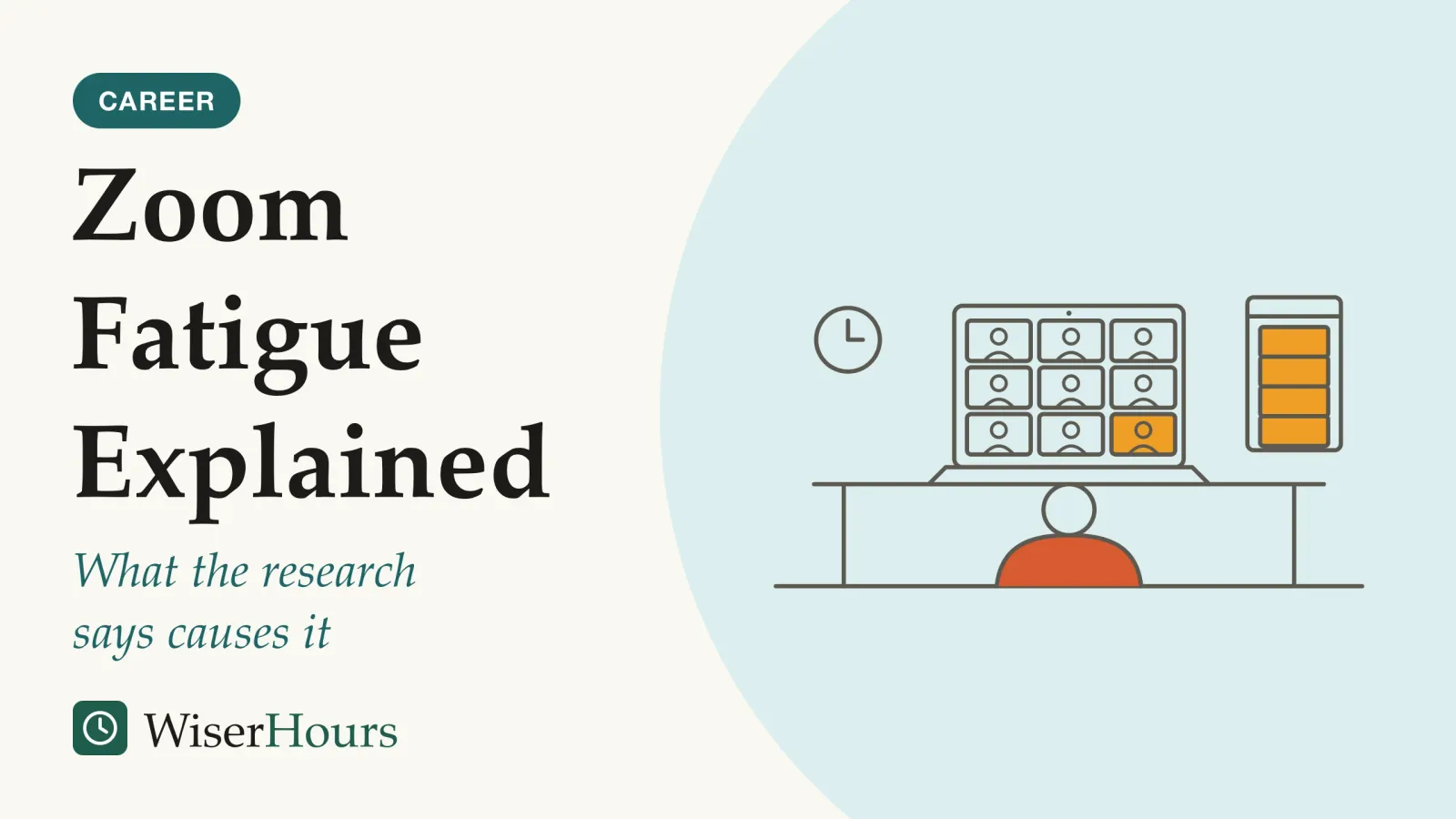
Your fourth video call of the afternoon ends on the hour, and the next one starts on the same minute. You have not moved from your chair since lunch. Every face in the grid looks straight at you, and in the corner a small window of your own face has been watching you all day.
Zoom fatigue is the tiredness people report after video calls, and the research points less at the screen itself than at what a call asks of you: holding eye contact with a grid of faces, watching yourself, staying inside the camera’s frame and working harder to send and read signals. In the one field experiment that switched employees’ cameras on and off, people reported more fatigue on camera-on days, most of all women and staff newer to the company.1 For your own calendar, that points to three things worth watching: how much of the day you spend on camera with your own face in view, how long you sit fixed in one spot, and how many calls run straight into the next.
Prefer to watch? The video covers the same ground as this article.
What Zoom fatigue is, and how researchers measure it
Zoom fatigue is a feeling of exhaustion from taking part in video calls. That is the definition Géraldine Fauville and colleagues at Stanford and the University of Gothenburg adopted in 2021, when they built the Zoom Exhaustion and Fatigue Scale, a 15-question survey that grew out of interviews and several rounds of surveys. It sorts the tiredness into five kinds: general, social, emotional, visual and motivational, and its social questions ask, for example, how much you want to be alone after a call.2 Someone who is fine after a two-hour workshop in a room but wants silence after two hours on screen is describing the kind of tiredness the scale tries to capture.
Two things follow for anyone reading the research. First, almost every finding rests on people rating their own tirednessself-report: A measure in which people describe their own behavior, feelings or circumstances, usually by answering a questionnaire. When the same person supplies both of the things being compared, shared habits of answering can make the link between them look stronger than it is.Full entry in the glossary, not on a measured drop in performance. Second, the label covers any platform: Zoom’s name stuck because it became the leading video-call software in 2020, and the brand turned into a verb for video calls in general.3 If your team is still settling how many days it spends at home, the terms for remote, hybrid and distributed work are explained separately; this article sticks to the self-reported tiredness itself, not eye health or any medical condition.
That has a practical upside. The thing researchers measure is the thing you feel, so a one-word note after each call (fine, tired, drained) is a fair way to see your own pattern before you blame the software or yourself.
- Myth
- Video calls are tiring because you stare at a screen for hours.
- Fact
- Screen time alone does not explain it. The tested suspects are features of the call: feeling watched, seeing yourself, being stuck in frame and the effort of reading faces on a grid.
Four causes Bailenson proposed in 2021
Jeremy Bailenson, a communication researcher at Stanford University, set out an academic account of Zoom fatigue in 2021. He argued that video calls cause nonverbal overload: they intensify the silent signals of face-to-face talk, such as gaze, facial expression and posture, until keeping up with them wears people out.3 He named four sources, and each draws on earlier academic research.
The first is close-up eye contact. On a grid, every face looks straight at you for the whole meeting, and the faces are large. In his own informal test, a colleague’s head in a one-on-one call looked as big as it would from about half a meter away, which is inside the distance that Edward Hall’s 1966 work on personal space classed as intimate, the space people keep for family and loved ones.3 In an elevator, strangers that close look at the floor. On a call, nobody can.
The second is effort. People nod longer and more obviously than usual so the nod shows on screen, center themselves in the frame and look into the camera to fake eye contact. They also misread cues: a colleague who glances sideways on your grid is probably reading a chat message, not reacting to you.3
The third is what Bailenson calls an all-day mirror. He compares the default self-view to an assistant following you through the workday holding up a hand mirror, and cites decades of research finding that seeing yourself makes you evaluate yourself, which can be stressful. The fourth is reduced mobility: to stay in view, people sit still and stare ahead in a small cone in front of the camera, when in a room they would pace, stretch or refill a glass.3
- Close-up eye gaze: every face on the grid looks straight at you, large and close, for the whole meeting
- Extra effort with cues: nodding longer so it shows, staying centered and reading glances that may mean nothing
- An all-day mirror: the self-view window keeps your own face in sight, which invites self-evaluation
- Stuck in frame: to stay in view of the camera, you sit still and face forward instead of moving
Bailenson presented the four as explanations still to be tested:
readers should consider these claims to be arguments, not yet scientific findings.
So when a tips list states the four causes as settled facts, read them as the four places researchers went looking. Their value was that each one could be measured.
Which causes of Zoom fatigue held up in a large survey
The largest test of Bailenson’s ideas we found is a survey run by Fauville’s team in early 2021 and published in 2023. People who felt physically trapped on calls, or anxious about their own image, reported the most fatigue, and every cause Bailenson proposed was linked to more tiredness even after accounting for how often and how long people were on calls.4
The study
Limited evidence
The survey that put Bailenson's causes to the test
Respondents who used video calls every day rated their fatigue and five experiences taken from Bailenson’s account: mirror anxiety from seeing their own image, hyper-gaze from feeling watched by many faces, feeling physically trapped, and the effort of producing and of interpreting nonverbal cues. All five were linked to more fatigue after allowing for how often, how long and how close together people’s calls were, and together they explained about a third of the variation in fatigue. Feeling trapped showed the strongest link, mirror anxiety the next. People with longer, more frequent and more tightly packed calls also reported more fatigue.4
The authors list the weaknesses themselves. It was a convenience sampleconvenience sample: A group of study participants chosen because they were easy to reach, such as students, app users or online volunteers, rather than drawn at random from the population of interest. Results from such samples may not hold for other people.Full entry in the glossary: people who answer a survey about Zoom fatigue after reading about it in the news may be more tired than most, everything was self-reported at one moment, and the three questions on feeling trapped did not hang together well.4 So the survey shows which experiences travel with fatigue, not that they cause it.
A later pooled analysis agrees. David Beyea and colleagues’ 2025 meta-analysismeta-analysis: A study that combines the results of earlier studies on the same question into one overall estimate. Pooling makes the estimate more precise, but it cannot repair the studies it pools: a meta-analysis of surveys is still survey evidence.Full entry in the glossary, which combined 38 quantitative studies after noting that earlier findings conflicted, found the largest links for psychological factors, and feeling trapped was the largest of the predictors it left uncategorized; we read only its abstract.5
By that logic, the useful question shifts from “how many hours was I on screen?” to “how much of that time was I on show, and how much could I move?” A long call where you listen with the phone to your ear and walk around is a different load from a short one spent upright and centered in frame.
Why women report more fatigue after video calls
Women reported more Zoom fatigue than men in Fauville’s survey, and the gap held after accounting for how many calls each group had. More than half of it ran through the same experiences in the Spotlight, above all mirror anxiety and feeling trapped. A smaller, separately recruited US sample showed the same direction, though the difference there was small.4
The authors’ explanation centers on social pressure. They cite research finding that concerns about looking attractive, positive and attentive in social settings are often stronger for women, and that women tend to pay closer attention to other people’s nonverbal cues. Both would make a self-view window and a grid of watching faces more work.4
Take two colleagues on the same hour-long call. One glances at their own tile to check their hair and expression every few minutes; the other barely notices it. By the survey’s logic, the first pays more for the same meeting.
The evidence is not all one way. In a 2024 EEG experiment at the University of Galway in Ireland, 32 volunteers took part in a live video meeting with self-view on and with it off. Brain activity that the researchers treat as a sign of fatigue was higher with self-view on, but it did not differ between men and women, and the authors say their study does not replicate the self-reported gap; we read only the abstract.6 On self-view itself, a small 2025 study in Germany agrees: 25 psychology students reported less fatigue in weekly Zoom seminars held with self-view switched off.7
For a manager, the safer reading is that the cost of a camera-heavy meeting culture may not fall evenly across a team, and the field experiment below points the same way.
Being on camera: what a field experiment found
The one field experiment on the camera itself comes from Kristen Shockley and colleagues, published in the Journal of Applied Psychology in 2021. Over four weeks, the study set when 103 employees kept their cameras on or off in virtual meetings, and people reported more fatigue on camera-on days, most of all women and those who had been with the organization a shorter time. The authors frame this around self-presentation: on camera, you are managing the impression you make as well as doing the work. Daily fatigue, in turn, went with speaking up less and lower engagement in meetings.1
Picture a new hire in their second month who keeps a bright, attentive face through five calls a day. Nobody sees them leave the room tired, but the authors’ supplemental analyses link that kind of fatigue to weaker meeting performance the same day and the next.
This is one experiment, the abstract does not describe the company or the employees’ jobs, and fatigue was self-reported. Whether teams should make cameras optional, and what that does to engagement, is a separate question with studies of its own. For anyone running meetings, a smaller step follows: notice who carries the most on-camera time, and check on newer colleagues first.
Back-to-back calls and the case for gaps
In a small 2021 study by Microsoft, which makes the Teams meeting software and the Outlook calendar, brain activity that the company links with stress built up across back-to-back video calls but not when short breaks separated them. The 14 US-based volunteers wore EEG caps through four half-hour meetings on each of two Mondays, once back to back and once with ten-minute meditation breaks. Without breaks, that activity rose from meeting to meeting and jumped at each changeover; with breaks, it held steady.8
- Meeting 130 minutes
- Break10 minutes of meditation
- Meeting 230 minutes
- Break10 minutes of meditation
- Meetings 3 and 4the same pattern
A meeting that starts the minute another ends asks you to change gears with no pause, which echoes research on attention residue, the part of your mind still on the last meeting.
Weigh this study lightly. It involved 14 people, it measured brain signals, not the tiredness people report, the breaks were spent meditating, and it was not peer reviewed. Microsoft published it alongside new Outlook settings that shorten meetings to leave gaps.8 Fauville’s survey points the same way from a different angle: people with shorter gaps between calls reported more fatigue.4
Evidence at a glance
| What might cause it | What the best evidence found | Evidence |
|---|---|---|
| Close-up gaze from many faces | Feeling watched by many faces went with more fatigue in a large survey | Theory, then one online survey (observational)4 |
| Seeing your own face | Mirror anxiety went with more fatigue; brain signals linked to fatigue were higher with self-view on in a 32-person EEG experiment, and 25 students reported less fatigue with it off | One survey (observational); two small studies, one read as abstract only467 |
| Being stuck in frame | Feeling trapped was the strongest link in the large survey and the largest uncategorized predictor in a 2025 meta-analysis | Survey (observational), then a meta-analysis of 38 studies, abstract only45 |
| Extra effort with cues | Producing and interpreting cues went with more fatigue, more weakly | One online survey (observational)4 |
| Being on camera | More fatigue on camera-on days, especially for women and newer staff | One field experiment with 103 employees (trial)1 |
| Calls with no gaps | Brain signals the company links to stress built up without breaks | Company study of 14 US workers, not peer reviewed8 |
What the research has not settled
The causes of Zoom fatigue are plausible and repeatedly linked to how tired people say they feel, but they are not proven. Most of the evidence comes from surveys taken once, with people rating their own fatigue, and the only experiment on the camera tested one feature over four weeks.1
Timing matters too. Most of this research was done in 2020 and 2021, when many people were new to spending whole days on video. Bailenson himself noted that people adapt to new media over time, and suggested that part of the tiredness may simply come from having more meetings than before.3 We found no study that followed the same people for years to see whether the load eases.
How to read a Zoom fatigue claim
Ask three things: did the study change anything, or only ask people how they felt; who answered, and how were they recruited; and was it run by a company that sells meeting software.
What the evidence does support is narrower and still useful. Practical changes to calls, from shorter meetings to audio-only options, are a topic of their own; the research here tells you which parts of a call to look at first.
The bottom line
People consistently say video calls tire them, and that tiredness tracks specific features of a call. The strongest links are to feeling stuck in the frame and watching your own face, and the one field experiment points at being on camera. If calls drain you, start by noticing when you are on show and when you cannot move.
Frequently asked questions
Is Zoom fatigue only about Zoom?
No. The name stuck because Zoom became the leading video-call software in 2020, and Jeremy Bailenson noted in 2021 that people had started using the brand as a verb for any video call. The questionnaire researchers use asks about video conferencing in general, so the research is about video calls in general, whether on Zoom, Teams or another platform.
Is Zoom fatigue a medical condition?
No. It is a research label for a feeling, not a diagnosis. Géraldine Fauville and colleagues defined it in 2021 as a feeling of exhaustion from taking part in video calls, and their scale asks people to rate how tired, drained or irritable they feel afterward. The studies in this article measured those ratings, not any illness.
Are video calls with friends as tiring as work calls?
Not in the one test of this. In a 2021 survey by Fauville and colleagues, respondents were randomly asked to rate either their work calls or their social calls, and those rating work calls reported more fatigue. The gap ran partly through feeling physically trapped and the effort of producing nonverbal cues, which the authors link to the self-presentation that work calls demand.
Does Zoom fatigue fade once people get used to video calls?
The studies so far cannot say. Most of the evidence was collected in 2020 and 2021, when heavy video use was new. Bailenson noted that people do adapt to new media over time, and Fauville and colleagues expect people to find ways to adapt too, but they call for studies that follow how people's fatigue builds and fades across a working week.
Sources
- The fatiguing effects of camera use in virtual meetings: A within-person field experiment. Shockley, K. M., Gabriel, A. S., Robertson, D., Rosen, C. C., Chawla, N., Ganster, M. L. & Ezerins, M. E. (2021). Journal of Applied Psychology, 106(8), 1137-1155
- Zoom Exhaustion & Fatigue Scale. Fauville, G., Luo, M., Queiroz, A. C. M., Bailenson, J. N. & Hancock, J. (2021). Computers in Human Behavior Reports, 4, 100119
- Nonverbal overload: A theoretical argument for the causes of Zoom fatigue. Bailenson, J. N. (2021). Technology, Mind, and Behavior, 2(1)
- Video-conferencing usage dynamics and nonverbal mechanisms exacerbate Zoom Fatigue, particularly for women. Fauville, G., Luo, M., Queiroz, A. C. M., Lee, A., Bailenson, J. N. & Hancock, J. (2023). Computers in Human Behavior Reports, 10, 100271
- Zoom fatigue in review: A meta-analytical examination of videoconferencing fatigue's antecedents. Beyea, D., Lim, C., Lover, A., Foxman, M., Ratan, R. & Leith, A. (2025). Computers in Human Behavior Reports, 17, 100571
- Does Self-View Mode Generate More Videoconferencing Fatigue in Women than Men? An Experiment Using EEG Signals. Xu, J., Whelan, E., O'Brien, A. & O'Hora, D. (2024). Cyberpsychology, Behavior, and Social Networking, 27(6), 426-430
- Fighting Zoom fatigue: Evidence-based approaches in university online education. Basch, J. M., Albus, P. & Seufert, T. (2025). Scientific Reports, 15, 7091
- Research Proves Your Brain Needs Breaks. Microsoft WorkLab, Work Trend Index special report (20 April 2021). Company research, not peer reviewed
How we researched this
We read Bailenson's 2021 paper, both Fauville et al. studies (the 2023 one as the journal's accepted pre-proof), a 2025 classroom study and Microsoft's 2021 report in full, the abstract and posted analysis output of Shockley et al. (2021), and the abstracts of a 2025 meta-analysis and a 2024 EEG experiment. Crossref, PubMed, OpenAlex and general web searches (September 2026) turned up sources dated 2021 to 2025. Main limitation: nearly all evidence is self-reported and from 2020-21.
Keep reading
Asynchronous Communication Explained: Working Together Without Being Online Together
Asynchronous communication means replies can wait. Remote work shifted over 61,000 US Microsoft staff toward it, a study estimated. When to write or talk.
How to Find Remote Jobs: Where to Look and How to Filter
How to find remote jobs: 4 places to look, filters that weed out hybrid and one-country roles, and the scam red flags US and Australian agencies list.
Proximity Bias Explained: Why Out of Sight Can Mean Out of Mind
Proximity bias favors the people a manager sees. In a Chinese trial published in 2015, home workers were promoted less for equal performance. Here is why.
Return-to-Office Mandates: What the Research Says About Productivity and Retention
Studies find no clear gain in firm performance after return to office mandates; a 2024 trial found two home days a week cut resignations by a third.