Proximity Bias Explained: Why Out of Sight Can Mean Out of Mind
Proximity bias favors the people a manager sees. In a Chinese trial published in 2015, home workers were promoted less for equal performance. Here is why.

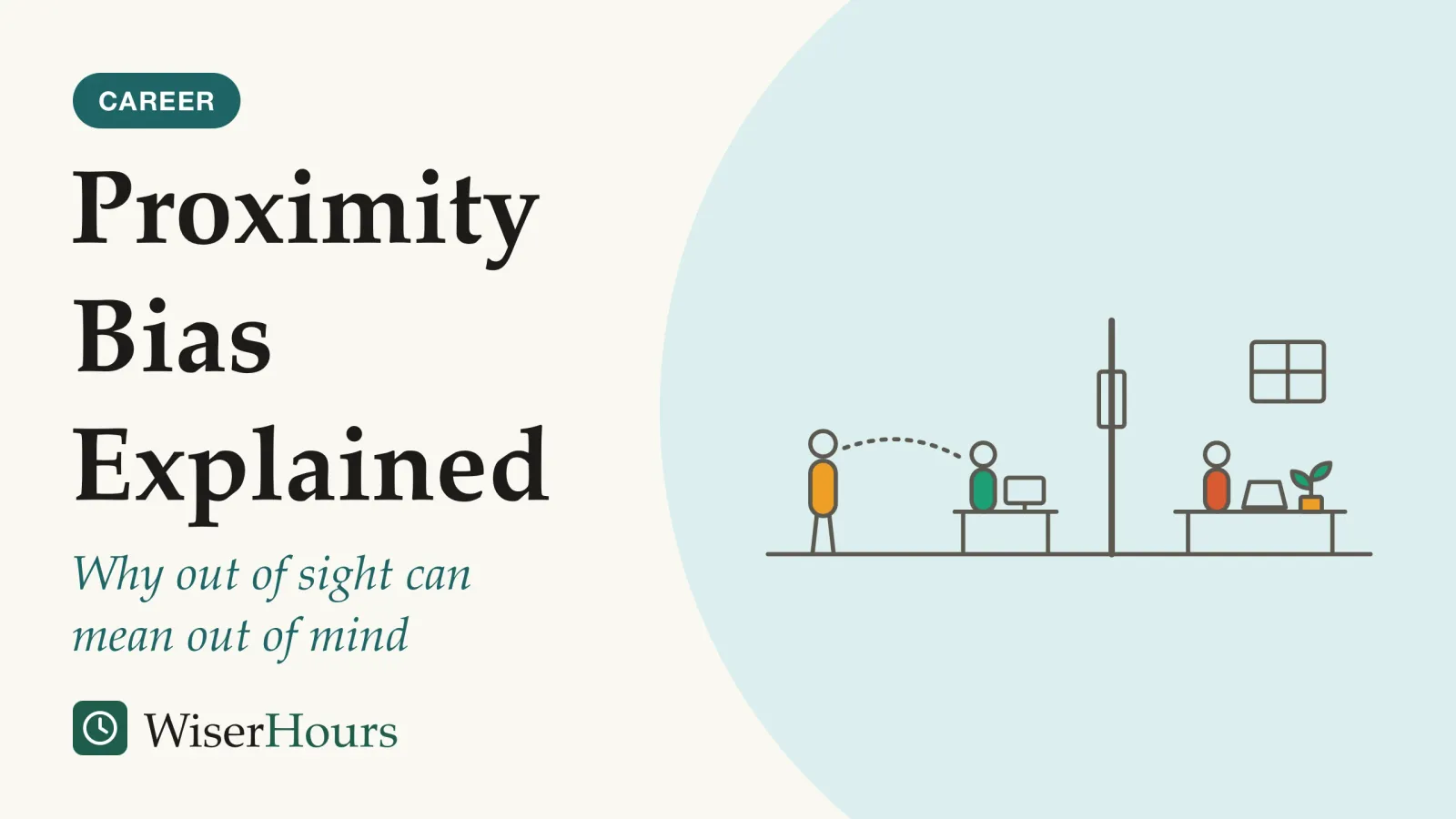
Consider two analysts on one team who close the same number of cases each month. One sits a few desks from the manager and is often seen there early; the other works from home in another city. When a team-lead role opens, the manager thinks first of the one down the corridor, and nobody has decided to be unfair. (The two are an illustration, not a real case.)
That pull has a name. Proximity bias is the tendency to rate, reward and include the colleagues we see in person more favorably than those we do not, even when the work is the same. In a randomized trial at the Chinese travel agency Ctrip, call-center staff sent home to work performed better, yet were promoted less often once that performance was taken into account.1
What helps, on the evidence so far, is changing what decisions rest on rather than trying to change how people see. Managers can judge everyone from a written record of results, read before anyone is discussed, and hand out feedback, mentors and stretch work on purpose instead of to whoever is nearby. Remote staff can agree with their manager which results count and how they will be reported, and ask more colleagues for input than feels natural. No study has yet tried these moves as a cure; the sections below show what each rests on.
The labels themselves, and how remote, hybrid and distributed work differ, have their own guide. This article stays with one question: how being out of view changes the way people are judged.
Proximity bias has an older research name: passive face time
Proximity bias is mainly a workplace label, not a research measure. Researchers study the same pull as passive face time: in Kimberly Elsbach, Daniel Cable and Jeffrey Sherman’s 2010 studies in Human Relations, simply being seen at work, with no conversation at all, seemed to shape the traits colleagues attributed to a person.2
Proximity bias, in one line
Proximity bias is the tendency to judge, reward and include colleagues you see in person more favorably than those you do not, for the same work.
The researchers began by interviewing 39 managers from 30 corporate offices in Northern California, in the US, and found two kinds of face time. Being seen at work during normal hours was read as a sign that someone was dependable; being seen outside normal business hours, as a sign of commitment. A follow-up experiment with 60 working professionals suggested these impressions form spontaneously: people make them without intending to, and without knowing they have. Both samples are small and American, and the interviews rest on managers’ recollections.2
Psychologists call this kind of process spontaneous trait inference, and the authors place face time within it: an observer who sees behavior quietly converts it into a trait. The managers they interviewed hinted at why: much of the work they judged was hard to see, and presence stood in as evidence of effort.2 A manager rarely sees the quality of someone’s thinking, but does see who is at their desk at 7 in the evening.
Picture that manager at appraisal time. “Committed” comes to mind for the person seen late, while a remote colleague who shipped the same work at the same hour leaves no such memory. Neither impression was chosen. A better question for a manager is not “Am I biased?” but “What will I be looking at when I decide?”
Better work, fewer promotions: the Ctrip trial
The clearest test of proximity bias comes from a trial that was not designed to find it. At Ctrip, now Trip.com, Nicholas Bloom, James Liang, John Roberts and Zhichun Jenny Ying randomly assigned call-center volunteers to work from home or in the office, then tracked their performance and, later, their promotions.1
The study
Moderate evidence
Nine months of home working at a Shanghai call center (Ctrip, 2010-12)
Over the nine-month experiment, performance among home workers rose by 13 percent, mostly because they worked more minutes per shift. Promotions told a different story. Once performance was taken into account, working from home was linked to a promotion rate about 50 percent lower, a result that passed only the loose 10 percent test of statistical significance.1
In plain terms, the home workers did more and were rewarded less. The authors offered explanations without separating them. One is “out of sight, out of mind”: supervisors noticed home workers’ performance less, a pattern employees and managers described in focus groups, and one reason some staff chose to return to the office. Another is that home workers had fewer chances to build the people skills that team-leader jobs need.3 The 2015 journal version adds a third: some home workers may not have wanted a promotion that meant returning to the office.1
The result has limits. It comes from one firm, from volunteers, and from call-center work, where output is counted to the minute. James Liang, a co-author, co-founded Ctrip, chaired it during the experiment and held extensive shares in it; the journal version was co-funded by the US National Science Foundation and the Toulouse Network for Information Technology, which Microsoft supports, and took no money from Ctrip.1 A later trial at the same firm tested two home days a week, and its results appear in the piece on what return to office mandates cost employers. Whether remote workers in general are promoted less is a wider question, studied mostly with observational data.
The striking part is where the gap appeared. Ctrip measured each person’s calls precisely, so the record existed, and the promotion gap opened anyway. Measuring work is not enough: the record has to be in front of the people deciding, at the moment they decide.
Distance also changes who asks for help
Being far away changes who asks whom for help, not only how people are judged. In a preprintpreprint: A research paper posted publicly before it has been peer reviewed or published in a journal; in economics and finance the same stage is usually called a working paper. Its findings may change, or fail to hold up, by the time it is published.Full entry in the glossary by Natalia Emanuel with Emma Harrington and Amanda Pallais on software engineers at a US online retailer, engineers who lost proximity to their teammates received less feedback on their code, and women stopped asking as many colleagues for it.4
When their teammates were no longer nearby, women received feedback from about 15 percent fewer people, while men’s range of reviewers barely changed. The authors read this as women being more reluctant to ask for feedback remotely; across all engineers, sitting near teammates made quick follow-up questions easier. The version we read is the June 2026 revision; the Quarterly Journal of Economics has since published the study, and the firm supplied the data.4
So “out of mind” runs both ways. The manager thinks of remote colleagues less, and remote colleagues, especially newer ones, reach out less. Consider a junior designer at home who is unsure about a layout. In the office she would have turned her screen toward a neighbor; at home, messaging a busy senior feels like an imposition, so she guesses, and the senior never learns what she can do.
Managers’ doubts add a third layer. In Microsoft’s 2022 Work Trend Index, 87 percent of employees said they were productive, while 85 percent of leaders said hybrid work made it hard to be confident that employees were. That is company research: a survey of 20,006 knowledge workers in 11 countries, run by Edelman Data and Intelligence for Microsoft, which sells workplace software, and not peer reviewed.5 The doubt sits in leaders’ view of the work, which is exactly where proximity bias operates.
- Being seen: in one small US study, office workers seen at work in normal hours were read as dependable, and those seen outside them as committed, without anyone deciding to judge them
- Asking nearby: engineers who lost proximity to teammates received less feedback on their work, and women asked fewer colleagues for it
- Only the record travels: in a randomized trial in China, home workers were promoted less often than office workers with the same measured performance
For remote staff, the practical point is to ask more people, more explicitly, than feels natural: name the person and the question rather than posting to a channel and hoping. For managers, it is to route feedback and stretch assignments on purpose, rather than to whoever happens to be nearby.
When the out-of-sight penalty is weaker
Being remote does not always count against people. Ravi Gajendran and David Harrison’s 2007 meta-analysismeta-analysis: A study that combines the results of earlier studies on the same question into one overall estimate. Pooling makes the estimate more precise, but it cannot repair the studies it pools: a meta-analysis of surveys is still survey evidence.Full entry in the glossary pooled 46 field studies and linked telecommuting to small, mostly beneficial effects, including on job performance, and found no general harm to workplace relationships. Telecommuting on more than 2.5 days in a typical week, though, was linked to worse relationships with coworkers.6
A later field study by the same researchers and Kelly Delaney-Klinger, with employees and their matched supervisors across several organizations, also found telecommuting linked to better performance. That link depended on two features of the setting: the quality of the employee’s relationship with their manager, and signals from coworkers and the supervisor that remote work was normal and appropriate.7 The abstract does not say which way either feature cut, so the study cannot tell a team whether its own setup helps or hurts. Both papers are correlational, and we had their abstracts alone.
- Myth
- Working remotely always hurts how you are rated.
- Fact
- A 2007 meta-analysis linked telecommuting to slightly better performance on average. A later study found the link depended on the manager relationship and on whether remote work was treated as normal.
The lesson is that the team around you matters as much as where you sit. Before you rely on a remote arrangement, ask your manager how results are judged on the team; the manager relationship was one of the two features the link depended on.
What remote workers do to be seen, and what it costs
People far from the managers who assign work tend to compensate, and the compensation can grow into a burden. Ioana Cristea and Paul Leonardi’s 2019 study in Organization Science, of two large, globally distributed product-development companies, found that employees based far from the managers who hand out work, and who signaled commitment in other ways, received better assignments.8
The catch was competition. Because many distant colleagues were sending the same signals, each had to keep sending them, until the behavior felt like sacrificing their personal lives for the job. Meanwhile, the staff at headquarters who handed out the better work did not notice the sacrifice behind the signals.8 The study is qualitativequalitative research: Research that collects words, observations or images, through interviews, focus groups or fieldwork, rather than numbers. It is good at showing how and why people experience something, but it is not designed to say how common that experience is.Full entry in the glossary, and we could not get past its abstract.
As an illustration, think of an engineer several time zones from headquarters who joins every late-evening call to show she is engaged. It works, so she keeps doing it; colleagues do the same, so it stops standing out, and she adds early-morning replies. Headquarters sees an engaged engineer, not the cost.
Signals of this kind have no natural ceiling. A steadier route is to agree with your manager which results matter and how they will be reported, so commitment shows in the work rather than the hours. If sharing those results feels like bragging, see how to get credit for your work without boasting for approaches that tend to land better.
Fixes that change the process, not the people
Tested fixes for proximity bias are scarce. The one randomized trial we found, a Harvard Business School working paper by Prithwiraj Choudhury, Jacqueline Lane and Iavor Bojinov, gave remote summer interns small video sessions with a senior manager, and found no overall difference in job offers or performance ratings.9
In secondary analyses of that 2020 trial, run with 1,370 interns in a large global firm’s North American program, interns whose senior manager matched them in gender and ethnicity, and those invited to more sessions, were more likely to receive offers.9 Subgroup results need repeating before anyone relies on them. The paper was funded in part by Harvard Business School and is not yet peer reviewed. On this evidence, contact time with senior people is not a reliable fix by itself.
The rest of the evidence points to changing the process rather than the people. Because face-time impressions form spontaneously, Elsbach and colleagues advise managers to weigh each person’s output explicitly in evaluations; a written record of results, read before a discussion starts, is one way to do that.2 Because feedback follows proximity, it helps to assign reviewers and mentors deliberately.4 Nobody has yet tested any of these steps as a remedy for proximity bias itself.
Before a review or promotion round
The studies this article leans on, side by side:
| Question asked | Main finding | How it was studied |
|---|---|---|
| Does being seen shape judgments? | Seen at work, people were read as dependable or committed, spontaneously | Interviews with 39 managers plus an experiment with 60 professionals, US2 |
| Does working from home cost promotions? | Home workers performed better but were promoted less, once performance was counted | Randomized trial, one Chinese firm3 |
| Does distance change who gets help? | Less feedback after losing proximity; women asked fewer colleagues | Natural experiment, one US firm, now peer reviewed4 |
| Is remote work always penalized? | Small, mostly beneficial links with performance; harm to coworker ties above 2.5 days a week | Meta-analysis of 46 field studies (abstract read)6 |
| What do remote staff do about it? | Signals of commitment won better work but escalated into sacrifice | Qualitative study, two global firms (abstract read)8 |
| Does video contact with seniors help? | No overall effect; gains in some subgroups | Randomized trial, remote interns, working paper9 |
The bottom line
Proximity bias is less about unfair managers than about how people form impressions: being seen gets read as dependability and commitment, and help flows to whoever is close. The best trial found remote workers doing more and being promoted less, in one firm. Judging people from a written record of their results, not from memory, is the change the evidence supports most directly.
Frequently asked questions
Is proximity bias the same thing as favoritism?
Not quite. Favoritism usually means knowingly preferring someone. In Elsbach, Cable and Sherman's 2010 studies, observers inferred traits such as dependability from a colleague's mere presence at work, and did so without intending to or knowing they had. That is why good intentions alone do not prevent it, and why the evidence points to changing how results reach decision makers.
Can training make managers immune to proximity bias?
We found no trial of bias training aimed at this problem, so nobody knows. Elsbach, Cable and Sherman's 2010 experiment suggests the impressions form spontaneously, which makes awareness alone a weak defense. Changes to the process, such as reviewing a written record of each person's results before discussing them, are easier to check than changes of mind.
Does proximity bias affect hybrid workers as well as fully remote ones?
Probably, though the research rarely separates the two. In Emanuel, Harrington and Pallais's working paper on software engineers at a US retailer, teams split across two buildings a short walk apart lost about as much code feedback as teams several states apart. If small distances matter, hybrid staff who rarely overlap with their manager may face similar risks.
Sources
- Does Working from Home Work? Evidence from a Chinese Experiment. Bloom, N., Liang, J., Roberts, J. & Ying, Z. J. (2015). The Quarterly Journal of Economics, 130(1), 165-218
- How passive ‘face time’ affects perceptions of employees: Evidence of spontaneous trait inference. Elsbach, K. D., Cable, D. M. & Sherman, J. W. (2010). Human Relations, 63(6), 735-760
- Does Working from Home Work? Evidence from a Chinese Experiment (working paper version). Bloom, N., Liang, J., Roberts, J. & Ying, Z. J. (2013). NBER Working Paper 18871
- The Power of Proximity to Coworkers. Emanuel, N., Harrington, E. & Pallais, A. (2023, revised June 2026). NBER Working Paper 31880; published in The Quarterly Journal of Economics, 141(3), 2026
- Hybrid Work Is Just Work. Are We Doing It Wrong? Microsoft (22 September 2022). Work Trend Index special report; survey by Edelman Data & Intelligence
- The good, the bad, and the unknown about telecommuting: Meta-analysis of psychological mediators and individual consequences. Gajendran, R. S. & Harrison, D. A. (2007). Journal of Applied Psychology, 92(6), 1524-1541
- Are Telecommuters Remotely Good Citizens? Unpacking Telecommuting's Effects on Performance Via I-Deals and Job Resources. Gajendran, R. S., Harrison, D. A. & Delaney-Klinger, K. (2015). Personnel Psychology, 68(2), 353-393
- Get Noticed and Die Trying: Signals, Sacrifice, and the Production of Face Time in Distributed Work. Cristea, I. C. & Leonardi, P. M. (2019). Organization Science, 30(3), 552-572
- Virtual Water Coolers: A Field Experiment on the Role of Virtual Interactions on Organizational Newcomer Performance. Choudhury, P., Lane, J. N. & Bojinov, I. (2021, revised 2023). Harvard Business School Working Paper 21-125
How we researched this
In September 2026 we combed Crossref, OpenAlex, the NBER archive and journal sites for trials, field studies and reviews linking face time or physical distance to how workers are judged, and read full texts when they were open. Sources span 2007 to 2026. Limits: we found no study that measures proximity bias itself; for three papers we saw nothing beyond the abstract; and the strongest trial covers one Chinese firm.
Keep reading
Return-to-Office Mandates: What the Research Says About Productivity and Retention
Studies find no clear gain in firm performance after return to office mandates; a 2024 trial found two home days a week cut resignations by a third.
Asynchronous Communication Explained: Working Together Without Being Online Together
Asynchronous communication means replies can wait. Remote work shifted over 61,000 US Microsoft staff toward it, a study estimated. When to write or talk.
Remote, Hybrid, and Distributed Work: What the Terms Actually Mean
Remote vs hybrid work, defined. In the year to August 2026, 26% of US full-time employees were hybrid and 12% fully remote. Why surveys count differently.