Sleep Debt Explained: Can You Really Catch Up on Lost Sleep?
Sleep debt builds night by night. In lab trials, 1 long night or a weekend of lie-ins repaid only part of it. What recovery really takes.

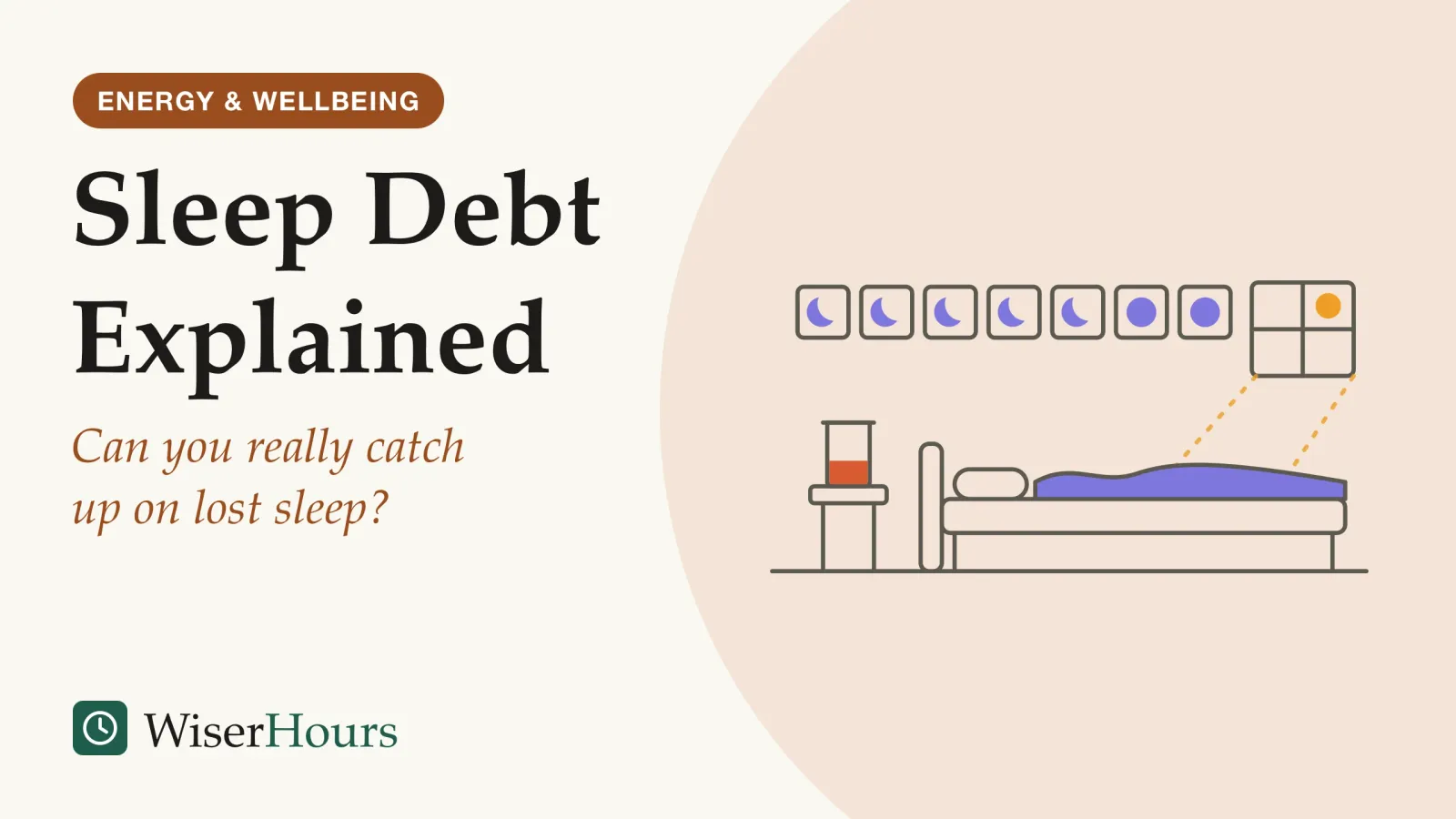
Lost sleep can be paid back, but only in part, and more slowly than a long lie-in suggests. Sleep debt is the shortfall that builds when you sleep less than you need, night after night. In lab research it adds up, it affects you more than you feel, and one long night does not clear it.
In two randomized lab trials in healthy adults (2010 and 2019), neither one long night nor a free weekend of extra sleep fully undid several nights of short sleep. What the evidence points to is less dramatic: stop the debt growing, add sleep through earlier bedtimes over several nights rather than one long lie-in, and keep your weekend alarm within about an hour of your weekday one.
Sleep debt adds up, and feeling fine is a poor gauge
Sleep debt behaves like a running total: each short night adds to it, and the cost shows up in performance before it shows up in how tired you feel. A 2003 University of Pennsylvania lab study tested this by randomly assigning healthy adults to between 4 and 8 hours in bed a night for two weeks.
People kept to 6 hours or less a night built cognitive deficits that grew across the fortnight until they matched up to two nights with no sleep at all. Their sleepiness ratings told a different story: they rose in the first days, then barely moved, and they did not clearly separate the two restricted groups. In the study’s model, lapses in alertness rose almost in a straight line with every hour people spent awake beyond about 16 a day, however they lost the sleep, and the authors suggest thinking of sleep debt as extra wakefulness whose cost accumulates.1 A nightly target is a better guide than feeling fine; how much sleep adults need and how to keep a steady schedule sets one out.
Think of a week of late project nights: nothing dramatic happens on any one day, but each late night adds to the tab your attention pays. The caveat: a small group of young adults over two weeks, so the study describes a stretch of short nights, not years of them.
The lesson for your own week: judge sleep debt by the hours you actually slept, not by how alert you feel this morning.
One long night helps, but it does not clear the tab
A single long night of recovery sleep improves alertness after several short nights but does not fully restore it, according to a 2010 University of Pennsylvania trial that gave people randomly chosen amounts of recovery sleep. The more sleep they got, the more they recovered.
In that trial, adults spent a working week on 4 hours in bed a night and were then given one recovery night of anywhere from no sleep to 10 hours in bed. Even the longest recovery night left attention lapses, sleepiness and fatigue short of where people started. The recovery sleep itself points the same way: after the longest night, total sleep and the intensity of deep sleep were still above people’s baseline, which the authors read as raised sleep pressure.2
In a 2003 Walter Reed Army Institute of Research study, people who spent a week on moderately short nights showed no clear recovery in reaction speed after three normal nights; the authors proposed that the brain adapts to steady restriction by holding performance at a lower level.3 A 2021 Rush University study found that most measures recovered after the first long recovery night, but vigilance lapses and reaction speed had still not fully recovered after four.4 Sustained attention is the slow part, and a long drive or a detailed review depends on it.
Sleep debt and the weekend lie-in: what a trial found
A weekend of unlimited sleep repaid only a small part of a workweek of short nights in a 2019 University of Colorado randomized trial, and it did not protect weight or blood-sugar control once the short nights resumed.
The study
Limited evidence
A free weekend after a short-sleep week, tested in a sleep lab
After a simulated workweek of short nights, people allowed to sleep as long as they liked over a weekend slept only about 1.1 hours more than their usual need across three nights, against more than 12 hours lost. On Sunday night they slept less than usual. After two more short nights, their weight gain matched that of a group that never got a weekend, and their insulin sensitivity was lower than at the start.5
Part of the reason is timing: sleeping in pushed people’s body clocks later. On Sunday they went to bed at about their usual time but had to rise early for Monday, so they slept less than usual, and the early alarm was more likely to fall in their biological night. The main caveat is the sample: lean, healthy young adults in a lab with free access to snacks, and insulin sensitivity is a marker of diabetes risk, not the disease. Earlier trials with fixed recovery schedules found mixed metabolic effects, so this is one careful test rather than a settled answer.5
Outside the lab, the same week looks like this: a late Friday, two long mornings, then a usual Sunday bedtime before an early Monday alarm. Researchers call the gap between the timing your body clock prefers and the timing your job imposes social jet lag, a term from a 2006 Munich study, which found that people with late body clocks build up sleep debt on workdays and compensate on free days.6
- Weeknights: each short night leaves a gap below your usual need (coral), and the gaps add up
- Friday and Saturday: longer sleep repays part of the total (green), but less than was lost
- Sunday: bedtime comes no earlier while Monday's alarm is early, so the night falls short again
- Monday: the new week starts with debt still owed and a body clock that has drifted later
Dashed line: your usual sleep need. A schematic of the pattern in a 2019 lab trial, not measured values.
The National Heart, Lung, and Blood Institute (NHLBI), a US government agency, advises keeping the difference between weekday and weekend sleep schedules to about an hour, because staying up late and sleeping in late can disrupt the body clock.7 That fits the Colorado result: if you need more sleep at the weekend, an earlier bedtime stays within that advice in a way a late lie-in does not.
- Myth
- You can sleep in at the weekend and cancel out the week's short nights.
- Fact
- In a 2019 lab trial, a weekend of extra sleep repaid only part of a workweek's debt and moved the body clock later, so the next week began on a short night.
How to pay down sleep debt without paying for it on Monday
Three habits and a rule for naps follow from the lab trials above and the NHLBI’s general advice, though no trial has tested them as a recovery plan.
- Stop the debt growing first. In the Pennsylvania model, the cost rose with every extra hour awake, so each earlier night keeps the tab from growing instead of leaving it all for the weekend.1 A small 2009 Army trial even found that a week of extra sleep beforehand softened the effect of a later run of very short nights.8
- Spread recovery over several nights. One recovery night did not restore everything in the Pennsylvania trial, so a few earlier bedtimes match the evidence better than one very long sleep.2
- Keep weekend wake-ups within about an hour of weekday ones, as the NHLBI advises.7
- Keep naps short. The NHLBI advises adults to nap for no more than 20 minutes, and people who have trouble falling asleep at night to nap less or earlier in the afternoon.7
New parents, shift workers and carers often cannot choose their nights, so treat these steps as aims, not a standard to fail. The NHLBI gives shift workers separate advice, such as naps and fewer shift changes.7 When a debt is unavoidable, postpone long drives and safety-critical work where you can.
A worked example
After a week of short nights, go to bed earlier on Friday, Saturday and Sunday instead of sleeping late, keep Saturday’s alarm within about an hour of your weekday one, and expect Monday to be your first normal day rather than a fully recovered one.
Do people who catch up at weekends live longer? The evidence is split
Long-term studies disagree on whether weekend catch-up sleep is linked to a longer life. Among adults under 65, a 2019 Swedish cohort found no clear difference in death rate between short weekday sleepers who slept longer at weekends and steady medium sleepers, unlike people who slept short all week; a 2024 UK study using wrist devices found no link between catch-up sleep and death.
The Swedish study, from the Karolinska Institute, followed tens of thousands of adults who in 1997 answered a survey at a charity walk; in that age group, short sleep on both workdays and days off went with a higher death rate during follow-up than medium sleep throughout. For this age group the paper reports only relative rates, so the absolute size of the difference is unclear. The authors call their catch-up reading speculative, and sleep was self-reported only once, at the start. Picture a colleague who runs short on weeknights and sleeps late on Saturdays: the data cannot tell whether her lie-ins repair anything or whether she is simply someone who sleeps well whenever work allows.9
Both newer studies followed large samples of UK adults who wore wrist monitors; in the 2026 study their average age was in the early sixties. The 2024 analysis found weekend catch-up sleep was not linked to death or heart disease, including among short weekday sleepers. Its authors note that this does not fit earlier recommendations by sleep authorities.10 One is a 2023 consensus statement from the US National Sleep Foundation, whose expert panel concluded that regular sleep timing matters for health but that catch-up sleep on non-work days may be beneficial when weekday sleep falls short.11 The 2026 analysis tracked night-to-night sleep over up to a week of wear instead: people whose sleep dropped well below their estimated need without a longer night afterward had a higher death rate, while those who had a rebound night showed no clear difference from regular sleepers.12
These are observational studiesobservational study: A study in which researchers record what people already do or are exposed to, rather than assigning anyone to anything. It can show that two things go together, not that one causes the other, because the groups being compared may differ in other ways as well.Full entry in the glossary, so none can show that sleeping in causes better health, and they measured different things: a survey gap between workdays and days off, a device-measured weekend gap, or a rebound the very next night.
The practical reading: use catch-up sleep as damage control, not as a plan. The trials show it repays only part of the debt, and the long-term studies cannot promise it protects you.
Further reading
Life Time: Your Body Clock and Its Essential Roles in Good Health and Sleep
An Oxford body-clock researcher on how circadian timing shapes sleep, and why late weekends and early Mondays leave people short.

As an Amazon Associate WiserHours earns from qualifying purchases.
Lab trials and long-term studies, side by side
The lab evidence that recovery is slower than it feels is consistent but comes from lab studies of healthy, mostly young adults; the evidence on long-term health is observational and mixed.
| Question | What the best evidence found | Evidence |
|---|---|---|
| Does short sleep add up? | Two weeks of 6 hours or less in bed built deficits matching up to two sleepless nights, while sleepiness ratings barely rose | Trial (lab, 48 adults), limited1 |
| Does one long night repay it? | Up to 10 hours in bed after 5 nights of 4 hours left attention lapses, sleepiness and fatigue short of baseline | Trial (lab, 159 adults), moderate2 |
| Do several normal or long nights? | Some deficits remained after three 8-hour nights, and vigilance lapses after four 12-hour nights | Lab studies, limited34 |
| Does a weekend lie-in? | Part of a workweek’s loss repaid; body clocks moved later; weight and insulin sensitivity not protected | Trial (lab, 36 adults), limited5 |
| Is catch-up sleep linked to a longer life? | Linked in a Swedish survey cohort; no link, or a link only with next-night rebound, in two UK device studies | Observational, mixed91012 |
Use the first four rows to plan a recovery week; the last row is the reason to treat a lie-in as a stopgap rather than a health habit.
When sleep debt needs more than an early night
A drowsy driver should stop at once, possible signs of a sleep disorder deserve a doctor’s appointment soon, and everyday sleepiness can wait for a routine visit. The ranking is ours, drawn from US CDC and NHLBI advice.
- Now: stop driving if you feel drowsy. In a 2009-2010 CDC survey of adults in 19 US states and Washington, DC, about 1 in 25 said they had fallen asleep while driving in the past month, more often among people who usually slept 6 hours or less.13 Warning signs listed by the National Institute for Occupational Safety and Health (NIOSH), part of the US CDC, include heavy eyelids or frequent blinking, being unable to recall the last few miles, and wandering across lane lines or onto a shoulder rumble strip.14 NIOSH’s advice is to leave the road at the next exit or at a rest area; if you cannot stop for long, even a 15- to 20-minute nap can help, and caffeine is only a temporary aid, never a replacement for sleep.15 Anyone who drives or operates machinery for work has the most at stake.
- Soon: book a doctor’s appointment if you often snore loudly, stop and start breathing in your sleep, or gasp for air, which the NHLBI lists with daytime sleepiness as symptoms of sleep apnea.16 Trouble sleeping even when you have the time may point to one of the types and causes of insomnia rather than to debt.
- Routine: if you are often sleepy in the day or rarely wake refreshed, the NHLBI says to mention it to a doctor, and suggests considering a sleep diary for a few weeks beforehand.17
The bottom line
You can repay sleep debt, but not hour for hour and not in one weekend. In the lab studies above, sustained attention was the slowest thing to come back. Stop the debt growing, add sleep through earlier bedtimes over several nights, and keep your weekend alarm close to your weekday one.
This article is general information, not medical advice. If you're worried about your health, talk to a doctor or another qualified professional.
Frequently asked questions
Can you bank sleep before a short week?
Possibly, according to one small lab study. In a 2009 Walter Reed Army Institute of Research trial, 24 healthy adults randomly assigned to a week of 10 hours in bed, rather than their usual amount, had fewer attention lapses during a following week of severely short nights and recovered faster afterward. Their sleepiness ratings were similar in both groups, and the study was run only in the lab.
How can you tell if you are carrying sleep debt?
Count hours rather than trusting how you feel, because in lab studies people's sleepiness ratings lagged behind their falling test scores. The US National Heart, Lung, and Blood Institute suggests considering a sleep diary kept for a few weeks, noting sleep and wake times, naps and how alert you feel. Sleeping much longer on free days than on workdays is another pattern researchers read as catching up.
Is it bad to sleep 10 hours on a day off?
Among adults under 65 in a 2019 Swedish cohort study, which asked about workdays and days off separately, usually sleeping 9 hours or more on days off was not linked to a higher death rate. Sleeping 8 hours or more on both was linked to a somewhat higher rate, given only in relative terms. A long lie-in can still push your body clock later, so the US NHLBI suggests keeping weekend schedules within about an hour of weekday ones.
Sources
- The cumulative cost of additional wakefulness: dose-response effects on neurobehavioral functions and sleep physiology from chronic sleep restriction and total sleep deprivation. Van Dongen, H. P. A., Maislin, G., Mullington, J. M. & Dinges, D. F. (2003). Sleep, 26(2)
- Neurobehavioral dynamics following chronic sleep restriction: dose-response effects of one night for recovery. Banks, S., Van Dongen, H. P. A., Maislin, G. & Dinges, D. F. (2010). Sleep, 33(8)
- Patterns of performance degradation and restoration during sleep restriction and subsequent recovery: a sleep dose-response study. Belenky, G., Wesensten, N. J., Thorne, D. R., et al. (2003). Journal of Sleep Research, 12(1)
- Residual, differential neurobehavioral deficits linger after multiple recovery nights following chronic sleep restriction or acute total sleep deprivation. Yamazaki, E. M., Antler, C. A., Lasek, C. R. & Goel, N. (2021). Sleep, 44(4)
- Ad libitum Weekend Recovery Sleep Fails to Prevent Metabolic Dysregulation during a Repeating Pattern of Insufficient Sleep and Weekend Recovery Sleep. Depner, C. M., Melanson, E. L., Eckel, R. H., et al. (2019). Current Biology, 29(6)
- Social jetlag: misalignment of biological and social time. Wittmann, M., Dinich, J., Merrow, M. & Roenneberg, T. (2006). Chronobiology International, 23(1-2)
- Sleep Deprivation and Deficiency: Healthy Sleep Habits. National Heart, Lung, and Blood Institute, National Institutes of Health (last updated 24 March 2022)
- Banking sleep: realization of benefits during subsequent sleep restriction and recovery. Rupp, T. L., Wesensten, N. J., Bliese, P. D. & Balkin, T. J. (2009). Sleep, 32(3)
- Sleep duration and mortality: Does weekend sleep matter? Åkerstedt, T., Ghilotti, F., Grotta, A., et al. (2019). Journal of Sleep Research, 28(1)
- Device-measured weekend catch-up sleep, mortality, and cardiovascular disease incidence in adults. Chaput, J.-P., Biswas, R. K., Ahmadi, M., et al. (2024). SLEEP, 47(11)
- The importance of sleep regularity: a consensus statement of the National Sleep Foundation sleep timing and variability panel. Sletten, T. L., Weaver, M. D., Foster, R. G., et al. (2023). Sleep Health, 9(6)
- Acute sleep rebound following sleep restriction is associated with reduced mortality risk. Li, X., Zhang, M., Li, Z., et al. (2026). Nature Communications, 17, 3820
- Drowsy Driving — 19 States and the District of Columbia, 2009–2010. Wheaton, A. G., Chapman, D. P., Presley-Cantrell, L. R., Croft, J. B. & Roehler, D. R. (2013). Morbidity and Mortality Weekly Report, 61(51), Centers for Disease Control and Prevention
- Module 11. Driving, Warning Signs. National Institute for Occupational Safety and Health, CDC (last reviewed 31 March 2020)
- Module 11. Driving, Preventing Crashes. National Institute for Occupational Safety and Health, CDC (last reviewed 31 March 2020)
- Sleep Apnea: Symptoms. National Heart, Lung, and Blood Institute, National Institutes of Health (last updated 9 January 2025)
- Sleep Deprivation and Deficiency: Diagnosis. National Heart, Lung, and Blood Institute, National Institutes of Health (last updated 30 July 2026)
How we researched this
Lab trials of sleep restriction and recovery, cohort studies of weekend catch-up sleep and public-health advice were gathered from PubMed, Europe PMC and NHLBI, CDC and NIOSH pages in September 2026. Of the ten studies, published between 2003 and 2026, seven were available to us in full text and three only as abstracts. The recovery trials are short lab studies in healthy, mostly young adults; the long-term evidence is observational.
Keep reading
Sleep Trackers: How Accurate Are They, and What Can They Tell You?
A 2025 review of 24 studies found wrist trackers misjudge sleep and wake time. What trackers get right, what they miss, and which symptoms need a doctor.
How Late Is Too Late for Coffee? Caffeine's Half-Life and Your Sleep
Caffeine's half-life is about 3 to 7 hours in adults, so an afternoon coffee is still working at bedtime. How dose, timing and your body set your cutoff.
Insomnia Explained: Types, Common Causes, and When to See a Doctor
Insomnia is trouble sleeping when you had the chance to sleep. What the 3-night, 3-month line means, what causes it, and when to see a doctor.
Chronotypes Explained: Are You a Lark, an Owl, or Somewhere in Between?
Most people are neither larks nor owls. How chronotypes are measured, what 351 gene regions, age and light do to them, and what owl headlines omit.