The Coffee Nap: Does Caffeine Before a Short Nap Work?
A coffee nap is a cup of coffee before a 15-20 minute nap. Small lab studies favor it; a 2026 US guideline rates the evidence very low certainty.
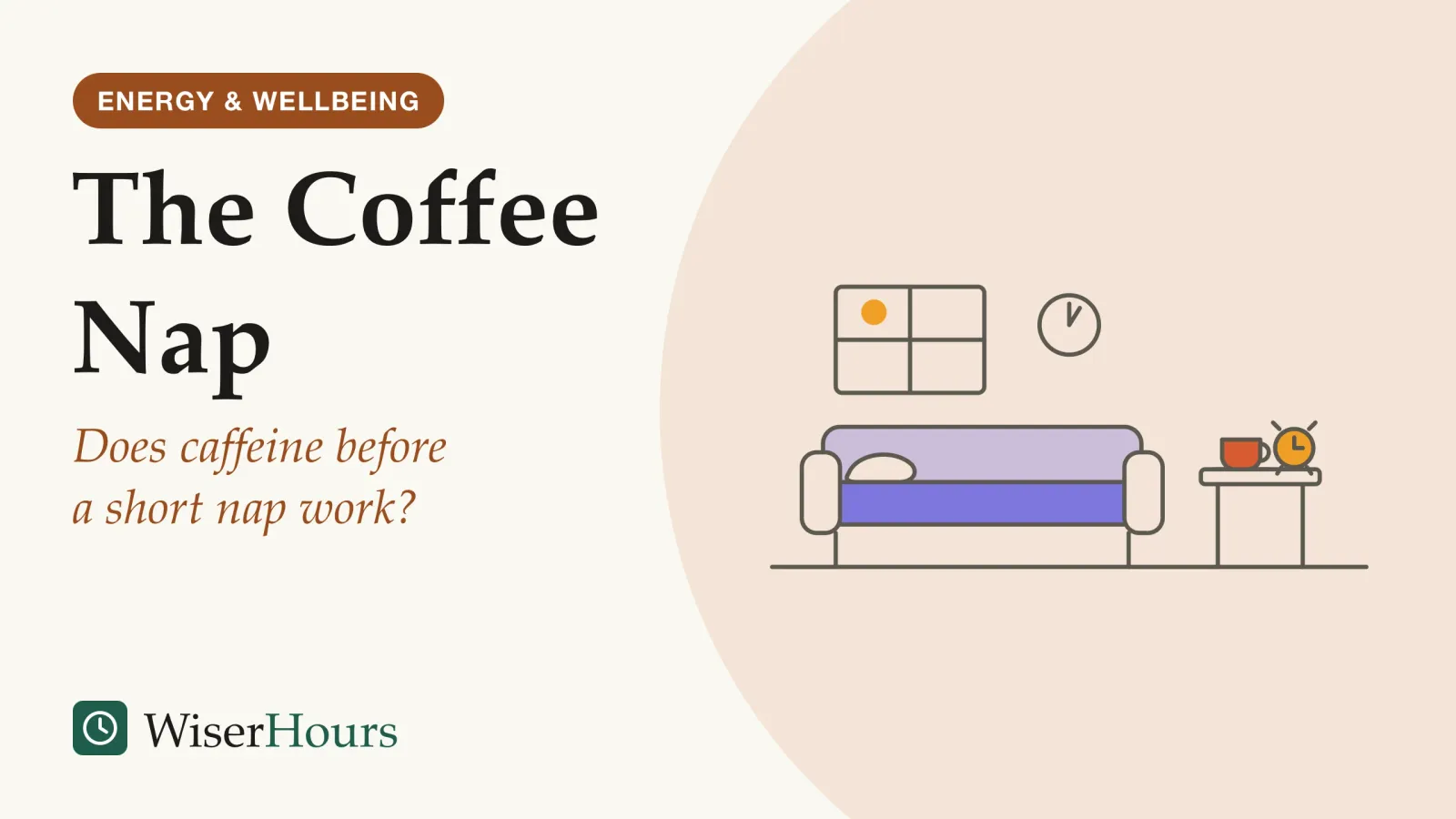
A coffee nap runs in what sounds like the wrong order: you drink a cup of coffee, lie down straight away for a short nap, and get up just as the caffeine starts to work. In small lab studies in the UK and Japan, adults who did this when sleepy were more alert afterwards than after a placebo, and usually more than after coffee or a nap alone.12
The strongest verdict so far is cautious. A 2026 US guideline from the American Academy of Sleep Medicine (AASM) suggests a nap plus caffeine before night shifts for sleepy adults with shift work disorder, and calls that evidence very low in certainty.3
The method is worth trying on a sleepy afternoon if caffeine suits you and the hour is early. The routine has five steps:
- Pick an early-afternoon slot and a safe place to lie down.
- Drink your usual coffee quickly.
- Lie down at once and set an alarm for about 20 minutes.
- Get up into bright light and move.
- Wait a few minutes before driving or anything risky.
It can give a short lift, does not make a drowsy drive safe, and counts for far less than the everyday habits behind better sleep.
What is a coffee nap, and why does the order matter?
A coffee nap, also called a caffeine nap, is caffeine taken just before a short sleep, so that the nap ends at about the time the caffeine takes hold. The timing rests on a delay: caffeine takes roughly 30 minutes after a drink to reach the central nervous system, according to a 2022 review in the Journal of Sleep Research.4
The method uses that gap. A coffee finished at half past one does little while you doze, and its caffeine starts reaching the brain soon after the alarm goes 20 minutes later. You wake with a nap and a coffee behind you instead of choosing between them.
The nap is kept short for a second reason. Grogginess after waking, which researchers call sleep inertia, is less likely after naps of half an hour or less, perhaps because deep sleep typically begins about half an hour in, a 2019 review of sleep inertia research says. The same review says caffeine taken before a short nap appears to be the most effective step against that grogginess that can be planned in advance.5
- The cup: a coffee finished quickly, then straight to the sofa or bed
- The alarm: about 20 minutes later, before deep sleep usually begins, which a 2019 review puts at about 30 minutes into sleep
- Caffeine arrives: it reaches the brain about 30 minutes after a drink, a 2022 review says
- The peak: caffeine reaches its highest level in the blood within an hour, says the US National Library of Medicine
- The rising line: a sketch of this timing, not measured data
Finish the coffee quickly, then, so the cup and the alarm start the same clock.
Why caffeine and a short nap might work together
Caffeine and sleep act on the same signal. Adenosine is a brain chemical thought to build up during long stretches awake and add to the pressure to sleep, and caffeine blocks the receptors it acts on. A popular explanation adds that the nap clears adenosine and frees more receptors for the caffeine, but no study cited here has measured that in people. The 2022 review is cautious about adenosine itself: in studies of rats and mice, levels around brain cells shifted within minutes, so the authors doubt it explains ordinary day-to-day sleepiness, though it may matter after unusually long spells awake.4
- Myth
- A coffee nap works because the nap flushes adenosine out of your brain.
- Fact
- That is a plausible guess no coffee-nap study has measured in people. The trials show the combination helped sleepy adults, without showing why.
The mechanism matters less to you than the timing it suggests: get the caffeine in before you lie down, and keep the nap short enough that you wake as it takes hold.
Does a coffee nap really work? What the driving studies found
Much of the evidence comes from the Sleep Research Laboratory at Loughborough University in the UK, where Louise Reyner and Jim Horne tested sleepy drivers in a car simulator in the 1990s. Their 1997 study tested the combination directly.
The study
Limited evidence
Reyner and Horne (1997): caffeine plus a short nap before a simulated drive
Twelve sleepy people took a 30-minute break before a 2-hour monotonous afternoon drive in a car simulator. The break held caffeine combined with a short nap, 200 mg of caffeine alone, or a placebo. The combination cut driving incidents to 9% of the placebo level, against 34% for caffeine alone, and removed the mid-afternoon peak in sleepiness. Naps in which people only dozed, without falling properly asleep, still helped.1
That is a large effect, but it was measured in a dozen people in one laboratory, on a simulator, and this article could not obtain more than its summary. It did not test a nap alone. The team’s 1996 study did: a short nap and a coffee each reduced driving impairment in sleepy volunteers, while a break with a placebo coffee did not help.6
The result supports one specific use: a planned break on a sleepy afternoon, before about two hours of a dull task. It says nothing about the hours after that, or about people who are still sleepy when they wake.
Afternoon and night-shift studies point the same way
At a desk, a 2003 study at Hiroshima University in Japan, funded by the Japanese education ministry, tested the idea after lunch. Ten healthy young adults were tested under five conditions, four of them with a 20-minute nap early in the afternoon, and caffeine before the nap came out best for sleepiness and task performance, with the benefit lasting through the hour of testing after waking. A minute of bright light straight after the nap came close on sleepiness.2
Night work has its own small trials. A 2006 US study found that an evening nap and nightly caffeine each improved alertness on simulated night shifts, with the combination best; in its field arm, night-shift workers given both performed better and felt less sleepy than on placebo.7 A 2020 Australian pilot study of six people found that after a caffeine nap in the middle of the night, attention and fatigue were better on waking than after decaf.8
Thin evidence of this kind is why the AASM grades its advice so cautiously. Its 2026 panel found a single randomized trial, run in a lab and in the field, of a nap plus caffeine before night shifts, and judged the certainty very low. Its recommendation also leaves open whether the coffee comes first.3
The newest test is less encouraging for one group. In a 2026 Loughborough study funded by the UK’s Road Safety Trust, drivers with treated obstructive sleep apneasleep apnea: A condition in which breathing repeatedly stops and starts during sleep, often with loud snoring, gasping and daytime sleepiness. It needs a sleep test and a doctor to diagnose; a phone or watch alert can prompt a test but cannot rule it in or out.Full entry in the glossary got some temporary benefit from a coffee nap but little practical gain over the same coffee without the nap.9
Every sample was small, most volunteers were healthy, and each trial covered one session or a few nights.
How long should a coffee nap be?
About 15 to 20 minutes lying down is the usual advice. Australia’s Sleep Health Foundation, a national sleep charity, describes a coffee followed at once by a nap of about 15 minutes, and suggests 15 to 30 minutes for naps in general.10 The US National Heart, Lung, and Blood Institute (NHLBI), in 2022 advice, puts the upper limit for adult naps at 20 minutes.11
The shorter end fits the coffee, because an alarm at about 20 minutes goes off before the caffeine has fully arrived and before deep sleep becomes likely.5
If you never quite fall asleep, stay put with your eyes closed until the alarm: in the 1997 driving study, naps of light dozing still helped.1
What is the best time for a coffee nap?
Early afternoon suits most people on a daytime schedule. The Sleep Health Foundation says people often feel sleepiest around 2 to 3 p.m.10 If you find it hard to get to sleep at night, the NHLBI suggests limiting naps or moving them earlier.11
The coffee sets a second deadline. The European Food Safety Authority (EFSA), an EU agency, concluded in 2015 that a single 100 mg dose of caffeine may change how long and how well some adults sleep, especially when taken close to bedtime.12 A coffee nap late in the afternoon can buy an alert evening at the cost of a lighter night, and how late caffeine affects sleep explains where to set your own cutoff.
Shift workers turn the clock around. The AASM’s suggestion is for a nap plus caffeine before a night shift, with the warning that caffeine too close to daytime sleep can disturb it.3 A nurse starting a night shift in the evening might fit a coffee nap into the late afternoon, before leaving for work.
How to take a coffee nap
The five steps at the top draw on the trials above and on general napping advice; no trial has compared one version of the routine against another.
1. Pick an early-afternoon slot and a safe place to lie down
Choose a quiet, dark spot at a comfortable temperature, as the Sleep Health Foundation suggests for any nap. In a car, that means parking away from the road, ideally at a rest stop.10
2. Drink your usual coffee quickly
The trials above mostly used 150 to 200 mg of caffeine, roughly one to two cups of instant coffee by the NHS’s estimate of about 100 mg a cup; filter and coffee-shop coffee can contain more.13 These are study amounts, not a dose to aim for. During pregnancy, with a medical condition or alongside other medicines, check with a doctor or pharmacist that caffeine suits you.
3. Lie down at once and set an alarm for about 20 minutes
The alarm protects the short nap the method depends on.
4. Get up into bright light and move
Open the blinds or step outside into daylight. After a nap in a car, the Sleep Health Foundation suggests walking around for 5 to 10 minutes before driving on.14
5. Wait a few minutes before driving or anything risky
The AASM warns that sleep inertia soon after a nap can briefly raise sleepiness and accident risk, and says time for it to pass may be needed before driving or other safety-sensitive tasks.3
Before your coffee nap
Is a coffee nap healthy? Who should skip it
For most healthy adults who already drink coffee, a coffee nap adds nothing new: one ordinary cup and a short nap. EFSA’s 2015 opinion found that single doses of up to 200 mg of caffeine raise no safety concerns for healthy adults, and that in pregnancy intakes up to 200 mg daily from all sources raise none for the fetus.12 The UK’s NHS gives the same daily limit in its 2026 pregnancy advice and links higher intakes to a higher chance of miscarriage and stillbirth.13 Outside the EU and UK, check your national health service’s guidance, and count a coffee nap’s cup in the day’s total.
MedlinePlus, the US National Library of Medicine’s consumer site, lists people who should ask a health care provider whether to limit or avoid caffeine: those who are breastfeeding, and those with insomnia or other sleep disorders, migraines, anxiety, reflux or ulcers, heart rhythm problems or high blood pressure. People taking stimulants, some antibiotics, or medicines for asthma or the heart are on the list too. It adds that children and teens should not have as much caffeine as adults and that sensitivity varies from person to person.15
A coffee nap is also no fix for short nights. The Sleep Health Foundation says a nap cannot replace good sleep at night and is only a short-term solution.10 If you reach for one most afternoons, look at your nights first; how sleep debt builds up and what repays it explains how to make up lost sleep.
On a sleepy drive, a coffee nap buys a short reprieve
A coffee nap is no license to keep driving while drowsy. As of 2026, the UK Highway Code tells sleepy drivers to stop in a safe place, and recommends a break of at least 15 minutes after every two hours of driving.16 Road rules vary by country, so check your local highway code or driving authority.
Once you have stopped, caffeine and a short nap can help for a while. Australia’s Sleep Health Foundation, which calls sleep the best cure for drowsiness, says caffeine may help alertness for an hour or two and that a nap of 15 to 20 minutes may refresh you enough to drive for another couple of hours.14 The authors of the 2026 Loughborough study conclude that every countermeasure they tested was temporary and could not replace a good night’s sleep before driving.9
If you are drowsy again soon after a coffee nap, find somewhere to sleep, hand over the wheel or wait it out, instead of stopping for a second cup.
When sleepiness needs more than a coffee nap
Drowsiness at the wheel calls for stopping at once, regular sleepiness while driving deserves a doctor’s appointment soon, and questions about caffeine and your health suit an ordinary check-up.
- Now: phone your local emergency number if someone is hurt or in danger on the road. If you feel drowsy while driving, stop somewhere safe, as the UK Highway Code advises.16
- Soon: the Sleep Health Foundation advises seeing a doctor if you are regularly drowsy while driving, and notes that people with sleep disorders such as obstructive sleep apnea and narcolepsy have a much higher risk of a crash due to sleepiness.14
- At your next appointment: ask about caffeine during pregnancy or breastfeeding, or if you have a heart rhythm problem, high blood pressure, anxiety or a sleep disorder, or take medicines that may interact with it, as MedlinePlus advises.15
The bottom line
A coffee nap can lift a sleepy afternoon for an hour or two at the cost of one ordinary cup, with small but consistent studies and a cautious US guideline behind it. Try it in the early afternoon with your usual coffee and an alarm set for about 20 minutes, give yourself a few minutes in daylight before you drive, and if you feel drowsy behind the wheel, stop first and plan for proper sleep.
This article is general information, not medical advice. If you're worried about your health, talk to a doctor or another qualified professional.
Frequently asked questions
Does a coffee nap work with decaf?
Nothing suggests it would, because the caffeine is the active part. In a 2020 Australian pilot study of six adults on a simulated night shift, decaffeinated coffee was the placebo, and the version with caffeine came out ahead on attention and fatigue after a 30-minute nap. No study has tested decaf as a coffee nap in its own right.
Can you have a coffee nap with tea or an energy drink?
The studies tested caffeine itself, so the amount matters more than the drink. The UK's NHS estimates about 75 mg of caffeine in a cup of tea against about 100 mg in a cup of instant coffee. MedlinePlus, the US National Library of Medicine's health site, notes that energy drinks vary widely in caffeine and their labels may not show the true amount.
How often can you take a coffee nap?
No study has tested coffee naps taken every day for weeks, so nobody knows. Australia's Sleep Health Foundation says a nap cannot replace good sleep at night and is only a short-term solution, and that long or late naps can make night sleep harder. If you need one most days, look at your nights or talk to a doctor.
Sources
- Suppression of sleepiness in drivers: combination of caffeine with a short nap. Reyner, L. A. & Horne, J. A. (1997). Psychophysiology, 34(6), 721-725
- The alerting effects of caffeine, bright light and face washing after a short daytime nap. Hayashi, M., Masuda, A. & Hori, T. (2003). Clinical Neurophysiology, 114(12), 2268-2278
- Management of shift work disorder: an American Academy of Sleep Medicine clinical practice guideline. Wright, K. P. Jr., Abbott, S. M., Ashbrook, L., et al. (2026). Journal of Clinical Sleep Medicine, 22(1), 202
- Adenosine, caffeine, and sleep-wake regulation: state of the science and perspectives. Reichert, C. F., Deboer, T. & Landolt, H.-P. (2022). Journal of Sleep Research, 31(4), e13597
- Sleep inertia: current insights. Hilditch, C. J. & McHill, A. W. (2019). Nature and Science of Sleep, 11, 155-165
- Counteracting driver sleepiness: effects of napping, caffeine, and placebo. Horne, J. A. & Reyner, L. A. (1996). Psychophysiology, 33(3), 306-309
- Laboratory and field studies of naps and caffeine as practical countermeasures for sleep-wake problems associated with night work. Schweitzer, P. K., Randazzo, A. C., Stone, K., Erman, M. & Walsh, J. K. (2006). Sleep, 29(1), 39-50
- A pilot study investigating the impact of a caffeine-nap on alertness during a simulated night shift. Centofanti, S., Banks, S., Coussens, S., et al. (2020). Chronobiology International, 37(9-10), 1469-1473
- Optimising the caffeine nap for counteracting driver sleepiness in CPAP treated obstructive sleep apnoea patients. Filtness, A. J., Miller, K. A., Maynard, S., et al. (2026). Scientific Reports, 16, 14380
- Napping. Sleep Health Foundation, Australia (fact sheet dated 12 January 2024)
- Sleep Deprivation and Deficiency: Healthy Sleep Habits. National Heart, Lung, and Blood Institute, National Institutes of Health (last updated 24 March 2022)
- Caffeine. European Food Safety Authority (topic page summarizing its 2015 scientific opinion)
- Foods to avoid in pregnancy. NHS (UK), page last reviewed 15 June 2026
- Drowsy Driving. Sleep Health Foundation, Australia (fact sheet dated 2 February 2024)
- Caffeine. MedlinePlus, US National Library of Medicine (last updated 8 September 2021)
- The Highway Code: Rules for drivers and motorcyclists (89 to 102). UK Government, Department for Transport and Driver and Vehicle Standards Agency
How we researched this
Studies were found through PubMed and Crossref in November 2026, with advice from the AASM, NHLBI, MedlinePlus, EFSA, the NHS, the UK Highway Code and Australia's Sleep Health Foundation. We read the 2026 AASM guideline, a 2026 trial and two reviews in full; the five other trials, from 1996 to 2020, were available to us only as abstracts. Main limitation: every coffee-nap trial is small, short and mostly in healthy adults.
Keep reading
Sleep Debt Explained: Can You Really Catch Up on Lost Sleep?
Sleep debt builds night by night. In lab trials, 1 long night or a weekend of lie-ins repaid only part of it. What recovery really takes.
Sleep Divorce: Is Sleeping in Separate Beds Good for Couples?
A sleep divorce means sleeping apart to sleep better. In a 2017 review of 38 studies, partners reported better sleep once a snorer's apnea was treated.
How to Sleep on a Plane, a Train, or in an Unfamiliar Hotel Room
How to sleep on a plane, train or hotel: 6 steps on timing, light, noise, seats and alcohol, plus why long seated trips raise clot risk and what to do.
Sleep and ADHD: Why Winding Down Is Harder and What May Help
ADHD and sleep: a late body clock, a busy mind, stimulant timing, restless legs or apnoea. What a 13-study review measured, and habits that may help.