Panel Interviews: How to Run Them Well
How to conduct a panel interview: 3 to 5 panelists, one chair, question areas split in advance and scores recorded alone.

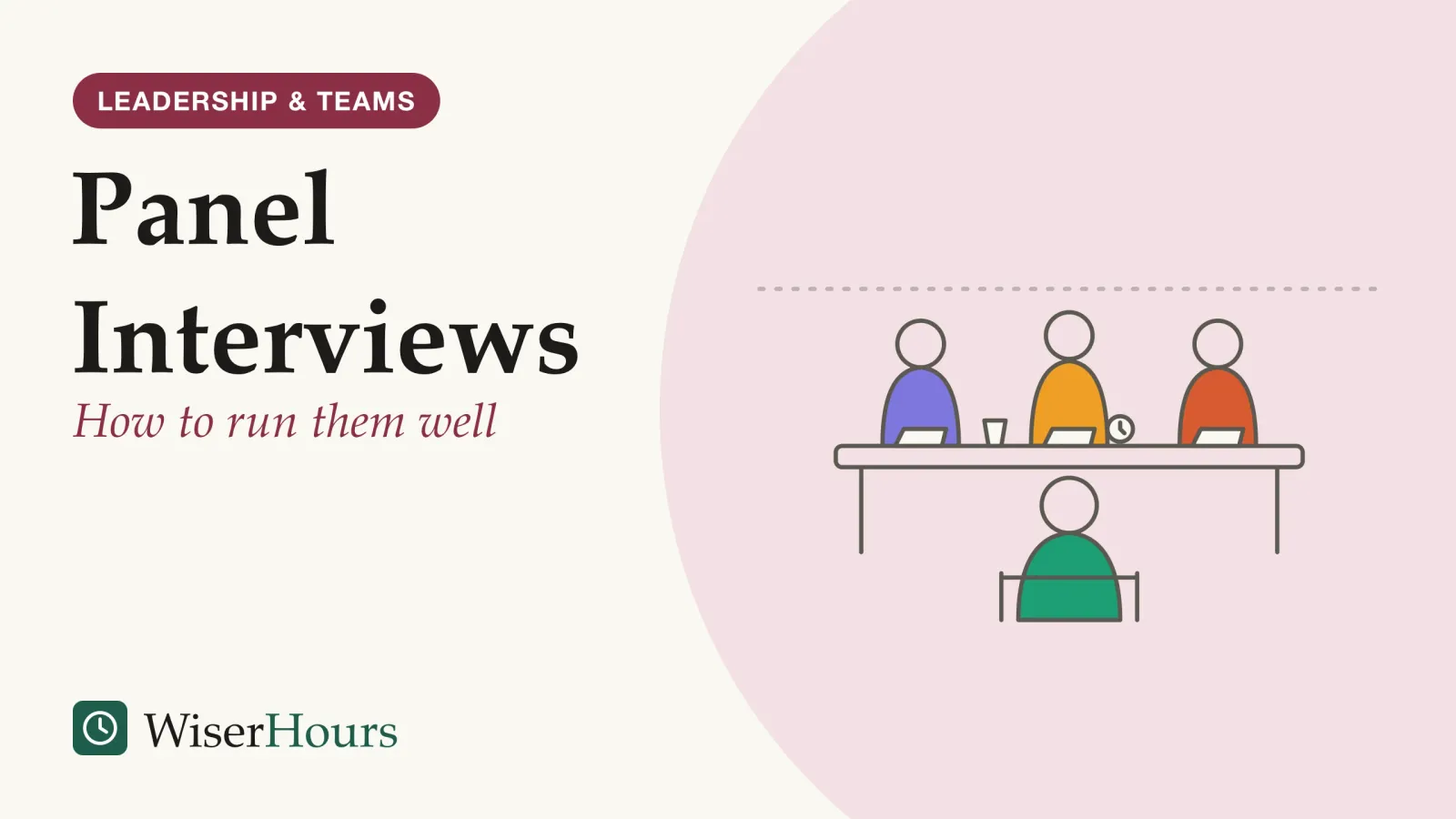
A panel interview is one sitting in which two or more trained interviewers question a candidate together, and each of them scores the answers. More chairs in the room do not, on their own, make the hiring decision more accurate. In a 1999 meta-analysismeta-analysis: A study that combines the results of earlier studies on the same question into one overall estimate. Pooling makes the estimate more precise, but it cannot repair the studies it pools: a meta-analysis of surveys is still survey evidence.Full entry in the glossary of 120 interview studies, Allen Huffcutt and David Woehr found that using a panel of interviewers added nothing to interview validity (how well interview scores predict later performance), and may even have hurt, while training interviewers was worth doing whether or not the interview was structured.1 What a panel can carry is the part that does matter: identical job-related questions for each applicant, plus a score sheet each panelist fills in alone.
How to conduct a panel interview, in short:
- Choose three to five panelists, one of them the chair.
- Agree the questions and the scoring scale before the first interview.
- Give each panelist their own question areas.
- Brief every panelist on the format and the rules.
- Open with introductions and explain the format.
- Keep time and take notes, in the room or on video.
- Close by telling the candidate what happens next.
- Score alone, then hold a short debrief on the gaps.
A panel is one stage in a well-designed hiring process; this guide stays with the panel itself.
Prefer to watch? The video covers the same ground as this article.
Panel or serial: choosing the format
Choose a panel when every interviewer needs to hear the same answers in one sitting, and a serial format, in which the candidate meets interviewers one after another, when separate conversations matter more. OPM, the US federal government’s HR agency, describes panelists in its 2008 structured-interview guide as people who know the job well and are trained to interview, and it allows either format.2
The two formats suit different needs. In a panel, everyone hears the same answer at the same moment, so the scores rest on identical evidence. Separate interviews give each interviewer a conversation of their own. In a 2013 meta-analysis of interviewer agreement, Allen Huffcutt’s team found it considerably higher in panels than in separate interviews. The authors stressed that reliability estimates should count every source of error, including how a candidate’s performance shifts from one occasion to the next, which one panel sitting cannot show.3
A panel also needs every member free in one slot, and a long technical conversation may suit a one-to-one meeting better. Choose the format for practical reasons like these; what the interview measures depends on its questions and scoring.
Are panel interviews better than one-on-one interviews?
Panel interviews are not more accurate than one-on-one interviews just because more people take part. The research on what makes interviews predict job performance points to structure instead: job-based questions asked of everyone and answers scored against set standards. Huffcutt and Woehr’s analysis comes closest to testing the panel itself.
The study
Moderate evidence
Panels, training and note-taking compared across 120 interview studies (1999)
The authors pooled 120 interview studies, with about 18,000 people in all, and tested four interviewer-related practices together. Training interviewers and keeping the same interviewer across all applicants were linked to better prediction; using a panel was not, and may have had a detrimental effect. Results for note-taking were inconclusive.1
The analysis compared existing studies rather than running an experiment, and all of its studies are more than 25 years old, so read it as good guidance rather than settled fact. An earlier meta-analysis backs the point about structure: in 1988, Willi Wiesner and Steven Cronshaw pooled 150 validity results from studies worldwide, comparing panel with individual interviews and structured with unstructured ones, and found structured interviews roughly twice as valid.4
Picture two hiring teams. One sends five managers into a room, each asking whatever occurs to them. The other sends two trained interviewers with a shared question list and a written scale. The second team looks less thorough, but the research suggests it is better placed to choose well.
So start with the questions and the structured interview behind them, then decide who should ask them.
How many people should be on an interview panel?
No study has fixed an ideal panel size. OPM’s guide describes a panel of two or three interviewers as better able than one person to record and interpret what a candidate says, and as a way to reduce the risk of bias in ratings. It adds that a panel allows a diverse range of interviewers, for example by race and sex, and that one member is usually the chair, who handles the arrangements and documents the process.2 Britain’s workplace advice service, Acas, advises having at least two interviewers whenever possible, because it lowers the risk of discrimination.5
Three is a practical default for most roles, and five a sensible ceiling. That is our suggestion rather than a research finding: every extra panelist makes the meeting harder to schedule, leaves less time for each person’s questions and crowds the candidate.
Mix roles as well as people. A panel for a project coordinator might be the hiring manager, a coordinator from the same team and someone from a team the role works with, so each sees a different side of the job.
Diversity on the panel does not replace structure. In one large study by US researchers of police officer applicants interviewed by three-person panels, the racial make-up of the panel showed the largest effect on the ratings applicants received: mostly White panels rated applicants of all races more favorably than mostly Black panels.6 A simple match between interviewer and candidate mattered less. Julia Levashina and three co-authors, in a 2014 review that counts the same police study, found small or no effects of race and gender similarity in rigorously designed structured interviews, including two-, three- and four-person panels.7
- One chair: welcomes the candidate, introduces the panel, explains the format, keeps time and keeps the record
- Question areas assigned in advance: each panelist asks the questions for their area, so nobody improvises or repeats
- A score sheet for everyone: every panelist notes and scores every answer, alone, before any discussion
How to conduct a panel interview, step by step
How to conduct a panel interview comes down to order: questions and roles are settled before the candidate arrives, and scores are settled before anyone talks. The steps follow OPM’s guide and 2026 guidance from two British bodies, the CIPD and Acas.
Agree the questions and the scoring scale before the first interview
Every panelist works from the same written questions and scale. OPM’s guide says each panel member should receive a written interviewer’s guide, and the chair should check before each interview that everyone understands the procedure and has the materials.2 For the questions themselves, see these behavioral interview questions for employers.
Give each panelist their own question areas
The CIPD’s 2026 selection-methods factsheet suggests the panel meet in advance to assign questions to individual members and to take notes independently.8 In the coordinator example, the hiring manager might ask about planning, the peer about teamwork and the partner-team member about keeping other teams informed. Everyone still scores every answer, not only the ones they asked.
Brief every panelist on the format and the rules
Use a short briefing to agree who asks what, how follow-up questions work and which subjects are off limits under equal-treatment law.
Open with introductions and explain the format
The chair's opening, in the order OPM's guide gives it
Welcome the candidate and introduce each panelist. Thank them for coming and describe the job briefly. Explain the format the same way for every candidate, say that panelists will take notes, and ask whether they have questions before you start.2
That opening tells the candidate who to look at, why people are writing and that pauses for notes are normal. Acas’s 2026 guidance notes that in Great Britain the law requires employers to check with every invited candidate whether they need reasonable adjustmentsreasonable adjustments: Changes an employer makes so that a disabled job applicant or worker is not put at a disadvantage, such as extra time in a test or changed hours. Great Britain calls them reasonable adjustments and the US reasonable accommodations; what the law requires depends on the country.Full entry in the glossary to attend, such as a sign language interpreter.5 Ask before the day, wherever you hire.
Keep time and take notes, in the room or on video
The chair watches the clock and hands over between question areas, so the last panelist is not squeezed, and every panelist notes what was said, not how they felt about it. For online interviews, Acas says to run them the same way as in person, check the candidate has the technology needed, have a backup plan for a dropped connection and get the candidate’s permission before recording.5 On video, the chair names who speaks next, and panelists stay muted between turns.
Close by telling the candidate what happens next
Acas lists what to cover at the end: invite the candidate’s questions, say when and how the decision will reach them, explain how to ask follow-up questions and say what feedback to expect.5
Before the candidate walks in
How do you score candidates in a panel interview?
In a panel interview, each panelist scores every answer alone, in writing, against the agreed scale, and hands in the scores before anyone discusses the candidate. The CIPD’s 2026 factsheet gives the reason: discussing candidates earlier makes interviewers more likely to be influenced by each other’s opinions, and potentially by the most senior person present.8
Independence protects the point of having several raters. If the department head says “strong hire” before anyone has written a score, the others hear a verdict before they weigh their own notes, and separate judgments start to collapse into one.
Scoring each answer on its own also guards against the halo effect, which OPM’s guide describes as letting a rating on one competency influence ratings on others: a fluent speaker scored high on problem solving, whatever they said about the problem.2
How you combine the scores matters too. A 1995 meta-analysis by James Conway and colleagues found that multiple ratings made interviews more reliable when combined mechanically, such as by averaging, with no evidence of that benefit when they were combined by subjective judgment.9 A 1996 study of 62 interviewers by Elaine Pulakos and colleagues found consensus ratings statistically more valid than averaged ones, but by a margin the authors judged probably too small to matter in practice.10
Average the scores first, and use discussion to check the evidence behind them rather than to replace them.
Running the debrief: discuss where the scores differ
A good debrief starts from the written scores and spends its time only where panelists disagree. OPM’s guide has panelists rate independently, then compare notes, explore the reasons for discrepancies and agree a consensus rating, with any change to an individual rating initialed on the group form.2 Given the 1996 result, a plain average of the independent scores is a reasonable alternative to a negotiated consensus.
- 1Collect every sheetthe chair shows all scores at once
- 2Accept close scorestake the average and move on
- 3Discuss wide gapsevidence from notes, most junior first
- 4Record any changewith the reason
Hearing the most junior panelist first is our suggestion, following the CIPD’s warning about senior opinions. The same logic applies between interviews: keep candidates out of conversation until every sheet is in.
What the panel research does and does not show
Most panel research is decades old, and several key results are available only as published summaries. The table rates each practice by the best evidence found.
| Practice | What the best evidence found | Evidence |
|---|---|---|
| Using a panel rather than one interviewer | Not linked to higher validity across 120 studies, and possibly harmful; interviewer training was linked to higher validity | Meta-analysis, 1999; moderate 1 |
| Structured questions and scoring | Structured interviews about twice as valid as unstructured ones | Meta-analysis, 1988; moderate 4 |
| Panel versus separate interviews | Higher agreement in panels, though one sitting cannot show change between occasions | Meta-analysis, 2013; moderate 3 |
| Averaging versus consensus | Mechanical combination aided reliability; consensus beat averaging by a margin judged probably not practical | Meta-analysis, 1995, and one study, 1996; moderate 9 10 |
Official guidance leans further toward panels than this research does. The CIPD’s 2026 factsheet says panels give fairer and more accurate results than several one-to-one interviews, citing the 2013 study, but that study measured how far interviewers agree, not how well their scores predict performance.8
No recent meta-analysis directly tests whether panels predict performance better than one-to-one interviews of the same structure.
Equal-treatment rules apply to every panelist
Equal-treatment law covers the whole recruitment process, so it covers every panelist’s questions, not only the chair’s. US federal law, as the EEOC (the federal equal-employment agency) summarized it in 2026, bars discrimination against job applicants on grounds that include sex, race, color, religion, national origin, disability, genetic information and age (for people 40 or older); the agency adds that pre-employment questions should stick to information essential for deciding whether someone is qualified for the job.11
In the UK, GOV.UK guidance (October 2026) says employers must not ask candidates about protected characteristics, or whether they are married or have or plan to have children, and may be breaking the law if discrimination happens anywhere in their recruitment process.12 Elsewhere, the International Labour Organization’s Convention 111 of 1958 commits each country that ratifies it to pursue a national policy against discrimination in employment, on grounds including race, color, sex, religion and national extraction.13 The ILO’s own database lists 175 ratifications as of October 2026; the US is not among them.14 Check your own country’s equality law and official guidance.
Call HR or an employment lawyer now if a candidate raises a concern over something asked, or a panelist strayed into forbidden ground; soon, before you record interviews, add health or adjustment questions, or reuse a panel format in another country; and as routine, once a year, to review your questions and who passes the panel stage.
The bottom line
A panel interview is worth running for practical reasons, such as sparing the candidate repeat visits and putting several roles in the room, and its accuracy comes from structure. Give three to five trained panelists the same questions, a written scale and their own question areas, then have each score every answer alone before the debrief opens. Keep every panelist’s questions within the equal-treatment law where you hire.
This article is general information, not legal advice. Rules differ by country and change over time; for your own situation, speak to a qualified lawyer or an official advice service where you live.
Frequently asked questions
Should the same panel interview every candidate?
Where you can, yes. A 2008 guide from OPM, the US federal HR agency, advises that the same interviewers should be used across all candidates when feasible, to keep ratings consistent. Allen Huffcutt and David Woehr's 1999 meta-analysis reached a similar conclusion, especially when the interview itself is not highly structured. If a panelist has to be replaced, brief the substitute on the same questions and scale.
Should the most senior person chair the panel?
Not necessarily. OPM's 2008 guide treats the chair's job as practical: arranging the interview, guiding the candidate through it and documenting the process. Britain's CIPD warns that discussing candidates before scoring lets the most senior person's opinion sway the others, so a chair who is not the most senior person, or who speaks last in the debrief, can help.
Can panelists talk about a candidate between interviews?
Ideally not. Keeping applicants and their answers out of conversation between interviews is one of the components of structure in the framework that Levashina's team reviewed in 2014. A quick word in the corridor spreads one person's impression before the others have scored, so save comments for the debrief, after every score sheet is in.
Sources
- Further analysis of employment interview validity: A quantitative evaluation of interviewer-related structuring methods. Huffcutt, A. I. & Woehr, D. J. (1999). Journal of Organizational Behavior, 20(4), 549-560
- Structured Interviews: A Practical Guide. US Office of Personnel Management (September 2008; accessed 2026-10-11)
- Employment interview reliability: New meta-analytic estimates by structure and format. Huffcutt, A. I., Culbertson, S. S. & Weyhrauch, W. S. (2013). International Journal of Selection and Assessment, 21(3), 264-276
- A meta-analytic investigation of the impact of interview format and degree of structure on the validity of the employment interview. Wiesner, W. H. & Cronshaw, S. F. (1988). Journal of Occupational Psychology, 61(4), 275-290
- Interviewing job applicants. Acas (Advisory, Conciliation and Arbitration Service), UK; page last updated 30 June 2026, accessed 2026-10-11
- Examination of structured interview ratings across time: The effects of applicant race, rater race, and panel composition. McFarland, L. A., Ryan, A. M., Sacco, J. M. & Kriska, S. D. (2004). Journal of Management, 30(4), 435-452
- The structured employment interview: Narrative and quantitative review of the research literature. Levashina, J., Hartwell, C. J., Morgeson, F. P. & Campion, M. A. (2014). Personnel Psychology, 67(1), 241-293
- Selection methods (factsheet). CIPD (Chartered Institute of Personnel and Development), UK; factsheet dated 22 September 2026, accessed 2026-10-11
- A meta-analysis of interrater and internal consistency reliability of selection interviews. Conway, J. M., Jako, R. A. & Goodman, D. F. (1995). Journal of Applied Psychology, 80(5), 565-579
- Individual differences in interviewer ratings: The impact of standardization, consensus discussion, and sampling error on the validity of a structured interview. Pulakos, E. D., Schmitt, N., Whitney, D. & Smith, M. (1996). Personnel Psychology, 49(1), 85-102
- Prohibited Employment Policies/Practices. US Equal Employment Opportunity Commission (accessed 2026-10-11)
- Employers: preventing discrimination (Discrimination in recruitment). GOV.UK, UK government guidance (accessed 2026-10-11)
- C111 - Discrimination (Employment and Occupation) Convention, 1958 (No. 111). International Labour Organization, NORMLEX (accessed 2026-10-11)
- Ratifications of C111 - Discrimination (Employment and Occupation) Convention, 1958 (No. 111). International Labour Organization, NORMLEX (accessed 2026-10-11)
How we researched this
Searches of Crossref, OpenAlex and publisher pages in October 2026 looked for meta-analyses and reviews of panel interviews, interviewer agreement and consensus scoring, plus official guidance from the US OPM, the EEOC, Acas, GOV.UK, the CIPD and the ILO, checked current on 11 October 2026. Research sources date from 1988 to 2014. Main limitation: most panel studies are decades old, and six of the papers were read as abstracts only.
Keep reading
Behavioral Interview Questions for Employers: 40 Examples by Competency
40 behavioral interview questions in 8 competencies, each with what a strong answer shows and a follow-up probe, plus a STAR-shaped scoring rubric.
Structured Interviews Explained: Why They Beat Unstructured Ones
Structured interviews explained: the 15 components of structure, how much you need, how to write questions and rating scales, and US and British rules.
The 30-60-90 Day Plan: A Template for New Hires and Managers
A 30-60-90 day plan template both sides can use: what the new hire writes, what the manager approves, 3 filled-in examples and a monthly review rhythm.
Performance Review Templates: Questions and Rating Scales
A free performance review template with 9 sections, question banks for manager, self and peer reviews, 3 rating scales and how to write their anchors.