Social Loafing: Why People Do Less in Groups and How to Prevent It
Social loafing is the drop in effort when work is pooled. What research since the 1880s found, why it happens, and 3 evidence-based ways to prevent it.

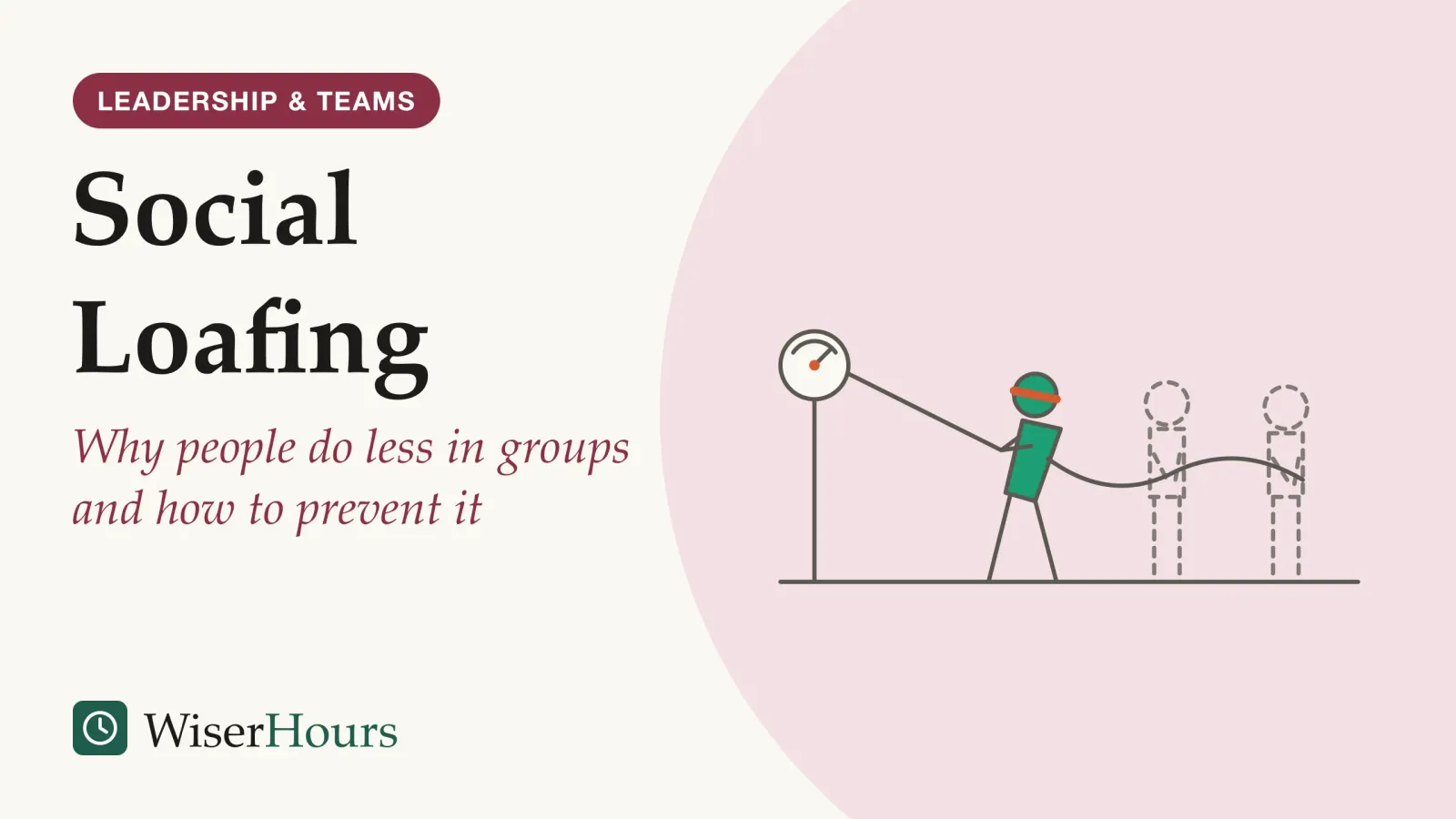
Blindfolded people who were led to believe that others were pulling a rope with them pulled less hard than on their solo trials, although in fact they were pulling alone. No teammate could have got in their way. They simply eased off.1
Social loafing is the tendency to put in less effort when your work is pooled with other people’s than when your own output stays separate. It is less a trait of lazy people than a response to how work is set up. Steven Karau and Kipling Williams, pooling 78 studies in a 1993 meta-analysis, found it across tasks and cultures, and found that it vanished when each person’s contribution could be evaluated.2
So set up shared work so that each person’s part is needed, carries their name and is judged against a clear standard.
Prefer to watch? The video covers the same ground as this article.
Social loafing versus coordination loss: two ways groups fall short
Social loafing, as Karau and Williams define it, is a drop in effort when people combine their inputs into a single group product, compared with doing the same task in the presence of others while their own output stays separate. The contrast is pooling, not company: other people are present in both conditions.2
That distinction explains why it happens. When outputs are pooled, your own piece disappears into the total. Nobody, including you, can easily tell how much of the result was yours, so the usual link between trying hard and getting credit (or avoiding blame) goes slack.
A group can also fall short without anyone easing off. People pull at slightly different moments, talk over each other or do the same piece of work twice. In 1972 the group researcher I. D. Steiner called that coordination loss, and he favored it as the simpler explanation for why groups underperform their members’ combined solo output.2
Five people write a proposal together (an illustrative case), and it comes out thin. One reason may be that two of them wrote the same section (coordination). Another may be that each wrote a little less carefully than they would under their own name, because the proposal goes out as the team’s (loafing). The fixes differ: a clearer plan solves the first, not the second.
The effort members put in together is one of the things researchers weigh when they ask what makes teams effective; this page is about why that effort leaks away. When a group’s output disappoints, ask two separate questions: did we get in each other’s way, and did each of us try as hard as we would have alone?
- Myth
- Social loafing is what lazy people do.
- Fact
- Ordinary people ease off when their share of pooled work cannot be traced or seems not to matter, and their own reports of effort barely show it.
From a rope in the 1880s to a lab full of shouting
The research began with a side finding. Ringelmann, a French agricultural engineer, measured people pushing or pulling a load in the 1880s, saw that groups fell short of what their members managed alone, and put it down mainly to poor coordination, though he was aware that motivation might play a part.3 The 1979 paper that named social loafing introduced him as a German psychologist.1 David Kravitz and Barbara Martin, who tracked down his original 1913 report in 1986, set the record straight.3
In 1974 Alan Ingham and colleagues re-examined Ringelmann’s rope-pulling result experimentally.4 In one condition, blindfolded male students pulled alone while believing others were pulling with them.2 As Bibb Latané, Kipling Williams and Stephen Harkins later summarized it, helpers only pretended to pull, and once the men believed two or more others were on the rope, they pulled at about 85 percent of their solo effort. That ruled out poor coordination. Latané’s team later excluded one remaining explanation, a larger audience watching the solo pullers.1
Latané’s team then turned to shouting and clapping. Male students at Ohio State wore blindfolds and headphones playing recorded crowd noise, so no one could hear anyone else. Believing five others were shouting with him, a student shouted only about three-quarters as intensely as when alone. For shouting, the authors estimated that roughly half of real groups’ shortfall came from poor coordination and half from reduced effort, and named the second half social loafing. Both studies were small and used only male students, so they show that the effect exists, not how large it is at work.1
Bar chart with 4 bars; the largest is Rope, pulling alone at 100%.
- Rope, pulling alone100%
- Rope, believing two or more others pulledabout 85%
- Shouting alone100%
- Shouting, believing five others shoutedabout 75%
Why would a person ease off with no one watching? Latané and colleagues suggested that in a group you can hide in the crowd, avoiding blame for slacking, or feel lost in it, unable to earn your share of credit for working hard. They compared it to the way responsibility for helping seems to be divided among bystanders at an emergency.1
A customer question posted in a busy team channel that ten people can see is the everyday version. Each reader assumes someone else will answer, and the question waits. Because effort fell even when people could not see or hear one another, the drop does not need visibly slack colleagues to set it off, so naming who answers today is a sensible fix to try.
How common is social loafing? What the 1993 meta-analysis found
Social loafing turned up in most comparisons in the meta-analysismeta-analysis: A study that combines the results of earlier studies on the same question into one overall estimate. Pooling makes the estimate more precise, but it cannot repair the studies it pools: a meta-analysis of surveys is still survey evidence.Full entry in the glossary that Karau and Williams published in 1993, across physical, thinking and judging tasks, and in schoolchildren as well as college students, though the few comparisons with employees showed no clear effect. It was a small-to-moderate effect, and its size varied a great deal from one study to the next.2
The study
Mixed evidence
What 78 studies of pooled effort showed (Karau and Williams, 1993)
About four in five comparisons showed less effort on pooled tasks than when individual output stayed separate, an average gap of about 0.44 standard deviations, which the authors rated small to moderate. The drop disappeared when each person’s output could be evaluated on the pooled task, when the task was highly meaningful to people, and when they worked with close friends or teammates.2
A gap that size shows across a whole team and is easy to overlook in one colleague. Most studies were simple lab tasks with students who were strangers to each other, which limits what they show. The effect was smaller in field studies, in women and in samples from China, Japan and Taiwan, though still present in each subgroup, and results varied so widely that the authors suggested loafing may be several effects with different causes.2 A preregistered 2021 meta-analysis found no overall effect of teamwork on effort, which is why the label here is mixed; the last section explains the disagreement.5
One further finding explains why loafing is hard to manage by asking about it. In studies that also asked people how hard they had tried, their answers barely differed between pooled and individual work: participants were either unaware that they loafed or unwilling to say so.2 So a retrospective question such as “did everyone pull their weight?” is a weak test, and so is your own sense that you gave a project everything.
Why effort leaks away in groups
Karau and Williams explained social loafing with a Collective Effort Model: people work hard to the extent that they expect their effort to lead to outcomes they value. On a pooled task that expectation has to survive more links than on solo work, and any link that looks broken drains effort. The chain runs from your effort to your part, from your part to the team’s result, from that result to what the team gets, and from there to what you get; the outcome also has to matter to you. What counts is how the links look to the person, not how they really are.2
- Your effort: the chain starts with how hard you try on your own piece
- Your part of the work: effort has to show up in something you produce
- The team's result: the first weak link: if your part is redundant, or the team would succeed without it, your effort seems not to count
- What the team gets: a good result has to earn the team something: credit, a reward, a win
- What you get: the second weak link: if nobody can trace the result back to you, credit and blame are spread thin, and the outcome also has to matter to you
A quarterly report assembled from six people’s sections and presented by the manager shows the chain. A weak paragraph from you gets diluted by five others, praise goes to “the team”, and the report may never be read closely. Nobody involved is lazy, yet three links are thin: your part barely moves the result, the credit never reaches you, and nobody may care about the outcome.
The model also predicts the reverse. When people expected capable co-workers, they loafed. When the task mattered and co-workers were expected to do poorly, people sometimes worked harder than alone, a pattern called social compensation, though the review found it in only a handful of comparisons.2 A team of strong performers is therefore not protected: in the review, people loafed when they expected capable co-workers and did not loaf when they expected weak ones. When you plan shared work, walk the chain for each person and look for the thin link.
How to prevent social loafing: three levers from the research
The conditions with the most direct tests behind them are making each contribution visible and comparable against a standard, making each part indispensable, and giving people a fair process and work they care about. None is a guarantee, and most tests were simple lab tasks, but each repairs one of the links described above.
Make each contribution visible, and give it a yardstick
In a 1985 brainstorming experiment with four-person groups, Stephen Harkins and Jeffrey Jackson found that making each person’s ideas identifiable raised output only when people believed their work could be compared with co-workers’. Identifiable but incomparable output did no better than pooled output.6
The meta-analysis draws the same line: evaluation needs both a known output and a standard to judge it against, and the evaluator can be a manager, a teammate or the person themselves.2 A shared deck in which each section carries an owner’s name and a stated standard (“one client example, one number, one recommendation”) supplies both halves. Names alone are the weaker half.
Make every part needed
In a 2006 field study, Kenneth Price, David Harrison and Joanne Gavin, all at US schools, followed 144 student project teams for most of a semester. Members who felt their contribution was dispensable were rated by teammates as loafing more, and the link was stronger in classes where students did not rate each other’s contributions. Members with more task-relevant skills felt less dispensable. Peer rating on its own showed no overall link to loafing; it mattered through its interaction with dispensability.7
The practical version is to give each person a distinct piece that the project visibly cannot finish without, matched to what they are good at, rather than five people polishing the same slides.

Decide fairly, and give people a group and a task worth caring about
The same field study found that members who saw the team’s decision-making as fair were rated as loafing less, a correlation from peer ratings rather than a tested cause.7 In the 1993 review, loafing disappeared among close friends or teammates and only shrank among mere acquaintances, and a highly meaningful task removed it.2 The 2021 meta-analysis did not repeat that last finding.5 Explaining who uses the work and why is cheap, but the evidence for it is contested, so treat it as a support for the first two levers rather than a substitute.
| Lever | What the best evidence found | Evidence |
|---|---|---|
| Visible output plus a standard | Identifiable output raised effort only when people believed it could be compared with co-workers’ output | One lab experiment, 1985; limited6 |
| A distinct, needed part | Feeling dispensable was linked to more peer-rated loafing in student teams, most where peers did not rate each other | One field study, 2006; limited7 |
| A fair decision process | Seeing decisions as fair was linked to less peer-rated loafing in the same student teams | Observational; limited7 |
| A meaningful task | Removed loafing in the 1993 review; made no difference to the teamwork effect in the 2021 review | Two meta-analyses disagree; mixed5 |
| Fewer people pooling output | Studies that pooled more people’s work found larger effects in the 1993 review | Comparison across studies; limited2 |
Before the next shared project
Download PDF
When teamwork lifts effort instead of draining it
Teamwork does not lower effort by default. A preregistered 2021 meta-analysis of 622 effect sizes by Ann-Kathrin Torka, Jens Mazei and Joachim Hüffmeier found no overall effect of teamwork on effort. Effort rose or fell with design: the authors name whether a person’s contribution was indispensable and whether they could compare themselves with teammates, and evaluation potential also moderated the effect.5
That turns “do groups make people lazy?” into “which arrangements do?” Two of the moderatorsmoderator: A variable that changes how strong an effect is, or whether it shows up at all, for different people or in different settings: who or what it works for, rather than how it works. Unlike a mediator, it is not a step in the chain between cause and outcome.Full entry in the glossary it confirmed, evaluation and dispensability, match the older review. Task meaningfulness and whether teams were ad hoc or established made no difference, so on meaningfulness the two reviews disagree, though the 2021 authors often had to infer meaningfulness from indirect cues. The self-report blind spot repeated: people reported effort gains when they had made them, but not losses they had objectively shown.5
Take an illustrative team of four preparing a client pitch, where each person owns one piece nobody else can do and everyone’s progress is on a shared board. Those resemble the conditions under which the 2021 review found effort could rise rather than fall. The same four people, all editing one document with no owner, would be set up for the opposite.
The bottom line
People put less into shared work when their part cannot be traced, seems unnecessary or feels pointless, and their own reports rarely show it. Effort holds up when each person’s part is needed, can be traced back to them and is judged against a clear standard. Build those conditions into your next shared project; the studies behind them were mostly simple lab tasks with students, so treat them as sensible conditions with no guarantee that no one will coast.
Frequently asked questions
What is the Ringelmann effect?
The Ringelmann effect is the finding that a group's combined output grows more slowly than the sum of its members' solo efforts. It is named after Ringelmann, a French agricultural engineer who measured people pushing and pulling loads in the 1880s. Later experiments showed that part of the shortfall is poor coordination and part is reduced effort, which is what social loafing refers to.
Is social loafing the same as free riding?
They overlap but are not identical. Karau and Williams's 1993 review describes free riding, from Norbert Kerr's experiments, as easing off because your input seems unnecessary: the group can succeed without it. That happened even when each person's contribution was identifiable. Social loafing is the broader drop in effort on pooled work, which also includes hiding in the crowd when nobody can tell who did what.
Who coined the term social loafing?
Bibb Latané, Kipling Williams and Stephen Harkins coined it in 1979, in a paper named after the old saying that many hands make light the work. In their experiments at Ohio State University, with US National Science Foundation funding, students shouted and clapped as loudly as they could, alone and in real or imagined groups.
Is social loafing always bad for a team?
Not necessarily, and the evidence is still open. Karau and Williams listed it as an unanswered question whether loafing can be adaptive, for example by freeing people to focus on the parts of a task they are best at, and whether quality always suffers when people loaf. A 2021 meta-analysis also found that the same teamwork can raise effort under some designs.
Sources
- Many hands make light the work: The causes and consequences of social loafing. Latané, B., Williams, K. & Harkins, S. (1979). Journal of Personality and Social Psychology, 37(6)
- Social loafing: A meta-analytic review and theoretical integration. Karau, S. J. & Williams, K. D. (1993). Journal of Personality and Social Psychology, 65(4)
- Ringelmann rediscovered: The original article. Kravitz, D. A. & Martin, B. (1986). Journal of Personality and Social Psychology, 50(5)
- The Ringelmann effect: Studies of group size and group performance. Ingham, A. G., Levinger, G., Graves, J. & Peckham, V. (1974). Journal of Experimental Social Psychology, 10(4)
- Together, everyone achieves more—or, less? An interdisciplinary meta-analysis on effort gains and losses in teams. Torka, A.-K., Mazei, J. & Hüffmeier, J. (2021). Psychological Bulletin, 147(5)
- The role of evaluation in eliminating social loafing. Harkins, S. G. & Jackson, J. M. (1985). Personality and Social Psychology Bulletin, 11(4)
- Withholding inputs in team contexts: Member composition, interaction processes, evaluation structure, and social loafing. Price, K. H., Harrison, D. A. & Gavin, J. H. (2006). Journal of Applied Psychology, 91(6)
How we researched this
The search ran through Crossref, PubMed and PsycInfo records and the reference lists of the two meta-analyses on the topic, covering 1974 to 2021; each paper was checked for retractions. Main limitation: the evidence rests largely on simple lab tasks with students, and three older papers were consulted only in abstract form or through summaries in other papers.
Keep reading
Psychological Safety in Teams: What Amy Edmondson's Research Found
Psychological safety is a team's shared belief that speaking up is safe. What Edmondson's 1999 study, a later meta-analysis and the open questions show.
What Makes a Team Effective? What Decades of Research Show
What makes a team effective? Decades of research point less to star talent than to how a team is set up and works together. Here is the evidence.
Conway's Law: Why Your Products Mirror Your Org Chart
Conway's law: systems copy the communication structure of the teams that build them. The 1968 wording, what 4 studies found, and how to use it.
15 Team-Building Activities That Aren't a Waste of Time
15 team building activities sorted by purpose, with time, group size and remote options. Goal and role work has the best evidence; skip forced fun.