Psychological Safety in Teams: What Amy Edmondson's Research Found
Psychological safety is a team's shared belief that speaking up is safe. What Edmondson's 1999 study, a later meta-analysis and the open questions show.

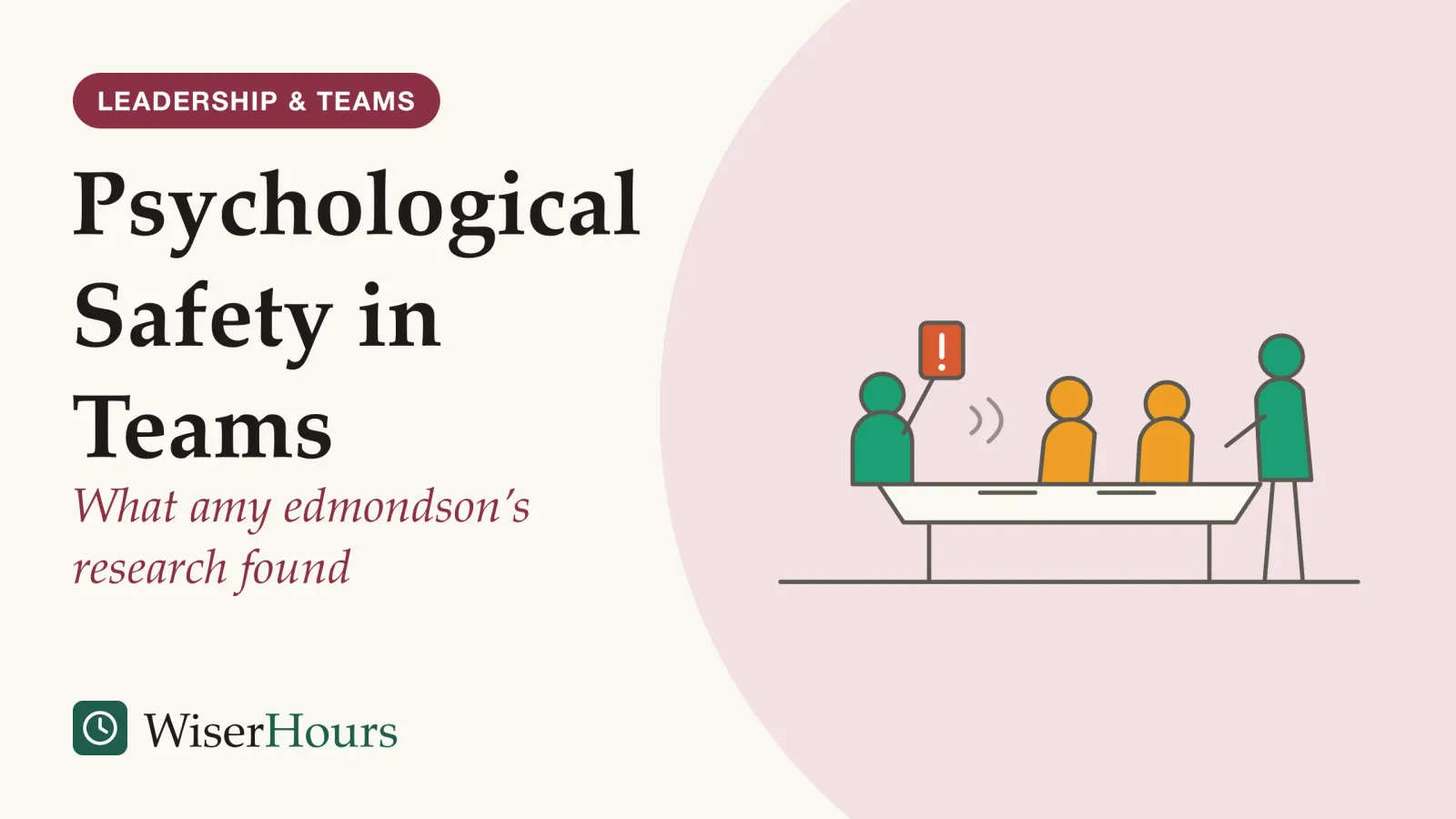
On the hospital wards Amy Edmondson studied in the 1990s, the units with stronger teamwork scores tended to have more medication errors on record, not fewer. She was then a Harvard doctoral student, comparing how patient care teams rated their own teamwork with the errors that investigators logged on their units, and her explanation for that upside-down result became one of the most studied ideas in team research.1
Psychological safetypsychological safety: A shared belief within a team that it is safe to take interpersonal risks, such as asking questions, admitting mistakes or raising concerns, without being punished or embarrassed. It is about candor, not about everyone being nice.Full entry in the glossary is a belief, shared across a team, that members can take interpersonal risks there: asking a naive question, admitting a mistake, challenging a plan. Edmondson defined it that way in a 1999 study of work teams, where it went hand in hand with more team learning.2 A 2017 meta-analysis by Lance Frazier and colleagues found it consistently linked to learning and information sharing, and more modestly to performance, though mostly in one-time surveys.3
For a manager, the research points to three habits, each covered below: present the work as something the team is still learning, ask questions you cannot answer yourself, and react to bad news so that people are glad they brought it. Psychological safety is one of several conditions behind what makes a team effective; this guide stays with the idea itself, what it is not, and how far the evidence goes.
What psychological safety means in Edmondson’s definition
In her 1999 paper in Administrative Science Quarterly, Edmondson defined team psychological safety as a belief, held in common by the members, that the group is a safe place to take interpersonal risks. She described it as confidence that colleagues would not embarrass, reject or punish a person who speaks up, a confidence that rests on mutual respect and trust. Why would speaking up feel risky at all? Asking for help, admitting an error or seeking feedback can make a person look incompetent and cost them face, and Edmondson argued that people tend to act in ways that block learning when they sense that threat. The weighing is usually silent: she noted that such beliefs are mostly tacit, taken for granted rather than discussed.2
Two features set the idea apart. First, it belongs to the group. Edmondson reports finding, in every organization she has studied, that psychological safety differs a great deal between groups inside the same company, and she traces much of that difference to local leaders. Second, it differs from trust. In her 2018 book The Fearless Organization, she draws the line this way: trust means giving others the benefit of the doubt, while psychological safety is about whether others will give it to you when you ask for help or admit a mistake.1
Take two teams under the same company policies (an illustrative case). In one, a new analyst says in the Monday meeting that she does not follow the forecast, and a colleague walks her through it. In the other, she spends an hour trying to reverse-engineer it alone and guesses. Nothing in the handbook differs; the belief about what happens next does. So if your organization runs a staff survey, look at the results team by team, because a healthy company average can hide very different climates.
The hospital puzzle behind the idea
The concept grew out of a study of medication errors in patient care units at two hospitals, which Edmondson published in 1996.4 In her book she describes the design: nurse investigators logged errors independently for six months while she surveyed the units on teamwork, and detected error rates differed about tenfold from the best unit to the worst. The better-rated teams had more errors on record, not fewer. A research assistant who knew neither her hypothesis nor the data then observed the units and found they differed sharply in whether people felt able to talk about mistakes, differences that closely tracked the recorded rates. Her explanation was that the stronger teams were more willing to report errors, not that they made more.1
Why would candor show up in an error count? An error is only counted once someone notices it and says so, and saying so carries exactly the risk the definition describes. Any count that depends on people reporting problems, such as incident logs, bug reports or safety near-misses, measures candor as well as failure. A software team with no reported incidents last quarter may be the most careful team in the building, or the quietest. Before you praise a low number, ask what it would look like if people felt free to report.
Edmondson then tested the idea on purpose in 51 teams at an office furniture manufacturer in the US Midwest, work that later influenced Google’s Project Aristotle (a story for a separate article).1 Teams higher in psychological safety showed more learning behavior, such as seeking feedback, asking for help, talking about errors and experimenting, and that learning behavior helped explain their better performance. She was candid that a survey taken once, in one company, could not show cause and effect.2
Learning first, results second: what later studies found
Later research has mostly backed Edmondson’s pattern. In the largest synthesis, a 2017 meta-analysis in Personnel Psychology led by Lance Frazier, psychological safety tracked learning behavior and information sharing closely and task performance more loosely, across studies from many workplaces.3
The study
Moderate evidence
136 samples, more than 22,000 people: where the links were strongest
Pooling 136 independent samples covering more than 22,000 people and nearly 5,000 groups, the authors found psychological safety correlated with learning behavior, information sharing, engagement and task performance. At the team level, its link with learning behavior (a corrected correlation of .52) was stronger than its link with task performance (.29). In a separate analysis of individuals, it still predicted performance when related factors such as leader relations or engagement were allowed for one at a time. Because most included studies measured everything at once, the authors could not make strong claims about cause.3
Read plainly, the link with learning is strong and the link with output is weaker: a difference you would see across hundreds of teams but might not notice in your own, and, as the last section explains, one that depends on how output is measured. That order makes sense if safety works mainly by making learning possible, which is how Edmondson’s original model placed it. Learning should pay off most when the work demands it, and in the meta-analysis interdependence was the work-design feature most strongly tied to psychological safety.3
A 2023 review by Edmondson and Derrick Bransby of 185 papers from 2013 to 2021 concluded that the field had matured, with broad agreement on how to define and measure the idea and much of the work coming from healthcare.5
So expect the biggest return where your team faces problems nobody has fully solved, such as a new product, an unfamiliar client or a changing process, and a smaller one where work is routine and done alone.
What psychological safety is not
Edmondson’s 2018 book lists several common misreadings. Psychological safety is not about being nice, is not a personality trait, is not another word for trust, and does not mean lowering performance standards or making people comfortable at work. Niceness can even be the opposite of safety: Edmondson describes companies whose people are polite in meetings and then disagree in the hallway afterward, so the real objections never reach the decision.1
Psychological safety is about candor, about making it possible for productive disagreement and free exchange of ideas.
A team where nobody challenges the plan may be pleasant and still unsafe for dissent. Quiet colleagues are a related but separate problem, covered in how to get quiet people to speak up in meetings.
The standards point matters most for managers. Edmondson treats psychological safety and performance standards as two separate dials. Low on both gives apathy; high safety with low standards gives a comfort zone where people get along but are not stretched; high standards with low safety gives an anxiety zone where people hold back questions and quality suffers, the combination she says worries her most; high on both is the learning zone.1
Across: performance standards, from low to high. Up: psychological safety, from low to high.
- Apathy zone (low safety, low standards): people show up, but choose self-protection over effort
- Comfort zone (high safety, low standards): people are open and collegial but not challenged by the work
- Anxiety zone (low safety, high standards): people are anxious about speaking up, and quality can suffer; the zone Edmondson worries about most
- Learning zone (high safety, high standards): people can collaborate, learn from each other and get complex work done; for uncertain or interdependent work, also the high-performance zone
Say a deadline is slipping (an illustrative case). One manager quietly moves the date to keep the peace, which drifts toward the comfort zone. Another keeps the date and a sharp tone, and hears about the problem only when it is too late, which is the anxiety zone. A third keeps the date and asks the team what is in the way, which is the learning zone. You can hold people to high standards and still make it safe to tell you the truth about them.
- Myth
- A psychologically safe team is a comfortable team where nobody is held to account.
- Fact
- Edmondson pairs psychological safety with high standards: people are expected to meet demanding goals and can say openly what stands in the way.
What managers can do: frame, ask, respond
Edmondson’s field studies and her book point to three things leaders do: frame the work as something to be learned, invite input with genuine questions, and respond well when people bring bad news or mistakes. The evidence for each comes mainly from observation and surveys, not controlled experiments.1
Some field evidence for this comes from cardiac surgery. A qualitative study of 16 hospitals adopting a new cardiac surgery technology found that the successful ones used the project’s first stage, which the authors call enrollment, to motivate the team, and designed practice sessions and early trials to create psychological safety.6 A second paper, on 16 operating room teams learning such a technology, found that the most effective leaders explained a motivating reason for the change and played down differences in power and status so that others would speak up.7 “We have not done this before, so I need everyone’s eyes on it” invites more than “just follow the plan.”
How a leader invites input may matter as much as whether they do. The 2023 review describes research by Constantinos Coutifaris and Adam Grant in which, in the review’s words, leaders who openly shared critical feedback they had received had a lasting, positive impact on their team’s psychological safety, while leaders who only asked for feedback did not.5
Responding is where the climate gets set. Edmondson’s 1999 paper argued that team members watch the leader, and that authoritarian or punitive reactions make people reluctant to discuss errors, as in the hospital units she had studied.2 The first reaction to bad news tells everyone in the room whether to bring the next piece.
Where the evidence runs thin
The research on psychological safety is broad but has clear limits: most of it is correlational, most comes from English-speaking and Western workplaces, and there is little tested evidence on what reliably creates it.
Cause and effect is the biggest gap. The 2023 review calls for field experiments that randomly assign leaders to different approaches and notes that studies following teams over time remain few.5 Safer teams may also be better led or better resourced, and learning that goes unpunished may itself make people feel safer, a loop Edmondson described in 1999.2
How things are measured matters too. The meta-analysis checked the worry that the links are an artifact of the same people rating everything at once: measured at different times or from different sources, they shrank but stayed moderate. Performance was another matter. In the results for individuals, the link with task performance was much larger when performance was rated by people, such as a supervisor, than when it was measured objectively, for example by course results, where it was close to zero.3 So claims that psychological safety raises output rest largely on people’s judgments of performance, and the case for hard results is still thin. If someone promises that lifting your team’s survey score will lift its sales or delivery figures, treat that as a plausible bet, not a demonstrated result.
Culture is another gap. The meta-analysis notes that most research has been done in English-speaking, Western countries. In countries it classed as less tolerant of uncertainty, such as Germany, Japan and Mexico, work design and a supportive work context showed stronger links with psychological safety, while relations with the direct leader showed weaker ones, which the authors call initial evidence.3 Norms about speaking up to seniors differ widely around the world, so if you lead a team across cultures, test what works locally rather than assuming a single script will.
Finally, more is not always better. A 2019 study of groups in Chinese organizations, summarized in the 2023 review, found that psychological safety was linked to more learning through less fear of failure but also to lower motivation to work, with the balance depending on collectivist or individualist norms.5 That fits Edmondson’s own warning about the comfort zone: safety without standards is not the goal.
| Claim | What the best evidence found | Evidence |
|---|---|---|
| Linked to team learning | Strong, consistent correlations with learning behavior and information sharing | Meta-analysis, mainly single-time-point surveys; moderate3 |
| Linked to performance | A moderate link, much weaker for objective measures than for ratings by people such as supervisors | Same meta-analysis; limited3 |
| Works the same everywhere | Mostly Western samples; some links differ by national culture | Moderator test in the meta-analysis; limited3 |
The bottom line
The idea began as an accident on hospital wards, where the better teams recorded more errors, and it names a team’s shared sense that candor will not be held against anyone. Decades of studies link it firmly to team learning and more modestly to performance, mostly through surveys taken once. It works alongside high standards. The most useful habit it suggests is also the simplest: when someone brings you bad news, make sure they are glad they did.
Frequently asked questions
How is psychological safety measured?
Usually with a short survey. Edmondson's scale, introduced in her 1999 study, asks team members how far they agree with statements such as whether a mistake is often held against you, whether it is safe to take a risk on the team and whether it is hard to ask colleagues for help. Answers are averaged across the team, because the idea describes the group rather than one person.
Who first used the term psychological safety at work?
Edgar Schein and Warren Bennis of MIT introduced it to organizational research in a 1965 book on organizational change, as a condition people need to cope with the anxiety of change. William Kahn linked it to engagement at work in 1990, and Amy Edmondson recast it in 1999 as a belief shared by a whole team.
Is psychological safety the same as trust?
No, though the two overlap. In her 2018 book Edmondson describes trust as a belief one person holds about another, while psychological safety is felt at the level of the group and concerns the immediate consequences of speaking up. Put simply, trust is giving others the benefit of the doubt; psychological safety is believing they will give it to you.
Can a team have too much psychological safety?
Possibly. A 2019 study of work groups in Chinese organizations, summarized in a 2023 review, found psychological safety linked to more learning through less fear of failure, but also to less motivation to work. Which effect dominated depended on whether a group leaned toward collectivist or individualist norms. It is one line of research, not a settled finding.
Sources
- The Fearless Organization: Creating Psychological Safety in the Workplace for Learning, Innovation, and Growth. Edmondson, A. C. (2018). Wiley
- Psychological Safety and Learning Behavior in Work Teams. Edmondson, A. (1999). Administrative Science Quarterly, 44(2)
- Psychological Safety: A Meta-Analytic Review and Extension. Frazier, M. L., Fainshmidt, S., Klinger, R. L., Pezeshkan, A. & Vracheva, V. (2017). Personnel Psychology, 70(1)
- Learning from Mistakes is Easier Said Than Done: Group and Organizational Influences on the Detection and Correction of Human Error. Edmondson, A. C. (1996). The Journal of Applied Behavioral Science, 32(1)
- Psychological Safety Comes of Age: Observed Themes in an Established Literature. Edmondson, A. C. & Bransby, D. P. (2023). Annual Review of Organizational Psychology and Organizational Behavior, 10
- Disrupted Routines: Team Learning and New Technology Implementation in Hospitals. Edmondson, A. C., Bohmer, R. M. & Pisano, G. P. (2001). Administrative Science Quarterly, 46(4)
- Speaking Up in the Operating Room: How Team Leaders Promote Learning in Interdisciplinary Action Teams. Edmondson, A. C. (2003). Journal of Management Studies, 40(6)
How we researched this
Sources were located via Crossref and OpenAlex and by following the citations in Edmondson's two Annual Review articles, covering 1996 to 2023, with full texts read for the 1999 study, the 2017 meta-analysis, the 2023 review and the publisher's sample chapter of Edmondson's 2018 book. Main limitation: most studies are single-time-point surveys from English-speaking, Western workplaces, and only the abstracts of three hospital studies were available.
Keep reading
Social Loafing: Why People Do Less in Groups and How to Prevent It
Social loafing is the drop in effort when work is pooled. What research since the 1880s found, why it happens, and 3 evidence-based ways to prevent it.
What Makes a Team Effective? What Decades of Research Show
What makes a team effective? Decades of research point less to star talent than to how a team is set up and works together. Here is the evidence.
Conway's Law: Why Your Products Mirror Your Org Chart
Conway's law: systems copy the communication structure of the teams that build them. The 1968 wording, what 4 studies found, and how to use it.
15 Team-Building Activities That Aren't a Waste of Time
15 team building activities sorted by purpose, with time, group size and remote options. Goal and role work has the best evidence; skip forced fun.