Deep Work by Cal Newport: Summary, Key Ideas, and Critique
A Deep Work summary and critique: Cal Newport's 4 rules, what field studies of protected work time support, and where the book's evidence runs thin.

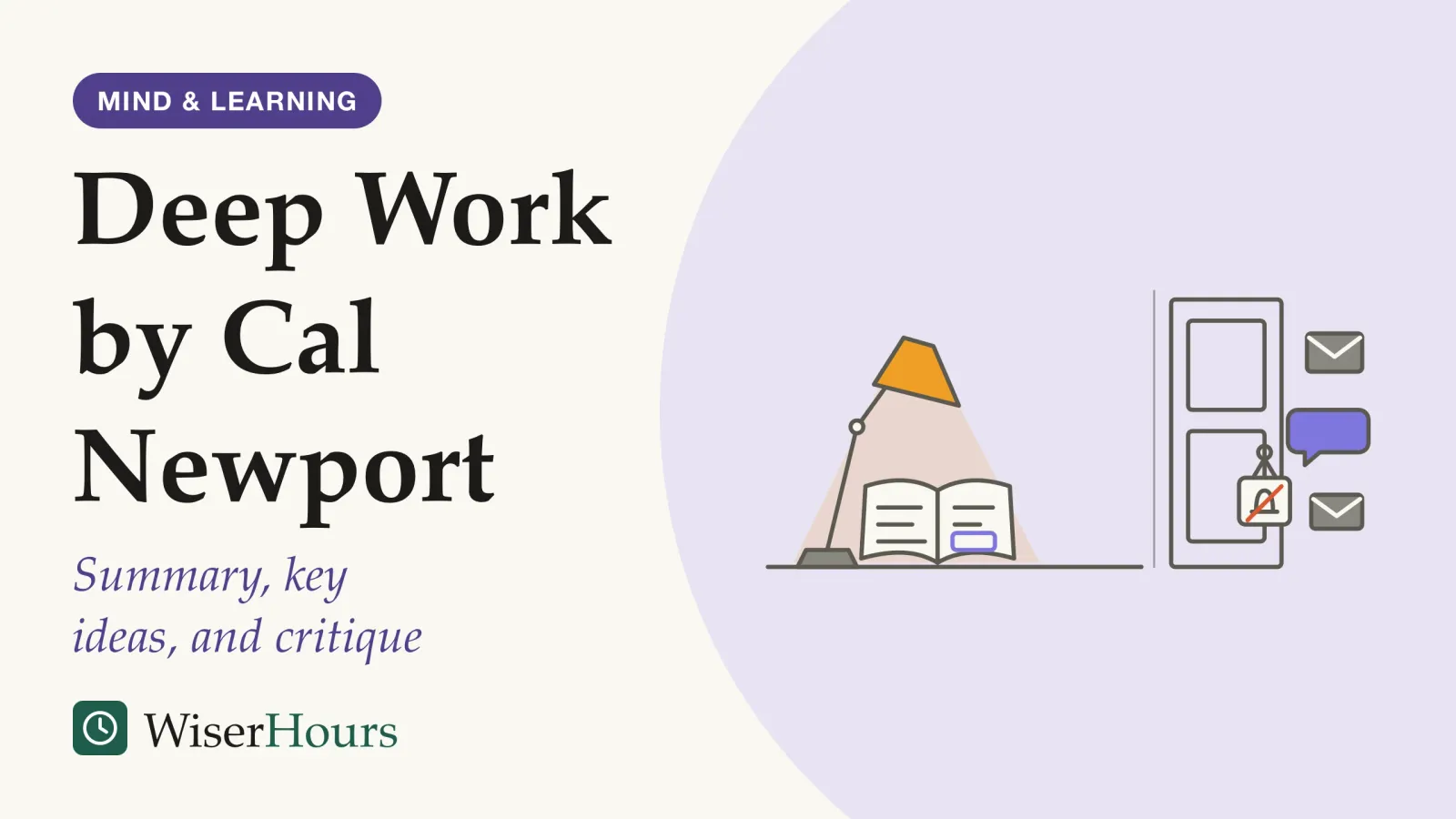
Cal Newport’s Deep Work (2016) rests on one bet: that the ability to concentrate without distraction on hard problems is getting rarer just as it gets more valuable, so the people who build it will stand out. This Deep Work summary sets out that argument and the book’s four rules, then checks its main claims against the research. The verdict is split: field studies of protected work time fit the book’s practical core, but its bolder promise, that depth is a fast route to elite skill, leans on deliberate-practice research that a 2014 meta-analysis found far weaker for professional work than for games, music or sports. No trial of the method as a whole turned up in our searches.
The book’s most usable advice fits in one sentence: reserve one or two long blocks a day for your hardest task, and agree them with your manager so they survive a busy week. Laying those blocks out on a calendar is the subject of our guide to time blocking, with templates.
The case and the rules: a Deep Work summary
Deep Work is a 2016 book by Cal Newport, published by Grand Central Publishing, that makes the case for focus as a skill worth reclaiming and then teaches four rules for building it: work deeply, embrace boredom, quit social media and drain the shallows.1 It sits beside other books in our book summaries and big ideas collection as the one most focused on attention at work.
Newport defines deep work as focusing without distraction on a cognitively demanding task, and states the book’s thesis as the deep work hypothesis: that such work is growing more valuable just as it grows rarer, so people who cultivate it will thrive.2 He is a computer science professor at Georgetown University.3
The first half makes three arguments, one per chapter. Deep work is valuable, because it lets you learn hard things quickly and produce more, and better, work. It is rare, because organizations encourage habits that work against it, such as open-plan offices and constant connectivity, and treat what Newport calls busyness as a proxy for productivity. And it is meaningful, a more satisfying way to spend a working day than hopping between small tasks.4 That last claim overlaps with research on flow and absorption in work.
Its opposite, shallow work, is the kind of task almost anyone could do with a little training, such as email replies and logistical planning.5 The second half turns the argument into rules.
- 1Work deeplyschedule depth, build rituals, shut down at day end
- 2Embrace boredomtrain focus; schedule distraction, not focus
- 3Quit social mediakeep only tools with a large payoff
- 4Drain the shallowsfewer shallow tasks, done faster
Two of the rules are more concrete than their titles suggest. Rule 1 includes an end-of-day shutdown: in a 2009 post, Newport describes updating his task lists, checking his calendar and weekly plan, and closing with a set phrase; if a work worry surfaces that evening, he reminds himself that everything was already checked.6 Rule 3 asks you to keep a digital tool only if its benefits to what matters most are substantial, not merely present.4 The same filter, applied to personal technology, is the core of digital minimalism for beginners.
A formula from a 2014 post, rooted in Newport’s years writing study advice for students, sums up the thinking: work accomplished equals time spent multiplied by intensity.7 Two afternoons can be the same length and produce very different amounts, because one of them was chopped into pieces. So judge a working session by how undivided it was, not by how long it ran.
Why Newport says brief switches wreck a working session
Newport’s central mechanism is that switching attention, even for a minute or two, dulls your thinking for some time afterward, so a session broken by frequent checks is only pseudo-depth. In a 2015 post he credits the idea to research by Bluma Zeigarnik, Clifford Nass, Gloria Mark and Sophie Leroy.8
His own illustration is a hypothetical: a hard client proposal written in two ways. In one, the writer closes her office door for a couple of hours but never goes more than 20 minutes or so without a glance at email, a social feed or a chat in the kitchen. In the other, she spends the morning away from the office, walking, drafting and redrafting, and checks email only when the draft is done.8 Both look like focus from the outside. On Newport’s account, only the second gives the problem time to sink in.
- Pseudo-depth: hours at the desk on a hard task, broken every so often by a glance at email, a feed or a chat; on Newport’s account, each switch leaves the mind slower for a while
- Deep work: the same hours without switching, so the problem has time to sink in; this is Newport’s argument, not a measured comparison
Part of that research base has held up better than the rest. Leroy’s idea, that attention lingers on the task you just left, has its own explainer on attention residue after switching tasks. The Zeigarnik effect, usually told as better memory for unfinished tasks, fared worse: in a 2025 meta-analysismeta-analysis: A study that combines the results of earlier studies on the same question into one overall estimate. Pooling makes the estimate more precise, but it cannot repair the studies it pools: a meta-analysis of surveys is still survey evidence.Full entry in the glossary, Romain Ghibellini and Beat Meier reported no memory advantage for unfinished tasks, only a general tendency to resume them.9 That pull back toward an open task may be part of why a quick look at the inbox costs more than it seems, though the meta-analysis did not test inbox checks.
What this means for you: a check that feels like two seconds can cost you the thread of a hard problem. If you must look, do it at a natural stopping point, and write one line about where you were before you switch.
Further reading
Deep Work: Rules for Focused Success in a Distracted World
Newport's original argument and four rules, worth reading in full before deciding which parts of the critique above you agree with.
As an Amazon Associate WiserHours earns from qualifying purchases.
Draining the shallows works best as a team agreement
Newport’s most practical advice is social: ask your manager what share of your time should go to deep work and what share to shallow work, then agree protected blocks rather than defending them alone.10 The 1999 field study Leslie Perlow ran with a single software team is the best evidence we found for that approach, and for its limits.
The reason is that a quiet morning is shared property. Your block holds best when colleagues save their questions too, and they are more likely to do that when nothing in the team rewards the quick interruption more than the finished work.
Perlow followed a 17-member software group racing a product deadline, then helped it try quiet time: no interruptions until noon, three days a week. A larger share of engineers rated their own productivity above average in the quiet-time phases than in a phase organized around set hours for interaction, and the division’s vice president credited the quiet-time study with the product’s on-time launch. The gains did not stick. Nine months after the last phase, Perlow found the lasting effects were minimal. On a visit a year after the launch, when managers had tried quiet time again, the engineers said quiet time alone was not enough, because nobody had any reason to stick to it.11
A 2023 randomized study at one large US technology company adds a newer test. It enrolled 89 engineering and development staff, and roughly half were randomly assigned a calendar feature that set aside two protected hours daily and muted notifications. In the three study weeks, that group reported more of the resources their work needed, while the rise in their performance ratings fell short of the usual threshold for statistical significancestatistical significance: A result that a statistical test says would be unlikely to turn up if there were no real effect. It does not carry the everyday sense of significant: it says nothing about how big the effect is or whether it matters in practice.Full entry in the glossary. The tool is Microsoft’s and several authors worked there, though the paper says the product’s developers played no part in the analysis.12
Newport’s own evidence for the conversation with a manager is a reader’s report: a marketer who agreed two blocks of 1.5 to 2 hours a day with his boss, and found three months later that nothing had broken.10 That is an anecdote, but it matches Perlow’s lesson: protected time holds when the people around you have agreed to it.
Deep work and deliberate practice: the book’s weakest link
Newport’s promise that deep work builds rare skill quickly rests on deliberate practice: effortful work at the edge of your ability, the kind of practice credited with making chess players and violinists elite. A 2012 post that first sketched deep work already framed it this way, as stretching just past your current skill level.5 The research on deliberate practice, though, is weaker for jobs than that framing implies.
The study
Moderate evidence
Practice and performance across five fields (Macnamara, Hambrick and Oswald, 2014)
Brooke Macnamara, David Hambrick and Frederick Oswald pooled studies that linked hours of deliberate practice to performance. Practice explained 26% of the differences in performance in games, 21% in music and 18% in sports, but 4% in education and less than 1% in professions, a result that was not statistically significant. The authors suggest deliberate practice is harder to define in education and work, and that people start jobs and courses with different amounts of prior knowledge.13
The finding is contested. K. Anders Ericsson, who introduced deliberate practice, argued with Kyle Harwell in 2019 that the meta-analysis counted many kinds of practice that did not meet his original definition, and their reanalysis of the studies that did found practice explained considerably more.14 The same year, Macnamara and Megha Maitra ran a double-blind replicationreplication: Running a study again with fresh data and the same method, to see whether the original result comes back. A finding that fails to replicate is not automatically wrong, but it stops being something you can lean on.Full entry in the glossary of Ericsson’s classic study of student violinists: practice still mattered, but considerably less than the original reported.15
Why would practice predict so little at work? One reason fits the authors’ own suggestion: a violinist knows what to practice, while an analyst’s hardest hour may be spent working out what the problem is. So a long focused session is not automatically practice at all.
Can resisting boredom train your focus?
Rule 2 treats concentration as a skill that has to be trained before you can use it well, and its remedy is to schedule your distractions instead of scheduling your focus.4 Among the researchers Newport credits for his worries about distraction is Clifford Nass, who studied people who juggle several streams of media at once.
In a 2009 study, Eyal Ophir, Nass and Anthony Wagner compared students who reported heavy and light media multitasking. The heavy multitaskers were more easily distracted by irrelevant information and did worse on a test of switching between tasks. The authors left the direction open: heavy multitasking may cause the difference, or the people least able to cope with several streams of input may be the ones who multitask most.16
Nine years later, Melina Uncapher and Wagner reviewed the studies that followed. On balance, they wrote, heavier media multitaskers did worse in several areas of thinking, but many studies found no difference, the findings diverged, and the direction of causality still needed research.17 We found no trial testing whether scheduled internet use, Newport’s specific remedy, rebuilds concentration.
- Myth
- Research shows that multitasking permanently damages your ability to focus.
- Fact
- Heavy media multitaskers did worse in some studies but not in many others, and a 2018 review said the direction of cause and effect was still unknown.
Scheduled distraction may still be a good habit for a simpler reason: it removes a decision. If the next look at the news is booked for 11:30, you do not have to argue with yourself at 10:50. Use it for that, without expecting it to rewire anything.
Does Deep Work fit a job you don’t fully control?
On our reading, Deep Work suits people whose value lies in hard thinking and who control a good part of their calendar: researchers, writers, programmers, analysts and many managers. It fits less well where responsiveness is the job, such as customer support, care work or shift work.
That gap is not unique to this book. In the discussion of their 2021 meta-analysis of time management, Brad Aeon and colleagues observe that being good at managing time often goes with privilege of various kinds, including income and education, and that standard advice may suit care work badly.18 On our reading, the book’s model deep worker is someone who can close a door. If you cannot, its schedules may frustrate you; the idea of guarding one undivided hour still travels.
A scorecard for the book’s main claims
Graded against the research, Deep Work’s practical advice on protected time has the most support, its claims about training your brain the least, and we found no test of its central economic argument. How to focus at work sets out the techniques with stronger evidence behind them.
| Claim in the book | Best evidence we found | Evidence |
|---|---|---|
| Deep work is growing more valuable and rarer | Argued from examples and Newport’s reading of the economy; we found no study measuring it | Expert: the book’s argument |
| Brief switches cost you focus | People tend to resume unfinished tasks; no memory advantage for them | Meta-analysis, moderate9 |
| Protected blocks, agreed with your team | Higher self-rated productivity during quiet time; minimal effect nine months later, without incentives | Observational, limited: one team11 |
| Protected calendar time for individuals | Protected group reported more job resources; performance rise below significance | Trial, limited: 89 workers, one company12 |
| Depth builds elite skill through deliberate practice | Practice predicted far less of performance in professions than in games, music and sports; the definition is disputed | Meta-analysis, moderate, contested13 |
| Resisting boredom trains concentration | Heavy media multitaskers did worse in some studies, not in many others; cause and effect unknown | Observational, mixed17 |
The bottom line
Read as a scheduling book, Deep Work earns its place: guard long, uninterrupted blocks for your hardest work, and agree them with your manager and team so they survive a busy week. Its larger claims, that depth makes you elite and that resisting boredom retrains your brain, run ahead of the research. Spend each protected hour on a specific stretch that someone, or something, can check.
Frequently asked questions
Who is Cal Newport?
Cal Newport is a computer science professor at Georgetown University, according to his own website, where he also writes about technology, work and depth. He earned his PhD at MIT and researches the theory of distributed systems. The book's introduction tells his own history with depth, starting as a graduate student at MIT, which is worth remembering if your job gives you less control over your time than an academic has.
What does 'schedule shutdown, complete' mean?
It is the phrase Cal Newport says to end his workday, described in a 2009 blog post. First he updates his task lists, checks his calendar for the next two weeks and revises his weekly plan. Then he says the phrase, and if a work worry comes up that evening he reminds himself that everything was already checked, rather than thinking the worry through.
What is the any-benefit mindset in Deep Work?
It is Cal Newport's name for choosing a digital tool because it offers some benefit, however small. In his annotated table of contents for Deep Work, he sets it against a craftsman mindset, which keeps only the tools whose benefits to the things you care about most are substantial. The rule is his argument, not a tested method, and he applies it most sharply to social media.
Sources
- Deep Work: Rules for Focused Success in a Distracted World. Newport, C. (2016). Grand Central Publishing, Hachette Book Group; publisher's page accessed 2026
- Deep Work: Rules for Focused Success in a Distracted World (book announcement). Newport, C. (2015, November 20). Study Hacks blog, calnewport.com
- Meet Cal Newport. Newport, C. Author's website, calnewport.com, accessed 2026
- The Book Facebook Doesn't Want You to Read. Newport, C. (2016, January 5). Study Hacks blog, calnewport.com (annotated table of contents)
- Knowledge Workers are Bad at Working (and Here's What to Do About It...). Newport, C. (2012, November 21). Study Hacks blog, calnewport.com
- Drastically Reduce Stress with a Work Shutdown Ritual. Newport, C. (2009, June 8). Study Hacks blog, calnewport.com
- Work Accomplished = Time Spent x Intensity. Newport, C. (2014, April 8). Study Hacks blog, calnewport.com
- Deep Habits: The Danger of Pseudo-Depth. Newport, C. (2015, December 12). Study Hacks blog, calnewport.com
- Interruption, recall and resumption: a meta-analysis of the Zeigarnik and Ovsiankina effects. Ghibellini, R. & Meier, B. (2025). Humanities and Social Sciences Communications, 12, 962
- Talk to Your Boss About Deep Work. Newport, C. (2016, April 22). Study Hacks blog, calnewport.com
- The Time Famine: Toward a Sociology of Work Time. Perlow, L. A. (1999). Administrative Science Quarterly, 44(1), 57-81
- Focused Time Saves Nine: Evaluating Computer-Assisted Protected Time for Hybrid Information Work. Das Swain, V., Hernandez, J., Houck, B., et al. (2023). Proceedings of the 2023 CHI Conference on Human Factors in Computing Systems
- Deliberate Practice and Performance in Music, Games, Sports, Education, and Professions: A Meta-Analysis. Macnamara, B. N., Hambrick, D. Z. & Oswald, F. L. (2014). Psychological Science, 25(8), 1608-1618
- Deliberate Practice and Proposed Limits on the Effects of Practice on the Acquisition of Expert Performance: Why the Original Definition Matters and Recommendations for Future Research. Ericsson, K. A. & Harwell, K. W. (2019). Frontiers in Psychology, 10, 2396
- The role of deliberate practice in expert performance: revisiting Ericsson, Krampe & Tesch-Römer (1993). Macnamara, B. N. & Maitra, M. (2019). Royal Society Open Science, 6(8), 190327
- Cognitive control in media multitaskers. Ophir, E., Nass, C. & Wagner, A. D. (2009). Proceedings of the National Academy of Sciences, 106(37), 15583-15587
- Minds and brains of media multitaskers: Current findings and future directions. Uncapher, M. R. & Wagner, A. D. (2018). Proceedings of the National Academy of Sciences, 115(40), 9889-9896
- Does time management work? A meta-analysis. Aeon, B., Faber, A. & Panaccio, A. (2021). PLOS ONE, 16(1), e0245066
How we researched this
Our account of the book comes from its publisher's page, Cal Newport's annotated table of contents and his blog posts; we did not work from the book's text itself. In September 2026 we looked in Europe PMC, Crossref and on the open web for tests of deep work and of the research behind it (deliberate practice, media multitasking, interruptions and protected work time), finding work from 1999 to 2025. The main gap: no trial of the method as a whole turned up, and one source was available to us only as an abstract.
Keep reading
Why We Sleep by Matthew Walker: What It Gets Right and Wrong
The Why We Sleep book, claim by claim: what a 2019 critique, Walker's own replies and later reviews show about short sleep, cancer, death and one chart.
Thinking, Fast and Slow by Daniel Kahneman: Key Ideas and Whether They Hold Up
A Thinking, Fast and Slow summary checked against later replications: its research on choices holds up, while chapter 4's priming studies did not.
The Psychology of Money by Morgan Housel: Summary and Key Lessons
The Psychology of Money summary: Housel's 19 stories, then the evidence on experience, compounding and 'enough' across US, Finnish and German data.
Atomic Habits by James Clear: Summary, Key Ideas, and Critique
An Atomic Habits summary that scores 9 of the book's ideas against habit research: which hold up, which are untested, and which the evidence contradicts.