Time Blocking: A Complete Guide With Templates
Time blocking gives each task its own slot on your calendar. What a 2018 study of planned workdays found, plus 6 steps and 3 day templates.

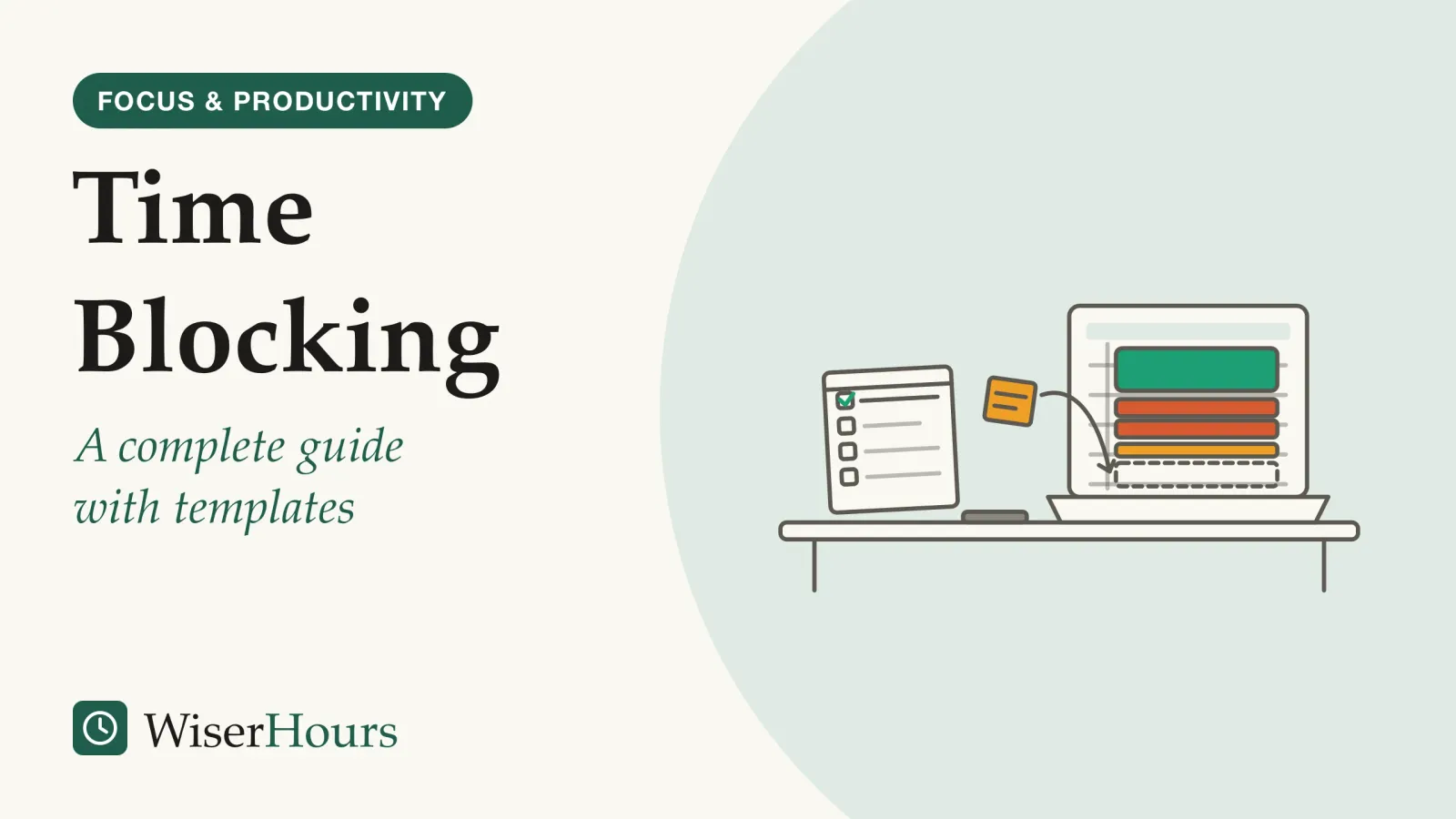
By late afternoon the list still says “draft the pricing proposal” at the top, where it sat at breakfast. The day went to replies, a meeting that ran long and a string of small requests. Nothing on the list said when the proposal would get written, so it never got a turn.
Time blocking closes that gap by giving each important task its own slot on the calendar, with a start and an end, so the decision about when is made once instead of all day. In a 2018 study that followed US employees through two work weeks, days on which people listed, ranked and scheduled their tasks were days they rated their engagement and performance higher, but the link faded on their most interrupted days.1 So a time-blocked day needs a plan for the blocks and a plan for when they break. In six steps:
- Start from a short list of what the day must hold
- Give your hardest task the longest block you can protect
- Make each focus block visible and quiet
- Put meetings together and batch the small tasks
- Leave open space and decide how to handle interruptions
- Redraw the day when it breaks
Time blocking turns a to-do list into appointments with yourself
Time blocking means dividing your day on the calendar into blocks, each reserved for a named task or kind of work, instead of working down a list as time allows. In a 2013 blog post, Cal Newport laid out his own method: each hour of a notebook page split into blocks labeled with specific assignments, with room beside them for corrections.2
The difference from a list is where the decision about when gets made. A list leaves it open at every free moment, and in those moments the nearest, loudest request tends to win, as it did over the pricing proposal. A block settles it in advance.
A 1999 field study by Leslie Perlow shows what leaving it open costs. The software engineers she observed did much of their solo work in short stretches between interruptions, and even a long quiet stretch was not seen as a chance for deep concentration because nobody had set it aside: they realized only afterward that they had had the time.3 A blocked hour and a free hour can be the same length. Only the blocked one arrives with a job attached.
The practical lesson: an important task needs a time, not just a place on a list. For the habits around it, such as ranking tasks by payoff, see the five time management habits for beginners.
Does time blocking work? Planned workdays offer the best clue
We found no trial of time blocking itself, so the best evidence comes from studies of daily planning. The closest is a 2018 Journal of Applied Psychology diary study by Michael Parke and four colleagues, which compared employees’ days with more planning against their own days with less.1
The study
Limited evidence
Two work weeks of diaries: how planned days compared with unplanned ones
Each morning, employees reported how much they had planned: listing tasks, setting priorities, making a schedule and deciding how long each task would get. Each afternoon, they rated their engagement, performance and interruptions. On more-planned days, people felt more engaged and rated their performance higher. The link weakened as interruptions rose, and on the most interrupted days, about one in five, it was no longer clear. A second kind of planning, thinking through likely interruptions and preparing alternatives, went with better days however interrupted they were.1
Comparing each person with themselves means the pattern is not simply organized people doing well. It cannot show that planning caused the better days: people may plan more on days that already look manageable, and the authors say a randomized experiment would be needed to settle cause and effect.1
Training has thin evidence too: a 2026 systematic reviewsystematic review: A review that fixes its question and its rules for including studies in advance, then searches out every study that fits and weighs them together. Some systematic reviews pool the results into a meta-analysis; others describe what the studies found without combining the numbers.Full entry in the glossary of workplace time management courses found only seven small controlled trials that met its criteria, all rated high or serious for risk of bias.4
What this means for you
Treat time blocking as a well-reasoned habit with indirect support, not a proven fix. Its benefit seems to shrink when interruptions pile up, so protect blocks as carefully as you draw them.
How to time block a workday in six steps
To time block a workday, list what it must hold, give the hardest task the longest protected block, make that block visible and quiet, group meetings and small tasks, leave open space with a plan for interruptions, and redraw the day when it breaks.
1. Start from a short list of what the day must hold
Write down what today has to include: the one or two tasks that move important work forward, fixed commitments such as meetings, and small tasks that would otherwise leak into every gap. Listing and ranking make up most of the planning measured in the 2018 diary study; drawing the blocks is the scheduling part.1 If the list holds more than the day can, move the extras now, while it is a calm decision.
2. Give your hardest task the longest block you can protect
Put the task that needs your best thinking into the longest uninterrupted stretch the day allows, ideally before other people’s requests arrive. Then write its first move as an if-then plan: “If the morning block starts, then I close my inbox and open the pricing table.” A 2025 meta-analysis led by Paschal Sheeran compared plan formats across experiments and found that plans written as a plain schedule had smaller effects than if-then plans.5 A block on its own is only a schedule, so a written trigger for its first move may add to it.
Gather what the block needs beforehand: when Perlow’s engineers first tried protected mornings, some stalled over help they could easily have lined up in advance.3
3. Make each focus block visible and quiet
Showing the block as busy and silencing notifications is the part of time blocking closest to a randomized test. In a 2023 study led by Vedant Das Swain with Microsoft researchers, about half of 89 engineering and development staff at a large US technology company were picked at random to use a calendar feature that booked two protected hours a day, showed them as busy and muted notifications.6
Over three weeks, the protected group reported having more of what their work needed, and activity logs showed somewhat less time active on their computers. Their higher ratings of performance and of focused immersion, which the authors report as gains, fell short of the usual threshold for statistical significancestatistical significance: A result that a statistical test says would be unlikely to turn up if there were no real effect. It does not carry the everyday sense of significant: it says nothing about how big the effect is or whether it matters in practice.Full entry in the glossary. Several authors work for Microsoft, which makes the tool; the paper says its developers played no part in collecting or analyzing the data.6
To copy it by hand, book the block as an event, set your status to busy and silence or batch notifications for its length.
4. Put meetings together and batch the small tasks
A half-hour stranded between two meetings can feel too short to use, and research on time perception suggests why. In eight lab and field studies published in 2019, Gabriela Tonietto, Selin Malkoc and Stephen Nowlis found that an hour before a scheduled task, such as a meeting, seemed shorter in advance than an hour with nothing after it, and people did fewer tasks in it and were less likely to start longer ones they had time for. Making a longer task easier to split into parts weakened the effect.7
So put meetings side by side where you can, gather email and admin into one or two batches, and keep small, separable tasks for the gaps that remain. Newport treats reactive work the same way: block it like any other commitment, with a second purpose in case it runs quiet.2
- Focus block: the hardest task first, shown as busy, notifications off
- Meetings together: back to back, so no half-hours are stranded between them
- Small tasks batched: messages and admin together, not in every gap
- Open space: room for overruns and the interruptions you planned for
- A loose window: breaks and leisure get a rough time, not a set start
5. Leave open space and decide how to handle interruptions
Leave part of the day unbooked, so an overrun has somewhere to go instead of pushing every later block back; that reasoning is ours, not a tested rule. Then add the second kind of planning from the 2018 diary study: settle beforehand how you will handle the interruptions most likely to hit. That contingent planning went with better days whether interruptions were few or many.1 It can be as simple as this: if a colleague stops by during the focus block, note the question and answer it in the admin block.
6. Redraw the day when it breaks
When a block is lost, move it rather than abandoning the plan: slide the task into the open space or onto tomorrow, and cross out what no longer fits. Newport leaves blank room beside his blocks for exactly these corrections.2
Before your first time-blocked day
Time blocking templates for three kinds of workday
Three layouts fit common kinds of workday: few meetings, many meetings and mostly reactive work. Each applies the six steps; shift the times to your own hours.
| Part of the day | Few meetings | Meeting-heavy | Mostly reactive |
|---|---|---|---|
| First 15 minutes | Plan: list, blocks, likely interruptions | Plan, noting which meetings could move | Plan: pick one deeper task |
| Early morning | Focus block, about 2 hours, notifications off | Focus block, the day’s only long one | Short focus block before requests start |
| Late morning | Messages batch, then a second focus block | Meetings, back to back | Reactive block, deeper task if quiet |
| Early afternoon | Meetings and calls, grouped | Meetings, back to back; small tasks for gaps | Reactive block |
| Late afternoon | Open space, then admin batch | Open space, then admin batch | Messages and admin batch |
| Last 15 minutes | Redraw; set tomorrow’s first block | Redraw; set tomorrow’s first block | Redraw; note what requests took |
Run one column for a week before changing it; the redraws show where your estimates and interruptions really fall.
Further reading
Deep Work: Rules for Focused Success in a Distracted World
Cal Newport's book-length case for protecting long focus blocks, including the plan-every-minute method this article's steps draw on.
As an Amazon Associate WiserHours earns from qualifying purchases.
Block work tightly and free time loosely
Exact start times suit work but can drain the pleasure from leisure, according to a 2016 series of studies by Gabriela Tonietto and Selin Malkoc. A fun activity booked for a set time felt more like work and less appealing, while a rough window, such as “sometime this afternoon,” kept people looking forward to it as much as to a plan made on impulse. The authors trace this to structure: a fixed time imposes order on something meant to flow freely. A scheduled chore felt no more like work.8
The clearest test came during exam season, when students got tickets for a free coffee-and-cookie break at either an exact time they picked or within a two-hour window. About half of the exact-time group came, against about a quarter of the window group, but they enjoyed the break less.8 Treat the size of the effect with care: only those who came could rate the break, most other studies used imagined plans, and one team ran them all.
- Myth
- If time blocking helps at work, blocking evenings and weekends to the minute should improve them too.
- Fact
- In 2016 experiments, leisure booked for an exact time felt more like work and was enjoyed less; a rough window avoided the dip.
The trade-off: a set time makes you more likely to take the break, and a window makes it feel more like one. So give work exact blocks, where showing up matters most, and give a walk or an evening with friends a window, such as “Saturday afternoon,” unless it is the kind of break you tend to skip.
Time blocking with a team: protect the same hours
Shared quiet hours can help a team, but they fade when its habits still reward interrupting: the lesson of Leslie Perlow’s 1999 study of one software team racing to launch a product. The engineers judged most interruptions helpful but able to wait, and almost all happened on the spot. With the team she set up “quiet time,” three mornings a week without interruptions. More engineers rated their productivity above average during quiet time than during a phase built around set hours for interaction.3
It did not last. Nine months after the study ended, its effects had largely faded. On a visit a year after the launch, when managers had tried quiet time again, engineers told Perlow it did not work on its own because nobody had an incentive to keep it.3 Protected hours are unlikely to last unless what gets rewarded changes with them: a team that declares quiet mornings but still praises the fastest reply is rewarding the interruptions. Those shared habits are part of what makes a team effective. They can also cost colleagues: in the Microsoft trial, one participant heard that coworkers struggled to book meetings with them.6
Which parts of time blocking have been tested?
The best-supported ingredient of time blocking is if-then planning, from a 2025 meta-analysis of experiments. The others rest on single studies, mostly self-reported, and the method as a whole is untested in anything we found.
| What it is | What the best evidence found | Evidence |
|---|---|---|
| Time blocking as a method | No trial found; seven weak trials of time management courses | Gap. Courses: trials, limited4 |
| Planning and scheduling the day | Better self-rated days, less so when heavily interrupted; planning for interruptions went with better days at any level | Observational, limited: one diary study1 |
| If-then first move | Larger effects than plain schedules, across studies | Meta-analysis, moderate5 |
| Busy status, muted notifications | More reported job resources; performance gain uncertain | Trial, limited: 89 workers, one company6 |
| Meetings side by side | Time before a scheduled task seemed shorter; people did less in it | Lab and field studies, limited: abstract read7 |
| Loose windows for leisure | Exact times made leisure feel like work; rough windows did not | Trials, limited: 13 studies by one team, mostly imagined plans8 |
| Team quiet hours | Higher self-rated productivity; faded after the study | Observational, limited: one team3 |
The bottom line
Time blocking works best as two decisions made before the day starts: a protected block with a clear first move for your most important task, and a plan for the interruptions you can predict. Put meetings together, leave room and keep leisure loose. Because we found no trial of the whole method, treat your first few weeks as the test.
Frequently asked questions
Do you need a special app for time blocking?
No. Any calendar that can show you as busy will do, and Cal Newport, who described his time-blocking method in a 2013 blog post, showed a day planned on paper in a notebook. The calendar feature tested in a 2023 trial at a large US technology company did three things you can copy by hand: it booked blocks ahead of time, showed the person as busy and muted notifications during them.
How long should a time block be?
No research we found tests an ideal length. The calendar feature in a 2023 workplace trial booked blocks of 30 minutes to 2 hours. In Leslie Perlow's 1999 field study of software engineers, most stretches of uninterrupted solo work lasted an hour or less, while the engineers said their real engineering needed long, uninterrupted blocks. Start with the longest block your day can protect, then adjust to what you actually sustain.
When should you make a time-blocked plan?
Before the first request of the day arrives; we found no study comparing evening and morning planning. In a 2013 blog post, Cal Newport described spending 10 to 20 minutes each evening building the next day's schedule. For a 2018 diary study of US employees, researchers learned from interviews that most people planned in the morning, just before or at the start of work, so that is when they measured it.
Sources
- When daily planning improves employee performance: The importance of planning type, engagement, and interruptions. Parke, M. R., Weinhardt, J. M., Brodsky, A., Tangirala, S. & DeVoe, S. E. (2018). Journal of Applied Psychology, 103(3), 300-312
- Deep Habits: The Importance of Planning Every Minute of Your Work Day. Newport, C. (2013). Blog post, calnewport.com
- The Time Famine: Toward a Sociology of Work Time. Perlow, L. A. (1999). Administrative Science Quarterly, 44(1), 57-81
- Do time management interventions support wellbeing in the workplace? A systematic review. Young, A. N., Di Blasi, Z., Foley, S., et al. (2026). Applied Psychology: Health and Well-Being, 18(3), e70149
- The when and how of planning: Meta-analysis of the scope and components of implementation intentions in 642 tests. Sheeran, P., Listrom, O. & Gollwitzer, P. M. (2025). European Review of Social Psychology, 36(1), 162-194
- Focused Time Saves Nine: Evaluating Computer-Assisted Protected Time for Hybrid Information Work. Das Swain, V., Hernandez, J., Houck, B., et al. (2023). Proceedings of the 2023 CHI Conference on Human Factors in Computing Systems
- When an Hour Feels Shorter: Future Boundary Tasks Alter Consumption by Contracting Time. Tonietto, G. N., Malkoc, S. A. & Nowlis, S. M. (2019). Journal of Consumer Research, 45(5), 1085-1102
- The Calendar Mindset: Scheduling Takes the Fun Out and Puts the Work In. Tonietto, G. N. & Malkoc, S. A. (2016). Journal of Marketing Research, 53(6), 922-936
How we researched this
Searches in September 2026 covered PubMed, Crossref, OpenAlex and the open web, looking for trials, diary and field studies and reviews on daily planning, scheduling and protected work time; PubMed held no trial of time blocking itself. Six of the seven research sources were read in full, one only at abstract level, plus one blog post; they span 1999 to 2026. Main limitation: the evidence is indirect, mostly self-reported and from single studies.
Keep reading
How to Say No at Work Without Damaging Relationships
How to say no at work in 6 steps, and why research finds a refusal strains the relationship less than the person saying no tends to expect.
The Four-Day Work Week: What Trials Reveal About Time and Output
Four-day work week trials, from 61 UK firms to Iceland's public sector, found staff felt better. What they measured, what they missed, and why.
How to Prioritize Tasks When Everything Feels Urgent
How to prioritize tasks when everything feels urgent: why a heavy load pulls you to easy wins, and a 6-step triage by cost of delay and payoff per hour.
Time Management for Beginners: Where to Start and What to Ignore
Time management for beginners: 5 habits roughly ranked by evidence, what a 158-study meta-analysis found, and the popular advice you can skip at first.