Needs vs. Wants: How to Draw the Line Honestly
Needs vs wants for grey areas like a car, phone, gym or childcare: 4 honest tests drawn from consumer finance guides in Canada, the US, the UK and Australia.

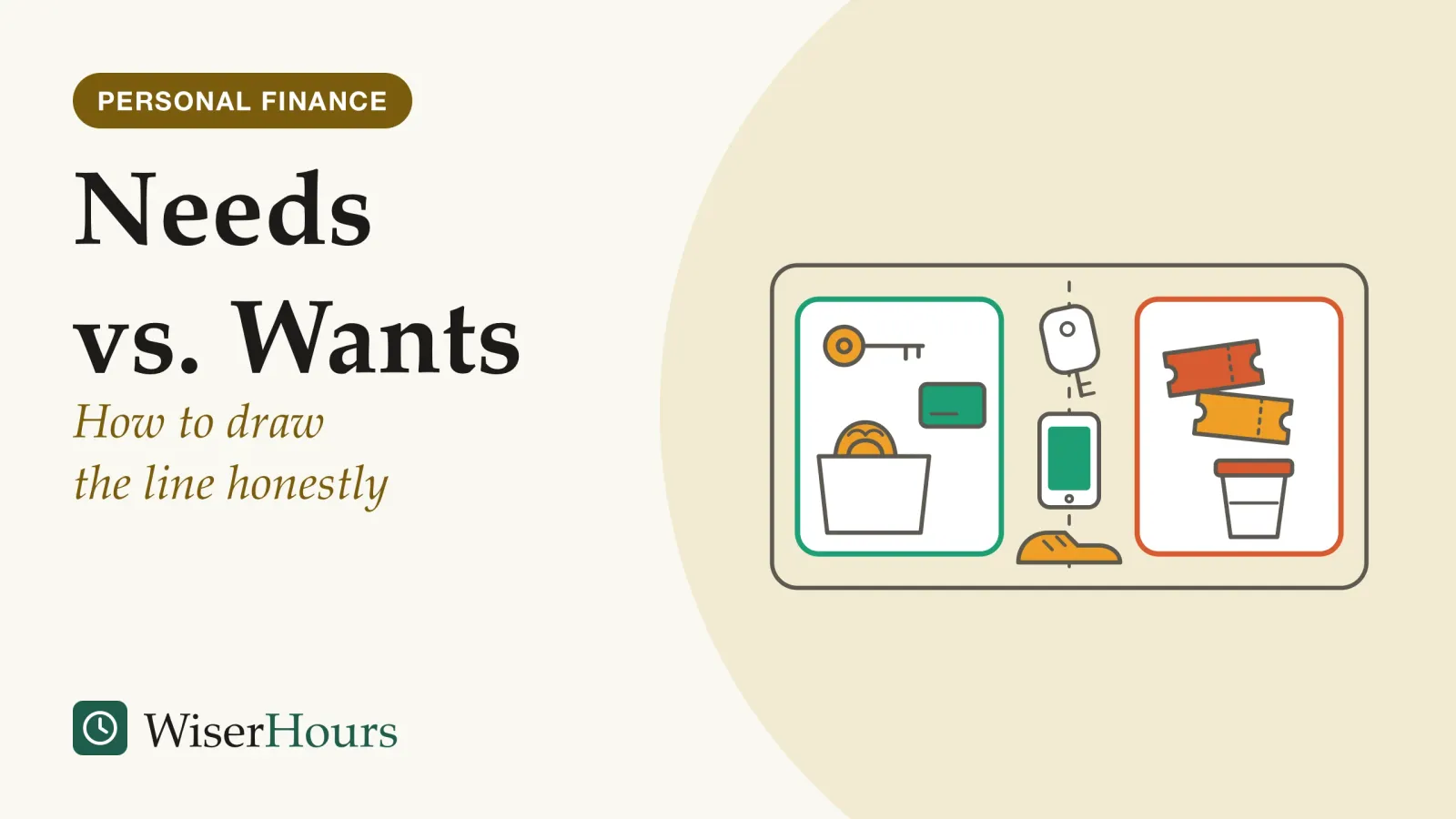
A car is where the classroom version of needs vs wants runs out. Canada’s Financial Consumer Agency uses it as its own example: near a bus route, a car may be a want, while someone with no transit nearby may need one.1 One item can sit on either side of the line depending on the life around it, so a fixed list stops helping at the first hard case.
A need is what you must pay to live, earn an income and protect what you have; a want is an upgrade on that, or an extra. That three-part line comes from a 2022 teaching guide by the US Consumer Financial Protection Bureau (CFPB).2 For the grey areas, four honest tests settle most cases:
- Price the plain version of the need
- Ask what a month without it would cost you
- Check whether it keeps you earning or healthy
- Adjust for where you live, who depends on you and how you work
Sorting costs this way is one step of making a budget from scratch, covered with its neighbours in the budgeting section, and it decides which costs are committed and which are choices.
What is the difference between needs and wants?
A need is a cost you have to pay to stay housed, fed, clothed, healthy, working and protected; a want is something you would like but could live without. The Financial Consumer Agency of Canada defines a need as something necessary, required or essential, and a want as something you’d like but don’t necessarily need. Its examples are the familiar ones: a roof over your head, clothing, food and medication on one side; restaurant meals, a trip, a gym membership and designer shoes on the other.1
The CFPB guide widens the need side in a useful way. Besides the basics people must have to survive, it counts resources needed to do a job, such as reliable transportation and the tools of the trade, and resources that protect money and property, such as emergency savingsemergency fund: Money kept in an account you can reach quickly, to cover unexpected costs or a drop in income without borrowing. How much to hold depends on your circumstances, and official guidance differs by country.Full entry in the glossary and insurance. Wants, in its wording, are upgrades and other things that would be nice to have but aren’t necessary for living, income or protecting what you have. The guide also tells teachers there may not be only one right answer, as long as the reasoning holds up.2
Moneysmart, the consumer site of Australia’s securities regulator, ASIC, lists essentials including rent or mortgage, groceries, energy and phone bills, medical costs, insurance and transport.3 The UK’s MoneyHelper uses “essential” and “non-essential”: essentials are costs you have no option but to pay, such as rent or mortgage, energy and food, while holidays, leisure and entertainment usually count as non-essential.4
The word “upgrades” carries most of the weight: a restaurant dinner is food with an upgrade attached, so one bill can hold both. Treat the agencies’ lists as a starting point and expect yours to differ in a few lines.
Four honest tests for grey-area spending
Grey-area costs such as a car, a phone, childcare or a gym sort cleanly once you ask four questions in order: what the plain version costs, what a month without it would do, whether it keeps you earning or healthy, and how your circumstances change the answer. The tests build on the official guides above; the order is WiserHours’ suggestion.
1. Price the plain version of the need
Most needs are a function, such as getting to work, staying reachable or eating, and many ways of meeting one cost more than the plainest reliable version. Split the bill: the cost of the plain version goes under needs, and the gap above it goes under wants.
Splitting one phone bill
Illustrative figures in euros, 2026. A phone plan with unlimited data and a new handset paid in instalments costs €65 a month. A SIM-only plan with enough data for work calls, maps and banking, on the handset already owned, would cost €20. In the budget, €20 goes under needs and €45 under wants.
The plain version has to be reliable. A cheap car that keeps failing, or a plan too small to receive a job’s messages, is a false saving, so price the cheapest option you could depend on.
- Transport: the plain version is the cheapest reliable way to reach work, school and shops from where you live; a newer or bigger car than that is an upgrade
- Phone: the plain version is a handset and plan that keep you reachable for work and services; extra data and the latest model sit above the line
- Exercise: a gym membership is one version of staying active, and official guides usually list it as a want; the cheapest way you will keep up is the base
2. Ask what a month without it would cost you
A need is a cost whose absence does damage; a want is one whose absence mostly disappoints. Picture a month without the item and ask what follows: losing your home, your power, your income, your health or your cover against a large bill points to a need, while missing a show or a favorite lunch points to a want.
MoneyHelper’s guide for people whose income has dropped suggests putting non-essentials in order of priority and cutting the least important until you are within budget.5 The month-without test produces that order. Cancelling a streaming service costs some evenings’ entertainment; dropping insurance can leave one accident between you and a bill you cannot pay.
3. Check whether it keeps you earning or healthy
Spending that protects your income or your health earns a place on the need side, even when it looks like a luxury on paper. The CFPB guide counts reliable transportation and the tools of the trade as needs because people use them to do their jobs, and childcare that lets a parent work fits the same logic.2
This is also the easiest test to stretch, so add one follow-up: would the cheaper version do the job just as well? A laptop for freelance design work is a need; the top model may be a want. MoneyHelper lists a gym membership among non-essentials, since the need is staying active and a particular gym is one way to meet it.5
4. Adjust for where you live, who depends on you and how you work
Your circumstances decide which version of a need is the plain one. Besides the car, the Canadian agency gives the example of a larger home that is a need while you raise a family and may shrink once the children move out.1 The most detailed public example of this kind of adjustment is the UK’s Minimum Income Standard.
The study
Moderate evidence
What a minimum budget must cover, as UK residents decided it (JRF, 2026)
Since 2008, researchers at Loughborough University have asked groups of UK residents to agree, item by item, what different households need for a minimum socially acceptable standard of living: more than food, clothes and shelter, enough to take part in society. After a full rebuild in 2024, groups reviewing the budgets in 2026 agreed that households without children in towns and cities would not need a car, relying on buses and some taxi trips, while families with children need one second-hand car. Each adult’s budget includes an inexpensive smartphone, and families’ budgets include full-time childcare for younger children so that parents are not shut out of paid work.6
The method draws the line separately for each kind of household, which is the habit worth copying. It reflects UK towns and cities outside London and assumes good health, and the report says it does not cover extra needs from living somewhere remote or having a disability. Teams in Ireland, France, Portugal, Japan, Singapore, Thailand, Tunisia and Mexico have used the same broad method, so your country may have its own version.6
Is a car, a phone or childcare a need?
A car, a phone or childcare is a need when it keeps you working, reachable or safely housed in your circumstances, and a want when a cheaper option would do the same job.
A phone is a need for most adults today, because work, banking and public services expect you to be reachable, and Moneysmart lists phone bills among essentials.3 Home internet is similar: the European Union’s measure of material and social deprivation counts an internet connection among 13 items it describes as necessary and desirable for an adequate life.7
| Grey area | Usually a need when | Usually a want when |
|---|---|---|
| Car | No workable public transport for work, school or care; children in the household | Buses, walking or occasional taxis cover the trips, or the model is above the plain version6 |
| Phone | You need to be reachable for work, services and banking | Extra data, a new handset each year3 |
| Childcare | It lets a parent work or study | It covers hours when you could care for the child yourself6 |
| Home internet | Work, school or public services run online | A faster package than you use7 |
| Gym | Rarely; the need is staying active | A membership you could replace with a cheaper activity5 |
The table is WiserHours’ reading of the official guides cited in each row; your own answers come from the four tests.
Why the line between needs and wants keeps moving
What people call a necessity follows time, income and place, so someone else’s list will not fit your life. In US polls reported by Pew Research Center, 32 percent of adults called a microwave oven a necessity in 1996, 68 percent in 2006 and 47 percent in 2009, after the recession began.89
- Myth
- Needs are a fixed list that is the same for everyone.
- Fact
- Canada's consumer agency says needs and wants differ between people and change over time, as when a family grows or children leave home.
In Pew’s 2006 survey, adults with higher family incomes were far more likely than lower-income adults to call most of 14 everyday items necessities, and people in rural areas rated fewer as necessities than city and suburban residents.8 Those are opinion surveys of US adults, and they show what people said rather than what anyone required, which makes the feeling of necessity a poor measuring stick for your own budget. The same drift happens inside one household: a second streaming service added for one series can feel essential a year later simply because everyone now uses it. When a cost feels essential, especially one that arrives with a ready-made reason such as “it’s for work”, trust the four tests over the feeling before you file it as a need.
Needs vs wants in a budget, without the shame
The sort is a planning tool that shows which spending is committed and which is choice, so you know where the room is when money tightens. MoneyHelper says splitting spending into essentials and non-essentials makes it easier to see what you are committed to and what you might cut back on.4
The 50/30/20 split is a handy way to teach the sort: in a 2022 CFPB lesson plan, half of take-home pay goes to needs, 30 percent to wants and 20 percent to savings, with a note for teachers that the rule will not fit every household.10 If your needs take more than half, that tells you about rents and prices where you live and nothing about your character.
Wants also deserve a line of their own. The EU’s deprivation measure counts regular leisure, a small weekly amount spent on yourself and a monthly meal or drink with friends among its 13 items for an adequate life.7 Even the UK minimum budget, which its authors say covers needs and leaves out wants, includes about £64 a week for social and cultural participation for a single working-age adult, at April 2026 prices.6 A budget with nothing in that line is leaner than the minimum the public itself agreed.
To use the sort, mark each line of a month’s statements as need, want or split (the guide to tracking your spending from statements shows how to gather them), and write a one-line reason beside every grey item. A reason you can read back is harder to stretch than one you only feel. If wants keep beating the plan through unplanned purchases, the tactics for curbing impulse buying cover that problem.
Sorting one month of spending
If your needs alone cost more than you earn
When the need column alone is larger than take-home pay, cutting wants cannot close the gap, and the problem is income or prices. In the UK in 2026, a single adult working full-time on the National Living Wage, the legal minimum for those aged 21 and over, had just under three-quarters of the income the public agreed a minimum standard needs.6 The tiers below are WiserHours’ ordering of official advice from several countries.
- Now: if you are behind on rent, food or energy, or a creditor or court has started action against you, reach free debt advice straight away. If money stress brings thoughts of suicide or self-harm, call your local emergency number; in the US, the 988 Lifeline takes free, confidential calls and texts.11
- Soon: if needs have outrun income two months running, book a free adviser in the next few weeks. In the US, the CFPB describes credit counselingcredit counseling: Help with budgeting and debts from a trained counselor, which in the US usually comes from a non-profit organization and may include a debt management plan. Not every provider is non-profit or free, and some have defrauded people, so check fees and credentials first.Full entry in the glossary organizations as generally non-profit, with free or low-cost help on offer, and warns that some services charge fees.12 In the UK, the GOV.UK guide to dealing with debts points readers to MoneyHelper for information on free debt advice services.13 In Australia, the National Debt Helpline is free and puts callers in touch with financial counsellors; Moneysmart adds that early help leaves more options open.14 In other countries, search for free debt advice from a charity or a government service.
- Routine: before a big personal decision, such as moving to cut rent, changing jobs or borrowing a large sum, a qualified, regulated financial adviser can review the numbers with you.
The bottom line
Your needs are set by where you live, who relies on you and how you earn, and the plain version of each one marks where the want begins. This month, mark every line of one statement as need, want or split, price the plain version of each grey item, and write down why it belongs where you put it.
This article is general education, not financial advice. For decisions about your own money, speak to a qualified, regulated adviser.
Frequently asked questions
Is rent always a need?
A home is a need, but the size and location of a home can include a want. The Financial Consumer Agency of Canada gives the example of a large house that is a need while you raise a family, when a smaller home may be what you need once the children move out. Moving is costly, so the practical step is to count today's rent as committed and revisit the choice at the next lease or move.
Are savings a need or a want?
Emergency savings count as a need in the US Consumer Financial Protection Bureau's 2022 teaching guide, which lists them with insurance as resources that protect your money and property. The same agency's 50/30/20 teaching rule gives savings a share of their own, separate from needs and wants. Either way, neither guide files emergency savings under wants.
Where do debt repayments go: needs or wants?
Treat at least the required repayments as committed. Australia's Moneysmart tells readers to add debt expenses, such as loan and credit card repayments, right after essentials when listing costs, and the US Consumer Financial Protection Bureau's 50/30/20 teaching rule places paying down debt in the savings share. Payments above the minimum are a choice, and a free debt adviser can help weigh them against other goals.
Can a want become a need?
Yes. The Financial Consumer Agency of Canada says needs and wants are not the same for everyone and may change over time, for example as a family grows or children leave home. A new job far from a bus route, a health condition or a baby can turn a want into a need, and the reverse happens too, so the sort is worth repeating when life changes.
Sources
- Making a budget. Financial Consumer Agency of Canada (date modified 21 August 2025)
- Budgeting for needs and wants (Building Blocks teacher guide). Consumer Financial Protection Bureau (US), Summer 2022
- How to do a budget. Moneysmart, Australian Securities and Investments Commission (last updated 9 October 2026)
- How to create a household budget for your family. MoneyHelper, Money and Pensions Service (UK), last updated 16 June 2026
- Review your budget after a drop in income. MoneyHelper, Money and Pensions Service (UK)
- A Minimum Income Standard for the United Kingdom in 2026. Blackwell, C., Stone, J., Balchin, E., Ellis, W., Padley, M. & Davis, A. (2026). Joseph Rowntree Foundation, 8 September 2026
- Glossary: Severe material and social deprivation rate (SMSD). Eurostat, Statistics Explained (European Union), last edited 9 April 2026
- Luxury or Necessity? Things We Can't Live Without: The List Has Grown in the Past Decade. Pew Research Center (US), December 2006
- Luxury or Necessity? The Public Makes a U-Turn. Pew Research Center (US), April 2009
- Learning about budgets (Building Blocks teacher guide). Consumer Financial Protection Bureau (US), Summer 2022
- 988 Suicide & Crisis Lifeline. 988 Suicide & Crisis Lifeline (US)
- What is credit counseling? Consumer Financial Protection Bureau (US), last reviewed 2 August 2023
- Options for dealing with your debts. GOV.UK, UK government guidance
- Financial counselling. Moneysmart, Australian Securities and Investments Commission (last updated 9 September 2026)
How we researched this
We read the needs-and-wants and budgeting guidance of the Financial Consumer Agency of Canada, the US Consumer Financial Protection Bureau, Australia's Moneysmart and the UK's MoneyHelper, the Joseph Rowntree Foundation's 2026 UK Minimum Income Standard report, the EU's material deprivation definition and Pew Research Center surveys, found through web searches in October 2026. Sources date from 2006 to 2026. Main limitation: no trial tests ways of sorting needs from wants, so the four tests rest on official guidance and our reasoning.
Keep reading
Gross vs. Net Income: Which Number Your Budget Should Start From
Gross vs net income: gross is pay before deductions, net is take-home pay. Why the US CFPB builds budgets and 50/30/20 on net, and when gross counts.
How to Make a Budget: A Step-by-Step Guide for Beginners
How to make a budget in 6 steps from US, Canadian and Australian government guides, plus what 2022 research shows about why spending estimates run low.
How to Save Money on Groceries Without Clipping Coupons All Day
How to save money on groceries: 7 moves ranked by effort, from checking the fridge to unit prices, and when coupons and bulk buys backfire.
Zero-Based Budgeting for Beginners: How to Plan Where Every Dollar Goes
Zero-based budgeting gives every unit of pay a job: 5 steps, a worked month in any currency, and what to do when a category runs dry. Evidence is thin.