How to Track Your Spending Without Losing Your Mind
How to track spending in 5 steps, from government money guides and from research linking regular progress checks to reaching goals.

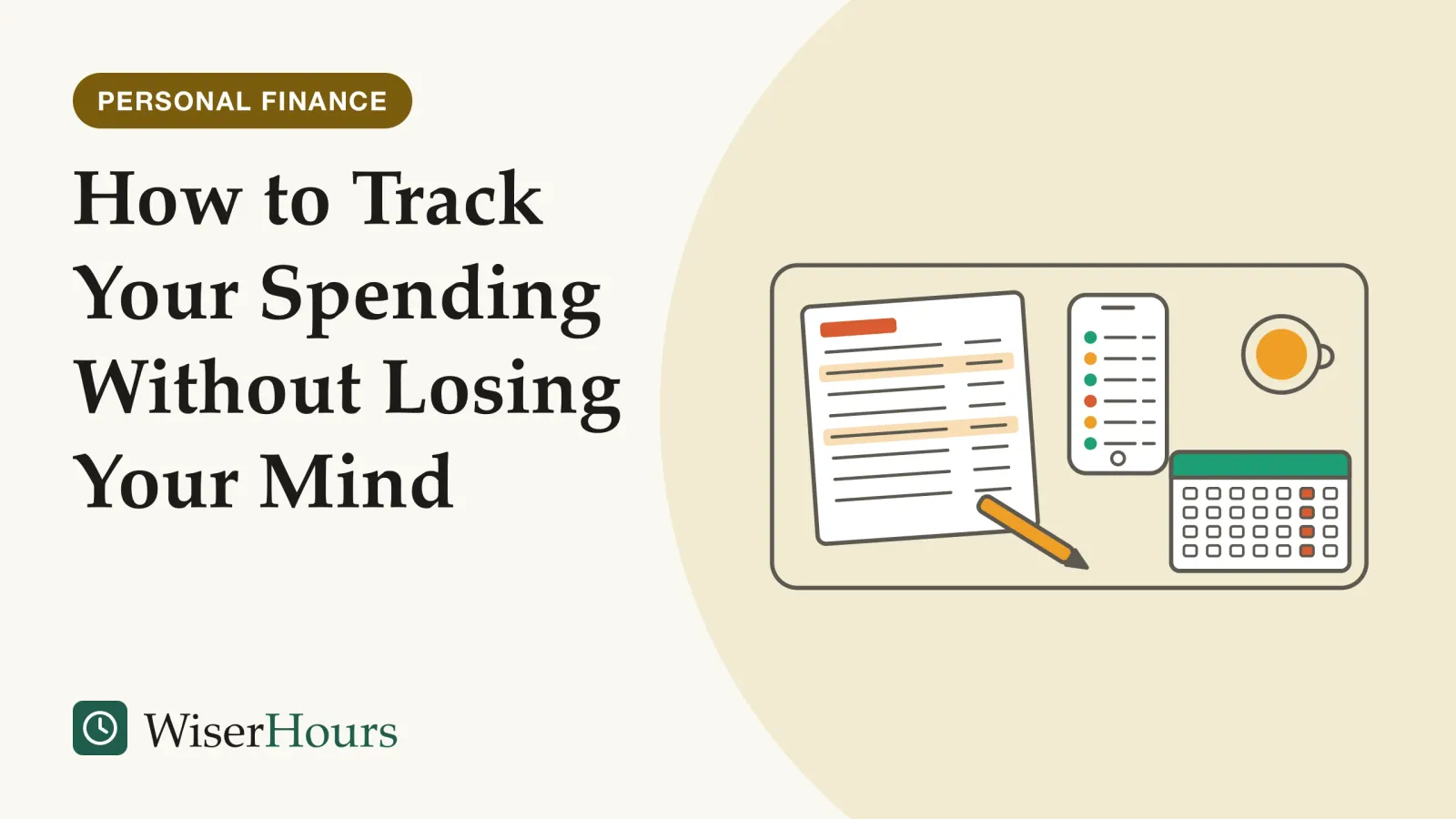
Tracking your spending works less like bookkeeping and more like a mirror. Research on monitoring progress toward goals, mostly in health, links the benefit to how often people check their results, and nothing in it requires logging every coffee perfectly. That is good news for anyone who has tried a spending diary and given up in week two.
How to track spending without it taking over your week comes down to five habits, taken from Australian and Canadian government money guides and from research on self-monitoring:
- Read back through a few months of statements
- Pick one way to catch the rest, cash included
- Sort spending into five or six groups
- Check the totals at a fixed time each week
- Change one thing, then look again
If you have not yet set up a plan, start with how to make a budget step by step; this guide goes deeper on one part of it, keeping an honest record without it becoming a second job.
Why looking at your spending helps
A 2016 meta-analysismeta-analysis: A study that combines the results of earlier studies on the same question into one overall estimate. Pooling makes the estimate more precise, but it cannot repair the studies it pools: a meta-analysis of surveys is still survey evidence.Full entry in the glossary by Benjamin Harkin and colleagues, pooling randomized studies, most of them on health goals, found that people prompted to check their progress made more progress toward their goals, with larger benefits in studies where they wrote the results down. The reason, as the authors explain it, is feedback: checking shows the gap between where you are and where you meant to be, and so tells you when more effort is needed.1
Think of someone who believes she spends a modest amount on takeaway food each month. She never checks, so the belief never meets a number. After a few weeks of adding up her card statement she sees the real figure, and the gap itself does the persuading. No willpower was involved yet; she simply looked.
The study
Moderate evidence
138 studies on checking progress, pooled by Harkin and colleagues in 2016
Researchers at the universities of Sheffield, Leeds and North Carolina pooled experiments that randomly assigned people either to a prompt to monitor their progress or to no prompt. The prompts made people check far more often, and the prompted groups made more progress toward their goals, an average effect the authors call small to medium. The benefit was larger in studies where people physically recorded what they found, and where they reported it to someone or made it public rather than keeping it private. A further analysis, of 21 studies, suggested that the extra checking itself explained part of the benefit. The authors found some signs that small positive studies were overrepresented, so the true effect may be smaller than the average.1
For money, the lesson comes by analogy, because none of the pooled studies was about spending. Still, the pattern matches what budgeting guides describe, and the practical parts (look often, write it down, share it) cost nothing to try.
The same review holds a subtler lesson, from smaller comparisons within it. Monitoring a behavior, such as how often you eat out, mainly changed that behavior, while monitoring an outcome, such as your weight, mainly changed the outcome.1 In money terms, counting takeaway orders watches a behavior, and the balance left at the end of the month is an outcome.
How to track spending in five steps
The five steps below lean mostly on government guidance from Australia and Canada, with the monitoring research behind the regular look. They begin with records you already have and finish with a single change, because the point is to learn where the money goes, not to audit yourself.
- Capture: statements do most of it; add cash and anything else with one method you will keep
- Look: a fixed weekly check of the totals; in research on goals, mostly in health, the extra checking appeared to explain part of the benefit
- Act: change one thing at a time; in an experiment with young people, an app for recording spending did not change saving
1. Read back through a few months of statements
Australia’s Moneysmart suggests a simple first step: review your bank statements or app transactions for the past few months, so you see both regular and occasional costs. As you go, it suggests grouping them into categories, highlighting bills that come quarterly or yearly, checking for fees you do not recognize and looking for subscriptions you no longer use.2
Statements do most of the recording for you, which is why this step comes first; the section on memory below explains why a remembered total is a poor substitute.
2. Pick one way to catch the rest, cash included
For day-to-day spending, Moneysmart suggests writing down everything you spend for the next couple of weeks, on your phone, in a notebook or in a budgeting app, and including cash purchases, which are easy to forget. It also notes that many banks’ apps sort spending into categories automatically.2 The Financial Consumer Agency of Canada’s advice is to keep track of everything you buy, from groceries to a daily coffee, for 1 or 2 months.3
The trade-off is effort against attention. Automatic sorting saves work; writing an amount down makes you notice it, and in the monitoring review, studies where people physically recorded their results found larger benefits.1 We found no study that compares the two methods for money, so choose whichever you expect to keep up a month from now.
- Myth
- Tracking only works if you record every purchase by hand.
- Fact
- Statements already record card spending. Research on monitoring goals, mostly in health, points to regular checking and writing down what you find.
3. Sort spending into five or six groups
Fewer categories make the totals easier to read. Moneysmart’s examples are food, transport, home, health and fun, and both it and the Canadian agency suggest sorting costs into needs and wants.23 Five or six groups can show where money goes: splitting takeaway from groceries reveals a habit, while splitting groceries into twelve kinds mostly creates sorting work.
4. Check the totals at a fixed time each week
Put a short weekly check in your calendar and keep it even after a bad week. In the monitoring review, a further analysis suggested the extra checking explained part of the benefit, and studies where people shared their results found larger effects.1 Moneysmart suggests that people who share money with a partner track spending together.2 No study we found compares weekly with monthly checks for money, so treat weekly as a sensible rhythm rather than a tested rule.
What a weekly check can look like
An illustration, not a rule. Open your banking app or statement in the same weekly slot, say Sunday evening. Note the week’s total and the total for the one category you are watching. Compare them with last week and with your plan. Write one sentence about what surprised you. Close the app.
5. Change one thing, then look again
Tracking shows where money goes; it does not change anything by itself. Moneysmart suggests picking one spending habit to start with and looking for quick wins such as switching to a cheaper phone or internet plan or cancelling subscriptions you do not use.2
A 2023 experiment with young people in Peru, published in the Journal of Economic Behavior & Organization, shows the limit. According to its abstract, which is all we had access to, young people given about six months of a budgeting app for recording spending, together with regular visits and text messages, scored higher on financial literacy and knowledge of prices, but their saving did not change and their use of credit rose.4 Young people are not most readers, and the app came bundled with other support, but the lesson carries: the record informs a decision you still have to make.
The checklist below gathers the first two weeks into one list you can tick off.
Two weeks to a working spending record
Memory is a poor record of card spending
Credit card payments were easier to forget than cash in small studies reported in a 2001 paper by Dilip Soman in the Journal of Consumer Research. In one of its small field studies, 30 adults with a single credit card underestimated the spending on their latest card bill by about 30 percent on average, against about 7 percent for cash and checks. These were small studies from an era of checks, and the author noted that the field studies were not controlled experiments.5
The paper’s explanation is rehearsal: writing a check makes you write the amount down, while signing for a card payment does not, so the amount leaves a weaker memory. In two experiments with students, past payments did more to dampen their stated intention to buy something else when the payment method had made them write the amount down.5
The same logic fits a modern week. Tap a card for lunch, a train fare and an online order, and none of the amounts had to be written or counted out, so none of them has much reason to stick. Your memory of last month is a guess, and your statement is a record. That is why step 1 starts from statements rather than from a remembered total.
People look away when money is tight
People tend to check their finances less when things are going badly, according to a 2025 study by Arna Olafsson and Michaela Pagel of logins to a money app used by about a fifth of adults in Iceland. Compared with their own usual habits, people logged in more on paydays and when they had more cash, and less once their accounts went into overdraft, falling further as the overdraft grew. The authors call this an ostrich effect, the avoidance of unpleasant information, and their data show patterns, not causes, so they cannot say that looking away made anyone’s finances worse.6
The pattern describes a familiar week: after an expensive month, the banking app is the last thing you want to open, and it is exactly when a look would help most.
There is some evidence linking easier looking to fewer costly slips. When the same Icelandic platform released a phone app in 2014, making balances quicker to check, users paid fewer fees for debit card payments declined for lack of funds, a finding from a quasi-experimentalquasi-experimental: Describes a study that compares a group that got something with a group that did not, where the researcher did not do the assigning: a policy, a rollout or people's own choices did. Because the groups were not formed at random, they may have differed before it started.Full entry in the glossary comparison rather than a randomized trial.7
The practical answer to the ostrich effect is to take the decision out of your mood, which is what the fixed slot in step 4 does. A check that happens at a set time, whatever the balance, does not depend on feeling ready for the news.
Tracking habits, ranked by the evidence behind them
The strongest evidence behind tracking comes from health goals, where checking progress regularly helps people succeed; direct evidence on spending is thinner, made up of small studies, one observational study, one quasi-experiment and one experiment with young people.
| Tracking habit | Best evidence found | Strength of evidence |
|---|---|---|
| Checking progress toward a goal | More progress toward goals, in studies nearly all on health; bigger where results were written down or shared | Meta-analysis, moderate for health goals (borrowed for spending)1 |
| Starting from statements, not memory | Card spending was remembered less accurately than cash in small 2001 studies | Small field studies and experiments, limited5 |
| Easier access to balances | Fewer fees for declined payments after a money app launched in Iceland | Quasi-experimental, moderate7 |
| Checking when money is tight | People logged in less as overdrafts grew; a pattern, not a cause | Observational, moderate6 |
| Recording spending in an app | Young people in Peru scored higher on financial literacy; no change in saving; more credit use | Experiment, limited (abstract only)4 |
| Few categories, one change at a time | Recommended in Australian government guidance; the weekly rhythm is our suggestion; none tested in trials | Expert guidance2 |
What this means for you: the regular look is the best-supported part, so protect the weekly slot first. The capture method, the categories and the pace of change are sensible defaults you can adjust to fit your life.
If what you find worries you
Tracking sometimes shows spending running above income month after month, and free help exists for that. WiserHours arranged the advice below by urgency; it comes from US, UK and Australian sources.
- Now: if you have thoughts of suicide or self-harm, whether or not money is part of it, get help straight away. In the US, the National Institute of Mental Health points to the 988 Suicide & Crisis Lifeline, by call, text or chat, and to 911 in life-threatening situations.8 In the UK, the NHS says to ring 999 or head straight to A&E if you might be about to harm yourself; in England, NHS 111 is open 24 hours a day and can help you find support.9 Anywhere else, call your local emergency number.
- Soon: if spending keeps beating income for longer than a month or two, get in touch with free debt advice within weeks. The CFPB, a US regulator, says in guidance last reviewed in 2023 that credit counseling is usually offered by non-profit organizations, which can help you develop a budget; it warns that some services may carry a fee and suggests looking an organization up with your state attorney general.10 The UK government’s debt guidance sends readers to MoneyHelper, which lists free services for advice on debt.11 Australia’s Moneysmart lists the free National Debt Helpline and notes that getting help early leaves you more options.12 In other countries, look for free debt advice run by a non-profit or the government.
- At your next planning point: choices that turn on your own situation, such as investing or taking on a large loan, belong with a qualified, regulated financial adviser.
The bottom line
The research behind tracking is about looking regularly, not logging perfectly. Start from your statements, pick one way to capture the rest, keep a handful of categories and look at the totals at a fixed time each week, especially when you would rather not. Then change one thing, because a record shows where money goes but does not move it.
This article is general education, not financial advice. For decisions about your own money, speak to a qualified, regulated adviser.
Frequently asked questions
How long should I track my spending before I change anything?
A few weeks to two months is a common starting point. The Financial Consumer Agency of Canada proposes tracking everything you buy for 1 or 2 months, and Australia's Moneysmart suggests reviewing the past few months of statements, then writing down daily spending for the next couple of weeks. After that, a weekly look at the totals is a reasonable rhythm, though no study we found tested one rhythm against another.
Do I need to track cash as well as card spending?
Yes, if you use cash, because it leaves no statement behind. Australia's Moneysmart says to include cash purchases when you write down daily spending, because they are easy to forget. A simple way is to note the amount as soon as you pay, or to record each cash withdrawal and keep a short note of what the cash went on.
What if tracking shows I spend more than I earn?
Treat it as useful information, not a verdict. Look for one or two changes you can make, such as an unused subscription or a costly plan, and if the gap persists, get advice early; much of it is free. In the US, non-profit credit counselors can help you develop a budget, according to the Consumer Financial Protection Bureau; in the UK, MoneyHelper lists free debt advice; in Australia, the National Debt Helpline is free.
Sources
- Does monitoring goal progress promote goal attainment? A meta-analysis of the experimental evidence. Harkin, B., Webb, T. L., Chang, B. P. I., Prestwich, A., Conner, M., Kellar, I., Benn, Y. & Sheeran, P. (2016). Psychological Bulletin, 142(2), 198-229
- Track your spending. Moneysmart, Australian Securities and Investments Commission (last updated 30 July 2026)
- Making a budget. Financial Consumer Agency of Canada (date modified 21 August 2025)
- Can a mobile-app-based behavioral intervention teach financial skills to youth? Experimental evidence from a financial diaries study. Frisancho, V., Herrera, A. & Prina, S. (2023). Journal of Economic Behavior & Organization, 214, 595-614
- Effects of Payment Mechanism on Spending Behavior: The Role of Rehearsal and Immediacy of Payments. Soman, D. (2001). Journal of Consumer Research, 27(4), 460-474
- The Ostrich in Us: Selective Attention to Personal Finances. Olafsson, A. & Pagel, M. (2025). The Review of Economics and Statistics, published online 5 March 2025
- Mobile Apps and Financial Decision Making. Carlin, B., Olafsson, A. & Pagel, M. (2023). Review of Finance, 27(3), 977-996
- Suicide Prevention. National Institute of Mental Health (US), last reviewed August 2026
- Help for suicidal thoughts. NHS website (NHS England), page last reviewed 26 April 2024
- What is credit counseling? Consumer Financial Protection Bureau (US), last reviewed 2 August 2023
- Options for dealing with your debts. GOV.UK, UK government guidance
- Financial counselling. Moneysmart, Australian Securities and Investments Commission (last updated 9 September 2026)
How we researched this
We searched PubMed, Crossref, Google Scholar and consumer finance regulators' websites during September 2026 for reviews, trials and large studies on self-monitoring and on spending tracking, and read Australian and Canadian government guidance. The sources run from 2001 to 2026. The chief limitation: the strongest evidence on monitoring comes from health goals, and we found no systematic review or large trial of spending tracking itself.
Keep reading
How to Budget With Irregular Income: A Guide for Freelancers and Gig Workers
In a 2025 Fed survey, 58% of self-employed US adults said their income varied month to month. How to budget around a lean month, a buffer and tax.
Cash Stuffing Explained: Does Paying With Cash Really Cut Spending?
Cash stuffing puts spending money in labelled envelopes. A 2024 review of 71 papers finds people spend only slightly less with cash, and the gap is shrinking.
Emergency Fund Basics: What It's For, How Big, and Where to Keep It
An emergency fund keeps a shock from becoming debt. Why 3 to 6 months is a rule of thumb, a smaller first target, and where the cash is protected.
How to Make a Budget: A Step-by-Step Guide for Beginners
How to make a budget in 6 steps from US, Canadian and Australian government guides, plus what 2022 research shows about why spending estimates run low.