Job Hopping vs. Staying Put: What the Evidence Says About Pay and Growth
In August 2026, US job switchers' median pay rose 5.0% a year before inflation vs 3.6% for stayers. When job hopping pays, its costs, how recruiters see it.

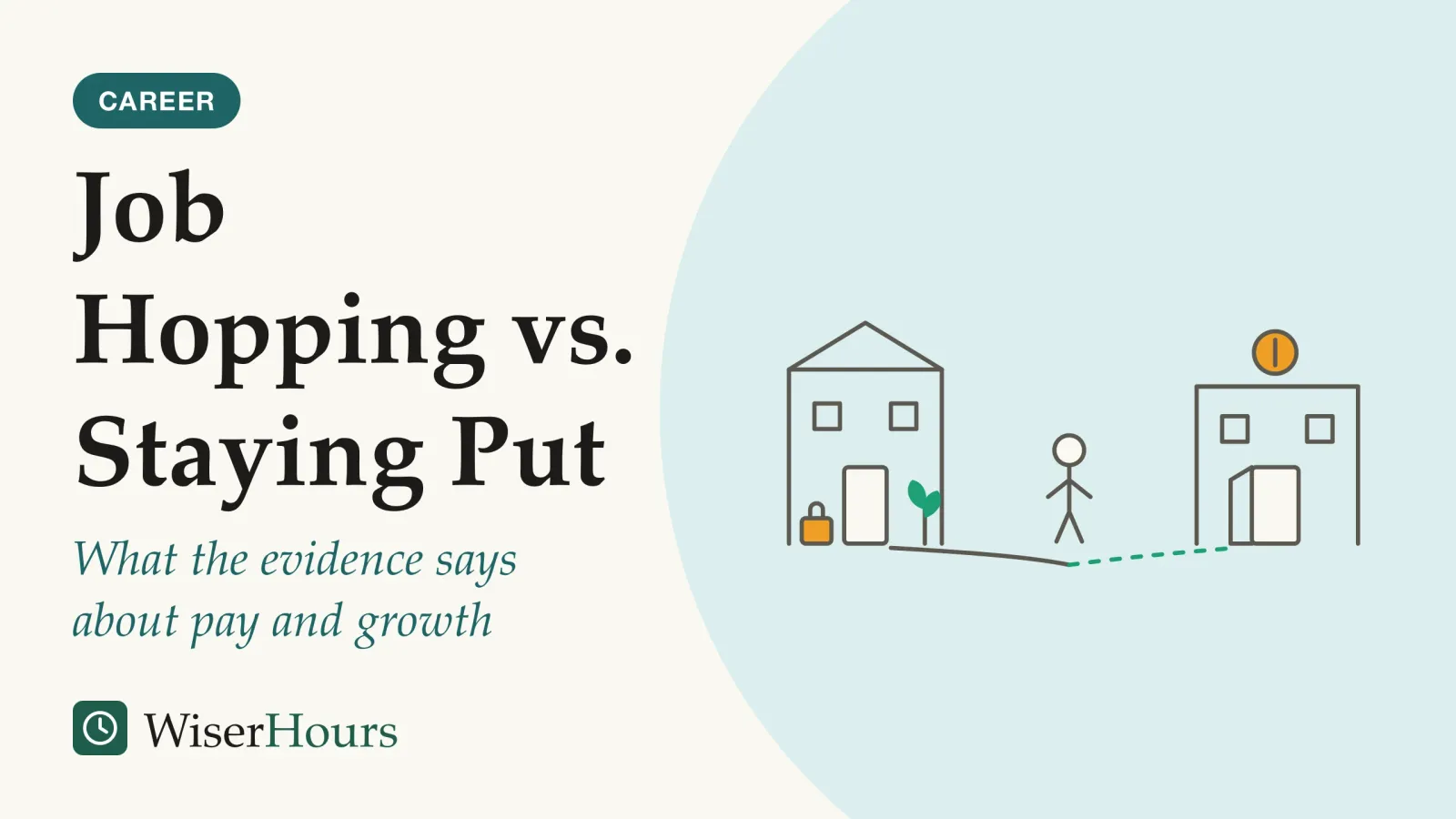
For six months in 2025, Americans who changed jobs saw their pay grow slightly more slowly than people who stayed put, a reversal of the usual order in the Atlanta Fed’s Wage Growth Tracker. Since then the familiar gap has returned: over the 12 months to August 2026, the median US worker who had switched jobs saw hourly pay rise 5.0 percent before inflation, against 3.6 percent for those who stayed.1
So job hopping usually comes with faster pay growth in the short run, but the premium swings with the job market and hides a wide spread of results. As a working rule, the pay gain from moving tends to be largest early in a career and when employers are hiring hard; the case for staying grows later on and when hiring is slow. Either way, set a real offer against everything you would leave behind: know-how that only counts where you are, pay that has not vested yet, and a record the next employer will read. This spoke takes one choice from what the research says about career growth and weighs it in detail.
Do job hoppers earn more? What US and UK pay data show
Yes, on average, in official data from both countries. The Atlanta Fed follows the same US workers 12 months apart and compares median hourly pay growth, averaged over three months, for people who changed jobs with people who did not; switchers have been ahead in most months since 1997.1 The UK’s Office for National Statistics found the same pattern in employer pay records from 2000 to 2018: in 2018, job changers’ median hourly pay grew more than twice as fast as stayers’.2 Its 2022 update found changers still ahead in pandemic-affected data for April 2021, although stayers’ average hourly pay was still 17 percent higher.3
Why would moving pay better than waiting? The ONS offers a plain reason: stayers’ pay is more closely tied to pay settlements that lag the economy, while a new employer has to beat your current pay to win you over.2 In our own gloss, your current employer sets your raise from a budget shared by everyone, while a rival sets its offer by what it takes to hire you.
Two caveats change how to read the headline. First, the Atlanta Fed counts as a switcher anyone who changed employer, occupation, industry or duties, so its “switchers” can include people whose duties changed without a new employer.1 Second, the people who move are not a random slice of workers: self-selectionself-selection: When the people in a study chose to take part, or chose the thing being studied, rather than being picked or assigned. Volunteers and choosers can differ from everyone else, so the result may not apply more widely or may reflect who chose rather than what they chose.Full entry in the glossary means some would have done well anyway, and others moved because they were laid off. The ONS could not tell voluntary from forced moves in its data.2
The average also hides a wide spread. In the ONS analysis, stayers’ pay growth was clustered: the bottom quarter saw no growth and the top quarter about 10 percent or more. Changers ranged far more widely, from pay cuts in the bottom quarter to growth of around 25 percent or more at the top.2
- Myth
- Job hopping always pays more than staying.
- Fact
- On average, changers' pay usually grows faster, but the gap reversed in the 2009 recession, and in UK data the bottom quarter of job changers took a pay cut.
Picture two analysts who each change employer in the same year. One trades up to a bigger role at a firm that is growing; the other takes a similar title after a restructuring, at a lower rate, to avoid a gap. Both count as job changers in the statistics, and their results average out to a healthy-looking premium neither of them actually got.
Read the average switching premium as a sign that the market often pays more than your employer’s budget allows, not as a forecast for your own move or for other countries. Only a real offer shows what moving would pay you.
Why the job-hopping premium rises and falls with the job market
The premium for moving rises and falls with the economy, in the US and UK data alike. In the Atlanta Fed series, the gap between switchers and stayers peaked in late 2022; during the 2009 recession switchers’ median pay growth fell below stayers’, and it has slipped slightly behind a few times since, most recently for six months of 2025.1
Stayed in the same job Switched jobs
- August 2009, recession: stayers 2.8%, switchers 1.7% (switchers behind stayers)
- November 2022: stayers 5.5%, switchers 8.2% (the widest gap since the series began in 1997)
- August 2026, latest: stayers 3.6%, switchers 5.0% (switchers ahead again)
Median 12-month change in hourly pay, US, 3-month averages, not adjusted for inflation. Source: Federal Reserve Bank of Atlanta, Wage Growth Tracker.
The UK shows the same rhythm in how many people move at all. The ONS found about 6 percent of workers changed jobs in 2010, after the downturn, against about 11 percent in 2017 and 2018, and it described changers’ pay growth as more cyclical and quicker to react than stayers’.2
The ONS suggested the 2010 low may have reflected a more risk-averse mood among workers after the downturn.2 In our own reading, when hiring freezes, fewer offers arrive, more moves are forced by layoffs, and the people who do move often take what they can get. Staying put in a slack market is not timidity; it is avoiding a draw from a worse pool of offers.
Watch the signals you can see from where you sit: how quickly recruiters answer, how many roles like yours are advertised, whether peers who left got better offers. If offers are thin, the case for moving on pay alone is weak, whatever the long-run average says.
Early career versus later: who gains most from moving
In the evidence available, the pay gain at a move is largest in the first years of work, when people are still finding a job that fits. Robert Topel and Michael Ward’s study of young white US men from 1957 to 1972, summarized in the career growth guide, adds a detail that matters here: for men with 7.5 to 10 years of experience, the average gain at a move was only half the typical gain across the first decade.4
Later moves carry more to lose. After several years in one place you know its systems, people and history, and some of that does not transfer. The ONS saw a flattening too: younger workers’ pay grew faster whether they moved or not, while since 2010 pay growth for those aged 35 and over was subdued for movers and stayers alike, with changers’ results again spread more widely.2
For a graduate in a second job, a move that brings a better fit often costs little. For a manager ten years into a firm, the same move means starting over on reputation and relationships, so it needs a bigger reason than a modest raise.
The further into a career you are, the more a move should be judged by what the new role adds (scope, skills, a better fit) rather than by the raise alone, because the raise tends to shrink while the cost of starting over grows.
What staying buys you: know-how, vesting and trust
Staying builds value that an outside offer does not price in. In a 2011 study of 2003 to 2009 personnel records at the US investment banking arm of a financial services firm, Matthew Bidwell found that outside hires were paid about 18 percent more than workers promoted into similar jobs, yet received lower performance ratings for their first two years and were more likely to leave.5
Bidwell’s explanation is twofold. Newcomers must learn skills specific to the firm before they perform as well as insiders, and employers know less about outsiders, so they lean on visible signals such as experience and education, and pay for them. The hires’ ratings caught up with the insiders’ over about three years, which Bidwell reads as a sign that they were not less able, only new.5 This is one firm in one industry, and the records show associations rather than causes.
The flip side matters for anyone staying: in the same firm, the promoted insiders’ base salaries were projected to take about seven years to catch up with the hires’, and their total pay never to catch up, so loyalty did not close the pay gap.5 Staying can also mean watching new colleagues join above you, a pattern known as salary compression.
Money on a timer is the other cost. Under US rules as of 2026, as the IRS sets them out, the money you put into a 401(k) plan401(k): A US workplace retirement plan in which employees save part of their pay, often with a matching contribution from the employer and tax advantages. Contribution limits, vesting of the employer's money and plan terms are set by US rules and each plan's documents.Full entry in the glossary yourself is always yours, but an employer’s contributions may vest over as long as six years of service, and any share not yet vested may be lost on departure.6 If you hold share awards or a retention bonus, check their terms for dates too. Pension and share rules differ by country and plan, so outside the US look up your own scheme’s terms or ask its provider.
Before you compare offers, write down every amount that depends on still being employed on a certain date, with the date, and ask your plan administrator or HR which of it you would keep. For large sums, a regulated or fee-only financial adviser can check them against your situation; for unclear contract terms, a union or local employment advice service can help.
How recruiters read a record of short stints
Frequent moves can cost callbacks, but the penalty depends on the occupation. The strongest evidence comes from field experimentsfield experiment: An experiment run in a real setting, such as a workplace, shop or website, with people going about their ordinary lives, usually with random assignment. It shows how an effect plays out in practice, though often for one setting and one group at a time.Full entry in the glossary, where researchers send matched fictitious resumes to real job ads and count the replies; a recent one ran in the US from 2019 to 2021.7
The study
Moderate evidence
Four employers or one: the same eight years on paper
Each fictitious applicant had a bachelor’s degree, eight years of experience and four positions. The job-hopper version moved to a new employer at each step; the stable version stayed with one employer and was promoted internally. Employers hiring for human resources, financial reporting, marketing and IT penalized the job hoppers, and in the three non-technical occupations callbacks were about a third lower than for stable resumes. Employers hiring software testers did the reverse and penalized the stable resumes. Pooled across all five occupations, the gap between the two kinds of resume was too small to rule out chance.7
The lesson is that there is no single rule: most of the jobs tested still preferred steady histories, and one tech job preferred movers. Because the resumes gave no reasons for the moves, the study leaves open whether explaining them helps. It measured only the first screen, and it was funded by a Canadian government research council.7
An earlier experiment in Switzerland, published in 2021 by Alain Cohn and colleagues, sent paired applications for administrative and clerical jobs and found that applicants with four employers got noticeably fewer callbacks than those with one over the same eight years. A follow-up survey experiment with human resources professionals suggested why: frequent changes read as a sign of poor work attitude.8
Surveys of recruiters are weaker evidence, because they record what managers say rather than whom they call back. In a June 2026 survey of 1,500 US hiring managers by Resume Genius, a company that sells resume tools, 65 percent named job hopping as a red flag; the firm itself says comparisons with its earlier surveys are only directional because the questions changed.9 Treat such figures as a mood reading, not a measurement.
What counts as short also varies by country. OECD data for 2025 put employees’ average time with their current employer at about 6.5 years in Korea but about 10 across the EU, so the same record can look restless in one market and ordinary in another.10
That advice is our reading, not a tested finding. The same habit helps with explaining a gap in your employment history.
Job hopping or staying: a verdict by situation
The evidence supports a conditional answer: moving has the strongest case early in a career and in a tight job market, and staying the strongest case later on and when hiring is slow. Everything else is a comparison of your own numbers.
| What it is | What the best evidence found | Evidence |
|---|---|---|
| Pay premium for switching | Switchers’ median pay growth is usually higher than stayers’ in the US | Official survey data, US, monthly since 19971 |
| Spread of outcomes | UK changers’ pay growth ranged from cuts to large rises; stayers’ was steadier | Official employer records, UK, 2000-20182 |
| Career stage | By years 7.5 to 10, the average gain at a move was half the first decade’s typical gain | Observational, young US men, 1957-724 |
| Staying | Promoted insiders were rated higher than outside hires at first but were paid less | Observational, one US investment bank, 2003-095 |
| Recruiters | Frequent movers got fewer callbacks in most occupations tested | Field experiment, US, 2019-21, moderate7 |
Four questions turn the evidence into a decision; the weighting is yours.
Four checks on any offer
How much of the raise survives after counting unvested pay and benefits you would lose? Is hiring in your field fast or slow right now? Does your field read short stints badly, going by the job ads and people you know? Would the new role add something you cannot get where you are?
If the honest answer is that you would stay for fair pay, ask for it first; how to ask for a raise covers that step. If your employer answers an outside offer with a counteroffer, weigh it against the same list, because it changes the pay but not the other reasons you looked. Once you choose to move, plan the job search in stages before you resign.
The bottom line
People who change employer usually see faster pay growth than those who stay, but the gap depends on the job market, narrows as a career matures, and hides many moves that paid less. Staying builds skills, standing and sometimes money that only count where you are. Before you move, put the offer next to everything you would leave behind, dated and in writing, and check how your field reads the move.
This article is general education, not financial advice. For decisions about your own money, speak to a qualified, regulated adviser.
Frequently asked questions
How long should you stay in a job before moving on?
No study sets a safe minimum. In a 2025 US resume experiment by Matissa Hollister and colleagues, the profile that employers in several occupations penalized changed employer about every two years over eight years. Norms also differ by country: OECD data for 2025 put employees' average time with their current employer at about 6.5 years in Korea and about 12 in Italy.
Does job hopping affect retirement savings?
It can, where employer contributions vest over time. Under US rules described by the IRS, your own 401(k) contributions are always yours, but an employer's contributions can vest on a schedule of up to six years (as of 2026), and unvested amounts may be forfeited on leaving. Rules differ by country and plan, so read your plan documents or ask the plan administrator before you decide.
Does a move inside the same company count as job hopping?
That varies by data source. The Atlanta Fed's tracker counts a change of duties as a switch. In the Office for National Statistics' UK analysis, people it classed as moving within a firm had slower pay growth than those moving between firms. In the 2025 US resume experiment, the stable profile's four roles were internal promotions at one employer.
Do job hoppers earn more over a whole career?
Nobody has settled that for today's workers. Robert Topel and Michael Ward's study of young white US men from 1957 to 1972 found that pay rises at moves accounted for at least a third of early-career pay growth, and the official series here compare one year at a time. Long-run studies that follow frequent movers into their 40s and 50s are scarce, so treat lifetime claims either way with caution.
Sources
- Wage Growth Tracker. Federal Reserve Bank of Atlanta, data through August 2026, updated 10 September 2026 (accessed 2026-09-27)
- Analysis of job changers and stayers. Office for National Statistics (UK), Economic Review, April 2019
- Job changers and stayers, understanding earnings, UK: April 2012 to April 2021. Office for National Statistics (UK), 19 May 2022
- Job Mobility and the Careers of Young Men. Topel, R. H. & Ward, M. P. (1992). The Quarterly Journal of Economics, 107(2), 439-479; working paper version: NBER Working Paper 2649, 1988
- Paying More to Get Less: The Effects of External Hiring versus Internal Mobility. Bidwell, M. (2011). Administrative Science Quarterly, 56(3), 369-407
- Retirement topics: Vesting. US Internal Revenue Service, last reviewed 8 April 2026 (accessed 2026-09-27)
- Do Employers Care about Past Mobility? A Field Experiment Examining Hiring Preferences in Technology and Non-Technology Jobs. Hollister, M., Denier, N. & St-Denis, X. (2025). Sociological Science, 12, 232-255
- Frequent Job Changes can Signal Poor Work Attitude and Reduce Employability. Cohn, A., Maréchal, M. A., Schneider, F. & Weber, R. A. (2021). Journal of the European Economic Association, 19(1), 475-508; working paper version: University of Zurich ECON Working Paper 210, revised 2019
- 2026 Hiring Trends Report. Resume Genius, survey of US hiring managers, June 2026; company research (accessed 2026-09-27)
- Employment by job tenure intervals: average job tenure. OECD Data Explorer, dependent employment tenure, 2022-2025 data (accessed 2026-09-27)
How we researched this
We searched Crossref, RePEc, Google Scholar and official statistics sites in September 2026 for data and studies on pay growth after job changes, external versus internal hiring, and employer responses to frequent job changes. Sources date from 1988 to 2026; the Atlanta Fed data, OECD data, ONS articles and IRS page were checked on 2026-09-27. The main limitation: pay data compare groups, not what a move does to one person, and the Cohn study was read in its 2019 working-paper version.
Keep reading
How to Ask for a Raise: A Step-by-Step Guide
US wages and salaries rose 3.2% in the year to June 2026. How to ask for a raise in six steps, from checking pay data to naming a figure and handling a no.
How to Be More Visible at Work Without Bragging
A 2003 meta-analysis of 31 studies found self-promotion did little for performance ratings or pay. What works better for visibility at work, and why.
How Careers Actually Grow: What the Research Says About Getting Ahead
What moves a career forward? A meta-analysis of 140 articles found pay, promotions and satisfaction have partly different predictors, so start by choosing one.