How to Be More Visible at Work Without Bragging
A 2003 meta-analysis of 31 studies found self-promotion did little for performance ratings or pay. What works better for visibility at work, and why.

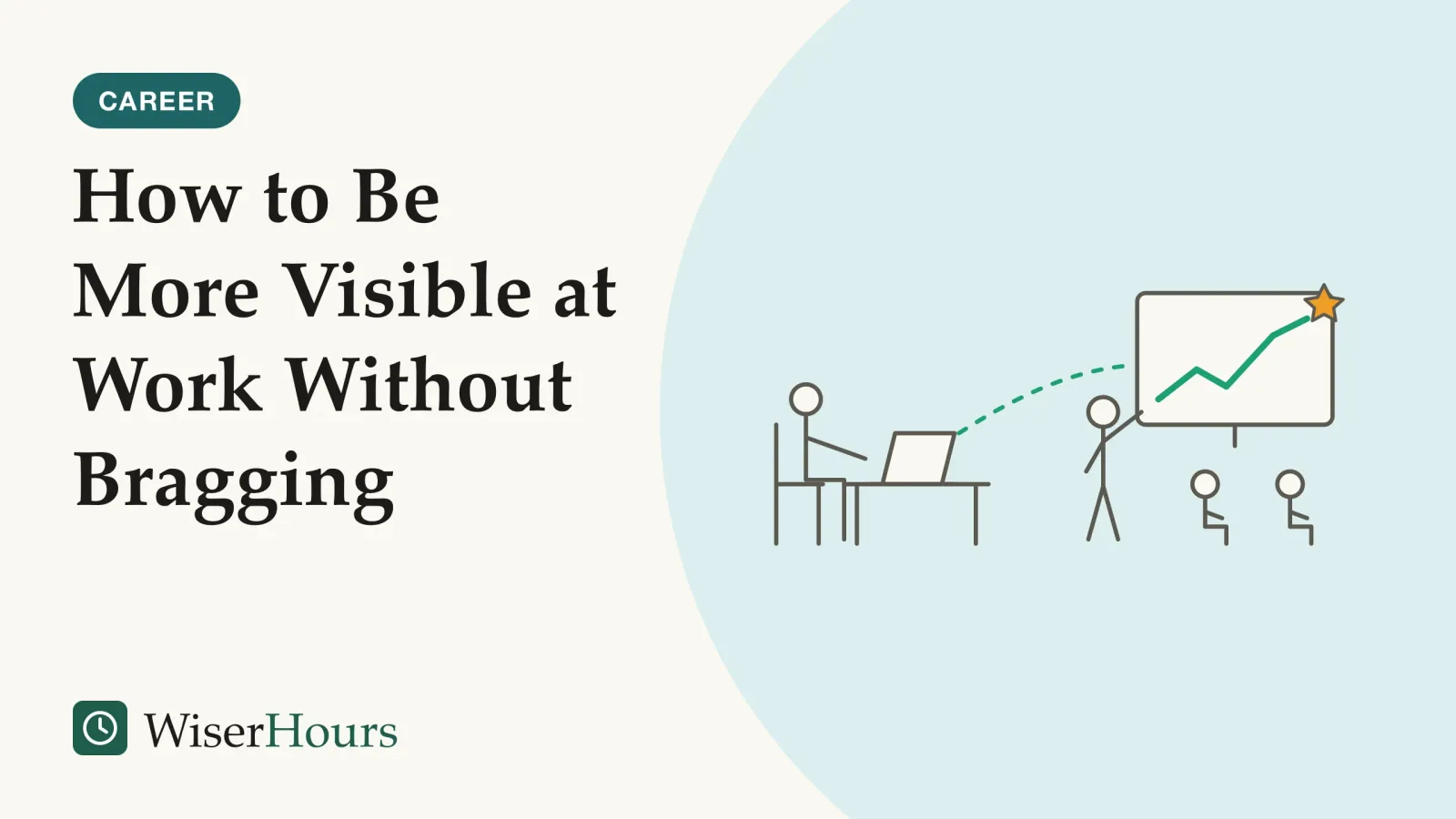
Visibility at work depends less on how often you mention your results than on who mentions them and what gets said. Self-promotion, the research term for talking up your own abilities and wins, earns less credit than most people expect, while praise from someone else tends to land better. Making good work known to the people who decide, without sounding as if you are selling yourself, is one of the habits in our overview of how careers actually grow, and it gets a closer look here.
To be more visible at work without bragging, change the channel and the content rather than the volume:
- Report results as plain facts other people can use
- Give others the material to speak for you
- Help colleagues and share credit generously
- Describe your performance accurately when asked
In practice, that is the difference between an end-of-week note saying “I saved the launch” and one saying “the fix cleared the error queue by Friday; the checklist is attached if your team wants it.” The second is just as visible, and it gives your manager something to repeat.
Why bragging does little for your visibility at work
Talking up your own achievements does surprisingly little for how you are rated at work. A 2003 meta-analysismeta-analysis: A study that combines the results of earlier studies on the same question into one overall estimate. Pooling makes the estimate more precise, but it cannot repair the studies it pools: a meta-analysis of surveys is still survey evidence.Full entry in the glossary by Chad Higgins, Timothy Judge and Gerald Ferris pooled workplace studies of influence tactics. Self-promotion had almost no link with performance ratings or with pay and promotions, and in the eight correlations where supervisors did the rating, more self-promotion went with lower ratings.1
The studies were mostly American, ran from 1973 to 2000 and measured associations, not causes. Job interviews looked different: there, self-promotion went with better ratings, though the authors called that estimate speculative because so few studies fed it. Their explanation is about what the listener already knows. An interviewer meets you briefly and has little to check your claims against; a supervisor has watched your work over a long stretch and in many situations, so they can check a boast against what they have seen.1 A 2017 meta-analysis by Jessica Peck and Julia Levashina pointed the same way: self-focused tactics, a group that includes self-promotion, were clearly linked to interview ratings but not clearly to job performance ratings.2
Part of the reason bragging disappoints is that people misjudge how it lands. In online experiments with US adults published in 2015, Irene Scopelliti, George Loewenstein and Joachim Vosgerau found that people recalling a time they bragged overestimated how happy and proud their listeners felt, and underestimated how annoyed they were. When people wrote short profiles meant to make strangers want to meet them, they promoted themselves more, and readers liked them less and saw them more as braggarts, without rating them any more successful.3
Two engineers fix the same outage. One posts in the team channel that she single-handedly saved the launch. The other posts what broke, what she changed and how the team can avoid a repeat. Both are visible, but only the second gives readers something to use and nothing to argue with. The same gap between intent and effect shows up in ordinary messages: see why written messages are misread more often than senders expect.
The lesson is not to go quiet. Supervisors who see your work every week can check a claim; what they need from you is information, not a verdict. So keep reporting, but report the work rather than your opinion of it, and leave the opinion to someone else.
- Myth
- Good work speaks for itself, so there is no need to mention it.
- Fact
- In large online experiments, women described equal test scores less favorably than men, and people predicting performance from those descriptions did not correct for the gap.
Let someone else tell the story
Praise carries more weight, and costs less goodwill, when someone else says it. In experiments reported in 2006, Jeffrey Pfeffer of Stanford University, with Christina Fong, Robert Cialdini and Rebecca Portnoy, found that people liked a job candidate or an author more, and offered more help, when an agent spoke the praise than when the person said the same words about themselves.4
The study
Limited evidence
Same praise, different speaker: three scripted experiments
Participants read an interview transcript or watched a filmed negotiation in which the same flattering claims were made either by the person or by an agent paid to represent them. When the agent spoke, the person was rated more likable and participants were more willing to offer extra help. In the hiring scenario, the candidate was also rated more competent and got a higher salary recommendation. The effects held even though participants were told the agent had a financial stake, and even when the person sat in the room while the agent spoke.4
The surprise is that knowing the agent was paid did not cancel the benefit; the authors’ explanation is that people do not fully discount the situation when they judge someone. The caveat is large: participants judged strangers in brief scenarios, and the authors suggest that a shared history might make self-promotion easier to accept.
At work, the agent is rarely paid. It is the manager who mentions your analysis in a leadership meeting, the client who forwards a thank-you note to your boss, or the colleague who says in a project review that your checklist saved a week. You cannot script those moments, but you can make them more likely.
One shortcut does not work. In two studies published in 2010, Nurit Tal-Or found that boasting about the success of people you are associated with did not make someone seem more competent, but did make them seem manipulative and unsociable, as direct self-promotion does.5 Borrowing a colleague’s glory is still you speaking for yourself.
Further reading
Give and Take: Why Helping Others Drives Our Success
Grant builds on Flynn's study of favor-giving cited here, and looks at when helping colleagues raises your standing and when it wears you out.

As an Amazon Associate WiserHours earns from qualifying purchases.
A sponsor, someone senior who spends their own credibility arguing for you, is a bigger commitment than a word of praise, and the evidence on sponsorship deserves its own look. For everyday visibility the move is smaller: make it easy for the people who already see your work to describe it well, which the second habit below turns into steps.
- You give a verdict about yourself: in online experiments with US adults, people writing to impress promoted themselves more and were liked less and more often seen as braggarts, without seeming more successful
- You share facts about the work: our suggestion for the safer way to report your own results; not tested as such
- Someone else gives the verdict: in scripted experiments with mostly US students, the same praise made a person better liked, and more likely to be offered help, than saying it themselves
- Someone else shares facts about your work: our suggestion, combining both ideas; not tested as such
Four habits for being seen without selling yourself
The four habits below turn this research into practice. Nobody has tested them as a visibility program in a real workplace: they draw on experiments about how self-promotion is received, mostly with students and online participants, and on a few workplace studies, so treat them as reasonable bets rather than proven fixes.
1. Report results as plain facts other people can use
Replace verdicts about yourself with specifics that let others reach the verdict: what changed, what it made possible, and what someone else can reuse. In Scopelliti’s profile experiment, extra self-promotion cost liking and bought no extra credit for success, so adjectives about yourself add risk without adding much.3 Facts are also easier for someone else to repeat.
These examples are illustrative, not quotations from the studies. The weekly or fortnightly one-on-one meeting with your manager is a natural place for this kind of update, because it is already expected.
The two-line update
Before your next check-in with your manager, write two lines: one result with a fact attached, and one thing from it that others could reuse. Say or send it as news, not as a request for praise.
Plain also means undisguised. A boast wrapped in a complaint or in modesty, such as groaning about yet another award dinner, feels safer than a plain one, but it tends to backfire. In a 2018 paper reporting nine studies, including a field experiment, Ovul Sezer, Francesca Gino and Michael Norton found these humblebrags less effective than straightforward bragging: people liked humblebraggers less and rated them less competent, and the authors trace the backfire to the humblebrag seeming insincere.6 If an achievement is worth mentioning, say it briefly and let the facts carry it.
2. Give others the material to speak for you
Because praise travels further from other people, make it easy for them to pass on. Send a short written summary your manager could forward, name the colleagues who helped so the story has more than one teller, and when a client or another team thanks you, ask whether they would mind saying so to your manager. A two-paragraph note after a project closes, listing what shipped, what it changed and who contributed, is the kind of thing a manager can paste into their own report almost unedited. This extends Pfeffer’s finding beyond what it tested: the experiments involved agents speaking to strangers, not managers or clients speaking to colleagues.4
3. Help colleagues and share credit generously
Generosity is its own kind of visibility. In a 2003 study of 161 employees at a large firm, Francis Flynn found that employees perceived as generous with favors had higher social status, while keeping favors evenly balanced went with higher productivity.7 The data come from one firm and describe a relationship, not proof that helping raised anyone’s standing.
A product designer spends an hour showing a new colleague how the team’s archive of past user research is organized. The colleague saves days, tells others where the help came from, and the designer becomes known as the person who knows what the team has already learned, without ever describing himself that way. Choose help that draws on what you are good at, so that it also shows what you can do. Help that nobody sees, and that crowds out your main work, is a different matter.
4. Describe your performance accurately when asked
When a manager, a review form or a promotion panel asks how you did, understating has a cost. In large online experiments, Christine Exley and Judd Kessler found that women described their performance on a math and science test about 13 points less favorably, on a 100-point scale, than men who had scored the same: enough to make equal performers look unequal on paper. The gap shrank somewhat but remained when participants were told exactly how they had scored, and even when nobody else would see their answers. More favorable self-descriptions made hiring more likely, and people asked to judge from the answers did not correct for the gap.8
The authors link the gap to gender norms around male-typed tasks, and they found no gap when people privately rated their performance on a more female-typed verbal task. The pressure also cuts both ways. In three experiments published in 1998, Laurie Rudman found that women who promoted themselves were rated more competent but less likable and less hireable, except by male judges whose own outcomes depended on them, while men who played themselves down lost ratings of competence and hireability.9 That double bind is for organizations to fix, not for individuals to solve alone. Meanwhile, accurate answers built on facts give an evaluator something to check.
In practice, if a self-review asks you to rate a project that met every target, the accurate rating is the high one, followed by the targets it met. If you manage people, the same research carries a lesson: a modest self-assessment is not evidence of modest performance, so ask for the specifics behind it.
Visibility habits to try this month
What the evidence on visibility shows, at a glance
Most of this evidence comes from experiments with students or online participants and from correlational workplace studies, so each row describes a tendency, not a promise.
| Tactic | What the research found | Evidence |
|---|---|---|
| Self-promotion at work | Almost no link with ratings or pay overall; a negative link where supervisors rated | Meta-analysis of mostly US correlational studies, 1973-20001 |
| Self-promotion in interviews versus on the job | Self-focused tactics linked to interview ratings, not clearly to job performance ratings | Meta-analysis of 18 articles2 |
| Bragging to impress | Braggers overestimated listeners’ good feelings; profiles written to impress were liked less | Online experiments, US adults3 |
| Praise from someone else | Better liked and offered more help than after the same self-praise | Experiments, mostly students; limited4 |
| Humblebragging | Less effective than plain bragging on liking and perceived competence | Nine studies, including a field experiment6 |
| Boasting about associates | No competence benefit, same costs as direct self-promotion | Two studies (abstract read)5 |
| Generosity with help | Linked to higher social status at work | Observational, 161 employees at one firm (abstract read)7 |
| Modest self-description | Women rated equal performance lower; people judging the answers did not correct | Online experiments8 |
| Women who self-promote | Rated more competent but less likable and less hireable, except by men whose outcomes depended on them | Three experiments, 1998 (abstract read)9 |
Read the table from the top down. The two meta-analyses are the firmest ground, and neither finds a clear payoff on the job from talking yourself up. The rows below them rest on single papers, three of them read only as abstracts, so they point to better ways of being seen rather than prove them. That is why the habits above lean on facts and on other people’s words, which fit every row, rather than on any one clever tactic.
The bottom line
Visibility at work comes less from talking about yourself than from making your work easy to see and easy for others to describe. Share facts rather than verdicts, give managers and colleagues the material to speak for you, and state achievements plainly, without a complaint or false modesty wrapped around them. When someone asks how you did, answer accurately, not modestly.
Frequently asked questions
When does talking up your achievements actually help?
Mostly when the listener knows little else about you and has asked. Both meta-analyses in this guide found self-promoting tactics more clearly linked to ratings in job interviews than on the job, though the 2003 review judged its interview estimate speculative because it rested on only three studies. In Exley and Kessler's experiments, more favorable self-descriptions made hiring more likely when employers saw only those self-descriptions.
Why do people keep bragging if it backfires?
Partly because they misread their audience. Scopelliti, Loewenstein and Vosgerau's 2015 experiments suggest that people project their own pride onto listeners: they expect others to feel happy for them and underestimate how annoyed others feel. The authors call this a failure of emotional perspective-taking. The participants were US online workers recalling or writing about themselves, not colleagues in a workplace.
Does self-promotion go down worse in some countries?
Probably, but the research here cannot say much about it. Almost all the studies in this guide were run in the United States: the 2003 meta-analysis found only two studies from outside the US, both from India. Scopelliti and colleagues expect cultural differences in how bragging is received, pointing to Scandinavian norms against standing out, but they did not test them.
Sources
- Influence tactics and work outcomes: a meta-analysis. Higgins, C. A., Judge, T. A. & Ferris, G. R. (2003). Journal of Organizational Behavior, 24(1), 89-106
- Impression Management and Interview and Job Performance Ratings: A Meta-Analysis of Research Design with Tactics in Mind. Peck, J. A. & Levashina, J. (2017). Frontiers in Psychology, 8, 201
- You Call It “Self-Exuberance”; I Call It “Bragging”: Miscalibrated Predictions of Emotional Responses to Self-Promotion. Scopelliti, I., Loewenstein, G. & Vosgerau, J. (2015). Psychological Science, 26(6), 903-914
- Overcoming the Self-Promotion Dilemma: Interpersonal Attraction and Extra Help as a Consequence of Who Sings One's Praises. Pfeffer, J., Fong, C. T., Cialdini, R. B. & Portnoy, R. R. (2006). Personality and Social Psychology Bulletin, 32(10), 1362-1374
- Direct and indirect self-promotion in the eyes of the perceivers. Tal-Or, N. (2010). Social Influence, 5(2), 87-100
- Humblebragging: A distinct—and ineffective—self-presentation strategy. Sezer, O., Gino, F. & Norton, M. I. (2018). Journal of Personality and Social Psychology, 114(1), 52-74
- How Much Should I Give and How Often? The Effects of Generosity and Frequency of Favor Exchange on Social Status and Productivity. Flynn, F. J. (2003). Academy of Management Journal, 46(5), 539-553
- The Gender Gap in Self-Promotion. Exley, C. L. & Kessler, J. B. (2022). The Quarterly Journal of Economics, 137(3), 1345-1381; working paper version: NBER Working Paper 26345, revised 2021
- Self-promotion as a risk factor for women: The costs and benefits of counterstereotypical impression management. Rudman, L. A. (1998). Journal of Personality and Social Psychology, 74(3), 629-645
How we researched this
We searched Crossref, OpenAlex, PubMed and publisher pages in September 2026 for meta-analyses and experiments on self-promotion, praise from third parties, humblebragging and modest self-description, reading full texts where available. Sources date from 1998 to 2022. Main limitation: most experiments used students or online participants reacting to written or filmed scenarios, the meta-analyses rest on mostly US correlational studies, and three papers (Tal-Or 2010, Flynn 2003, Rudman 1998) were read as abstracts only.
Keep reading
Job Hopping vs. Staying Put: What the Evidence Says About Pay and Growth
In August 2026, US job switchers' median pay rose 5.0% a year before inflation vs 3.6% for stayers. When job hopping pays, its costs, how recruiters see it.
How to Ask for a Raise: A Step-by-Step Guide
US wages and salaries rose 3.2% in the year to June 2026. How to ask for a raise in six steps, from checking pay data to naming a figure and handling a no.
How Careers Actually Grow: What the Research Says About Getting Ahead
What moves a career forward? A meta-analysis of 140 articles found pay, promotions and satisfaction have partly different predictors, so start by choosing one.