Salary Compression: Why New Hires Sometimes Earn More Than You
Salary compression lets new hires match or out-earn longer-serving staff. Why starting pay outruns raises, when it is legal, and 4 steps to raise it.

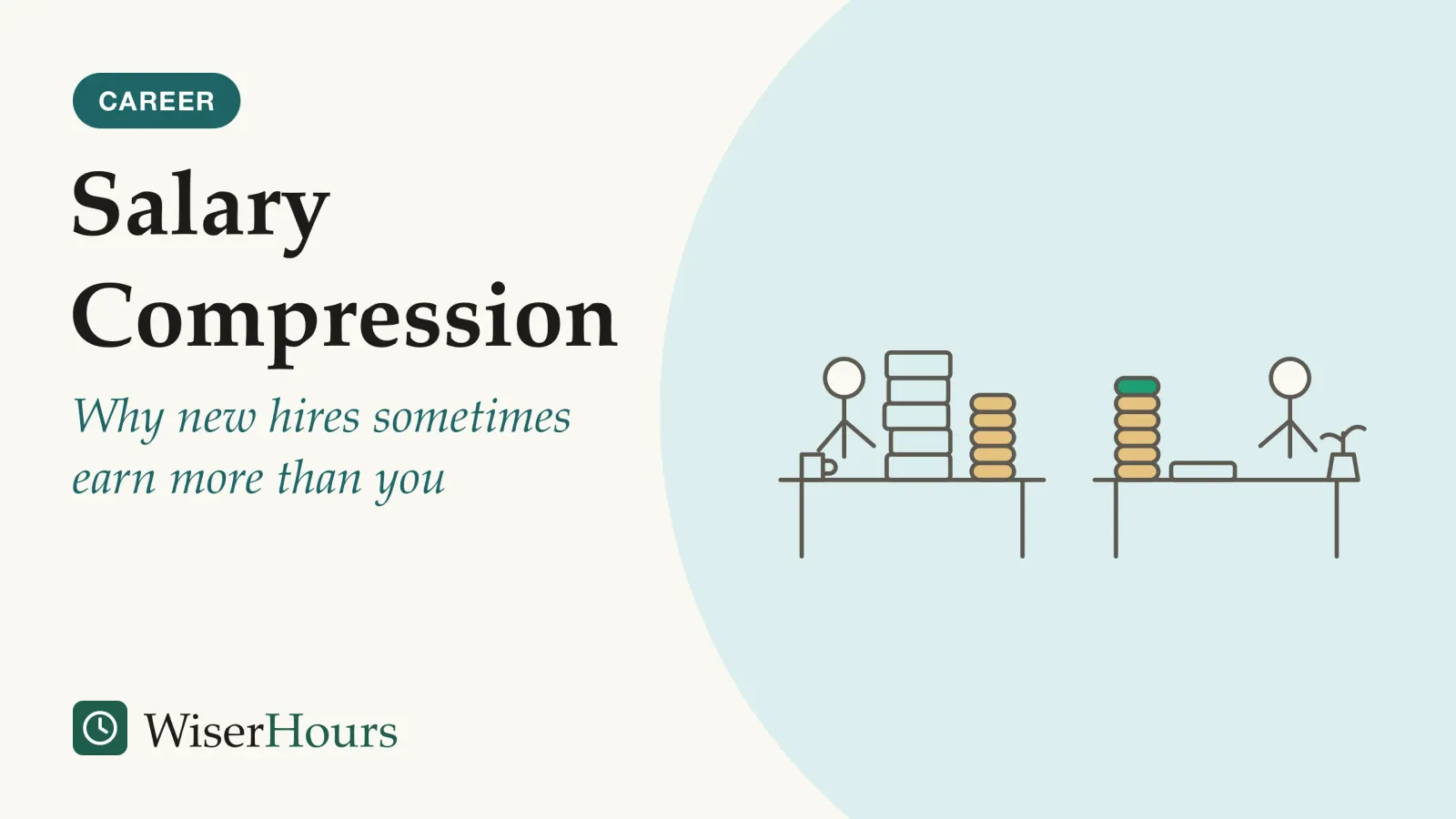
Salary compression is the shrinking of the pay gap between people with very different experience, skills or tenure in similar work, until a colleague hired last month earns about what you earn after five years. When the newcomer’s pay passes yours, the usual name is pay inversion. A new hire’s salary is set by what the job market demands on the day of the offer, while raises for existing staff come from a yearly budget that often moves more slowly.
Official US data show how far apart those two clocks can drift. The widest gap in the Federal Reserve Bank of Atlanta’s wage tracker came in November 2022, when job switchers’ median pay grew 8.2 percent against 5.5 percent for stayers over 12 months, before inflation.1 Pay is one of the three outcomes in the research on career growth, and compression is one place where it stops tracking experience.
If you have just found out, the useful response has four parts: check what your role pays on the market now, see where your salary sits in your employer’s range, ask your manager for a specific market adjustment framed around keeping you, and settle your fallback before you ask.
What is salary compression?
Salary compression means pay that no longer reflects real differences between people. Pearl Meyer, a US pay consultancy, defined it in a 2017 article as little or no difference in pay combined with large differences in responsibilities, skill level or qualifications, and noted that it is rarely a deliberate pay strategy.2
Definition
Salary compression is a narrowing of the pay gap between people whose experience, skills or responsibilities differ a lot. Pay inversion is its extreme form: the newer or more junior person earns more.
According to the same article, it appears in three places: between new and experienced staff in the same job, between supervisors and the people they supervise, and between the pay-range midpoints of neighboring job grades.2
A support engineer who joined five years ago, and has had a modest raise every spring since, sees her team advertise her own job with a starting salary close to hers. Nobody cut her pay. The market price of the role rose, her raises followed the company’s budget, and the two lines drew together.
A gap that follows when people joined points to a lag in the pay system.
Why do new hires get paid more than existing employees?
New hires can earn more because a recruiter has to beat a candidate’s other options today, while existing staff are paid through an annual raise process. A 2019 analysis by the UK’s Office for National Statistics explained why the two groups’ pay moves at different speeds: stayers’ pay is linked more closely to periodic pay settlements, which trail the economic cycle, while changers’ pay responds faster. It also found that stayers earned more per hour on average, so changers led on pay growth.3
American data point the same way. The Atlanta Fed’s tracker compares the median yearly change in hourly pay for people who moved with that for people who did not; movers came out ahead in most months since the series began in 1997, and still were in September 2026. It counts a change of employer, occupation, industry or job duties as a move, so its movers are a wider group than new hires.1
Inside a single firm the premium can be large. Matthew Bidwell’s 2011 study of personnel records from the investment banking unit of one US financial services firm found that people hired from outside started on around 18 percent more pay than staff promoted into comparable jobs, even though the promoted staff performed better over the first two years.4 The records come from a single employer in a single industry; the guide to whether job hopping pays more than staying weighs what moving and staying each buy you.
Starting pay offered for the role Your pay, raised once a year
- You are hired: at what the market paid for the role that year
- Yearly raises: small steps from a budget shared by everyone
- The crossing: starting pay for your role catches up with yours (compression), then passes it (inversion)
Schematic for illustration; the slopes are not data.
A software company that cannot fill data-engineering posts raises the advertised salary in March, while its engineers wait for the January review. For ten months, the newest engineer may out-earn colleagues who are training her.
- Myth
- If a new hire earns more than me, my employer must rate my work lower.
- Fact
- Often the gap reflects when each person was hired: starting pay follows the job market of the day, while raises follow a budget set once a year.
Before you treat the gap as a verdict on your work, ask HR or your manager two plain questions: when was pay for existing staff in your role last reviewed against the market, and has the starting range for the role changed since then?
When salary compression is most common
Salary compression spreads fastest when employers compete hard for people: in tight labor markets, in years of high inflation and in roles with scarce skills, starting offers rise quickly while raise budgets move slowly. The Atlanta Fed’s 2022 peak, the widest switcher-stayer gap in the series, came in exactly such a hiring boom.1
Employer surveys agree, though they are weaker evidence. In an August 2017 survey of US companies by Pearl Meyer, which sells pay advice and did not report its sample size in the article, more than 60 percent said compression arose because roles needing “hot skills” forced higher starting salaries; it was most common in IT and engineering or science jobs.2 More than three quarters of companies with compression had longer-serving staff whose yearly raises had not kept pace with the market or inflation.2
The pressure can ease when hiring cools. In the Atlanta Fed data, switchers’ median pay growth slipped slightly behind stayers’ for six months of 2025.1
Where people rarely move, long service can even go with lower pay, though the evidence is contested. Michael Ransom reported in 1993 that, among university professors with the same total experience, more seniority was associated with lower salaries, which he attributed to employers’ wage-setting power over staff who stay.5 James Monks and Michael Robinson, using a 1993 US national faculty survey, found pay and seniority positively related once past job moves were accounted for.6
| What it is | What the best evidence found | Evidence |
|---|---|---|
| Switchers versus stayers | US switchers’ median pay growth beats stayers’ in most months; the gap peaked in November 2022 | Official US survey data, monthly series from 19971 |
| Why stayers lag | Stayers’ pay is tied to settlements that lag the economy | Official analysis, UK, 2000-2018 data3 |
| Outside hires in one firm | Paid more at first than promoted insiders, yet rated lower | Observational personnel records, one US firm, 2003-20094 |
| Where it is common | Hot-skill roles and raises that lag the market or inflation | Company survey, US, 2017, sample not reported2 |
| Seniority and pay | Negative link among university professors in one study, positive among US faculty in another | Contested, observational56 |
Job ads for your role with higher ranges, more recruiter messages and colleagues leaving for large raises are signals worth watching.
What finding out does to people, and what to do with the feeling
Learning that you earn less than colleagues in the same unit tends to lower job satisfactionjob satisfaction: How positively a person judges and feels about their job, as a whole or in parts such as pay, colleagues or the work itself. It is usually measured by questionnaire and is related to engagement, but it is not the same thing.Full entry in the glossary and to raise stated plans to look for another job. The strongest test is a randomized study of University of California staff by the economists David Card, Alexandre Mas, Enrico Moretti and Emmanuel Saez, which appeared in 2012.7
The study
Moderate evidence
A salary website, a random email and three campuses
A random subset of employees was told about a newspaper website listing every University of California salary. Among those paid below the median for their unit and occupation, being told raised the share saying they were very likely to look for a new job by 4.3 percentage points, about a fifth above the control group’s rate, and lowered their satisfaction with their pay and job. Workers paid above the median were no more satisfied than those not told.7
The study measured stated intentions; its estimate of effects on people actually leaving was too imprecise for a firm conclusion, and it ran during a deep recession in California, when other jobs were scarce.7
The result was lopsided: learning you were behind lowered satisfaction, while learning you were ahead did not raise it. That makes the moment of finding out a poor time to decide anything. Wait a day and check that the comparison is fair before emailing your manager.
Is it legal to pay a new hire more than me?
In many countries, paying a new hire more for similar work is lawful in itself; what equal pay laws forbid is a pay difference based on sex or, under wider discrimination rules, on characteristics such as race or age. Protected grounds vary by country, so treat the examples below as orientation and check the law where you work.
In the US, the Equal Employment Opportunity Commission’s guidance says the Equal Pay Act requires employers to pay men and women equally for substantially equal jobs in one workplace, and that other federal laws also bar pay decisions that turn on race, color, religion, national origin, age or disability, as well as sex.8 Acas, the UK’s workplace conciliation service, says the law gives men and women equal pay for equal work, and suggests raising the issue with your employer first.9
Pay transparency rules are making ranges easier to see. Under the 2023 EU Pay Transparency Directive, someone applying for a job is entitled to be told the starting pay or pay range, employers may not ask about pay history, and workers can ask for their own pay level alongside average pay by sex for the same work or work of equal value; member states were due to apply it by 7 June 2026, so the exact rights depend on each country’s law.10 In the Canadian province of British Columbia, employers must include pay information on all publicly posted jobs since 1 November 2023.11
If the gap follows hire dates, it is usually a market problem to negotiate, unless the better-paid newer hires are mostly of one sex or group. If it seems to follow sex, race, age or another protected ground, treat it as a possible equal pay issue and look up the rules in your country.
How do you fix salary compression from your side?
Fixing salary compression from your side is mostly preparation: evidence of what the role pays elsewhere, your place in the range, a figure with a date, and a fallback. A market and retention case gives your manager something concrete to take to HR or finance.
1. Gather market pay data for your role
Collect pay for the same job, level and location from several places: ranges in job ads (required in some places, as above), your employer’s own postings, national pay statistics by occupation and salary surveys. Match by duties, since titles differ between firms.
2. Find your position in the range
If your employer shares its pay range, or posts one for your role, place your salary in it and see how a newcomer’s offer would sit. The method, and the questions to ask HR, are in the guide to compa-ratio and range penetration.
3. Ask for a market adjustment with a figure and a date
Frame the request as a market and retention issue: the role’s price has moved, and you want your pay brought in line before the next review. Employers have tools for this; Pearl Meyer’s article lists off-cycle adjustments during the year in response to market forces and yearly updates to pay structures among them.2 Rest your case on posted ranges and market data rather than on a colleague’s salary shared in confidence, though the EU directive bars contract terms that stop workers disclosing their own pay for equal pay purposes.10 One opening line might be: “Our posted range for my role now starts close to my salary, and I’d like to discuss a market adjustment before the next review cycle.” The full conversation, from timing to handling a no, is in how to ask for a raise.
4. Know your fallback before the meeting
Negotiators call it your BATNA, the best alternative to a negotiated agreement, which the Program on Negotiation, part of Harvard Law School, defines as what you will do if you do not reach a deal.12 For pay, that might be an outside offer, a planned move inside the company or a decision to wait for a stated review date. Knowing it keeps you from accepting a vague promise or making a threat you would not carry out.
Before you raise a compression gap
When a pay gap needs outside advice
How soon you need advice depends on what the gap seems to rest on.
- Act now if the gap seems to track a protected characteristic such as sex, race, age or disability: contact an employment lawyer, your union or the national equality body (in the UK, Acas), because claims can have short time limits. In the US, the EEOC says a charge under most federal discrimination laws must be filed within 180 days, which state laws may extend, while an Equal Pay Act claim can go to court within two years.8 For sex-based equal pay claims under the EU directive, once national law applies, the limitation period is at least three years.10
- Ask soon if HR declines pay information that local transparency rules entitle you to; a union, labor inspectorate or equality body can explain your rights.
- As a routine step, if you are weighing an outside offer against pension, share or bonus terms that depend on staying, ask the plan administrator, and consider a regulated or fee-only adviser for large sums.
The bottom line
Salary compression usually comes from timing: starting pay moves with the market on the day of hire, while your raises wait for a yearly budget. Before your next review, take your manager a market figure for your role and a date for the adjustment, with your fallback settled before you walk in.
This article is general education, not financial advice. For decisions about your own money, speak to a qualified, regulated adviser.
This article is general information, not legal advice. Rules differ by country and change over time; for your own situation, speak to a qualified lawyer or an official advice service where you live.
Frequently asked questions
Can salary compression affect managers?
Yes. Pearl Meyer, a US pay consultancy, notes in a 2017 article that compression can occur between supervisors and the people they supervise, as well as between new and experienced staff in one role. A manager whose team includes recent hires on market-rate pay can end up earning little more than they do, which is worth raising in the same market terms.
Why do some employers give new hires a one-time bonus instead of a higher salary?
Partly to limit compression. Pearl Meyer's 2017 article describes sign-on bonuses as a one-time premium payout to new hires rather than an ongoing premium in their salary, so the newcomer's base pay stays closer to that of existing staff. A bonus like this can come with conditions, so read its terms.
Is salary compression the same as wage compression?
The terms overlap, and salary compression and pay compression are often used as other names for wage compression. Economists, though, often use wage compression for a wider pattern: the pay of low-skilled and high-skilled workers moving toward each other across a labor market. Inside a workplace, the phrase usually means newer staff catching up with longer-serving ones.
Sources
- Wage Growth Tracker. Federal Reserve Bank of Atlanta, data through September 2026, updated 8 October 2026 (accessed 2026-11-07)
- Salary Compression: The Squeeze is On. Toman, R. (2017). Pearl Meyer, US compensation consultancy; first published in WorldatWork's Workspan, November/December 2017; company research (accessed 2026-11-07)
- Analysis of job changers and stayers. Office for National Statistics (UK), Economic Review, April 2019
- Paying More to Get Less: The Effects of External Hiring versus Internal Mobility. Bidwell, M. (2011). Administrative Science Quarterly, 56(3), 369-407
- Seniority and Monopsony in the Academic Labor Market. Ransom, M. R. (1993). American Economic Review, 83(1), 221-233
- The returns to seniority in academic labor markets. Monks, J. & Robinson, M. (2001). Journal of Labor Research, 22(2), 415-426
- Inequality at Work: The Effect of Peer Salaries on Job Satisfaction. Card, D., Mas, A., Moretti, E. & Saez, E. (2012). American Economic Review, 102(6), 2981-3003
- Equal Pay/Compensation Discrimination. US Equal Employment Opportunity Commission (accessed 2026-11-07)
- If you are not getting equal pay: Equal pay, advice for employees. Acas (UK), last updated 7 November 2024 (accessed 2026-11-07)
- Directive (EU) 2023/970 to strengthen the application of the principle of equal pay for equal work or work of equal value between men and women through pay transparency and enforcement mechanisms. European Parliament and Council of the European Union (2023). Official Journal of the European Union, L 132, 17 May 2023
- More transparent job postings mean fairer work environments. Government of British Columbia (Canada), Ministry of Finance, news release, 2023 (accessed 2026-11-07)
- What is BATNA? How to Find Your Best Alternative to a Negotiated Agreement. Subramanian, G. Program on Negotiation at Harvard Law School, updated 30 September 2026 (accessed 2026-11-07)
How we researched this
In November 2026 we read the Atlanta Fed's Wage Growth Tracker data (downloaded 2026-11-07), UK official analysis of job changers, peer-reviewed studies of pay and seniority, a randomized study of pay disclosure, a consultancy's compression survey, and equal pay and pay transparency rules from the US, UK, EU and British Columbia. Main limitation: no official series measures how often new hires out-earn existing staff, so prevalence rests on employer surveys.
Keep reading
Compa-Ratio and Range Penetration: The Pay Metrics HR Uses
A compa ratio of 1.0 means pay at the midpoint of its range. How compa ratio and range penetration are worked out, why they disagree and how they shape raises.

How to Ask for a Promotion (With Scripts)
How to ask for a promotion in 6 steps, from learning who decides to agreeing a follow-up date, with short scripts for opening, making the case and hearing no.

Performance Improvement Plan (PIP): What It Means and What to Do
A performance improvement plan often runs 30 to 90 days. What a PIP contains, how to read support from a paper trail, and what to do week by week.

The Peter Principle: Do People Really Rise to Their Level of Incompetence?
The Peter principle began as a 1969 satire. A 2019 study of US sales workers found top sellers were promoted most and managed less well; here is the evidence.