Active Listening Explained: What It Is and How to Practice It
Active listening, from its 1957 origin to the experiments: what it is, what feeling heard does for a speaker, and five steps to practice it at work.

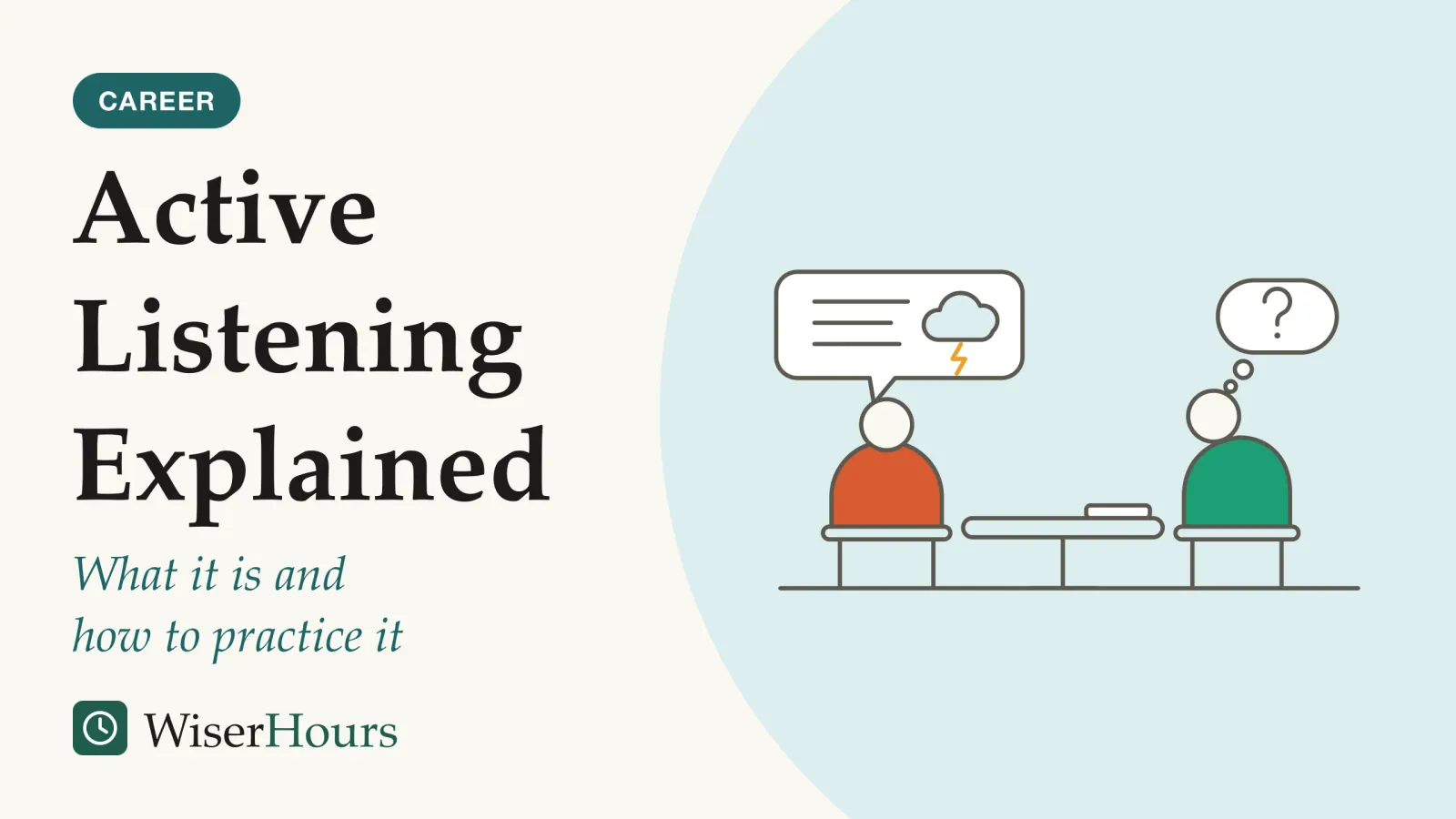
In 1957, the psychologist Carl Rogers and Richard Farson published a short paper through the University of Chicago’s Industrial Relations Center with an example from the shop floor. A machinist tells his foreman he has finally finished a lathe setup he plainly hated. The foreman can hand over the next job, or first answer the frustration in the words. Rogers and Farson argued for the second, and called it active listening.1
Active listening is listening to understand what a message means to the speaker, the facts and the feeling behind them, and showing that understanding by checking it out loud before you give your own view. The tests of it are small, but they agree: in a 2014 experiment with 115 participants, people whose conversation partner gave active listening responses felt more understood than people who got advice or simple acknowledgments.2 To practice active listening:
- Give the speaker your full attention
- Listen for the feeling as well as the facts
- Check your understanding in your own words
- Invite them to say more
- Hold advice and judgment until they feel understood
What active listening is, and where it came from
Active listening, as Carl Rogers and Richard Farson defined it in 1957, means grasping a message from the speaker’s point of view and then showing the speaker you have grasped it. They presented it as a way of handling the ordinary problems of any job, not as long sessions spent hearing grievances.1
People hold a picture of themselves, they wrote, and they defend it when someone tries to change them. Advice reads as an attempt to change the speaker, and judgment, even praise, makes it harder for the speaker to say what is really going on. A listener who stops steering removes that threat. From that came three practices. Listen for the total meaning, because most messages carry content and a feeling about it. Respond to the feeling when it matters more than the content. And notice the cues beyond the words: hesitation, tone, facial expression, posture.1
In an office it sounds like this. A colleague says, “Well, the client signed off. Finally.” The content is good news; the word “finally” is the message. Replying “Great, next up is the budget deck” answers the content. Replying “Sounds like that dragged on” answers the person.
The US Labor Department’s O*NET job database treats active listening as one of its essential skills, the ones most jobs need, and describes it in behavioral terms: full attention, time taken to grasp the points being made, questions where they fit, and no untimely interruptions.3 Feeling listened to matters at work, too. Pooling the research on it, a meta-analysismeta-analysis: A study that combines the results of earlier studies on the same question into one overall estimate. Pooling makes the estimate more precise, but it cannot repair the studies it pools: a meta-analysis of surveys is still survey evidence.Full entry in the glossary by Avraham Kluger’s team, published in 2024, linked it to better working relationships and, more weakly, to performance, mostly in self-reports; the guide to the core communication skills sets that finding beside the other skills.4
The lesson from the origin is that the goal was always understanding the person. Nodding and saying “I hear you” were never the point.
Restating is a test of understanding, not an echo
The best-known active listening move, restating what the speaker said, was meant as a check on your own understanding. Carl Rogers made this explicit in a 1986 column, where he said he had become unhappy with the phrase “reflection of feelings” because it was often taught as a technique, sometimes a wooden one.5
I am trying to determine whether my understanding of the client’s inner world is correct
He proposed calling these responses “testing understandings” or “checking perceptions” instead, because each one carries an unspoken question: is this how it is for you?5 The 1957 paper said the same in practical terms. Its suggested exercise for a heated discussion is that nobody may make their own point until they have restated the other person’s in their own words, accurately enough to satisfy that person. Parroting the other person’s words back, the authors noted, proves only that you heard them.1
- The speaker says it: you listen for the content and the feeling
- You restate it: in your own words, not theirs
- You ask if it is right: "Is that it?"
- The speaker confirms or corrects: a correction sends you back to step 2
- Only then, your view: once the speaker is satisfied you understood
“So you’re saying the timeline is unrealistic” repeats. “So the deadline itself is fine, but legal review was never in the plan. Is that it?” tests. The second version can be wrong, and that is its value: when the speaker corrects you, you have learned something you would otherwise have missed. End a restatement with a question, and treat a correction as the exchange working.
Five habits to practice in your next conversation
These habits come from Rogers and Farson’s advice and from the experiments described further down. None has been tested on its own as a workplace routine, so treat them as a practice plan, not a formula.
1. Give the speaker your full attention
Close the laptop, turn away from the screen and let the speaker finish. O*NET’s definition opens with full attention and a warning against interrupting at the wrong moment.3 On a video call, leave the chat unread while they talk.
2. Listen for the feeling as well as the facts
Ask yourself what the message means to the speaker, not only what it says. Rogers and Farson suggested watching for hesitation, stressed words, tone and posture, and answering the feeling when it is the real message.1 “It’s fine, I’ll redo the slides,” said flatly, is probably not about the slides.
3. Check your understanding in your own words
Restate the point in fresh words and end with a question. If a teammate says, “I can’t get to the audit until Thursday,” try “So Thursday is the earliest, because something else jumped the queue?” and let them fix what you got wrong. Paraphrasing and summarizing are skills of their own, and a future guide covers them in depth.
4. Invite them to say more
A short open question keeps the speaker exploring: “What makes it hard?” or “What happened next?” O*NET’s definition includes asking questions where they fit.3
5. Hold advice and judgment until they feel understood
Advice is not wrong, only early. In Weger’s 2014 experiment, people given advice were no less satisfied than those given active listening, but they felt less understood.2 Give it after the check, or when the speaker asks. When a colleague only wants to know where the file is, give them the file.
After your next important conversation
Does it work? The experiments are small but consistent
Controlled tests of active listening are few, small and mostly with students, and they point one way: the full set of responses goes with people feeling understood, while a paraphrase on its own was linked mainly to the listener seeming likable. The best-known come from communication researcher Harry Weger and colleagues.
In the 2010 experiment, undergraduates interviewed by a peer received either a paraphrase of what they had said or a simple acknowledgment. The paraphrases were linked to rating the listener as more socially attractive, but not to feeling more understood or more satisfied with the conversation.6
- Myth
- Repeating back what someone said is what makes them feel heard.
- Fact
- In a 2010 experiment with undergraduates, paraphrases were linked to the listener seeming more likable, but not to speakers feeling more understood.
The 2014 experiment compared full active listening responses from trained confederates with advice and with simple acknowledgments. Participants who got active listening felt more understood than either comparison group. Advice matched it on satisfaction with the conversation and on how likable the listener seemed, and both beat simple acknowledgments by margins the authors call small.2
A 2015 experiment by Graham Bodie and colleagues tested a harder moment: students describing a recent upsetting problem, some of them to a listener trained to ask open questions, paraphrase, reflect feelings and check assumptions. Their active listening behaviors were rated as signaling more emotional awareness and promoting more emotional improvement, though not as more useful for solving the problem.7
The pattern fits what the 1957 paper predicted: a restatement proves you heard the words, while understanding shows in a response to what the speaker meant. Picture a teammate who says a customer call went badly. “So the call went badly” is a paraphrase. “That sounds rough. Was it the pricing again, or something new?” names the feeling and asks, as the trained listeners did. All three were single conversations, not months of working together. The practical lesson: pair any paraphrase with a question, and do not expect listening to replace help when someone wants a solution.
Further reading
On Becoming a Person: A Therapist's View of Psychotherapy
Carl Rogers, who named active listening, including his rule for a disagreement: restate the other view to its speaker's satisfaction first.
You're Not Listening: What You're Missing and Why It Matters
A journalist draws on listening researchers to explain why people half-listen and what attentive listening does for the person speaking.


As an Amazon Associate WiserHours earns from qualifying purchases.
What being heard does for the speaker
Being listened to well changes how speakers think, not only how they feel, according to experiments led by Guy Itzchakov, now at the University of Haifa.
The mechanism he proposes follows Rogers closely. In four lab experiments published in 2017, high-quality listening was hypothesized to lower speakers’ social anxiety, making them less defensive, and the results fit that account: speakers became more aware of the contradictions in their own attitudes, more able to tolerate them and less extreme in their views.8 A later set of experiments put the idea under more pressure, in live disagreements.
The study
Moderate evidence
When the listener seemed to disagree, and listened anyway
Participants explained their view on a divisive topic, such as COVID-19 vaccination certificates or a universal basic income, to a listener who they were told held the opposite view. They were randomly assigned to trained listeners who either listened well, with attentive body language and at least one summary checked with the speaker, or only moderately well, with minimal feedback and at least one moment of distraction. Speakers who got high-quality listening felt more connected to the listener and reflected more on their own view. In the two studies that tested attitude extremity, they also came away holding their attitude a little less extremely, while the comparison group did not change. Their views moved toward the middle without switching sides, and the listeners never argued.9
The study shows that listening alone, with no counterargument, can soften a speaker’s position slightly. Its main caveat is the design: speakers did most of the talking, the comparison was deliberately mediocre listening, and every study was run in Israel. The authors also warn that the same effect could pull a speaker toward a listener’s harmful views, so good listening is not automatically good for the outcome.9
At work, this suggests a different move when a colleague pushes back on your plan: summarize their objection until they agree you have it, before defending anything. If a teammate calls the new rota unfair, “So the late shift covers the weekend gaps, and nobody asked them first?” gives them room to think again.
Why it feels hard, and how people get better at it
Rogers and Farson called active listening a skill that is not easy to acquire and that demands practice, partly because it may require listeners to change their own basic attitudes. Truly seeing the world as someone else sees it, they warned, means risking being changed yourself.1 The habit can slip exactly when it matters: in a tense one-on-one, the urge to correct or reassure may arrive before the urge to understand.
Two small workplace studies suggest it can be taught. In 2023, Itzchakov and colleagues reported two quasi-experimentsquasi-experimental: Describes a study that compares a group that got something with a group that did not, where the researcher did not do the assigning: a policy, a rollout or people's own choices did. Because the groups were not formed at random, they may have differed before it started.Full entry in the glossary at an Israeli high-tech firm and an Israeli insurance company. Employees took 12 or 15 hours of group training in the authors’ own listening-circle method: one person speaks at a time, and listeners hold back advice, comments and even agreement. Compared with colleagues who got no training or different training, trainees felt better heard by their trained colleagues, closer to them and less emotionally exhausted, and in the second study less inclined to quit, three weeks later too, though the authors say how stable the gains are needs more research. But whole teams or branches, not individuals, were assigned, the samples were small, the outcomes self-reported and the method the authors’ own.10
The lesson fits the 1957 advice: expect active listening to feel clumsy at first, and practice it in low-stakes conversations, such as a routine status check, before you need it in a tense one.
Where the evidence is solid and where it is thin
The evidence for active listening is consistent but thin: a handful of short experiments, mostly with students or in one country, and one large review built mostly on self-reports.
| What it is | What the best evidence found | Evidence |
|---|---|---|
| Full active listening responses | Speakers felt more understood than with advice or simple acknowledgments; about as satisfying as advice | Trial, limited (115 participants, one conversation, abstract read)2 |
| A paraphrase on its own | Listener seemed more likable; speakers felt no more understood than with an acknowledgment | Trial, limited (undergraduates, abstract read)6 |
| Trained active listener for someone upset | Behaviors rated as signaling more emotional awareness and emotional improvement; not more useful for problem-solving | Trial, limited (students, abstract read)7 |
| High-quality listening in a disagreement | Speakers felt closer, reflected more and held views slightly less extremely | Trial, moderate (four experiments in Israel; extremity in two)9 |
| High-quality listening and attitudes | Speakers grew more aware of contradictions in their views and more tolerant of them | Trial, moderate (four lab experiments, abstract read)8 |
| Listening training at work | Trainees felt better heard, closer to colleagues and less exhausted, weeks later | Quasi-experiment, limited (two small samples)10 |
| Feeling listened to at work | Linked to better relationships and performance, mostly in self-reports | Meta-analysis, moderate4 |
For a manager, the restate-and-ask check has its most direct support as a way to help one conversation go better; a promise that it will cut staff turnover rests on one small quasi-experiment.
The bottom line
Active listening is a check, not a performance: grasp what the message means to the speaker, say it back in your own words, and ask if you have it right before offering your view. The experiments behind it are small and short, but consistent: people feel more understood when a listener checks what they meant with genuine attention, and a paraphrase on its own does not get them there.
Frequently asked questions
Is active listening the same as empathic listening?
The two overlap heavily. Rogers and Farson's 1957 version asks the listener to see the situation from the speaker's point of view and to respond to feelings, which is what most people mean by empathic listening. The US Labor Department's O*NET database describes it in narrower, behavioral terms: full attention, time taken to grasp the points being made, questions where they fit, and no untimely interruptions.
Can active listening come across as fake?
Yes. Rogers and Farson warned in 1957 that a listener who only pretends interest is quickly found out, and that the speaker then stops talking freely. In 1986 Rogers wrote that reflecting feelings had often been taught as a technique, sometimes a wooden one. Restatements work best as genuine questions, offered because you want to know whether you understood, and dropped when they turn into a formula.
What does an active listening response sound like?
It names what you think the speaker meant, including the feeling, and leaves room to be corrected. Rogers and Farson's advice was to respond to the whole message rather than only its content. If a colleague says the client finally approved the draft, a reply such as 'Sounds like that dragged on. Was it the legal review again?' answers both the news and the frustration behind it.
Sources
- Active Listening (1957 excerpt, reprinted by Gordon Training International, a company that sells listening and leadership training). Rogers, C. R. & Farson, R. E. (1957). Industrial Relations Center, University of Chicago
- The Relative Effectiveness of Active Listening in Initial Interactions. Weger, H., Castle Bell, G., Minei, E. M. & Robinson, M. C. (2014). International Journal of Listening, 28(1), 13-31
- Essential Skills: Active Listening. O*NET OnLine, U.S. Department of Labor, Employment and Training Administration
- A Meta-analytic Systematic Review and Theory of the Effects of Perceived Listening on Work Outcomes. Kluger, A. N., Lehmann, M., Aguinis, H., et al. (2024). Journal of Business and Psychology, 39(2), 295-344
- Reflection of Feelings (Carl Rogers's Column). Rogers, C. R. (1986). Person-Centered Review, 1(4), 375-377
- Active Listening in Peer Interviews: The Influence of Message Paraphrasing on Perceptions of Listening Skill. Weger, H., Castle, G. R. & Emmett, M. C. (2010). International Journal of Listening, 24(1), 34-49
- The Role of Active Listening in Informal Helping Conversations: Impact on Perceptions of Listener Helpfulness, Sensitivity, and Supportiveness and Discloser Emotional Improvement. Bodie, G. D., Vickery, A. J., Cannava, K. & Jones, S. M. (2015). Western Journal of Communication, 79(2), 151-173
- I Am Aware of My Inconsistencies but Can Tolerate Them: The Effect of High Quality Listening on Speakers' Attitude Ambivalence. Itzchakov, G., Kluger, A. N. & Castro, D. R. (2017). Personality and Social Psychology Bulletin, 43(1), 105-120
- Listening to Understand: The Role of High-Quality Listening on Speakers' Attitude Depolarization During Disagreements. Itzchakov, G., Weinstein, N., Leary, M., Saluk, D. & Amar, M. (2024). Journal of Personality and Social Psychology, 126(2), 213-239
- Learning to Listen: Downstream Effects of Listening Training on Employees' Relatedness, Burnout, and Turnover Intentions. Itzchakov, G., Weinstein, N. & Cheshin, A. (2023). Human Resource Management, 62(4), 565-580
How we researched this
Our September 2026 search covered ERIC, PubMed, Crossref and ordinary web results, looking for where active listening began and for experiments that tested it. We read Rogers and Farson's 1957 text (as reprinted), Rogers's 1986 column and two Itzchakov papers in full, and only the abstracts of the Weger, Bodie, Kluger and 2017 Itzchakov papers. Sources run from 1957 to 2024. Main limitation: most tests are short conversations with students or trained confederates.
Keep reading
How to Give Constructive Feedback Using the SBI Model (With Examples)
The SBI feedback model in 3 steps (situation, behavior, impact), with examples for praise and correction, and the next step it leaves out.

How to Write a Professional Email: Structure, Length, and Tone
How to write a professional email: the request first, only the detail the reader needs, a courteous tone, and what a review of 62 work-email papers found.
What Are Communication Skills? A Plain-English Guide to the Core Set
Communication skills explained: the core six, the two tests they are judged on, and why email senders in a 2005 study expected 78 percent accuracy but got 56.