The Culture Map Explained: Eight Scales for Working Across Borders
The Culture Map's 8 scales, from feedback to scheduling, why relative position matters, what the research behind it shows, and a team mapping exercise.

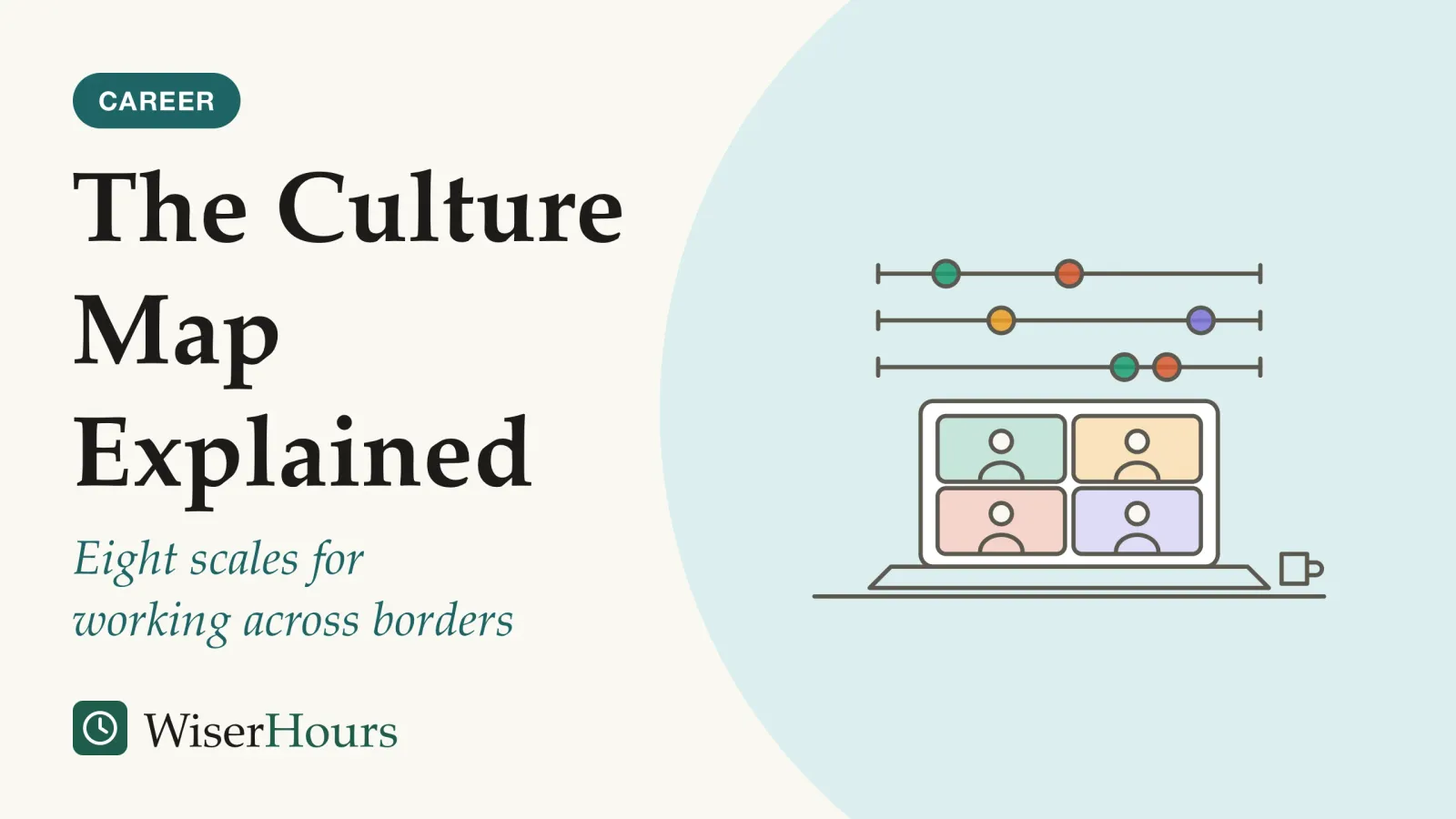
Aaron grew up in Tel Aviv with Russian-born parents and spoke Russian well. He had run teams in Israel and a large organization in Canada. Yet six months after his Israeli-owned company sent him to run a newly bought plant in Moscow, he was still struggling to manage his team there. His story is the opening of Erin Meyer’s 2014 piece for Harvard Business Review.1 Knowing the language and the culture from home had not been enough.
The Culture Map is Meyer’s 2014 book about exactly that gap. It places cultures on eight scales of everyday work behavior: communicating, evaluating, persuading, leading, deciding, trusting, disagreeing and scheduling.2 Its central claim is that what matters is where two cultures sit relative to each other, because the same colleague can look blunt to one person and evasive to another.3 INSEAD, the international business school where Meyer is a professor, presented the book as a framework for managers working with colleagues, clients and suppliers from other countries.4 The most practical use of it is a team exercise, set out in steps below: place each person on the eight scales, find the two or three widest gaps, and agree a working norm for each.
Reading cultural differences belongs with the core communication skills employers look for, and the eight scales give it a working vocabulary.
The main idea of The Culture Map: position is relative
The main idea of The Culture Map is that no culture is direct, punctual or hierarchical in absolute terms, only more or less so than another one. A 2025 review of the book in the Australian Journal of General Practice sums up Meyer’s argument: relative positioning, not a culture’s absolute place on a scale, determines how people see each other.2
Meyer gave a clean example in a 2014 interview with Yale Insights. On a team of British and French colleagues, the British described the French as disorganized and always late. When Indian colleagues joined, they described the same French colleagues as rigid and too focused on punctuality. France sits between the UK and India on her scheduling scale, so each side saw the French from the opposite direction.5
- Teal dot: British teammates, nearer the linear-time end: to them, the French colleagues looked late and disorganized
- Amber dot: French colleagues, between the two on the scheduling scale
- Coral dot: Indian teammates, nearer the flexible-time end: to them, the same French colleagues looked rigid
Clock: the linear-time end of the scale. Looping line: the flexible-time end. Each arrow is one group looking at the middle group from its own position.
The Guardian’s Oliver Burkeman made the same point about friendliness in 2014: the British come across as reserved in California and as warm in Paris.6 Your sense of what counts as normal is a position too, and readers sit at every point on every scale, so no country is the zero point the others are measured from.
When a colleague strikes you as rude, vague, slow or pushy, ask where you sit on that scale before you decide what the behavior means, and whether something cultural could be shaping your reaction.
The eight scales of the culture map, with an example of each
Each scale runs between two ends. The labels below follow a US National Science Foundation training deck that reproduces Meyer’s figures; the example in each row is an illustration of a gap, written for this guide.
| Scale | One end | Other end | What a gap can look like at work |
|---|---|---|---|
| Communicating | Low-context: the message is in the words | High-context: much is left implied | “Let’s revisit this later” means no to one person; the other books a follow-up.7 |
| Evaluating | Direct negative feedback | Indirect negative feedback | “A few small things to tidy” is meant as a warning and heard as praise.7 |
| Persuading | Principles first: theory, then conclusion | Applications first: conclusion, then support | One presenter opens with the method; the room wanted the recommendation on slide one.7 |
| Leading | Egalitarian | Hierarchical | A manager asks for ideas; half the team waits to hear what the boss wants.7 |
| Deciding | Consensual | Top-down | A lead announces a decision after a short call; colleagues who expected to be consulted feel bypassed.7 |
| Trusting | Task-based: trust comes from delivery | Relationship-based: trust comes from personal connection | One colleague opens with the agenda; the other expected lunch first.7 |
| Disagreeing | Confrontational | Avoids confrontation | A hard argument over an idea reads as interest to one person and as a personal attack to another.7 |
| Scheduling | Linear time: one thing at a time, on schedule | Flexible time: plans adapt as things come up | “We start at nine” means nine sharp to some and roughly nine to others.7 |
Communicating and evaluating are separate scales
Communicating measures how much meaning sits in the words, while evaluating measures how bluntly criticism is given, and a culture can sit at different ends of the two. Meyer uses France and the United States to show it. Americans tend to be more explicit than the French in everyday communication, yet the French tend to be more direct with negative feedback than Americans, so the two countries swap places between the scales.5
She described an American boss who opened a correction with three positives, as many US managers are trained to do. His French report left the meeting thinking it was the most positive review she had ever had; he believed he had told her off.5
If your feedback habits come from one end of the scale, a structure such as the SBI feedback model helps because it names the behavior and its impact plainly, whichever end the listener is used to. This is a different question from personal style: passive, aggressive and assertive communication styles describe individuals, while Meyer’s scales describe the norms around them.
High-context and low-context communication come from the anthropologist Edward T. Hall, who introduced the terms in his 1959 book The Silent Language.8 In high-context communication, much of the meaning sits in relationships, shared history and unspoken cues; in low-context communication, people expect the words to carry the message. Meyer’s book page cites the Japanese idea of “reading the air”, picking up what a conversation leaves unsaid.3 Meyer told Yale Insights that the more people work over email and phone, the less aware they are that culture is affecting them,5 which is why negotiating by email across cultures needs extra care.
Leading and deciding can point in different directions
Leading is about how much deference people show the boss; deciding is about who gets a say before a choice is final. The training deck treats them as two scales, egalitarian to hierarchical and consensual to top-down, so a team can sit toward one end of the first and either end of the second.7
Meyer told Yale Insights that Danish staff tend to be motivated by a boss who acts as a facilitator among equals, while Russian staff respond better when the boss is clearly in charge.5 Her book page describes a Danish manager whose Russian team saw his egalitarian style as weak.3 If you lead people whose expectations differ from yours, say out loud how decisions will be made and who has the final word, so nobody has to guess which end of either scale applies.
Persuading, trusting, disagreeing and scheduling
The remaining four scales govern how a case is made, how trust forms, how disagreement is voiced and how time is treated. On persuading, the training deck’s advice for an applications-first audience is to lead with a case or application; a principles-first audience wants the reasoning laid out before the conclusion.7 Whichever way you order a pitch, the appeals in ethos, pathos and logos still apply.
Trust shows up in small habits. Meyer recalled a Saudi client who said that sending a written recap after a phone call, standard practice in the US, would signal distrust if the two of them had a good relationship. Disagreement and turn-taking work the same way. In an INSEAD student group she supervised, an American described two Malaysian teammates as shy and quiet, while the Malaysians found no gap to speak in, because they had learned to wait for a pause before answering.5
Before reading silence as having nothing to say, or a recap as distrust, check where the other person sits on that scale.
How to use the culture map with a global team
The most useful way to use the culture map with a global team is to map the people in it, not the passports. The NSF training deck sets the same goal: identify your own tendencies on each scale, then your teammates’, then the shifts that would help, scoring each scale from 1 to 10.7 Meyer’s website offers a 24-question personal profile and a team mapping tool for this; a whiteboard works too.3
1. Place yourself first
Score yourself on each of the eight scales. Do it for how you behave at work, and note where your answer would change with a different boss or team.
2. Ask each teammate to do the same
Share the eight scales and ask everyone to place themselves privately, then compare. A Brazilian engineer who trained in Germany, or a Nigerian manager who has worked in Dubai for years, may sit far from where a country average would put them.
3. Find the two or three widest gaps
Plot everyone on one sheet and look for the scales where people sit furthest apart. The extremes matter less than the distance between people who work together every day, since relative position is what shapes how they see each other.
4. Agree a working norm for each gap
Turn each gap into a sentence the team agrees on: “Critical feedback goes one-to-one, in writing if it is detailed”; “Decisions in the Tuesday call are final unless someone flags new facts within a day”; “Meeting times are firm; a five-minute wait is the limit.” A shared norm saves each person from guessing which end of the scale applies.
5. Revisit the map when the team changes
A new member changes every gap, as the British, French and Indian team above showed. Redraw the map when someone joins or a project moves to a new region.
Map your team in one meeting
Is The Culture Map based on research?
The Culture Map rests on Meyer’s experience with executives and on earlier cultural research, not on one published, validated measurement instrument. Meyer told Yale Insights she had built on the work of others in her field.5 Her book page describes the model as field-tested and based on her work at INSEAD.3 Our searches found no peer-reviewed study validating the eight scales or the country positions on them.
The older frameworks it draws on have mixed evidence. Hall’s high- and low-context model is the most cited framework in intercultural communication articles in business and technical communication journals, yet it has been thinly tested. A 2008 review by Peter Cardon of 224 articles in those journals, published between 1990 and 2006, found that few of the model’s propositions had been examined empirically, and the tests run most often had failed to support many of them, particularly those about directness.9 Geert Hofstede’s dimensions, such as power distance, came from a statistical analysis of a worldwide IBM employee survey run between 1967 and 1973, and critics have questioned whether nations are the right level at which to measure culture.10
The national-level criticism is backed by a large pooled dataset, and it changes how much weight a country’s position on any culture map can bear.
The study
Moderate evidence
Where cultural values differ most: inside each country
Vas Taras, Piers Steel and Bradley Kirkman pooled 558 studies that had used Hofstede’s cultural values framework. About 80% of the variation in cultural values lay within countries rather than between them, which the authors read as showing that country is often a poor proxy for culture. They suggest that professions, socio-economic classes and free versus oppressed societies may mark cultural boundaries better than countries do.11
A meta-analysismeta-analysis: A study that combines the results of earlier studies on the same question into one overall estimate. Pooling makes the estimate more precise, but it cannot repair the studies it pools: a meta-analysis of surveys is still survey evidence.Full entry in the glossary of values is not a test of Meyer’s behavioral scales, and this guide used only the paper’s published summary, going no further than it. The 2025 review makes a similar point in summarizing Meyer: a culture sets a range of acceptable behavior, and each person chooses where to sit within it.2 Treat a country’s position as a first guess about a colleague, and replace it with what you learn about the person.
- Myth
- The culture map tells you how anyone from a given country will behave.
- Fact
- Country positions describe broad tendencies; individuals, regions and professions vary widely within every country.
The bottom line
The Culture Map is most useful as a vocabulary for differences that otherwise get read as rudeness, vagueness or weakness, and as a reminder that every judgment of that kind is made from your own position on the scale. Its country placements are informed guesses; ask the people in front of you where they sit, and let their answers replace them. This week, pick the scale where your team clashes most and agree one working norm for it.
Frequently asked questions
Who is Erin Meyer?
Erin Meyer is an American author and professor at INSEAD, a business school with campuses in France, Singapore and Abu Dhabi and a hub in San Francisco. She wrote The Culture Map in 2014, directs INSEAD's Leading Across Borders and Cultures program, writes for Harvard Business Review, and co-wrote No Rules Rules with Netflix co-founder Reed Hastings in 2020.
How many countries does The Culture Map cover?
A 2025 review of the book in the Australian Journal of General Practice says the eight scales have been mapped for 67 countries. Meyer's website sells an online country-mapping tool that shows where selected countries sit on the scales; the positions are her judgments, and no published dataset behind them was found in our search.
Is there a culture map test you can take?
Yes, as a paid tool. Erin Meyer's website offers a personal profile of 24 questions that places you on the eight scales and compares you with your own culture and with other countries, plus a team version. It is self-report, and we found no published validation study of it, so treat the result as a starting point for a conversation.
How does The Culture Map differ from Hofstede's cultural dimensions?
Hofstede's dimensions describe values, derived by statistical analysis of a worldwide IBM employee survey run between 1967 and 1973, with a score per country. Meyer's scales describe everyday work behavior, such as how feedback is given or decisions made, and she stresses where two cultures sit relative to each other. She says she built on earlier work in her field.
Sources
- Navigating the Cultural Minefield. Meyer, E. (2014). Harvard Business Review, May 2014
- The Culture Map: Decoding how people think, lead, and get things done across cultures (book review). Magiros, M. & Casey, C. (2025). Australian Journal of General Practice, 54(4)
- The Culture Map: Breaking Through the Invisible Boundaries of Global Business. Erin Meyer, official website (book and tools page), accessed October 2026
- New INSEAD book reveals eight-scale framework decoding cultural differences impacting international business. INSEAD (2014). Press release, 11 June 2014
- How Do We Work Across Cultures? Meyer, E., interviewed by M. O'Rourke (2014). Yale Insights, Yale School of Management, 24 September 2014
- This column will change your life: are you wasting your warmth? Burkeman, O. (2014). The Guardian, 14 June 2014
- Working with Multicultural Teams (training slides). Larson, C. K. (2015). US National Science Foundation, training presentation based on Meyer's The Culture Map
- High-context and low-context cultures. Wikipedia, accessed October 2026
- A Critique of Hall's Contexting Model: A Meta-Analysis of Literature on Intercultural Business and Technical Communication. Cardon, P. W. (2008). Journal of Business and Technical Communication, 22(4), 399-428
- Hofstede's cultural dimensions theory. Wikipedia, accessed October 2026
- Does Country Equate with Culture? Beyond Geography in the Search for Cultural Boundaries. Taras, V., Steel, P. & Kirkman, B. L. (2016). Management International Review, 56(4), 455-487
How we researched this
In October 2026 we read Erin Meyer's own pages, INSEAD's 2014 announcement, a 2014 Yale Insights interview, a 2025 journal review of the book, a US National Science Foundation training deck that reproduces the scales, and Wikipedia on Hall and Hofstede, then searched Crossref for critiques. Main limitation: the book and Meyer's HBR articles were not read in full (paywalled), and the two critiques were read as abstracts only.
Keep reading
Framing Effects: How the Way You Present an Idea Changes the Answer
The framing effect explained: why the same facts get different answers, what a 36-sample retest found, and how to frame work proposals honestly.
Ethos, Pathos, Logos: Aristotle's Persuasion Toolkit for Modern Work
Ethos, pathos and logos explained with 4 work examples, how each appeal fails when overdone, what kairos adds, and what persuasion research says.
Communication Styles Explained: Passive, Aggressive, Passive-Aggressive, Assertive
The 4 communication styles, where the model comes from, why your style shifts with the situation, and what style tests like DISC can and cannot tell you.
Assertiveness for Beginners: Saying What You Mean Without Steamrolling
How to be more assertive at work in 6 steps, from I-statements to handling pushback, and why too little and too much assertiveness both cost you.