How to Write a Professional Email: Structure, Length, and Tone
How to write a professional email: the request first, only the detail the reader needs, a courteous tone, and what a review of 62 work-email papers found.

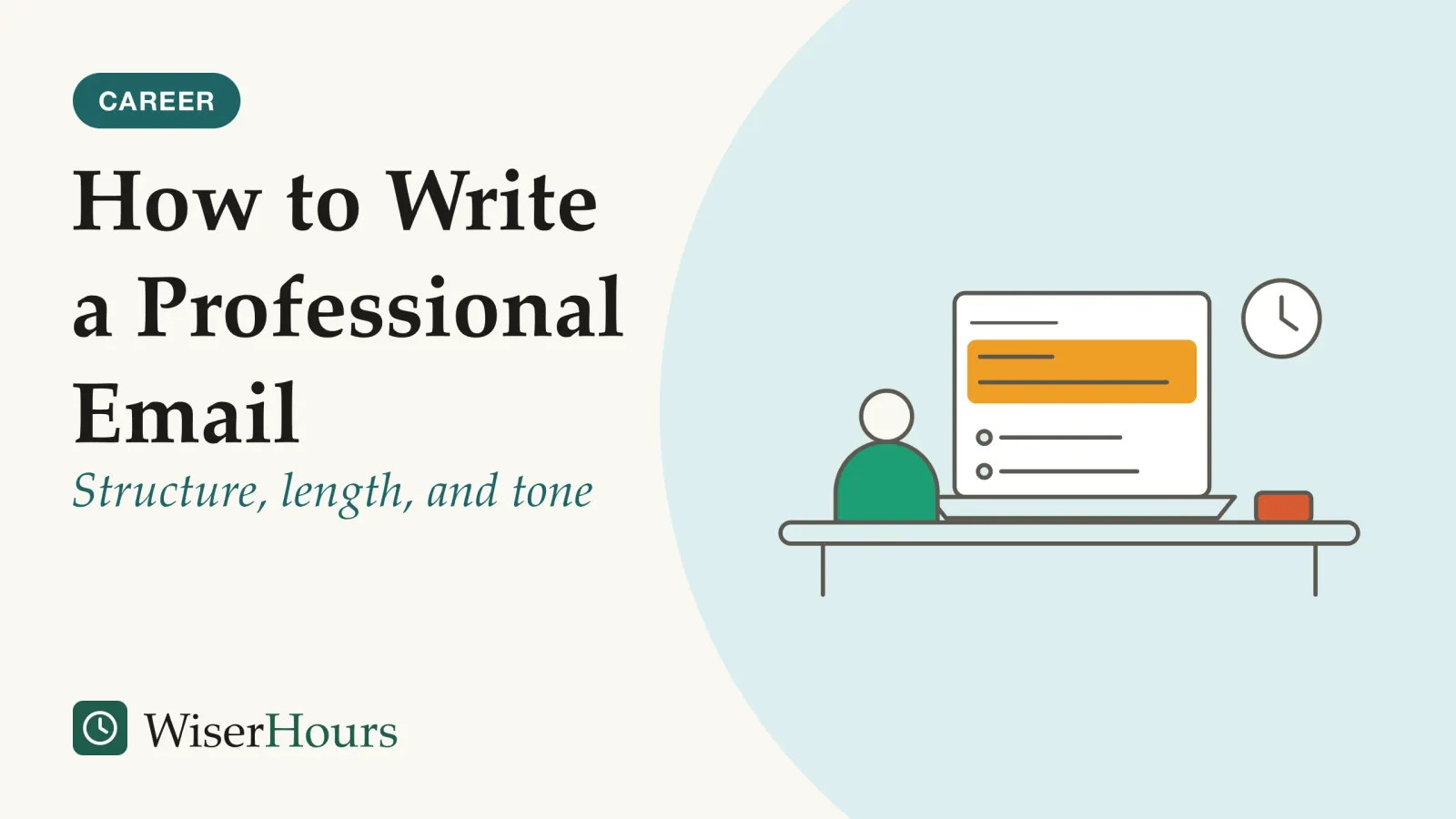
More than half the time, a work email that someone opens is closed again within 10 seconds, according to researchers at Microsoft and the University of Amsterdam who analyzed 2017 reading logs from a large commercial email service used by businesses. Whatever you send lands in front of that reader: busy, skimming, and deciding at a glance whether the message needs them.1
A professional email is one the reader can understand and act on in a single quick read, in a tone that suits the working relationship. A systematic reviewsystematic review: A review that fixes its question and its rules for including studies in advance, then searches out every study that fits and weighs them together. Some systematic reviews pool the results into a meta-analysis; others describe what the studies found without combining the numbers.Full entry in the glossary published in 2023, covering 62 papers on work email, found that uncivil or inconsiderate emails, including abrupt, ambiguous or overcomplicated ones, were consistently linked to worse work performance and wellbeing, and civil, considerate ones to better.2 To write a professional email, in six steps:
- Decide the one thing you need before you write
- Put the request or the answer at the top
- Give only the background the reader needs to act
- Make the reply easy
- Keep the tone courteous and businesslike
- Proofread names, numbers and spelling before you send
What a professional email has to do in a few seconds
A professional email has to survive a quick read: within seconds, the recipient should know what you are asking, the deadline, and why it lands on their desk. The US Army’s rules for correspondence set the same bar, defining effective writing as writing a reader understands in a single rapid reading.3
The reason is how email is actually read. The researchers logged two weeks of reading by over a million users of a business email service in 2017, timing each email from the moment it opened in the reading pane until the reader moved on. On computers and phones alike, more than half of those reading events lasted less than 10 seconds.1
Treat that figure as a rough picture, not a rule. The logs mixed every kind of email, from colleagues’ messages to hotel and restaurant emails, and left out conversation threads; an open reading pane does not prove anyone read the message; and the study is a preprint written mostly by Microsoft staff, not a peer-reviewed paper.1 Still, it matches what most people see in their own inbox: every message gets a first glance, and only some earn a second.
Take a manager with 30 unread emails and 5 minutes before a call. One email opens with “Hope you’re well. Following up on our chat last month about the vendor review.” Another opens with “Could you approve the Q3 vendor contract by Thursday noon?” Only the second one can be handled in that gap.
The practical test: write the first two lines so that they would do the job even if the reader stopped there. Writing for what the other person will take away, rather than what you meant, is also the thread running through communication skills at work more broadly.
Put the request first and the background last
The most useful structural choice in a professional email is to open with its purpose and main point and leave background for the end. US federal plain-language guidance gives that advice, and the government’s accessible-email guidance adds that the subject and body should state the purpose clearly and concisely.45
Why it works comes down to what busy readers do with text. Harvard researchers Todd Rogers and Jessica Lasky-Fink, authors of Writing for Busy Readers, describe a habit they call early quitting: readers skim a message, decide it is too much to deal with at that moment, and move on before finishing. Some never come back, and others come back after a deadline has passed. In their own experiment with a shorter email request, described in the guide to writing emails with AI and reported by the authors rather than in a peer-reviewed paper, they suggest some readers of the longer version stopped before they reached the request at the end.6 A request in the last paragraph is the part most at risk.
Here is the vendor email written both ways. The facts are identical; only the order changes.
The version on the right still greets Sam and still says why. It moves the request from the last line to the first and turns the history into one sentence about what changed. The drawing below shows the order it follows.
- The request and the deadline, right under the greeting
- Why it matters to the reader, in a sentence
- Only the detail they need to act; the rest goes in an attachment
- An easy way to reply: a yes or no, or a choice between two options
What this means for you: before you send, read only your first two lines. If they don’t say what you need and by when, find the sentence that does and move it to the top.
Further reading
Writing for Busy Readers: Communicate More Effectively in the Real World
The book behind the early-quitting research cited here: why busy readers skip long messages, and how to put the request where they will see it.
As an Amazon Associate WiserHours earns from qualifying purchases.
How long a professional email should be
A professional email should be as long as the reader needs to act, and no longer: in most cases a few short paragraphs, with anything else attached or linked. Length matters because readers judge the effort a message will take before they start on it, and they put off the ones that look like work.7
The clearest evidence comes from a 2019 Microsoft study of why people put email off. In interviews with 15 Microsoft employees, the time or effort a message seemed to need was the main reason for leaving it until later: people asked themselves whether they knew the answer and whether the email meant doing a task. In a model built on the logs of about 40,000 users, the length of the email body was one of the two strongest predictors of deferral, alongside how many unhandled emails the person already had.7
That is a pattern in logs, not a test of cutting words, and a deferred email is not an ignored one. But it explains why a long email from a colleague often waits for “later”: it looks like a job, so it goes to the back of the queue. A five-paragraph project update is the typical case. Cut to three lines, saying what changed, what you need and by when, with the full notes attached, it asks for a quick decision instead of a sitting.
The US Army’s correspondence rules offer a workable ceiling. They ask writers to keep sentences to about 15 words on average, keep most paragraphs to 10 lines or fewer, and put extra information in enclosures rather than the main text.3 The rules are written for letters and memos, but the same limits suit an email.
Short is not the same as curt, though. In a 2010 experiment by the psychologists Vignovic and Thompson, readers formed negative impressions of email senders who broke etiquette norms, which the researchers defined as short messages lacking a conversational tone.8 Cut the padding, the history and the repeated points, and keep the “please” and the “thanks”.
A businesslike tone is the safer default
A courteous, businesslike tone is the safer default for a professional email, even though a casual tone often feels friendlier to the writer. In field experiments published in 2023, formal government letters got more people to act than informal versions of the same message, and in the same paper’s online studies, readers rated the senders of formal letters as more competent and trustworthy.9
- Myth
- A casual, chatty tone gets more replies than a formal one.
- Fact
- In field experiments with government letters, formal versions drew more responses than informal ones, although most experts surveyed predicted the opposite.
The study’s authors, led by Elizabeth Linos of the Harvard Kennedy School, set out to test what most practitioners believed, and the results ran the other way.
The study
Moderate evidence
Formal against friendly in three US government mailings
US government bodies sent randomly chosen residents or businesses either a formal letter or a friendlier, more colorful version of the same request. In the largest experiment, about 35,000 city residents were invited to join an ambulance-cover scheme: about 2.6 percent of those sent the formal letter enrolled, against about 1.8 percent of those sent the informal one. In another, with 10,000 businesses, about 9 percent of those sent the formal letter registered, against about 7 percent of those sent the informal one. Over 84 percent of 351 researchers and practitioners had predicted the informal letter would win each time.9
The effect is small in absolute terms, about 1 or 2 extra responses per 100 letters, but it held in all three settings. The authors’ online studies suggest why: formality worked as a shortcut for credibility and importance, with no sign that it changed how well readers understood the letters. There are two catches. In the largest experiment, the two letters differed mainly in their look rather than their wording.9 And the tests ran on official letters to members of the public, where a casual style may look out of place. Nobody has run the same test on email between colleagues.
For an email, businesslike means complete sentences, a greeting and a sign-off, and no slang or jokes that depend on tone of voice. Compare “Quick one, any chance you could eyeball the deck at some point?” with “Could you review the deck by Wednesday? Your view on the budget slide matters most.” The second is just as polite, and it reads as a request someone means. Tone is also harder to carry in writing than it feels: in a 2005 series of five experiments, people tended to believe they could communicate by email more effectively than they actually could.10 Greetings, sign-offs, exclamation points and emoji each deserve a closer look than this guide can give them, and WiserHours will cover them separately.
How to write a professional email, step by step
Six steps turn the evidence into a routine: settle the request, put it first, trim the background, make replying easy, set the tone, and check the details. The early steps rest mainly on government writing guidance, the later ones on log studies, survey research and one experiment, and nobody has tested the six together as a method.
1. Decide the one thing you need before you write
Write down, in one sentence, what you want the reader to do and by when: for example, “Sam approves the Q3 vendor contract by Thursday noon.” If you cannot, the email is not ready. If you need several things from different people, consider separate emails, so each reader sees only the request that is theirs.
2. Put the request or the answer at the top
Open with the request, or with the answer if you are replying. Federal plain-language guidance advises stating the purpose and the bottom line at the start.4 A greeting can come before it; history and context come after.
3. Give only the background the reader needs to act
Ask of each sentence: would the reader act differently without it? Keep what changes their decision, such as a new fact, a cost or a deadline, and attach the rest. The Army’s rules send extra information to enclosures for the same reason.3
4. Make the reply easy
In the Microsoft interviews, emails that looked like effort were the ones people put off.7 So lower the effort: ask a question that can be answered with a yes or a no, offer two options or two time slots, attach the file instead of describing where to find it, and state the deadline.
5. Keep the tone courteous and businesslike
Use full sentences, a greeting and a thank-you. The systematic review counted an abrupt or rude tone, pressure for an immediate reply and ambiguous content among the uncivil email behaviors linked to worse outcomes.2
6. Proofread names, numbers and spelling before you send
In the 2010 experiment, readers formed negative impressions of senders whose emails contained spelling and grammar errors, although knowing the sender came from another culture softened most of those judgments.8 Check the recipient’s name, every date and figure, and the attachment, then read the first two lines once more as the recipient.
Before a professional email goes out
What the email research can and cannot tell you
The evidence behind professional email advice is thinner than its confident tone suggests. The review of work email rests mostly on surveys, the strongest experiments used government letters rather than email, and the reading-time figures come from one unreviewed preprint.
| The advice | What the best evidence found | Evidence |
|---|---|---|
| Courteous, clear work email | Uncivil email, including abrupt, ambiguous or overcomplicated messages, linked to worse performance and wellbeing | Systematic review of 62 papers, mostly surveys and interviews; limited2 |
| Speed of reading | More than half of reading events in the logs lasted less than 10 seconds | Observational, limited: one company’s logs, preprint1 |
| Request and main point first | Advised in US federal plain-language guidance | Expert: US government guidance4 |
| Length and effort | Email length was among the strongest predictors of deferral; emails that looked like effort were put off | Observational, limited: one study’s logs of one email service, plus 15 interviews7 |
| Formal versus casual tone | Formal letters drew more responses than casual versions | Trial, moderate: government letters, not email9 |
| Typos and curt messages | Readers judged the senders more harshly | Trial, limited: one experiment, abstract only8 |
What this adds up to: treat the six steps as well-grounded defaults rather than proven rules, and let your own inbox refine them. If a request-first email still goes unanswered, try making the ask clearer or the reply easier before you add more explanation.
The bottom line
Write every professional email for a reader who may give it a few seconds: the request and the deadline in the first two lines, then why it matters, then only the detail they need to act, and an easy way to answer. Keep it short by cutting history and repetition, not courtesy, and let a businesslike tone and a final proofread do the rest.
Frequently asked questions
Is it professional to use bullet points in an email?
Yes, when the email has several separate items. US federal guidance on accessible email, published on Section508.gov, recommends bulleted or numbered lists made with the email program's built-in list tools. Keep the request itself in a full sentence at the top, and use a list for the details or the options the reader has to choose between.
How formal should an email to a close colleague be?
Less formal than a first email to a stranger, but still courteous. The field experiments on formal letters tested government mail to residents, not messages between colleagues, so nobody has measured the right register for a teammate. What the evidence does cover is the floor: in the 2023 systematic review of work-email studies, abrupt or rude emails were consistently linked to worse outcomes at work.
Do people read work email on their phones?
Many do, at least at first. In a Microsoft analysis of enterprise email logs from 2017, people who read the same email on two devices had usually opened it first on a phone and then again on a computer. So the opening lines have to work on a small screen, and the details can wait for a second read at a desk.
Sources
- Characterizing Reading Time on Enterprise Emails. Li, X., Lee, C.-J., Shokouhi, M. & Dumais, S. (2020). arXiv preprint 2001.00802, not peer-reviewed
- Getting on top of work-email: A systematic review of 25 years of research to understand effective work-email activity. Russell, E., Jackson, T. W., Fullman, M. & Chamakiotis, P. (2023 online; 2024 in print). Journal of Occupational and Organizational Psychology, 97(1), 74-103
- Army Regulation 25-50: Preparing and Managing Correspondence. Headquarters, Department of the Army, US (10 October 2020; current file dated 4 October 2024)
- Organize the information (Plain language guide series). Digital.gov, US General Services Administration (11 September 2025)
- Accessible Email Messages. Section508.gov, US General Services Administration (page reviewed July 2026)
- When Writing for Busy Readers, Less Is More. Rogers, T. & Lasky-Fink, J. (11 September 2023). Behavioral Scientist; research from their book Writing for Busy Readers (Dutton, 2023)
- Characterizing and Predicting Email Deferral Behavior. Sarrafzadeh, B., Hassan Awadallah, A., Lin, C. H., Lee, C.-J., Shokouhi, M. & Dumais, S. T. (2019). Proceedings of the 12th ACM International Conference on Web Search and Data Mining (WSDM 2019), 627-635
- Computer-mediated cross-cultural collaboration: Attributing communication errors to the person versus the situation. Vignovic, J. A. & Thompson, L. F. (2010). Journal of Applied Psychology, 95(2), 265-276
- The formality effect. Linos, E., Lasky-Fink, J., Larkin, C., Moore, L. & Kirkman, E. (2023 online; 2024 in print). Nature Human Behaviour, 8(2), 300-310; working paper version, Harvard Kennedy School RWP23-009 (2023)
- Egocentrism over e-mail: Can we communicate as well as we think? Kruger, J., Epley, N., Parker, J. & Ng, Z.-W. (2005). Journal of Personality and Social Psychology, 89(6), 925-936
How we researched this
The sources come from September 2026 searches of Crossref, OpenAlex, Europe PMC, PubMed and general web search for systematic reviews, experiments and large log studies of how people read, answer and judge work email, plus current US government writing guidance. They were published between 2005 and 2026. The main limitation is that few studies test work-email writing directly: the strongest experiments used government letters, and one key Microsoft study is an unreviewed preprint.
Keep reading
How to Give Constructive Feedback Using the SBI Model (With Examples)
The SBI feedback model in 3 steps (situation, behavior, impact), with examples for praise and correction, and the next step it leaves out.
Active Listening Explained: What It Is and How to Practice It
Active listening, from its 1957 origin to the experiments: what it is, what feeling heard does for a speaker, and five steps to practice it at work.
What Are Communication Skills? A Plain-English Guide to the Core Set
Communication skills explained: the core six, the two tests they are judged on, and why email senders in a 2005 study expected 78 percent accuracy but got 56.