Six Thinking Hats: How to Look at a Problem From Every Angle
Six thinking hats, Edward de Bono's 1985 method: what each of the 6 colors covers, a sample meeting sequence with timings, and what the studies show.

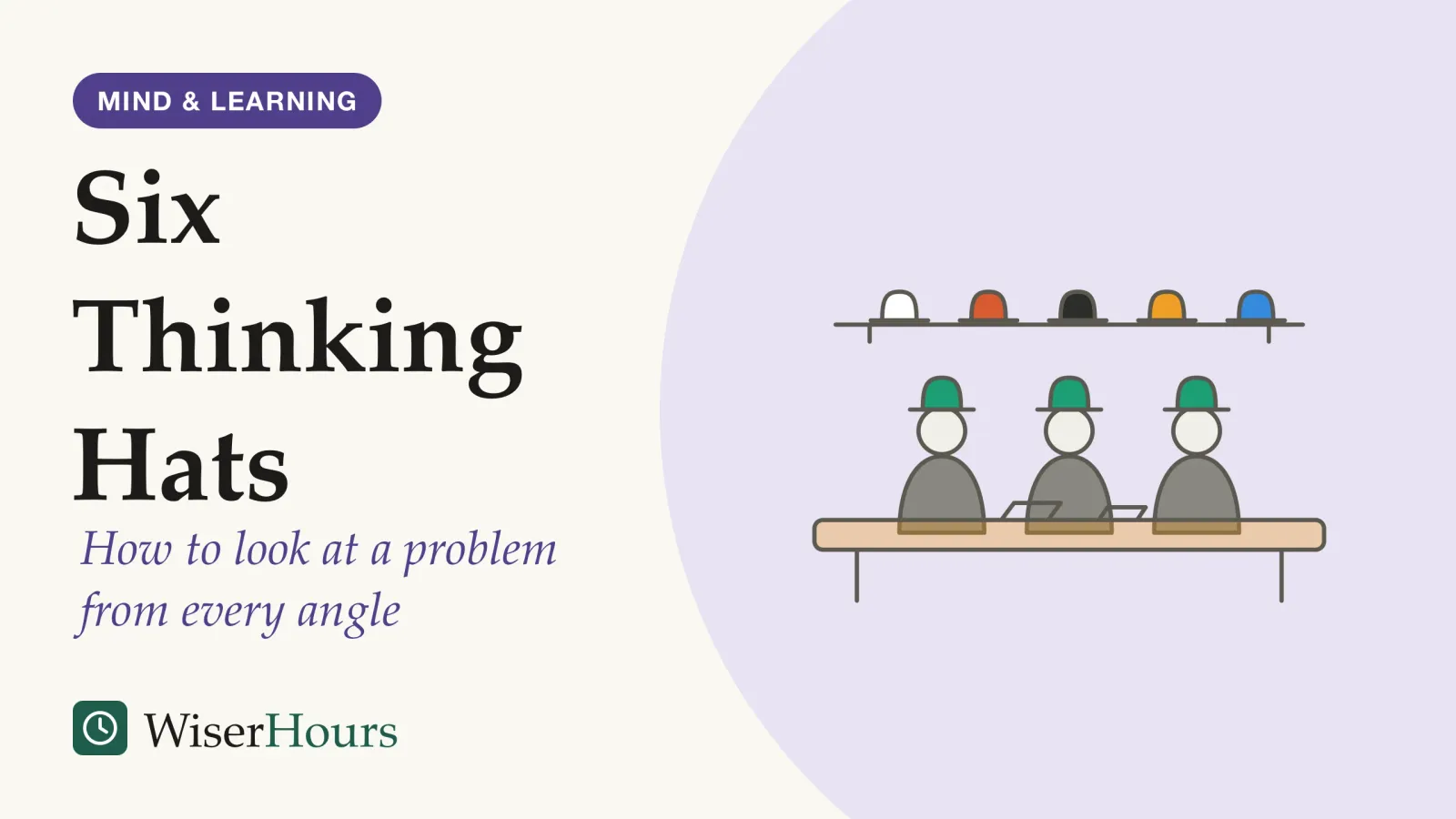
Five people are deciding whether to move a customer newsletter from weekly to monthly. One lists everything that could go wrong, another defends the idea, a third keeps asking for numbers, and after forty minutes the meeting ends with no decision. Each of them was thinking well, but in a different direction from the others.
Six thinking hats is Edward de Bono’s 1985 method for that problem: the group looks at a question in one direction at a time, marked by an imaginary colored hat, and everyone wears the same hat at once. White covers facts, red feelings, black risks, yellow benefits, green new ideas and blue the process itself.1 Evidence for the method is thin, but in one small online experiment run by researchers at a UK university, people given the hats restated a problem in more, and more original, ways than people given no technique.2 A decision meeting with the hats runs in five moves:
- Open with the blue hat and agree the question
- Lay out the facts under the white hat
- Generate options under the green hat
- Weigh benefits, then risks, then take a gut vote
- Close with the blue hat and name the next step
The hats are one of several idea-generation techniques, each rated by how well it is tested; this guide goes deep on running them.
What are the six thinking hats?
The six thinking hats are six directions of thinking, each named by a color: white for information, red for feelings and hunches, black for caution, yellow for benefits, green for new ideas and blue for managing the thinking. Wikipedia’s entry on de Bono’s book describes switching direction as putting on a different hat, literally or in the mind, and notes that he first used the image of a thinking hat in 1971.1
| Hat | What it covers | Questions to ask under it |
|---|---|---|
| White | Facts and information | What do we know? What do we need to find out?3 |
| Red | Feelings, hunches and intuition | What is my gut telling me about this?3 |
| Black | Caution, risks and difficulties | What problems could arise? Where are the weak points?3 |
| Yellow | Benefits and value | What are the advantages? Why might this work?3 |
| Green | Creativity and new ideas | What else is possible? How could this be improved?3 |
| Blue | The process and the big picture | Where are we now? What thinking do we need next?3 |
De Bono’s wider career and the debate over his methods are covered in this guide to lateral thinking and de Bono’s techniques, so this article stays with the hats.
Most colors carry their usual associations, which makes them easy to remember: red for emotion, black for a judge’s caution, yellow for sunshine. The black hat is the one people misread as unwelcome. The de Bono Group, which sells the official training, calls it the risk management hat and probably the most powerful of the six, though a problem if overused.4
Why the whole group wears the same hat at once
The central rule is that everyone uses the same hat at the same time, which de Bono called parallel thinking. The NHS England library guide to the method explains the gain: people think together in one mode instead of in different, conflicting ones, and the discussion moves faster.3
Ordinary meetings mix the modes. One person proposes an idea, another attacks it, a third voices a worry, and each contribution answers a different question, so the loudest mode wins. Under the hats, criticism still happens, but in its own time slot, after the idea has been heard and its benefits listed. Wikipedia’s summary makes the same point: a group focused on one approach at a time tends to collaborate better than one where people react emotionally, objectively and critically all at once.1
In a budget meeting, this changes the tone more than the content. The finance lead who usually opens with “we can’t afford it” now waits for the black hat, and the same concern lands after the yellow hat has shown what the money would buy.
The NHS guide also asks facilitators to discourage people from describing themselves as a particular hat, such as the colleague who stays quiet while saving every comment for the black hat.3
What order should the six thinking hats be used in?
There is no single correct order, but every sequence starts and ends with the blue hat: the group agrees how it will think, does the thinking, then decides what happens next. Wikipedia lists sample sequences from de Bono’s training materials. For choosing between alternatives, the order is blue, white, green, yellow, black, red and blue, with green marked optional; for quick feedback, it is just blue, black, green and blue.1
The decision order follows a logic you can reuse. Facts come early, so everyone argues from the same information. New ideas come before judgment, so options are not killed while still half-formed. Benefits come before risks: the NHS guide reports that its teams found it useful to start with yellow, because criticism heard after the positives tends to be milder.3 Feelings come near the end, once people know enough to have a gut reaction worth hearing.
How to use the six thinking hats in a meeting
To use the six thinking hats in a meeting, one person wears the blue hat as facilitator: they explain the plan, keep time and keep the group on one hat at a time, as the NHS guide describes the role.3 Each hat gets a few minutes; Wikipedia, citing de Bono’s training materials, puts a typical hat at about 2 minutes, with a longer white hat at the start and about 30 seconds for the red hat, often as a dot vote.1 The NHS guide reports de Bono suggesting about 4 minutes per hat.3 With short slots, a long critique under the black hat cannot eat the time meant for new options.
- Blue: agree the question, the order of hats and the time boxes
- White: the facts you have and the facts you are missing
- Green: options, including ones nobody has proposed yet
- Yellow: the benefits of each option, before anyone criticizes
- Black: risks and reasons each option could fail
- Red: a quick gut vote, with no reasons required
- Blue: the decision, the owner and the next step
1. Open with the blue hat and agree the question
The facilitator states the decision in one sentence, shows the hat sequence and the time boxes, and asks whether anything is missing. The NHS guide even suggests words for steering people back when they drift:
Excuse me, we are on the yellow hat now, so only positive comments about benefits and good points are allowed
2. Lay out the facts under the white hat
Everyone lists what is known and what is missing, without interpreting it. Turn each missing fact into a task with a name on it instead of guessing what it might show.
3. Generate options under the green hat
The group proposes options, including ones nobody arrived with. Spoken idea rounds have a known weakness: while one person talks, the others wait and lose ideas, which is why the research on why group brainstorming often underperforms favors writing first. Give everyone a minute to write options alone, then read them out.
4. Weigh benefits, then risks, then take a gut vote
Run the yellow hat on each option, then the black hat, then a quick red-hat vote. NHS teams have set ground rules such as equal time for yellow and black, or a black list no longer than the yellow one, and the guide suggests a quick return to the green hat to reduce the drawbacks the black hat found.3
5. Close with the blue hat and name the next step
The facilitator summarizes where the group has landed and asks for a decision, an owner and a date. If the group cannot decide, the missing white-hat facts usually explain why, and the next step is to get them.
Before you close a six hats meeting
One newsletter decision, hat by hat
The newsletter team from the opening can settle its question in about 20 minutes. The example is invented, but every move follows the sequence and guidance above.
Under the blue hat, the facilitator writes the question: should the customer newsletter go from weekly to monthly? Under the white hat, the team lists what it knows (open rates, how long each issue takes to write) and what it lacks: whether readers would miss the weekly issue. That gap becomes a task, a short reader survey.
Under the green hat, everyone writes options alone for a minute, and the list grows past the original two: fortnightly, or monthly plus short alerts when something urgent ships. Under the yellow hat, monthly frees the writer’s time and makes a fuller issue, and alerts keep urgent news fast. Under the black hat, monthly risks readers forgetting they subscribed, and alerts could quietly become a second newsletter.
The red hat takes 30 seconds, and most dots land on monthly plus alerts. Under the closing blue hat, the team agrees a one-quarter trial owned by the editor, with the survey as the check and a cap on alerts to answer the black-hat worry. The criticism arrived after the options existed, so it shaped the plan instead of ending the discussion.
Can you use six thinking hats on your own?
Yes. Wikipedia’s entry notes that the hats and their sequences may be used by individuals working alone as well as by groups.1 Alone, the hats guard against arguing with yourself in circles, where each new idea is criticized before it is finished.
A person weighing a job offer can give each hat a heading on a page and a few minutes on a timer. The white hat lists salary, commute and what is still unknown about the team. The green hat adds options beyond yes and no, such as negotiating the start date. The red hat matters more alone than in a group: writing the honest gut reaction down stops it from being quietly overruled by the spreadsheet, or from secretly steering it.

Does the six thinking hats method work?
The six thinking hats method has little controlled evidence behind it. A few experiments suggest the hats help people see a problem in more ways, and classroom studies report that students like the method, though the ones found for this guide had no comparison group. A 2006 Cambridge University Press review of thinking frameworks, quoted on Wikipedia, found sparse evidence that hats training improves thinking in general.1
The study
Limited evidence
Do the hats help people restate a problem? An online test with 100 people
David Vernon and Ian Hocking randomly assigned 100 people to use the six hats, a set of six simple questions, or no technique, then asked them to restate a problem in as many ways as they could in 3 minutes. Both techniques beat the control group on how many restatements people produced and on originality; the questions had the stronger effect on the count, the hats on originality.2
The study tested a narrow skill over a few minutes online, and it says nothing about meetings or teams. Restating a problem well is still an early step in solving it, so the result fits the method’s promise that deliberate shifts of view widen what people see. The abstract, the only part open for this guide, gives no effect sizes, so the strength of the boost is unknown.
The other controlled study looked at single hats. In the second of two experiments by Öznur Göçmen and Hamit Coşkun, researchers at two universities in Turkey, people assigned the green hat produced more unique ideas than those under the yellow or red hat, and the abstract reports that an instruction to work fast appeared to add more unique ideas still.5 For a facilitator, that result fits the advice to give the green hat its own protected time.
Much of the remaining research comes from classrooms. A 2025 study of 160 nursing students at one university in Saudi Arabia found that about 7 in 10 had a positive attitude to the method, and their scores on a critical thinking questionnaire rose over the course. It measured one group before and after, with no control groupcontrol group: The group in a study that does not get the treatment being tested, so its results show what would have happened anyway. It may get nothing, usual care, a placebo, a place on a waiting list or a different activity, and which one it gets shapes what the comparison can show.Full entry in the glossary, so the rise cannot be separated from the effect of the course itself, and the authors note it was run at a single institution.6 Students liking a method is a fair reason to use it in class; it is weak evidence that their thinking improved.
| Claim | What the best evidence found | Evidence |
|---|---|---|
| The hats widen how people see a problem | More, and more original, restatements than no technique in a 3-minute online task | One randomized online experiment, 100 people, UK researchers, limited2 |
| The green hat produces more new ideas | More unique ideas than the yellow or red hat in brainstorming sessions | The second of two experiments in Turkey, read as abstract only, limited5 |
| Students value the method | About 7 in 10 nursing students in a 2025 Saudi study rated it positively | One group, no control group, limited6 |
| Hats training improves thinking in general | Sparse evidence, in a 2006 review of thinking frameworks | Expert review, limited1 |
| Meetings get much shorter | Claimed by the company that sells the training; no independent test found | Vendor claim, untested4 |
- Myth
- Six thinking hats is a proven way to make better decisions.
- Fact
- No study found for this guide measured decision quality. The few experiments tested short idea tasks, and the classroom studies found had no comparison group.
Treat the hats as a meeting structure that costs little to try and is easy to drop. Run it on two or three real decisions, then compare those meetings with your usual ones on things you can see: how long they took, whether a decision was made, and whether the risks raised turned out to matter.
The bottom line
The hats work best as a shared agenda for thinking, with one direction at a time, benefits heard before risks and a blue hat who keeps time. Next time a decision meeting goes in circles, write the question down, put up the sequence blue, white, green, yellow, black, red, blue, and give each hat a few minutes.
Frequently asked questions
Who invented the six thinking hats?
Edward de Bono, the Maltese doctor and writer on thinking, set out the method in his 1985 book Six Thinking Hats. According to Wikipedia, he had already used the image of an imaginary hat for a thinking direction in a 1971 management handbook, and his CoRT thinking program of 1973 contained tools that match each hat.
Do you need real hats for the six thinking hats?
No. The hats are a metaphor for a direction of thinking, and the NHS England library guide says so plainly. The same guide notes that some NHS teams keep a supply of cheap colored caps because it is fun and reminds people to stay on one kind of thinking. A colored card on the table or a heading on a shared screen does the same job.
Is Six Thinking Hats a trademark?
The name is presented as a registered trademark by the organizations that sell de Bono's training, such as the de Bono Group, and Wikipedia describes the official training as franchised. Using the idea in your own meetings needs no certificate. Paid courses add practice and official materials, but no independent study found for this article compares certified and self-taught use.
How are the six thinking hats related to lateral thinking?
The green hat is where de Bono's lateral thinking tools belong. Wikipedia's comparison links the green hat to his concept challenge and po techniques, while the other hats cover facts, feelings, benefits, risks and process. Lateral thinking is a set of tools for new ideas; the six hats are a way of organizing a whole discussion, of which idea generation is one part.
Sources
- Six Thinking Hats. Wikipedia (accessed 17 October 2026)
- Thinking hats and good men: Structured techniques in a problem construction task. Vernon, D. & Hocking, I. (2014). Thinking Skills and Creativity, 14
- Six Thinking Hats. NHS England Knowledge and Library Services (accessed 17 October 2026)
- Six Thinking Hats. The de Bono Group (accessed 17 October 2026)
- The effects of the six thinking hats and speed on creativity in brainstorming. Göçmen, Ö. & Coşkun, H. (2019). Thinking Skills and Creativity, 31
- Effect of applying six thinking hats teaching method for development through life span course on students opinion and critical thinking skills. Elbilgahy, A. A. & Alanazi, F. J. (2025). BMC Medical Education, 25
How we researched this
We read the six hats method in Wikipedia's entry and the NHS England Knowledge and Library Services guide, and the de Bono Group's own description. For evidence we searched OpenAlex, Crossref and Europe PMC for experiments and classroom studies of the method (2014 to 2025). Main limitation: the two controlled experiments were read only as abstracts.
Keep reading
Lateral Thinking: Edward de Bono's Techniques Explained
Lateral thinking, Edward de Bono's 1967 idea, explained: 4 of his techniques worked through on one problem, and what the thin evidence on training shows.
How to Come Up With Ideas: 12 Techniques Worth Trying
How to come up with ideas: 12 techniques, from working alone first to a walk or an AI draft, each labelled for how strong its evidence is.
Does Brainstorming Work? What Decades of Research Show
Does brainstorming work? Since 1958, lab studies have found people working alone out-produce talking groups. Why, and when group ideas pay off.
How to Solve It: George Pólya's Four Steps, Still Useful Today
Pólya's How to Solve It in 4 steps: understand, plan, carry out, look back. The key questions, two worked examples and what later research adds.