Does Brainstorming Work? What Decades of Research Show
Does brainstorming work? Since 1958, lab studies have found people working alone out-produce talking groups. Why, and when group ideas pay off.

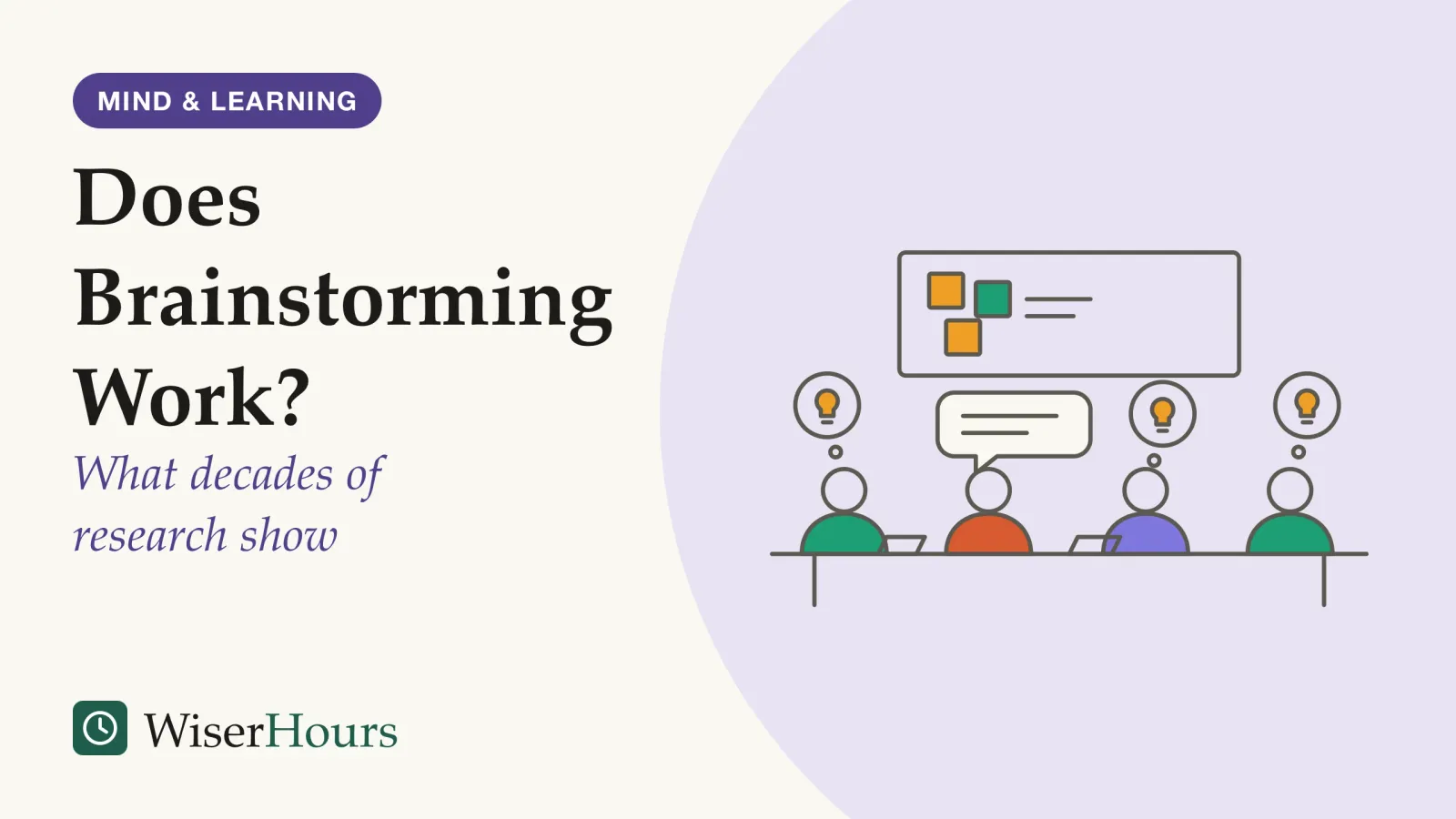
Brainstorming was sold as a way to multiply a group’s ideas, and on that promise it has failed its tests since the 1950s. So does brainstorming work? As a way to produce ideas, a group talking around a table usually does worse than the same people working separately and pooling their lists. Across decades of laboratory studies, pooled in a 1991 meta-analysis, face-to-face brainstorming groups produced fewer ideas, and no better ones, than the same number of people working alone. The method can be rescued: in experiments, large groups typing into a shared system out-produced people working alone, and students who thought alone before sharing did better than the same students working as a team throughout.
The practical version is short. Before anyone talks, give everyone a few minutes to write ideas alone; keep the spoken part small; and before the vote, have people mark the ideas that look most original. The sections below show the evidence behind each change, and the wider creativity and problem-solving section covers other idea techniques.
What Osborn promised, and how researchers tested it
Alex Osborn’s brainstorming asked groups to follow four rules: aim for as many ideas as possible, welcome wild ones, combine and improve ideas already suggested, and criticize nothing. In his book Applied Imagination, he claimed that people following those rules would double their output in a group.1
the average person can think up twice as many ideas when working with a group than when working alone
Testing that claim needs a fair comparison. Researchers use a nominal group: people who work alone on the same problem for the same time, whose lists are then combined, with any idea suggested twice counted once. It shows what the same people would produce if meeting neither helped nor hurt them. The first test, by Taylor, Berry and Block in 1958, gave four-person groups and individuals 12 minutes each. The nominal groups came up with nearly twice as many different ideas as the real ones, the reverse of Osborn’s promise. When Michael Diehl and Wolfgang Stroebe tabulated the experiments in 1987, most had found the same; the few that found no difference all used pairs.1
- Myth
- People come up with more ideas in a group than on their own.
- Fact
- In laboratory studies, groups talking together produced fewer ideas than the same number of people working alone and pooling their lists.
The gap is easy to miss from the inside. People enjoy group brainstorming and judge it effective, notes a 2018 review led by Paul Paulus at the University of Texas at Arlington.2 Take an invented but typical case: four colleagues spend 20 minutes on ways to cut customer wait times, the whiteboard fills and the talk is lively. The research suggests the same four people, writing separately for those 20 minutes, would usually have handed in a longer combined list.
So judge an idea meeting against the right baseline. A full whiteboard shows that the group had ideas, not that it had more than its members would have written alone.
Does brainstorming work? The 1991 meta-analysis says no, for idea counts
Pooled across the classic experiments, group brainstorming loses to solo work on both quantity and quality. That is the verdict of a 1991 meta-analysismeta-analysis: A study that combines the results of earlier studies on the same question into one overall estimate. Pooling makes the estimate more precise, but it cannot repair the studies it pools: a meta-analysis of surveys is still survey evidence.Full entry in the glossary in which Brian Mullen, Craig Johnson and Eduardo Salas combined the studies that compared brainstorming groups with nominal groups.3
The study
Moderate evidence
Mullen, Johnson and Salas (1991), Basic and Applied Social Psychology
Across 34 comparisons of idea counts, brainstorming groups produced significantly fewer ideas than nominal groups, and the smaller set of 9 comparisons of idea quality showed the same pattern. The authors describe the loss as strong in magnitude. It was larger in bigger groups, when the experimenter was present, and when people spoke their ideas aloud instead of writing them down.3
One limit matters most for workplaces: these are ad hoc groups working on set problems in controlled conditions, a research tradition the Paulus review describes as rarely tested inside organizations.2
The groups did not make up in quality what they lost in quantity, which counts against the hopeful reading that talking produces fewer but better ideas. The three conditions that made losses worse are ones a team lead controls: how many people are in the room, whether an authority figure is watching, and whether ideas are spoken or written. The authors advised anyone still using brainstorming to choose the opposite set: smaller groups, no evaluator present and written contributions.3
For anyone who runs idea meetings, those are the first three settings to change. If the boss wants to hear the ideas, let the boss read the written list afterward rather than sit in while people speak.
Why groups fall behind: waiting to speak and feeling watched
The best-known explanation is production blocking: in a spoken meeting only one person can talk at a time, so everyone else holds ideas they cannot yet say. Diehl and Stroebe’s 1987 experiments identified it as the main cause.1 The 1991 meta-analysis gave the larger role to the effect the group has on each member, such as feeling watched.3
Their decisive test had 60 psychology students in Tübingen brainstorm ways to reduce unemployment, most of them sitting alone in separate rooms linked by intercom. Some could speak whenever they liked. Others had to wait until a panel of lights showed that nobody else in their “group” was talking. People free to speak produced roughly twice as many ideas, and the waiting rule cut output to the level of real groups whether or not people could hear one another. Their other experiments found smaller roles for free riding, where people coast on others’ effort, and for fear of being judged.1
- Spoken turns: only one person can talk at a time, so ideas wait in a queue and some are lost or held back
- Writing in parallel: everyone adds ideas at the same moment, and the group reads and builds on the shared pool
Mullen’s team read the pooled evidence differently. Because losses grew in larger groups, when an experimenter watched and when ideas were spoken, they judged these effects of the group on its members the main cause and turn-taking a secondary one. They found the least support for deliberate slacking: people in brainstorming groups do not seem to hold back on purpose.3
A made-up but familiar example: in a product meeting, a colleague spends two minutes explaining one idea through a story. By the time the floor is free, you have forgotten one of your three ideas and decided another no longer fits. The Paulus review notes that storytelling is common in groups, and that asking people to keep suggestions short can greatly increase the number of ideas.2
The two camps disagree on the cause but overlap on the fix: writing removes the queue, and Mullen’s team itself recommended written contributions.3 Let people get ideas out in parallel and with less exposure, usually by writing them down before anyone discusses them.
Screens change the result, in both directions
Typing ideas into a shared system removes the queue, and an early experiment found it reversed the usual result for large groups. In a 1993 experiment by Alan Dennis and Joseph Valacich, 12-member groups brainstorming by computer produced more ideas than 12-member nominal groups, while 6-member groups did about as well as their solo comparison. The authors credit the format with few of the usual losses, such as waiting to speak, and with gains such as synergy and avoiding duplicate ideas.4
The Paulus review adds that in electronic brainstorming, groups of eight or more tend to produce more ideas than smaller ones, unlike spoken meetings, where bigger groups fall further behind, but that judging ideas seems to go better face to face.2
A video call is not a shared document. In a 2022 lab study and a field experimentfield experiment: An experiment run in a real setting, such as a workplace, shop or website, with people going about their ordinary lives, usually with random assignment. It shows how an effect plays out in practice, though often for one setting and one group at a time.Full entry in the glossary across five countries, Melanie Brucks and Jonathan Levav found that videoconferencing inhibited the production of creative ideas compared with meeting in person. Video groups showed no sign of being worse at choosing which idea to pursue. Eye-gaze and recall measures suggested that looking at a screen narrows attention.5
For remote and hybrid teams, the evidence points to splitting the work: collect ideas in a shared document or board where everyone types at once, and use the call to discuss and choose. No study has tried that combination as a whole; it is our reading of separate experiments, worth trying and checking against your own results.
Alone first, then together: more and better ideas in a 2010 test
A format that mixes solo and group work, with people generating ideas alone and then sharing and building on them together, beat a team working together throughout in a 2010 experiment at the University of Pennsylvania. Karan Girotra, Christian Terwiesch and Karl Ulrich had the same students work both ways: as a four-person team for 30 minutes, or 10 minutes alone followed by 20 minutes together.6
The hybrid format produced about three times as many ideas in the same time, of higher average quality, and its best ideas were better. Ideas that built on someone else’s were, on average, no better than the rest. Hybrid groups were also better than teams at picking their best ideas, although both did poorly in absolute terms. The participants were students in a product design course who had already been trained in idea generation, and the authors caution that the results may not hold in every setting.6
- 1Think aloneeveryone writes ideas at the same time
- 2Share and buildthe group reads, combines and adds
- 3Think alone againcatch what the discussion sparked
- 4Mark, then chooseflag the most original ideas before the vote
Paulus and colleagues also suggest a solo session after group sharing, to catch associations the discussion sparked. In their reading, the benefit of alternating solo and group rounds had so far been shown only when ideas are shared in writing, and the best split of time is unknown.2 In practice, give people a few quiet minutes before anyone speaks, and a moment to add ideas after the discussion.
Generating more ideas does not mean choosing better ones
Producing ideas is only half the job, and groups are poor judges of their own lists. In a 2006 experiment by Eric Rietzschel, Bernard Nijstad and Wolfgang Stroebe, nominal groups again produced more ideas, and more original ones, but the ideas chosen as best were no better than those chosen by interactive groups, and selection overall was not significantly better than chance. Keeping generation and selection strictly apart made no difference to the quality of the chosen ideas.7
One reason is a pull toward the safe option. When groups select, they tend to favor feasible ideas over novel ones, the Paulus review reports. The same review suggests marking ideas that look highly novel as the session goes, then choosing from the most-marked set, so unusual ideas reach the final round.2
Most people have seen the scene, here in illustrative form: the whiteboard is full and the team votes. The familiar, doable ideas win, and the strange one that someone could have developed further gets no votes.
Psychologists count an idea as creative only when it is both new and useful, as the guide to how psychologists define creativity sets out. Ask both questions of every idea on the shortlist before the vote, so the safe option has to beat the novel one on usefulness, not on comfort.
What the evidence implies for group idea sessions
The research does not say groups are useless for ideas. It says that talking in turns is a slow way to collect them, and that the fixes are mostly structural: fewer people, writing or typing, time alone, and a deliberate check that unusual ideas survive the vote.
| Format or factor | What the best evidence found | Evidence |
|---|---|---|
| Talking group versus the same people alone | Groups produced fewer ideas and no better ones | Meta-analysis of lab studies, moderate3 |
| Waiting for a turn to speak | Accounted for most of the loss in one set of experiments; a later meta-analysis disputes that it is the main cause | Four lab experiments, mixed1 |
| Typing ideas into a shared system | Large electronic groups beat people working alone; small ones matched them | Lab experiment, limited (abstract only)4 |
| Videoconference versus in person | Fewer creative ideas on video; choosing an idea was no worse | Lab and field experiments, moderate (abstract only)5 |
| Alone first, then together | More ideas, better on average, and better best ideas | One experiment with students, limited6 |
| Choosing the best idea afterward | Selection was not clearly better than chance | Lab experiment, limited (abstract only)7 |
If idea sessions are part of a heavy meeting load, the research on why meetings fail looks at what separates productive meetings from the rest.
What this suggests for your next idea session
Before anyone speaks, give everyone a few quiet minutes to write their own ideas. Keep the talking group small, ask for short suggestions, and before the vote, have people mark the ideas that look most original. These are suggestions drawn from lab studies, not guarantees.
Brainwriting, the best-known written method, and the mechanics of running a session each get a separate guide.
The bottom line
Brainstorming as Osborn sold it, a group calling out ideas in turn, produces fewer ideas than the same people working alone, and decades of experiments agree on that. Groups still earn their place when members share ideas they have already written down, as in the alone-then-together experiment. So collect ideas in parallel, in writing or on a shared screen, give people time alone before and after the discussion, and choose in a way that protects the unusual ideas, such as marking the most original ones before the vote.
Frequently asked questions
Who came up with brainstorming?
The term was popularized by Alex Osborn, whose book Applied Imagination described a procedure in which groups generate as many ideas as possible in a short time without concern for quality, a 2018 review by Paul Paulus and colleagues says. Osborn also claimed, as a 1987 paper by Diehl and Stroebe quotes him, that people could think up twice as many ideas in a group as alone.
What are the four rules of brainstorming?
Osborn's four rules, as summarized by Michael Diehl and Wolfgang Stroebe in 1987, are: the more ideas the better, the wilder the better, improve or combine ideas already suggested, and do not criticize. A 2018 review by Paul Paulus and colleagues found some evidence that the rules help, with the best evidence for putting quantity first, since judging quality early makes people hold ideas back.
What size should a brainstorming group be?
For spoken brainstorming, smaller is better: a 1991 meta-analysis found that groups fell further behind people working alone as group size grew, and a 2018 review names a pair as the most productive size per person. Electronic brainstorming behaves differently; that review reports that groups of eight or more typing ideas into a shared system tend to produce more ideas than smaller ones.
Sources
- Productivity loss in brainstorming groups: Toward the solution of a riddle. Diehl, M. & Stroebe, W. (1987). Journal of Personality and Social Psychology, 53(3)
- Enhancing collaborative ideation in organizations. Paulus, P. B., Baruah, J. & Kenworthy, J. B. (2018). Frontiers in Psychology, 9
- Productivity loss in brainstorming groups: A meta-analytic integration. Mullen, B., Johnson, C. & Salas, E. (1991). Basic and Applied Social Psychology, 12(1)
- Computer brainstorms: More heads are better than one. Dennis, A. R. & Valacich, J. S. (1993). Journal of Applied Psychology, 78(4)
- Virtual communication curbs creative idea generation. Brucks, M. S. & Levav, J. (2022). Nature, 605(7908)
- Idea generation and the quality of the best idea. Girotra, K., Terwiesch, C. & Ulrich, K. T. (2010). Management Science, 56(4)
- Productivity is not enough: A comparison of interactive and nominal brainstorming groups on idea generation and selection. Rietzschel, E. F., Nijstad, B. A. & Stroebe, W. (2006). Journal of Experimental Social Psychology, 42(2)
How we researched this
We searched Crossref, Europe PMC and publisher pages in September 2026 for experiments, meta-analyses and reviews that compare group brainstorming with people working alone, and read full texts where we could. Sources date from 1987 to 2022; three were read as abstracts only. Main limitation: most studies are short lab sessions with students, and we found no meta-analysis comparing brainstorming groups with people working alone newer than 2007.
Keep reading
How to Come Up With Ideas: 12 Techniques Worth Trying
How to come up with ideas: 12 techniques, from working alone first to a walk or an AI draft, each labelled for how strong its evidence is.
The Incubation Effect: Why Stepping Away Solves Problems
Setting a stuck problem aside helps on average in lab studies. When a break works best, what to fill it with, and 2 popular explanations that did not hold up.
Writer's Block: What Research Says About Causes and Fixes
Writer's block research since 1980 links it to rigid rules, harsh self-talk and waiting for the mood. What helps, plus a 2-week routine to test.
Design Thinking Explained: The Five Stages With Examples
Design thinking in 5 stages: empathize, define, ideate, prototype and test. What each asks of you, an example, and what research supports.