Phubbing: How Phones Hurt Relationships and What to Do
Phubbing, snubbing someone for your phone, is linked to lower relationship satisfaction. What studies show, what they can't, and 6 agreements to try.

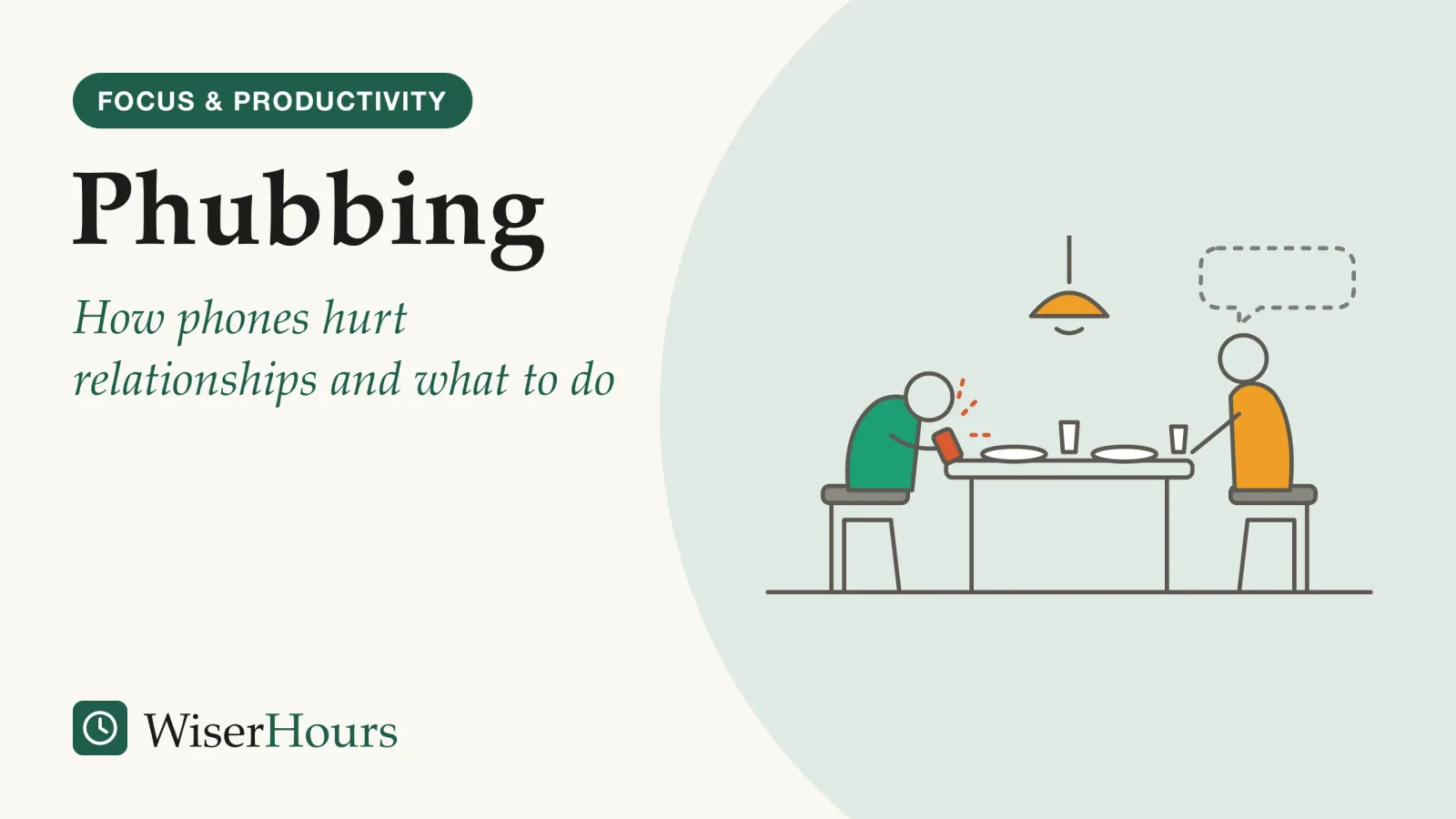
Phubbing is snubbing the person you are with by turning to your phone: a glance at a message mid-sentence, or a scroll through dinner. The word blends “phone” and “snubbing”. It was coined in May 2012 for a campaign by Australia’s Macquarie Dictionary and the advertising agency McCann.1
The research on phubbing is real but easy to overstate. A 2025 meta-analysis of partner phubbing studies found that people who feel phubbed by a partner tend to report lower relationship satisfaction, a modest link drawn mostly from one-off surveys that cannot show which came first.2 Short experiments add that using a phone during a conversation can make it feel worse, while the claim that an unused phone merely lying on the table does harm is shakier. What helps is a few low-risk house rules: phones away at meals and in conversations that matter, a quick word before any check, and nobody phubbing back. Phubbing is one corner of building a calmer relationship with your devices, the part that plays out between people.
What is phubbing, and who does it happen to?
Phubbing is any moment when a phone wins over the person in front of you, and researchers now study it between partners, between parents and children, and between coworkers. The best-known measure, a nine-item Partner Phubbing Scale built by James Roberts and Meredith David at Baylor University in the US, asks how often a partner does things such as glancing at their phone while you talk.2
What makes it sting is the message it seems to send. Picture telling your partner about a hard meeting while they nod and keep scrolling. They may be listening, but what you notice is that a screen came first.
So when a partner says “you’re always on your phone”, arguing about whether you were listening misses the point. Ask when it felt that way instead.
Is phubbing disrespectful? Most people think so, and do it anyway
In surveys, most people say phones spoil a conversation, and most use them anyway. In a 2014 Pew Research Center survey of US adults, 82 percent said phone use at social gatherings frequently or occasionally hurts the conversation, while 89 percent of phone owners had used theirs at the last gathering they attended.3 These are US figures; other countries may differ.
Varoth Chotpitayasunondh and Karen Douglas at the UK’s University of Kent asked 128 students to watch a short animated conversation and imagine being one of the two people. Those whose animated partner phubbed them extensively rated the conversation as worse and felt less satisfied with the relationship, and the effect ran through a weaker sense of belonging and a worse mood.4 The study used cartoon figures, an imagined conversation and a small student sample that was mostly women. Still, it is a randomizedrandomized controlled trial: A study that assigns participants to the treatment or the comparison group at random, so the groups start out alike and a difference in what happens next can be put down to the treatment. Random assignment makes the two groups comparable; it does not make the people in the trial representative of anyone else.Full entry in the glossary test, and it agrees with the surveys.
So yes, phubbing usually reads as disrespect, even when none is meant. If you must check, say so (“one second, it’s the school”), or leave it until later.
How does phubbing affect relationships?
Feeling phubbed by a partner goes with less satisfaction, less closeness and more conflict, according to a 2025 meta-analysis published in Frontiers in Psychology, the biggest pooled analysis of partner phubbing we found. The links are modest and vary between studies, and the authors note that the studies cannot show whether phubbing harms relationships or unhappy relationships produce more phubbing.2
The study
Moderate evidence
Partner phubbing across 52 studies and nearly 20,000 people: a 2025 meta-analysis
Pooling 52 studies with 58 samples and nearly 20,000 people, researchers in China, Iran and Malaysia found that feeling phubbed by a partner was linked to lower relationship satisfaction (a correlation of about −0.22 across 30 samples). Links with lower intimacy, less responsiveness, more jealousy and more conflict were also found, with results varying widely between studies. The authors write that the mostly cross-sectional designs prevent causal conclusions.2
A correlation of that size is modest: plenty of phubbed partners are content, and plenty of unhappy ones are rarely phubbed.
Roberts and David’s 2016 paper in Computers in Human Behavior, the study behind most news stories, fits this pattern.5 According to Baylor University’s magazine, its two US surveys covered 453 adults, nearly half of whom said a partner had phubbed them, and traced a path from phubbing to conflict and lower relationship satisfaction. The magazine went further, saying phubbing “led to” lower life satisfaction and, ultimately, higher depression.6 A snapshot survey cannot show that chain. A 2016 survey of 143 married or cohabiting women by US researchers Brandon McDaniel and Sarah Coyne found the same pattern for “technoference”, everyday interruptions by devices, and it too tested a statistical model of associations, not cause.7
- Myth
- A Baylor study proved that phubbing causes depression.
- Fact
- Surveys link feeling phubbed with conflict, lower satisfaction and low mood. None has shown cause, and unhappy couples may also phub more.
In a 2026 diary study led by the UK’s University of Southampton, 196 people living with a partner reported each day how phubbed they felt. On heavier phubbing days, people prone to attachment anxiety, a habitual worry about being let down by a partner, reported lower mood and self-esteem, yet their relationship satisfaction was not affected.8
- Phubbing wears the relationship down: the reading many news stories chose
- An unhappy relationship invites more phubbing: a partner who feels distant reaches for the phone
- Something else drives both: such as problem phone use, the factor most strongly linked to phubbing in a 2025 meta-analysis
Treat phubbing as a signal worth talking about.
Does a phone on the table change a conversation?
A phone that is out and free to use during time together tends to make it less enjoyable, mainly by distracting people; whether an unused phone merely in view does harm is contested.
The idea that a phone’s mere presence hurts closeness comes from a 2013 study by Andrew Przybylski and Netta Weinstein at the UK’s University of Essex. In two experiments, pairs who talked with a phone in view reported less closeness, connection and conversation quality, most clearly when the topic was personally meaningful.9 A 2018 partial replicationreplication: Running a study again with fresh data and the same method, to see whether the original result comes back. A finding that fails to replicate is not automatically wrong, but it stops being something you can lean on.Full entry in the glossary by US researchers John Crowley and colleagues found no such effect on relationship quality or empathy.10 In a field experimentfield experiment: An experiment run in a real setting, such as a workplace, shop or website, with people going about their ordinary lives, usually with random assignment. It shows how an effect plays out in practice, though often for one setting and one group at a time.Full entry in the glossary with 100 pairs by Virginia Tech researcher Shalini Misra and colleagues, conversations with no device out were rated as better, but people chose whether to bring out their phones, so this part shows a link, not a cause.11
The firmer evidence concerns phones that are out and free to use. In a 2018 experiment led by Ryan Dwyer and Elizabeth Dunn of Canada’s University of British Columbia, more than 300 people sharing a restaurant meal with friends or family were randomly assigned to keep their phones on the table or put them away. With phones present, people felt more distracted, which reduced how much they enjoyed the meal.12 In a second study, people who used their phones during everyday time with others also reported more distraction and less enjoyment.12
The meal study points to distraction. A friend is describing a breakup over coffee: your phone buzzes twice, you glance both times, and each glance costs a piece of the story. A phone left in a bag removes the choice before the first buzz, so for a talk that matters, put it away and out of sight.
Why do people phub?
The research points mostly to habit and the pull of the phone. In the 2025 meta-analysis, the factor most strongly linked to phubbing a partner was problem phone or media use; anxious and avoidant attachment styles, depressive symptoms and loneliness showed smaller links, and self-esteem showed no clear one.2 In a 2016 online survey, the same Kent researchers linked fear of missing out, internet addiction and low self-control to problem smartphone use, which in turn predicted phubbing. People who were phubbed more also tended to see phubbing as normal.13
That describes a loop most families will recognize. One person checks a message at dinner, the other feels sidelined and picks up their own phone, and soon both are scrolling without either deciding to. The Southampton diary study looked at this tit-for-tat. When people picked up their own phones in response, on heavier phubbing days they agreed more strongly with reasons such as revenge, boredom, and seeking support or approval from others.8
If you are the phubbed partner, the phone often reflects a habit rather than a verdict on you. Since phubbing back keeps the loop going, somebody has to stop first.
How to stop phubbing, and how to ask a partner to stop
No trial has tested a couple’s or family’s phone rules as a package, so the agreements below are low-risk habits drawn from what the studies point to, not a proven treatment. Device settings are covered in the steps that reduce screen time; these agreements are about time together rather than the daily screen total.
1. Raise it at a calm moment, about how it feels
Pick a phone-free time and describe the moment, not the person: “When you scroll while I’m talking, I feel like I’m boring you.” That is easier to hear than a charge of addiction. Ask what your partner notices about your phone use too.
2. Keep shared meals for talking
Meals are where the strongest experiment took place: putting phones away during a restaurant meal left people less distracted and enjoying it more.12 Agree where phones go while you eat, such as a shelf or another room, rather than relying on willpower.
3. Put the phone away for conversations that matter
Talks about plans, worries or the relationship are where even the contested mere-presence studies saw the clearest effect.9 Out of sight is the safest default.
4. Agree on a “check it together” rule
Some checks are legitimate, such as a message from a child’s school or a map. Agree that whoever needs the phone says why, and shares the screen when it is about something you are doing together. A check that is announced is less likely to read as a snub, though nobody has tested this rule directly.
5. Give the bedroom a quieter phone rule
Charging phones outside the bedroom is a simple shared rule that keeps one more room for talking.
6. Don’t phub back
When you feel phubbed, say so or wait, instead of reaching for your own phone. Retaliating keeps the loop going.8
A household phone agreement
Children are on the receiving end too. In a 2018 study of 170 US families with young children, about 3 years old on average, parents who reported more problem technology use also reported more device interruptions in time with their child, and mothers’ interruptions were linked to more behavior problems reported by both parents.14 It was a survey, and the authors call for tests of direction; a child’s difficult behavior could also send a tired parent to their phone. Workplaces show a similar pattern. In a 2025 survey of electricians in Sweden, those phubbed by coworkers during breaks reported less support, trust and commitment at work.15
When a phone has to stay close
Our suggestions: if you are on call, caring for someone, or need to be reachable for safety, keep the phone within reach and agree on how urgent calls will be handled. A rule should make time together easier, not make anyone feel monitored.
How strong is the phubbing evidence?
The evidence is strongest that phubbing is common and widely disliked, moderate that it goes with less satisfying relationships, and thin on whether it causes lasting harm.
| Situation | What studies found | Study type and strength |
|---|---|---|
| Feeling phubbed by a partner | Linked to lower satisfaction and more conflict; direction unknown | Meta-analysis of mostly surveys, moderate2 |
| Being phubbed in a conversation | Lower rated conversation quality and relationship satisfaction (UK students, animation) | Trial, limited4 |
| Phones out during a shared meal | More distraction, less enjoyment, at meals with friends or family | Trial, limited12 |
| A phone merely in view | Less closeness in a 2013 UK study; not replicated in a 2018 US-led study | Trials, mixed10 |
| Parents’ device interruptions | Linked to more child behavior problems reported by parents (US) | Survey, limited14 |
| Phubbing and depression | Linked with low mood in surveys; no evidence of cause | Surveys, limited7 |
When phone conflict points to something bigger
Phone rules will not fix depression, and they are no substitute for help when a relationship or a mood is in trouble. We grouped the routes below by urgency ourselves.
- Now: if you or someone at home has thoughts of suicide or self-harm, or is in danger, call your local emergency number first, or a crisis line, without delay. To find a crisis line, the International Association for Suicide Prevention (IASP) keeps a directory of verified helplines covering more than 150 countries.16 Two country examples: in the US, the National Institute of Mental Health lists 911 for life-threatening situations and the 988 Suicide & Crisis Lifeline, by call or text;17 in the UK, the NHS says to call 999 or go to A&E when a life is at risk, and lists Samaritans on 116 123.18
- Soon: the World Health Organization advises getting help from a healthcare provider for depression. Its fact sheet describes an episode as low, empty or irritable mood, or lost interest or enjoyment in activities, that lasts most of each day, nearly daily, for at least two weeks.19 A family doctor is a good first stop; seeing one within days is our suggestion.
- Routine: if arguments about phones keep returning after you have tried shared rules, a couples counselor or family therapist can help you look at what sits underneath them.
The bottom line
A phone out and in use during time together tends to make that time feel worse, and people who feel phubbed by a partner tend to be somewhat less satisfied, though nobody yet knows which comes first. Put phones away at meals and in conversations that matter, say what you are checking, and do not phub back.
This article is general information, not medical advice. If you're worried about your health, talk to a doctor or another qualified professional.
Frequently asked questions
How common is phubbing?
Common, though estimates vary by study and country. In Roberts and David's 2016 US surveys, nearly half of participants said a romantic partner had phubbed them. A 2014 Pew Research Center survey of US adults found that 89 percent of cellphone owners had used their phone at the last social gathering they attended. Rates in other countries are measured with different scales and are hard to compare.
Does phubbing happen at work?
Yes. A 2025 study of electricians in Sweden found that workers who were phubbed by coworkers during breaks reported less support, trust and commitment at work, and the links were stronger for more severe phubbing. Because it was a survey, the link could run either way.
Is phubbing the same as phone addiction?
Not necessarily. Most phubbing looks like ordinary habit, but a 2025 meta-analysis found problem phone use to be the factor most strongly linked with phubbing. A 2016 survey by University of Kent researchers also tied fear of missing out and low self-control to phubbing through problem phone use. If phone use feels out of control, a doctor or local mental health service is a sensible place to ask.
Sources
- Phubbing. Wikipedia (checked 11 October 2026)
- A meta-analytic study of partner phubbing and its antecedents and consequences. Ni, N., Ahrari, S., Zaremohzzabieh, Z., Zarean, M. & Roslan, S. (2025). Frontiers in Psychology, 16, 1561159
- Americans' Views on Mobile Etiquette. Pew Research Center (2015), survey of US adults conducted May-June 2014
- The effects of “phubbing” on social interaction. Chotpitayasunondh, V. & Douglas, K. M. (2018). Journal of Applied Social Psychology, 48(6), 304-316
- My life has become a major distraction from my cell phone: Partner phubbing and relationship satisfaction among romantic partners. Roberts, J. A. & David, M. E. (2016). Computers in Human Behavior, 54, 134-141
- Bad Connection. Baylor Magazine, Baylor University (2015)
- “Technoference”: The interference of technology in couple relationships and implications for women's personal and relational well-being. McDaniel, B. T. & Coyne, S. M. (2016). Psychology of Popular Media Culture, 5(1), 85-98
- Attachment, Perceived Partner Phubbing, and Retaliation: A Daily Diary Study. Carnelley, K. B., Hart, C. M., Vowels, L. M. & Thomas, T. T. (2026). Journal of Personality, 94(3), 431-445
- Can you connect with me now? How the presence of mobile communication technology influences face-to-face conversation quality. Przybylski, A. K. & Weinstein, N. (2013). Journal of Social and Personal Relationships, 30(3), 237-246
- Replication of the Mere Presence Hypothesis: The Effects of Cell Phones on Face-to-Face Conversations. Crowley, J. P., Allred, R. J., Follon, J. & Volkmer, C. (2018). Communication Studies, 69(3), 283-293
- The iPhone Effect: The Quality of In-Person Social Interactions in the Presence of Mobile Devices. Misra, S., Cheng, L., Genevie, J. & Yuan, M. (2016). Environment and Behavior, 48(2), 275-298
- Smartphone use undermines enjoyment of face-to-face social interactions. Dwyer, R. J., Kushlev, K. & Dunn, E. W. (2018). Journal of Experimental Social Psychology, 78, 233-239
- How “phubbing” becomes the norm: The antecedents and consequences of snubbing via smartphone. Chotpitayasunondh, V. & Douglas, K. M. (2016). Computers in Human Behavior, 63, 9-18
- Technoference: Parent Distraction With Technology and Associations With Child Behavior Problems. McDaniel, B. T. & Radesky, J. S. (2018). Child Development, 89(1), 100-109
- Coworker Phubbing and Links to the Psychosocial Work Environment Among Electricians in Sweden. Martinsson, P., Larsman, P., Allard, K., Gunnarsson, M., Spante, M. & Thomée, S. (2025). Scandinavian Journal of Psychology, 66(5), 792-812
- Crisis Centres & Helplines. International Association for Suicide Prevention (IASP) (checked 11 October 2026)
- Help for Mental Illnesses. National Institute of Mental Health (US), last reviewed April 2026 (checked 11 October 2026)
- Where to get urgent help for mental health. NHS (UK), page last reviewed 26 April 2023 (checked 11 October 2026)
- Depressive disorder (depression). World Health Organization, fact sheet of 11 September 2026 (checked 11 October 2026)
How we researched this
We searched Europe PMC (which includes PubMed) and OpenAlex in October 2026 for meta-analyses, experiments and surveys on phubbing, partner phubbing and phones during conversations, and read full texts where they were open (six papers only as abstracts, and one only through its university's magazine). Sources span 2013 to 2026. Main limitation: most studies are one-time surveys from a few countries, so they show links, not causes.
Keep reading
Digital Eye Strain: Causes and Prevention
Digital eye strain is common and temporary: its causes, what trials found on the 20-20-20 rule, why blue-light glasses disappoint and which signs need a doctor.
How to Quit Social Media (or Just Use It Less)
How to quit social media in 6 steps, from app limits to deletion: what trials found, how to save your data and what to move before you leave.
How to Reduce Screen Time: 15 Practical Steps
15 ways to reduce screen time, graded by the trials behind them: firm app limits, fewer alerts, grayscale, phone placement and what tends to fade.
Doomscrolling: Why You Do It and How to Stop
In 2021 experiments, 2 to 4 minutes of COVID-19 news on social media lowered positive mood. Why doomscrolling hooks you, and 5 habits that may help.