The Job Characteristics Model Explained: Designing Jobs People Engage With
The job characteristics model explained: 5 job features, 3 psychological states, the motivating potential score, and what decades of research support.

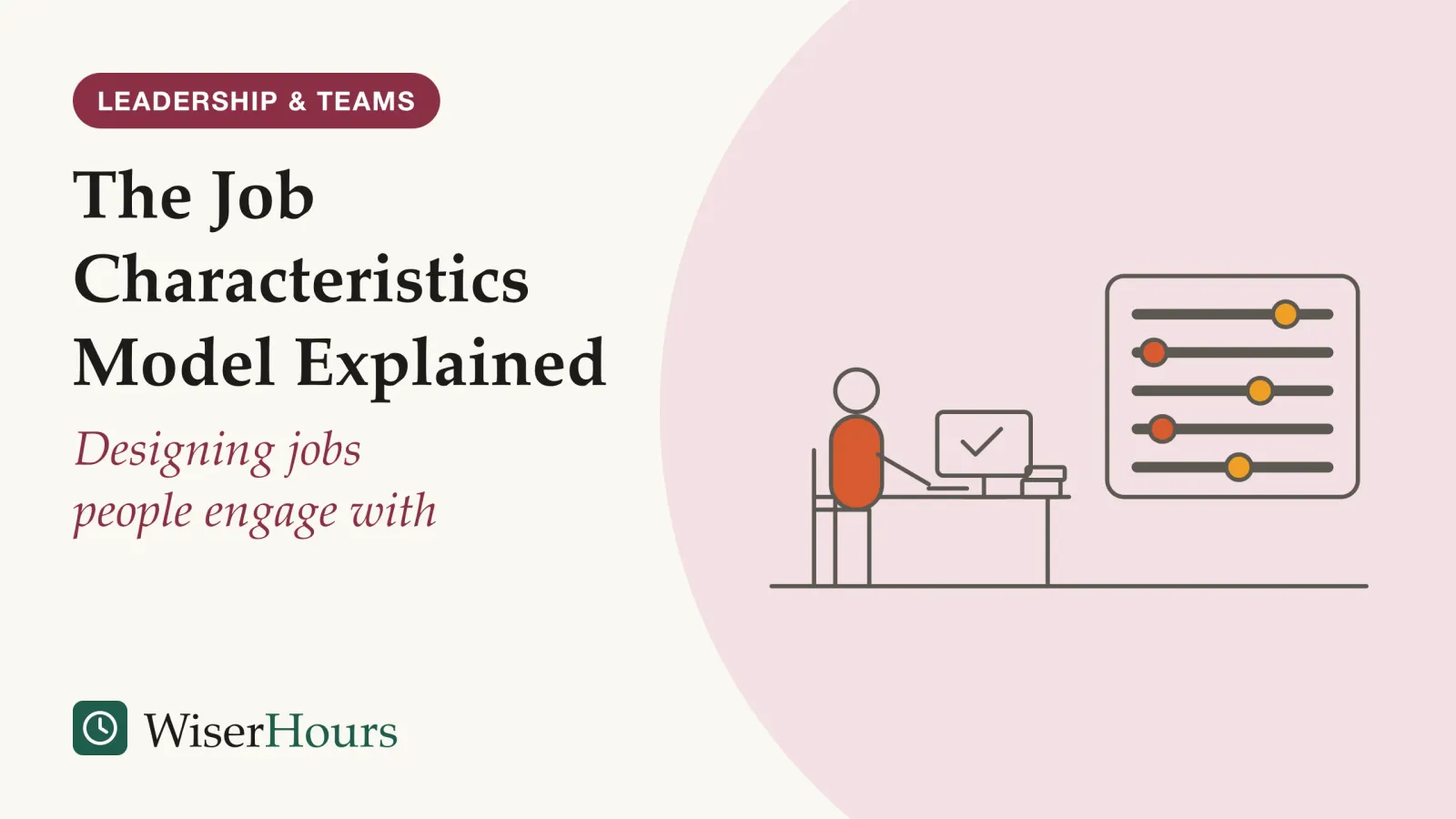
Hackman and Oldham’s job characteristics model rates any job on five features: skill variety, task identity, task significance, autonomy and feedback. J. Richard Hackman and Greg Oldham proposed in the 1970s that these features create three states of mind, and that those states lead to motivation, satisfaction and better work. Half a century of research backs the broad idea more than the details: job features track how people feel more closely than how they perform, and the model’s scoring formula predicts no better than adding the ratings up.1
Of the conditions linked to employee engagement, the design of the job is one a manager can change directly. The model gives that change a vocabulary and a way to check whether it worked. Its quickest use needs no formula: ask the person in a role to rate each feature from 1 to 7, add the five ratings, and start any redesign with the lowest one.
What is the job characteristics model?
The job characteristics model is a theory of work design that links five measurable features of a job to three psychological states and then to motivation, satisfaction and performance. Hackman and Oldham set it out in the mid-1970s, building on earlier work by Turner and Lawrence and by Hackman and Lawler, and gave it its final form in their 1980 book Work Redesign.2
Definition
The job characteristics model holds that skill variety, task identity, task significance, autonomy and feedback make work feel meaningful, owned and visible in its results, and that those states drive motivation and satisfaction.
The model was an answer to job simplification. Breaking work into short, repetitive tasks was supposed to raise output, but the gains sometimes vanished as people grew dissatisfied with the work. Frederick Herzberg had already argued for enriching jobs, and Herzberg’s two-factor theory and its critics covers that argument. Hackman and Oldham added two things: questionnaires to measure the features, and the idea that people differ in how much they want an enriched job.2
The measuring tool was the Job Diagnostic Survey, a questionnaire meant to diagnose a job before redesign and to evaluate the changes afterward. Alongside the job features, it measures growth need strength, which Hackman and Oldham interpret as how ready a person is to respond to an enriched job.3
A call-center agent and a hospital pharmacist can both be busy all day and still have very different jobs on these measures. When someone calls a job boring, the model replaces that vague complaint with five specific questions you can ask about it.
What are the five core job characteristics?
The five core job characteristics are skill variety, task identity, task significance, autonomy and feedback from the job itself. Greg Oldham, Richard Hackman and Jone Pearce defined each one in a 1976 paper as a matter of degree, so any job can be rated from low to high on all five.
| Feature | What it describes | Low end (illustration) | High end (illustration) |
|---|---|---|---|
| Skill variety | How many different activities, skills and talents the work calls on | Keying the same fields all day | Diagnosing a fault, fixing it and explaining it to the customer4 |
| Task identity | Whether the person completes a whole, identifiable piece of work with a visible outcome | Doing one stage of a process and passing it on | Taking a piece of work from start to finish4 |
| Task significance | How much the work affects the lives or work of other people, inside or outside the organization | Filing reports nobody reads | Work that patients, customers or colleagues depend on4 |
| Autonomy | Freedom and discretion to schedule the work and choose how to do it | Following a script and a fixed order | Deciding the order, the method and small exceptions4 |
| Feedback | Whether doing the work itself shows the person how well it is going | Hearing at the annual review | Seeing each result as it happens4 |
Feedback in the model means information that comes from the work itself. A support agent who sees each ticket marked resolved, or reopened, has feedback from the job; a manager’s monthly comment is a different channel.
When a team says a job is dull, ask which of the five is low. Dullness from low variety calls for different tasks, while dullness from never seeing how the work turns out calls for a feedback loop.
The three critical psychological states and what they lead to
In the job characteristics model, the five features matter because of the states of mind they create: experienced meaningfulness of the work, experienced responsibility for its outcomes, and knowledge of results. Skill variety, task identity and task significance feed meaningfulness, autonomy feeds responsibility, and feedback from the job feeds knowledge of results.1
- 1Five job featuresvariety, identity, significance, autonomy, feedback
- 2Three psychological statesmeaningfulness, responsibility, knowledge of results
- 3Outcomesinternal motivation, satisfaction, quality of work
The theory says a person needs all three states for the outcomes to appear. People keep working well when doing well feels good, and it only feels good when the work matters, the result is theirs, and they can tell how it went. A translator whose drafts are rewritten by an editor she never hears from has meaningful work and makes her own choices, but she has no knowledge of results, so good work brings her no reward she can feel.2
The 1980 version of the model dropped absenteeism and turnover from its outcomes after studies found weak links between the psychological states and those behaviors.2
The model also says the same job will not suit everyone. In the 1976 study of 201 clerical employees in a large city bank, run by US researchers, people with strong growth needs who were also satisfied with their pay, job security, co-workers and supervisors responded more positively to enriched jobs than the others did. The authors’ explanation is that active dissatisfaction with the context pulls attention away from the work itself and toward coping with the problem.4 If a team is fighting about pay or a supervisor, settle that before you enrich anyone’s job.
What is the motivating potential score?
The motivating potential score (MPS) is Hackman and Oldham’s single index of how motivating a job is likely to be: the average of skill variety, task identity and task significance, multiplied by autonomy and then by feedback. With each feature rated on a seven-point scale, scores run from 1 to 343.1
A job can feel meaningful through any one of the first three features, so they are averaged and can make up for each other. Autonomy and feedback are the only routes to responsibility and to knowledge of results, so a low rating on either one drags the whole score down.2
- A job that is middling on all five features: skill variety, task identity and task significance are averaged, then multiplied by autonomy and by feedback; the score comes out middling too
- A meaningful job with almost no autonomy: strong variety, identity and significance cannot make up for it: multiplying by a very low autonomy rating pulls the whole score close to the floor
The formula has not held up in later research. Reviewing the research in 2001, Billy Boonzaier, Bernhard Ficker and Braam Rust of the Cape Technikon in South Africa found no evidence for the multiplied score and recommended a simple sum of the five ratings instead. Their review reports the same verdict from earlier work: Yitzhak Fried and Gerald Ferris’s 1987 review and meta-analysismeta-analysis: A study that combines the results of earlier studies on the same question into one overall estimate. Pooling makes the estimate more precise, but it cannot repair the studies it pools: a meta-analysis of surveys is still survey evidence.Full entry in the glossary, covering nearly 200 studies, found the plain sum a better predictor of work outcomes, and a 1991 study of 1,193 male blue-collar employees in Ontario, Canada, also preferred the simple additive version.1
Keep the theory’s warning in mind as a hypothesis: a job with no say and no feedback may be hard to rescue with meaning alone, even though the data do not support the exact arithmetic.
Which parts of the model hold up in the research?
Research since the 1970s ties job features clearly to people’s feelings about the job; the evidence is weaker or contested on performance, on the three psychological states and on who benefits most. The largest summary is a 2007 meta-analysis by Stephen Humphrey, Jennifer Nahrgang and Frederick Morgeson.5
The study
Moderate evidence
Motivational job features line up with satisfaction far more than with quitting, across 259 studies
Pooling 259 studies with 219,625 participants, the authors found that 14 work characteristics together explained, on average, 43% of the variation in 19 worker attitudes and behaviors. Motivational features, the group that extends the original five, explained 34% of the variation in job satisfactionjob satisfaction: How positively a person judges and feels about their job, as a whole or in parts such as pay, colleagues or the work itself. It is usually measured by questionnaire and is related to engagement, but it is not the same thing.Full entry in the glossary but only 2% in turnover perceptions. The social features of a job added a further 24% for intentions to quit.5
A job’s ratings on these features say a good deal about how satisfied and committed its holder is, and much less about whether they will leave. The figures come from pooled correlations, so they show which features and attitudes go together and cannot show that changing one changes the other.
A warehouse picker given more say over her route may like the job better within weeks, while her pick rate and her plans to stay can also hang on pay, shifts and the local job market. Earlier reviews draw the same line between feelings and behavior. Fried and Ferris found job characteristics related to both kinds of outcome, with real variation across studies in the link to performance.6 The 2001 South African review judged the links to motivation and satisfaction strong and those to performance and absence weak.1
The middle of the model is contested. Fried and Ferris report support for the psychological states as the bridge between job features and attitudes, and suggest that growth need strength changes how strongly job features go with performance.6 The 2001 review found little support for either part as the model specifies it.1
Engagement research points at the meaning features. Christian, Garza and Slaughter’s 2011 meta-analysis of work engagement found that task variety and task significance stayed related to engagement once other factors were taken into account, while autonomy and feedback were not strongly related.7
Experiments are rarer and more encouraging. In the first of three field experimentsfield experiment: An experiment run in a real setting, such as a workplace, shop or website, with people going about their ordinary lives, usually with random assignment. It shows how an effect plays out in practice, though often for one setting and one group at a time.Full entry in the glossary published in 2008, Adam Grant found that fundraising callers given a task significance intervention increased their job performance, compared with callers in two other conditions and with their own earlier results.8 Across workplaces, a 2019 systematic review by Caroline Knight and Sharon Parker found that 39 of 55 studies of top-down work redesign reported a positive effect on performance, two a negative one and the rest mixed results.9
Looking back in 2010, Oldham and Hackman themselves pointed future work toward the social side of jobs, toward the ways people craft their own jobs, and toward work done by teams.10
For a manager, this sorts the promises. Jobs rated higher on these features tend to have more satisfied and committed holders, and most redesigns tested in real workplaces reported better performance as well. Expect the change in attitude first, and measure output separately before you credit the redesign with it.
How do you apply the job characteristics model?
To apply the job characteristics model, rate one job on the five features with the people who hold it, check what in the surrounding context is distracting them, raise the weakest feature, and rate the job again a few months later. The steps below follow an accounts-payable clerk through that process; the ratings are an illustration, not data.
1. Score the job together with the person in it
Ask the people in the role to rate each feature from 1 to 7, and rate it yourself. The model was built on jobholders’ own descriptions, and in the 1976 bank study supervisors’ ratings of the jobs agreed closely with employees’ ratings.4 Where your ratings and theirs differ, the conversation about why is often more useful than the numbers.
2. Check the context and the person before you redesign
Ask about pay, security, co-workers and supervision before you change the work. Fix what you can of those first. Some people prefer a predictable role, so offer a redesign and discuss it with each person before it starts.
3. Raise the weakest feature first
The clerk keys invoices for one stage of the process, follows a fixed procedure and hears about errors only when a supplier complains. In the redesigned job, the clerk owns a set of suppliers from invoice to payment, resolves mismatches with them, can approve small price differences up to a set limit, and gets a weekly count of invoices paid on time sent straight to them. Giving away that approval limit is often where managers stall, and the obstacles to delegation explain why.
| Feature | Before | What changed | After |
|---|---|---|---|
| Skill variety | 2 | Resolves mismatches and talks to suppliers | 4 |
| Task identity | 2 | Owns a set of suppliers from invoice to payment | 6 |
| Task significance | 4 | Sees which suppliers are small firms that rely on prompt payment | 5 |
| Autonomy | 2 | Can approve small price differences up to a limit | 5 |
| Feedback | 3 | Weekly on-time count sent to the clerk directly | 6 |
| Motivating potential score | 16 | Average of the first three, times autonomy, times feedback | 150 |
| Simple sum of the five | 13 | Recommended by the reviews instead of the multiplied score | 26 |
The sum doubles while the multiplied score rises more than ninefold, which shows how the formula magnifies small changes in autonomy and feedback. Use the sum and the profile to decide what to change next.
4. Rate the job again after a few months
Repeat the same ratings after the change has had time to settle, and look at what people do as well as what they say. Since the evidence is stronger for satisfaction than for performance, expect changes in output to be less certain and harder to measure.
Redesigning one job with the model
The bottom line
Use the five features as a checklist for designing work people care about, and expect the clearest gains in satisfaction and commitment. Read the plain ratings as a profile and leave the multiplied score aside. This month, pick one role, rate it with the person who does it, and change the lowest-rated feature first.
Frequently asked questions
What is the Job Diagnostic Survey?
The Job Diagnostic Survey is the questionnaire Hackman and Oldham published in 1975 to measure their model. It was built to diagnose jobs before a redesign and to evaluate the changes afterward, and it measures the job dimensions, the psychological states, people's reactions to their work and their growth need strength. A companion form, the Job Rating Form, lets supervisors or observers rate the same job.
What is growth need strength?
Growth need strength is a person's need for accomplishment, learning and development at work. The job characteristics model predicts that people high in it respond more positively to enriched jobs. The evidence is mixed: Fried and Ferris's 1987 meta-analysis suggested it moderates the link between job features and performance, while a 2001 South African review judged its role as a moderator seriously in doubt.
Is the job characteristics model still relevant?
Yes, as a starting point. Its five features remain the core of later work design research, and a 2007 meta-analysis by Humphrey, Nahrgang and Morgeson extended the list with social and work-context features. In that review, social features added to the prediction of commitment and of intentions to quit beyond what the motivational features explained.
Sources
- A review of research on the Job Characteristics Model and the attendant job diagnostic survey. Boonzaier, B., Ficker, B. & Rust, B. (2001). South African Journal of Business Management, 32(1), 11-34
- Job characteristic theory. Wikipedia (accessed November 2026)
- Development of the Job Diagnostic Survey. Hackman, J. R. & Oldham, G. R. (1975). Journal of Applied Psychology, 60(2), 159-170
- Conditions under which employees respond positively to enriched work. Oldham, G. R., Hackman, J. R. & Pearce, J. L. (1976). Journal of Applied Psychology, 61(4), 395-403
- Integrating motivational, social, and contextual work design features: A meta-analytic summary and theoretical extension of the work design literature. Humphrey, S. E., Nahrgang, J. D. & Morgeson, F. P. (2007). Journal of Applied Psychology, 92(5), 1332-1356
- The validity of the Job Characteristics Model: A review and meta-analysis. Fried, Y. & Ferris, G. R. (1987). Personnel Psychology, 40(2), 287-322
- Work engagement: A quantitative review and test of its relations with task and contextual performance. Christian, M. S., Garza, A. S. & Slaughter, J. E. (2011). Personnel Psychology, 64(1), 89-136
- The significance of task significance: Job performance effects, relational mechanisms, and boundary conditions. Grant, A. M. (2008). Journal of Applied Psychology, 93(1), 108-124
- How work redesign interventions affect performance: An evidence-based model from a systematic review. Knight, C. & Parker, S. K. (2021). Human Relations, 74(1), 69-104 (online 2019)
- Not what it was and not what it will be: The future of job design research. Oldham, G. R. & Hackman, J. R. (2010). Journal of Organizational Behavior, 31(2-3), 463-479
How we researched this
Searches of OpenAlex, Crossref, Wikipedia and the open web (November 2026) looked for the model's original papers, reviews and meta-analyses of its evidence, and experiments that changed job features. Sources run from 1975 to 2021 and include a South African review and studies from the US and Canada. Main limitation: the 1976 test of the theory and several meta-analyses could not be opened in full, so only their abstracts, or descriptions in reviews that were read in full, are used.
Keep reading
Herzberg's Two-Factor Theory: Hygiene Factors, Motivators, and What Critics Say
Herzberg's 1959 theory splits work into hygiene factors and motivators. What it claims, why critics doubt the split, and what still helps managers.
The Drivers of Employee Engagement: What the Research Ranks Highest
A 2023 meta-analysis links room to learn and personal resilience most closely to engagement; a 2010 one ties red tape and role conflict to lower engagement.
Normalization of Deviance: How Cutting Corners Becomes Part of the Culture
Normalization of deviance is how a rule break becomes routine when nothing goes wrong. What NASA's 2 shuttle losses and hospitals show, and how to stop it.

Retention Bonuses and Counteroffers: Do They Work?
A retention bonus pays you to stay until a set date. English teachers offered extra pay were 23% less likely to leave; counteroffers mostly buy months.