Normalization of Deviance: How Cutting Corners Becomes Part of the Culture
Normalization of deviance is how a rule break becomes routine when nothing goes wrong. What NASA's 2 shuttle losses and hospitals show, and how to stop it.

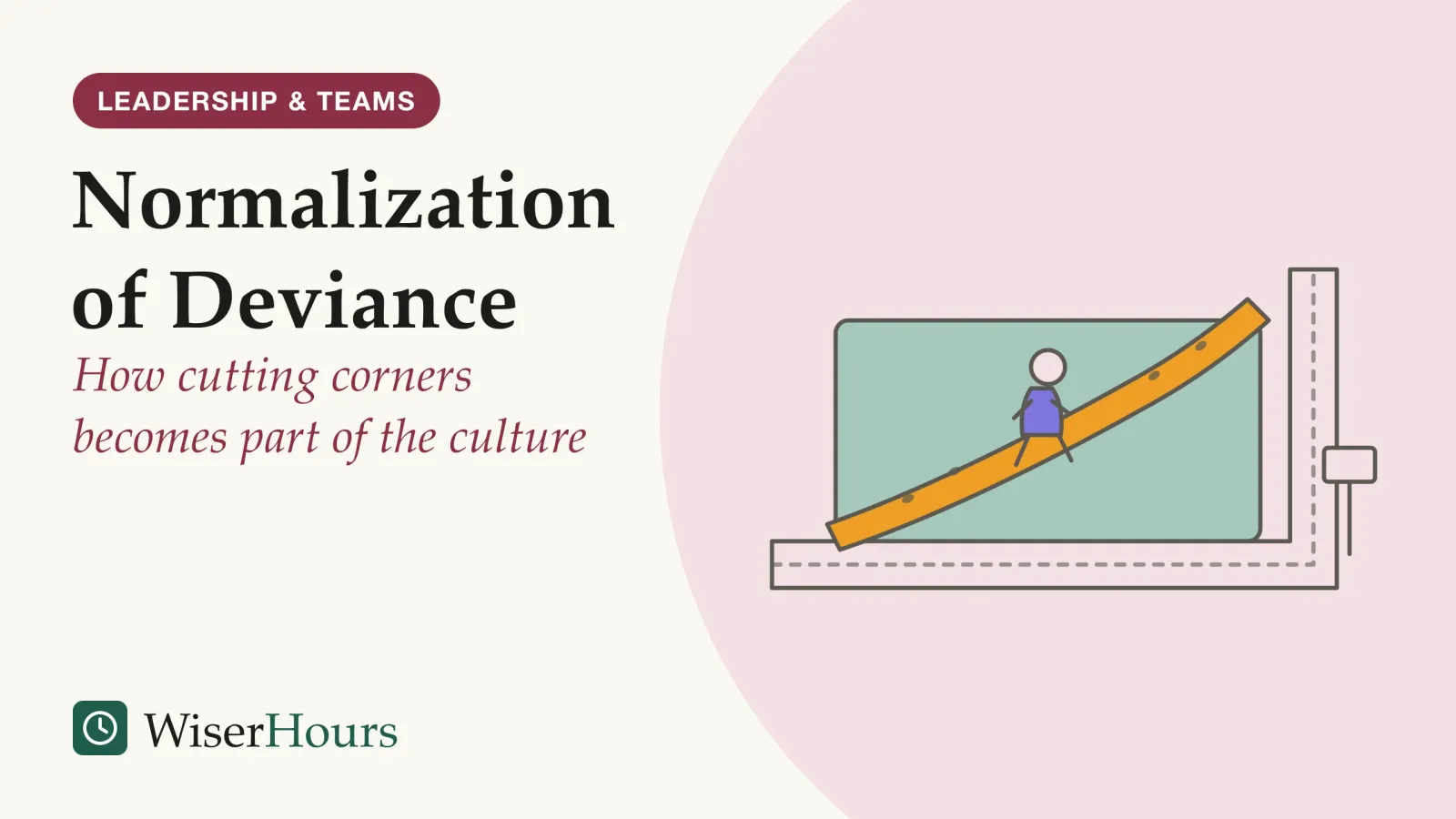
Normalization of deviance is the slow process by which a break from a rule or standard becomes the accepted way of working, because each time people take the shortcut, nothing bad happens. The sociologist Diane Vaughan named it in her 1996 study of NASA’s decision to launch the Space Shuttle Challenger, and she found that the disaster grew from a mistake, not misconduct.1 The same drift shows up in hospitals, factories and ordinary offices, wherever a skipped check keeps turning out fine.
Teams can check the drift with four habits: compare what people do with the written standard, treat near misses as data, make it safe to speak up, and fix rules that cannot be followed instead of tolerating the breaks. The drift often spreads through the everyday habits new staff pick up from colleagues, the same culture that shapes what employee engagement means and how it is measured.
What does normalization of deviance mean?
Normalization of deviance is a group’s gradual acceptance of a practice that departs from its own standard, once the practice has been repeated without harm. Vaughan’s definition, quoted in 2017 by Flight Safety Australia, the magazine of Australia’s aviation safety regulator, stresses that the change is gradual and social.2
the gradual process through which unacceptable practice or standards become acceptable.
“Deviance” here has nothing to do with crime. It means any departure from the standard a group has set for itself: a design specification, a procedure, a policy or a professional norm. The deviance becomes “normalized” when the people doing it stop seeing it as a departure at all.
The mechanism is reinforcement by luck. Risk-taking usually has no bad consequences on the day, as Flight Safety Australia points out, so each skipped step seems to confirm that the step was unnecessary.2 A finance team that is supposed to have a second person approve every supplier payment starts approving small ones after they are paid, during a busy quarter. No fraud turns up. A year later, the after-the-fact approval is simply how payments work, and a new hire learns it on day one.
Nobody has to decide to lower a standard for this to happen. To see where your team stands, look for the gaps between the written process and what people do, and assume they arrived one reasonable step at a time.
Who coined the term? Diane Vaughan and the Challenger launch
Diane Vaughan, an American sociologist, coined the term in The Challenger Launch Decision, her 1996 account of why NASA launched Challenger on January 28, 1986, despite warnings.1 Challenger broke apart 73 seconds after launch, and its seven crew members died.3
Rubber O-rings sealed the joints of the shuttle’s solid rocket boosters. Damage to them was a violation of the design, yet erosion turned up on earlier flights, and after the first incident engineers concluded the joint could tolerate it.3 Each flight that came back safely made the next decision to fly look sounder.2 After a January 1985 launch in unusually cold weather, hot gas had burned past the primary O-ring and reached the backup seal; after analysis, that strong signal was redefined as a weak one.3
- Myth
- Disasters like Challenger come from reckless people who knowingly break the rules.
- Fact
- Vaughan found no misconduct: insiders accepted the warning signs one reasonable step at a time until the deviance felt normal.
Her publisher describes the book as contradicting conventional interpretations of the accident. Vaughan retold the decision through the eyes of the managers and engineers and described an incremental descent into poor judgment, with insiders who normalized the deviance so that it became acceptable to them.1 In her account, no rule violations and no intentional wrongdoing explain what happened; what drifted was the group’s sense of what counted as acceptable.2
For a manager, this shifts the useful question. When an order ships to the wrong address, asking who packed it finds a person. Asking when the team stopped checking addresses against the order, and who agreed to each exception along the way, finds the drift and tells you which step to restore.
The Columbia report found the same pattern 17 years later
The Columbia Accident Investigation Board concluded in 2003 that NASA had repeated the Challenger pattern, and it used Vaughan’s term to describe the acceptance of events that are not supposed to happen. Foam debris from the external tank had struck shuttles for years, and the board found that those strikes were normalized until they were treated as a maintenance issue.3
The study
Moderate evidence
Two shuttle losses, one pattern (Columbia Accident Investigation Board, 2003)
On February 1, 2003, Columbia broke up on re-entry because foam that came off the external tank during launch had breached the left wing’s heat shield; all seven crew members died. Comparing the foam history with the O-ring history before Challenger, the board found that in both cases a first decision to accept the damage and fly set a precedent, and later incidents were read as evidence that the design was behaving as predicted.3
The board likened NASA’s experience base to an elastic waistband that kept stretching to hold larger deviations. Foam problems were filed as “in-family”, a label meaning within past experience, so they drew less attention.3 A software team builds its own version of “in-family” when a failing test is marked as known to be flaky and the release ships anyway; a few releases later, nobody reads that failure at all. At NASA, engineers who wanted images of the damaged wing were asked to prove the shuttle was unsafe to fly, where the usual standard asks a team to prove it is safe. The board also listed reliance on past success as a substitute for sound engineering practice among the cultural traits it found harmful.3
The report even calls the drift a slippery slope. That is the documented kind, where each step can be traced in records, which is different from the slippery slope fallacy in arguments, where one step is simply claimed to lead to disaster. Check for the documented kind by reading old decisions in order: if each one cites the last as precedent, the baseline has been moving.
How cutting corners becomes normal, step by step
Read together, accounts from NASA, aviation and hospitals point to a four-step loop: a shortcut, no bad outcome, a new baseline, and pressure that makes the next shortcut look reasonable. The loop runs quietly, and each turn feels like ordinary judgment to the people inside it.2
- A shortcut: someone skips a step or bends a rule to get the work done
- Nothing goes wrong: the job turns out fine, and the good outcome is read as proof the shortcut is safe
- A new baseline: the shortcut becomes how the work is done and how newcomers are taught
- Pressure of time and targets: deadlines and budgets make the next, slightly bigger shortcut look reasonable
The first step is almost always well meant. A support lead, short of time before the weekly target is counted, lets agents close tickets before customers confirm the fix. The customers do not complain, so the next week the same thing happens without anyone asking.
The second step does the damage, because success is taken as proof. In experiments published in 2008, Robin Dillon and Catherine Tinsley, working with students and with NASA employees and contractors, found that people rated a manager whose decisions produced a near miss about as highly as one whose decisions produced a success. In a second set of studies, people given near-miss information chose riskier options, which the authors attribute to a lower sense of risk after the near miss.4 A near miss that should read as a warning gets filed as evidence that the system works.
The third step is the new baseline. John Banja, an ethicist at Emory University, wrote in 2010 that newcomers in hospitals are exposed to rule breaks, often by senior staff, and have them explained as normal for the organization, so the deviation looks normal from the start.5
The fourth step is pressure. The Columbia board found that the schedule and a shoestring budget weighed as heavily as engineering judgment on what was done about known flaws, and that launches went ahead with engineering work on those flaws still unfinished.3
When a deadline is the reason for an exception, write the exception down, give it an end date and name an owner. On that date, the owner either restores the normal step or asks for the rule to be changed in the open.
What is an example of normalization of deviance in healthcare?
John Banja’s 2010 paper in Business Horizons, citing a 2005 study by the US training company VitalSmarts and the American Association of Critical-Care Nurses, lists common rule breaks in US hospitals: hand hygiene skipped, gloves not changed, armbands not checked and safety checks not done. In one negligence case he worked on as an expert witness, a ventilator switched off for an X-ray was not turned back on, the alarms had been set so they would not sound, and the patient later died.5
Banja’s examples show that the people involved usually believe they are doing the right thing. In one neonatal unit, nurses were meant to call a second nurse to witness the disposal of leftover medicine. Busy and offended by the implied suspicion, they shared passwords and entered each other’s codes instead, which defeated the whole purpose of the rule.5 Banja groups the reasons people give: the rule seems stupid and inefficient, they are breaking it for the patient’s good, they would never do what the rule guards against, and they are afraid to speak up.
A small 2023 interview study of 21 health workers at a public children’s hospital in northeastern Brazil found the same examples: hand hygiene skipped, protective equipment misused and alarms turned off.6 A 2023 UK-led systematic reviewsystematic review: A review that fixes its question and its rules for including studies in advance, then searches out every study that fits and weighs them together. Some systematic reviews pool the results into a meta-analysis; others describe what the studies found without combining the numbers.Full entry in the glossary of 33 papers from high-risk industries, read as an abstract, linked the pattern to production pressure, culture and a lack of negative consequences.7 Both are small or qualitative, so they show the pattern recurring across settings, not how common it is.
Offices hear the same reasons. When someone calls a rule stupid, ask what makes it hard to follow; the answer tells you something about the rule as well as about the person.
Signs that corner-cutting has become normal on your team
Normalization of deviance is hard to see from inside, because the people doing it no longer notice anything unusual. The warning signs are mostly things people say and things that stop happening, drawn from the Columbia board’s report and Banja’s hospital cases.5
- Workarounds nobody questions: a form gets filled in after the fact, a test step is marked done without being run, or a sign-off happens in batches at month end.
- “We always do it this way”: ask why a step is skipped and the answer is history, with no reason attached.
- Near misses described as luck: a payment almost goes to the wrong account, or a release almost ships with a bug, and the story ends with relief rather than a report.
- Warnings that get reclassified: like the “in-family” label at NASA, a problem moves from urgent to routine without being fixed.3
- Fixes that keep slipping: after a large foam strike in October 2002, the deadline for corrective action was pushed back past the next flight, and then past Columbia’s.3
- Silence in meetings, where people with doubts stay quiet, or problems get softened as they move up the chain of command.5
The drift is not limited to dangerous work. Australian researchers argued in 2018 that Vaughan’s theory can account for why some research papers misquote the sources they cite.8
How to prevent normalization of deviance at work
Prevention means checking the gap between written standards and real practice on a schedule, treating near misses as data, making it safe to raise concerns, and fixing rules people cannot follow. Vaughan has said that normalization of deviance is easier to prevent than to correct, Flight Safety Australia reports.2
1. Compare what people do with the written standard
Walk through one routine process with the people who run it and note every place where practice differs from the procedure. Do it with curiosity; the aim is to find the gaps, and blame makes people hide them. When a gap turns out to matter, a root cause analysis can trace why it opened.
2. Treat near misses as data
Count near misses and look at them together. The Columbia board noted that foam strikes and O-ring erosion were examined separately, one at a time, so no single incident looked like a strong signal.3 Ask “what nearly went wrong?” in every review, and thank people who report one.
3. Make it safe to speak up
The Columbia board found that people with little power in an organization may hold useful information they do not share, even when encouraged.3 Banja recommends policies that say when speaking up is expected and that protect the people who do it.5 Building psychological safetypsychological safety: A shared belief within a team that it is safe to take interpersonal risks, such as asking questions, admitting mistakes or raising concerns, without being punished or embarrassed. It is about candor, not about everyone being nice.Full entry in the glossary is slow work, and Amy Edmondson’s studies of teams where people feel safe to speak describe how leaders frame, ask and respond.
4. Fix unworkable rules instead of tolerating breaks
If most people ignore a rule, ask Banja’s questions: were people trained on it, is it really necessary, and might a reasonable person in the same position judge breaking it justified?5 Then either change the rule so it can be followed or remove what makes it hard to follow, and say clearly which version now applies.
5. Act early, and start at the top
Banja advises stepping in promptly, because the longer a deviation runs, the more acceptable it looks.5 Vaughan’s advice, as Flight Safety Australia reports it, adds that employees who see executives breaking rules will treat it as normal.2
A quarterly drift check for your team
The bottom line
Normalization of deviance usually begins with a shortcut that worked once and was never revisited, so a good outcome is weak evidence that a skipped step is safe. Pick one routine process this month, compare it step by step with what is written down, and decide for each gap whether to restore the standard or rewrite the rule.
Frequently asked questions
Is normalization of deviance the same as cutting corners?
Not quite. Cutting corners is a single act; normalization of deviance is what happens when a group repeats the act until it stops seeing it as a deviation. John Banja, writing in 2010 about hospitals, describes the point at which staff no longer regard such acts as untoward and treat them as routine, rational and acceptable. By then nobody feels they are cutting a corner at all.
Does normalization of deviance only happen in high-risk industries?
No. The best-known cases come from spaceflight, aviation and health care, where the harm is easiest to see, and a 2023 UK-led review of 33 papers looked only at high-risk industries. Yet Australian researchers argued in 2018 that Vaughan's theory can account for misquoted citations in research papers, which suggests the same drift can reach routine work, from expense checks to code review.
Who is to blame when deviance becomes normal?
Usually more than one person, and the system around them. The Columbia Accident Investigation Board stressed in 2003 that individuals must still take responsibility for their actions, while showing that schedule pressure, budgets and structure shaped the decisions. John Banja suggests asking whether the person was trained, whether most colleagues ignore the rule and whether the rule is even necessary before assigning blame.
Is every workaround a sign of normalization of deviance?
No. A workaround can be a sensible response to a rule that does not fit the work, and it can point to a rule that needs fixing. It becomes a problem when it goes unexamined, gets passed on to new staff as the normal way and quietly removes a safeguard, as when hospital staff shared passwords to skip a required second witness in Banja's 2010 examples.
Sources
- The Challenger Launch Decision: Risky Technology, Culture, and Deviance at NASA, Enlarged Edition (publisher's page). Vaughan, D. (1996; enlarged edition 2016). University of Chicago Press
- Safety in mind: Normalisation of deviance. Flight Safety Australia, Civil Aviation Safety Authority, Australia (15 May 2017)
- Columbia Accident Investigation Board Report, Volume I. Columbia Accident Investigation Board (August 2003). NASA and US Government Printing Office
- How Near-Misses Influence Decision Making Under Risk: A Missed Opportunity for Learning. Dillon, R. L. & Tinsley, C. H. (2008). Management Science, 54(8), 1425-1440
- The normalization of deviance in healthcare delivery. Banja, J. (2010). Business Horizons, 53(2), 139-148
- Normalization of deviance in pediatric hospital: perception of health workers. Carvalho, G. D. S. et al. (2023). Revista Gaúcha de Enfermagem, 44, e20220236
- A qualitative systematic review on the application of the normalization of deviance phenomenon within high-risk industries. Sedlar, N., Irwin, A., Martin, D. & Roberts, R. (2023). Journal of Safety Research, 84, 290-305
- Normalization of Deviation: Quotation Error in Human Factors. Lock, J. & Bearman, C. (2018). Human Factors, 60(3), 293-304
How we researched this
We started in November 2026 from Diane Vaughan's account of the Challenger decision, as described by her publisher and by Australia's Civil Aviation Safety Authority, and read the Columbia Accident Investigation Board report (2003) and John Banja's 2010 paper in full. We then searched PubMed and Crossref for reviews and studies of normalization of deviance and near misses. Sources span 1996 to 2023. Main limitation: the evidence is mostly case analyses and interviews, and four studies were read only as abstracts.
Keep reading
The Job Characteristics Model Explained: Designing Jobs People Engage With
The job characteristics model explained: 5 job features, 3 psychological states, the motivating potential score, and what decades of research support.

Retention Bonuses and Counteroffers: Do They Work?
A retention bonus pays you to stay until a set date. English teachers offered extra pay were 23% less likely to leave; counteroffers mostly buy months.
Exit Interview Questions: How to Get the Truth and Use It
Exit interview questions grouped into 6 topics, plus what makes leavers candid, how to code their answers and why you also need data from people who stay.
Employee Retention Strategies: What the Evidence Supports
Pay predicts quitting less well than rewards beyond pay or job embeddedness, a 2018 meta-analysis found. 5 steps to a retention plan built on evidence.