Retirement Planning for Beginners: The Big Pieces and How They Fit Together
Retirement planning for beginners: the 3 sources of retirement income, the 4 levers that grow savings, and the late choices that are hard to undo.

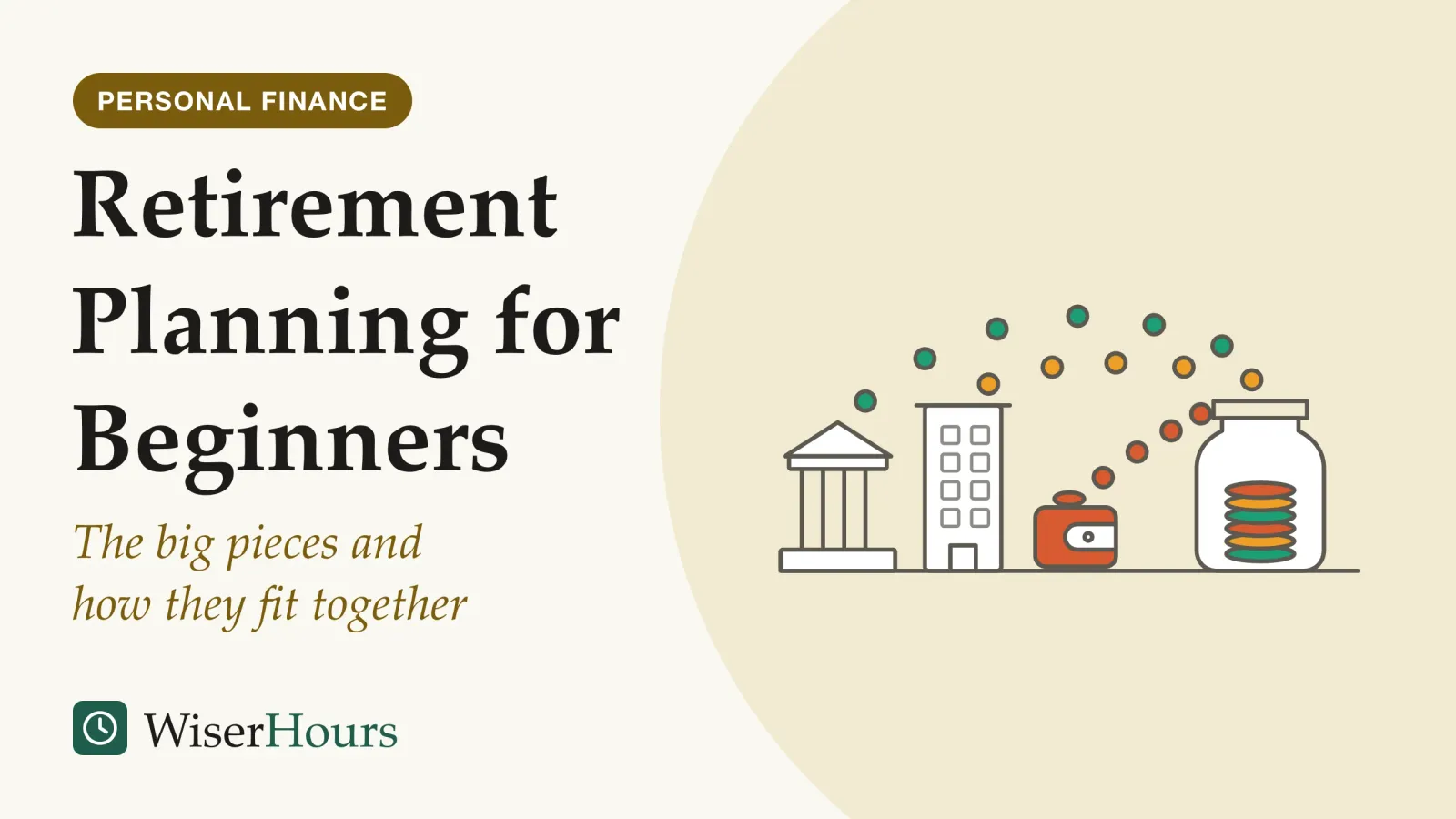
Where you work shapes your retirement before you save a single dollar, euro or rupee of your own. In the OECD’s 2025 projections for someone starting a full career at the average wage in 2024, mandatory pension schemes alone would replace less than two-fifths of take-home pay in Ireland and Korea, but nearly all of it in the Netherlands, where near-universal workplace pensions are counted as mandatory.1
That is why retirement planning for beginners starts with a map rather than a product. Your retirement income will come from up to three sources: a state pension or social security, workplace plans, and your own savings. Planning comes down to four moves, in this order:
- Find out what the state and any workplace pension will pay.
- Set a rough income target and see the gap.
- Fill the gap with four levers: contributions, investment mix, fees and time.
- Take the late, hard-to-reverse decisions with official guidance or regulated advice.
For the bigger idea behind all this, that savings can make paid work a choice, see what financial independence actually means.
Prefer to watch? The video covers the same ground as this article.
Retirement income comes from three places
In most countries, retirement income comes from a pension paid by the state or a social security system, from pensions or savings plans arranged through work, and from money you save and invest yourself. Canada’s official retirement income calculator, for example, asks about each in turn before it estimates what you might have.2
The first source is easy to overlook because you do not choose it, yet it sets how much the other two must do. Canada shows two common ways of earning it: the calculator asks for your contribution statement for the Canada Pension Plan, and for your residence history for Old Age Security.2 So a state pension can depend on how many years you paid in, how long you lived in the country, or both.
The second source, workplace plans, comes in two broad designs: a pension promised by a formula, or an account whose value depends on what goes in and how the investments do. Our comparison of defined benefit and defined contribution pensions explains who carries the risk in each.
The third source is whatever you arrange yourself. In the UK, a personal pension invests what you pay in, and what you get out depends on how much went in, how the investments did and how you take the money; you usually get tax relief on payments.3 The US Department of Labor, for its part, points savers to individual retirement accounts, with tax advantages that depend on the type you choose.4
Start your own plan with one line per source, saying what you have and where its latest statement lives. If a statement is missing, for example for a pension from an old job, finding it is your first task.

- Myth
- Retirement planning starts with picking the right investments.
- Fact
- It starts with finding out what the state and your workplace will pay. How you invest is one of four levers on the savings that fill the gap.
Your country sets the size of each piece
The OECD’s Pensions at a Glance 2025, which models the pension rules of its 38 member countries, shows mandatory pensions covering most of a worker’s pay in some countries and well under half in others, leaving voluntary saving a very different job to do.1
The reason is design. Some countries make workplace saving compulsory or nearly so; the OECD counts Denmark, the Netherlands, Sweden and the UK among countries whose private pensions reach nearly everyone.1 In others, among them the US, Canada, Germany and Ireland, the OECD models voluntary plans with broad coverage, which workers can choose whether to pay into.
The study
Moderate evidence
How far a lifelong voluntary plan lifts the pension, in OECD models of 2024 career starters
In the 10 countries where the OECD models widespread voluntary pensions, mandatory schemes alone are projected to replace about half of an average earner’s take-home pay. Adding a voluntary plan paid into for a whole career lifts that to about 72%. In the US, the projection roughly doubles, from about half of take-home pay to about all of it.1
The projection assumes a full career from the early twenties at the average wage, paying in every year, with defined contribution plans earning a steady 2.5 percent a year above inflation; real returns can be lower. Real careers have gaps, and the same report’s models show breaks for unemployment or childcare lowering the pension, though credits in many countries soften part of the blow. What carries over to any reader is the shape: where the state piece is small, your own saving decides most of the outcome.
So the first practical step comes before any calculation: get your official forecast of the state or social security piece, because every other number depends on it.
| Where you work | The state piece | Where to get your own figure |
|---|---|---|
| United States | Social Security, claimable between ages 62 and 70 | Your Social Security account shows what you would get at different claiming ages 5 |
| United Kingdom | The State Pension | The GOV.UK State Pension forecast: the amount you could get, when, and whether you can raise it 6 |
| Canada | Canada Pension Plan and Old Age Security | The Canadian Retirement Income Calculator, which adds workplace pensions and personal savings; estimates only 2 |
| Australia | The Age Pension, alongside superannuation (super) | ASIC’s Moneysmart retirement planner, which steps from where you are now to how much you will need 7 |
Elsewhere, request a record and a forecast from your national pension or social security authority. If you have worked in several countries, ask each one; the rules in this guide are examples, not a description of your system.
A rough target starts from the pay you live on now
A first retirement target is usually a share of the income you earn before you stop: the US Department of Labor quotes an expert estimate that people need 70 to 80 percent of pre-retirement income to keep their standard of living.4 Treat it as a US rule of thumb for a first sketch.
Why less than all of it? Once you stop work, you stop saving for retirement, and some work costs end. In many countries, pensions also carry lower taxes and social contributions than wages, which is why the OECD finds take-home replacement rates higher than gross ones.1
The gap is what matters. Here is an invented US example in 2026 dollars: pay of $4,000 a month before tax suggests a target of roughly $2,800 to $3,200. If an official forecast showed Social Security paying $1,600, workplace and personal savings would need to supply the rest: roughly $1,200 to $1,600 a month. The department notes that Social Security replaces about 40 percent of pre-retirement income on average, so in the US that remaining gap is typical, not a sign of failure.4
Rules of thumb miss a lot: a paid-off home, rent that continues, health costs, a partner’s pension. Write your gap as a range and redo it as your life changes. Turning a yearly gap into a savings target is a separate step, covered in our guide to calculating an FI number.
Four levers decide how far your savings go
Four things decide how much your workplace and personal savings can pay: how much goes in, how it is invested, what fees take out, and how many years the money has to grow. You control some directly and others only through the plans you choose.
How much goes in
Some countries set a floor by law. As of 2026, Australian employers must pay a super guarantee of 12 percent of each eligible employee’s earnings.8 For UK workers who are automatically enrolled, at least 8 percent of their earnings within set limits usually goes in, of which the employer pays at least 3 percent (as of 2026).9 Contributing to a workplace plan in the US is usually a choice, and the Department of Labor reports that roughly 30 percent of private-industry workers offered a workplace savings plan did not take part in 2024.4 If your employer adds money when you contribute, our guide to how an employer match works shows how to claim it.
How it is invested
Your mix of shares, bonds and cash sets both the likely growth and the size of the swings. The SEC’s investor education site calls the choice a personal one that depends on how long you will invest and how much loss you can stand; people with longer horizons may be comfortable with more volatile investments.10 Holding several kinds of investment, so that one bad performer hurts less, is called diversificationdiversification: Spreading money across many investments, and across different kinds of investment, so that a fall in one has less effect on the whole. It reduces the risk tied to any single holding but cannot remove the risk of the whole market falling.Full entry in the glossary, and our explainer on how diversification works goes further. The practical step here is to find out which mix each of your accounts holds today.
What fees take out
Fees look small because they are quoted as a percentage, but they come off every year, whatever the investments do. The SEC’s investor education site shows the effect with one hypothetical sum that grows at the same rate under three different yearly fees.11
Bar chart with 3 bars; the largest is Fee of 0.25% a year at about $208,000.
- Fee of 0.25% a yearabout $208,000
- Fee of 0.50% a yearabout $198,000
- Fee of 1.00% a yearabout $179,000
The highest fee leaves roughly a seventh less money than the lowest, from a difference of under one percentage point a year. The illustration is hypothetical; real returns vary and can be negative. Find the total yearly charge on every account you hold, because it is one of the few levers you can see in advance.
How long it has
Time lets returns build on earlier returns, the effect known as compoundingcompound interest: Interest worked out on the original amount plus the interest already added to it, so the total grows faster over time. It works for savers and against borrowers, whose unpaid interest itself starts to attract interest.Full entry in the glossary. The OECD’s projections show what time is worth: among eight countries with widespread voluntary pensions, a worker who joins the voluntary plan only at 45 ends up with a markedly lower pension than one who pays in from the start of a career.1 The lever works slowly, so starting with small amounts beats waiting for large ones.
Near the end: when to stop and how to draw an income
The last big decisions are when to stop work and start your pensions, and how to turn savings into income. Both are often hard to reverse. Across the OECD, the normal retirement age for men retiring in 2024 averaged just under 65, and under current laws it will rise to about 66 for people starting work now.1
Ages vary more than that average suggests: under current law, future normal retirement ages reach 70 or more in Denmark, Italy, the Netherlands, Sweden and Estonia.1 Timing also changes the amount. In the OECD’s review of contributory schemes, a pension taken a year early was cut, and one taken a year late was raised, by roughly 4 to 5 percent on average.1 In the US, the Social Security Administration says the monthly amount is higher the longer you wait to claim, up to age 70.5
Drawing an income from savings is the second decision. In the UK, most personal pensions cannot normally be drawn before 55, and HMRC’s pensions manual says that minimum age rises to 57 in April 2028.12 For what is left after any tax-free lump sum, the main options are cashing some or all of it, swapping it with an insurer for an income paid until you die (an annuity), or leaving it invested and drawing an income you can adjust. GOV.UK adds that taking large amounts at once can mean a higher rate of tax.3 Other countries use similar building blocks under different rules. The trade-off is certainty against flexibility, which our guide to how annuities work sets out in detail. Whatever your country, ask for forecasts at two or three different stopping ages before you settle on one.
Retirement planning for beginners: an order of first steps
For a beginner, a sensible order moves from facts you can look up to choices you can change. We suggest this order; it has not been trialled, but each step supplies what the next one needs.
Retirement planning: first steps
Download PDF
None of the steps requires buying anything. Repeat the first three whenever your job, household or country changes, because each changes the gap.
Free guidance first, regulated advice for the big calls
Leaving work, choosing between an annuity and an invested income, and moving or cashing in a pension are difficult to reverse, and the best choice depends on details no guide can see. Before any of them, a sensible sequence is free official guidance first, then a regulated adviser for personal advice; the SEC suggests asking any adviser how they get paid.11
UK readers are directed by GOV.UK to MoneyHelper, a free and impartial information service, and once over 50 can have a free Pension Wise session on their choices, though that service does not handle the State Pension or salary-based pensions, such as final salary and career average schemes.3 US readers can look up an investment professional’s background in BrokerCheck, which FINRA offers free of charge.13 For UK readers, the Financial Services Register is the Financial Conduct Authority’s official public record of firms and individuals.14 Readers elsewhere can ask their own country’s financial regulator whether an adviser is authorized and whether free official guidance exists.
The bottom line
Before choosing a single investment, find out what the state and your workplace will pay, because that sets how much your own saving has to do, and that share differs hugely from country to country. Get your official forecast, write your gap as a range, and then work the four levers: what goes in, how it is invested, what fees take out and how long it has. Save the irreversible decisions, when to stop and how to draw an income, for a moment when you have your numbers and, ideally, regulated advice.
This article is general education, not financial advice. For decisions about your own money, speak to a qualified, regulated adviser.
Frequently asked questions
What is a replacement rate?
A replacement rate compares your pension with what you earned while working. The OECD's Pensions at a Glance 2025 says the net version, pension after taxes and contributions against pay after taxes and contributions, matters more to individuals, because it reflects disposable income in retirement compared with working life. It is usually higher than the gross rate, since pensions tend to carry lower contributions and taxes than wages.
Can I keep working after my pension starts?
Often, but the rules vary. The OECD's Pensions at a Glance 2025 found no limits on combining work and a pension after the normal retirement age in half of its member countries. In the US, the Social Security Administration withholds part of the benefit of people below full retirement age who earn over an annual limit; after that age, earnings no longer affect it.
What is a target-date fund?
A target-date fund is a fund whose investment mix is set around a chosen target date, such as the year you plan to retire. The US Securities and Exchange Commission explains that the fund's investment adviser rebalances the mix over time, typically becoming more conservative as that date approaches. It spares you choosing a mix yourself; its fees still need checking like any other fund's.
Sources
- Pensions at a Glance 2025: OECD and G20 Indicators. OECD (2025). OECD Publishing, Paris; accessed 2026-09-28
- Canadian Retirement Income Calculator. Government of Canada, page dated 2025-11-25; accessed 2026-09-28
- Personal pensions. GOV.UK (UK government), accessed 2026-09-28
- Top 10 Ways to Prepare for Retirement. US Department of Labor, Employee Benefits Security Administration; accessed 2026-09-28
- Plan for Retirement. US Social Security Administration, accessed 2026-09-28
- Check your State Pension forecast. GOV.UK (UK government), accessed 2026-09-28
- Retirement planner. Moneysmart, Australian Securities and Investments Commission (ASIC); accessed 2026-09-28
- Super guarantee. Australian Taxation Office, last updated 17 April 2026; accessed 2026-09-28
- Workplace pensions: what you, your employer and the government pay. GOV.UK (UK government), accessed 2026-09-28
- Asset Allocation and Diversification. Investor.gov, US Securities and Exchange Commission; accessed 2026-09-28
- Understanding Fees. Investor.gov, US Securities and Exchange Commission; accessed 2026-09-28
- PTM062100: Member benefits: pensions: pension age. HM Revenue & Customs, Pensions Tax Manual (UK), updated 6 April 2024; checked current 2026-09-28
- About BrokerCheck. Financial Industry Regulatory Authority (FINRA, US), accessed 2026-09-28
- How to check a firm or individual is authorised. Financial Conduct Authority (UK), first published 20 March 2023, last updated 22 September 2026; accessed 2026-09-28
How we researched this
Sources, read on 2026-09-28: the OECD's Pensions at a Glance 2025 (full report), and official pages from government bodies and regulators in the US, UK, Canada and Australia on pensions, contributions, fees, investment mix and advice. Main limitation: the OECD figures are projections for a hypothetical full-career worker under current law, not measured outcomes, and rules change; check your own country's current rules.
Keep reading
What Is Financial Independence? A Definition Beyond "Never Working Again"
Does financial independence mean never working again? A plain definition, why it comes in degrees, and why the 4% rule is a US rule of thumb, not a promise.
Pension Basics: Defined Benefit vs. Defined Contribution Plans
A defined benefit plan promises an income; a defined contribution plan builds a pot. Who bears the risk, what job moves do, and 2026 protections.
Lean, Fat, Barista, and Coast FIRE: The Main Variants Compared
The 5 main types of FIRE compared: Lean, regular and Fat set how much you spend; Barista and Coast set how you bridge the years before the target.
Annuities: An Honest Look at How They Work, What They Cost, and the Trade-Offs
How annuities work: when income starts, who bears market risk, where fees hide, and why the UK saw 1 annuity sale per 4 plans entering drawdown in 2025/26.