Diversification Explained: Why Spreading Your Money Reduces Risk
Diversification explained: why spreading cuts one company's risk but not the market's, and why one US study found the stocks needed rose from about 20 to 50.

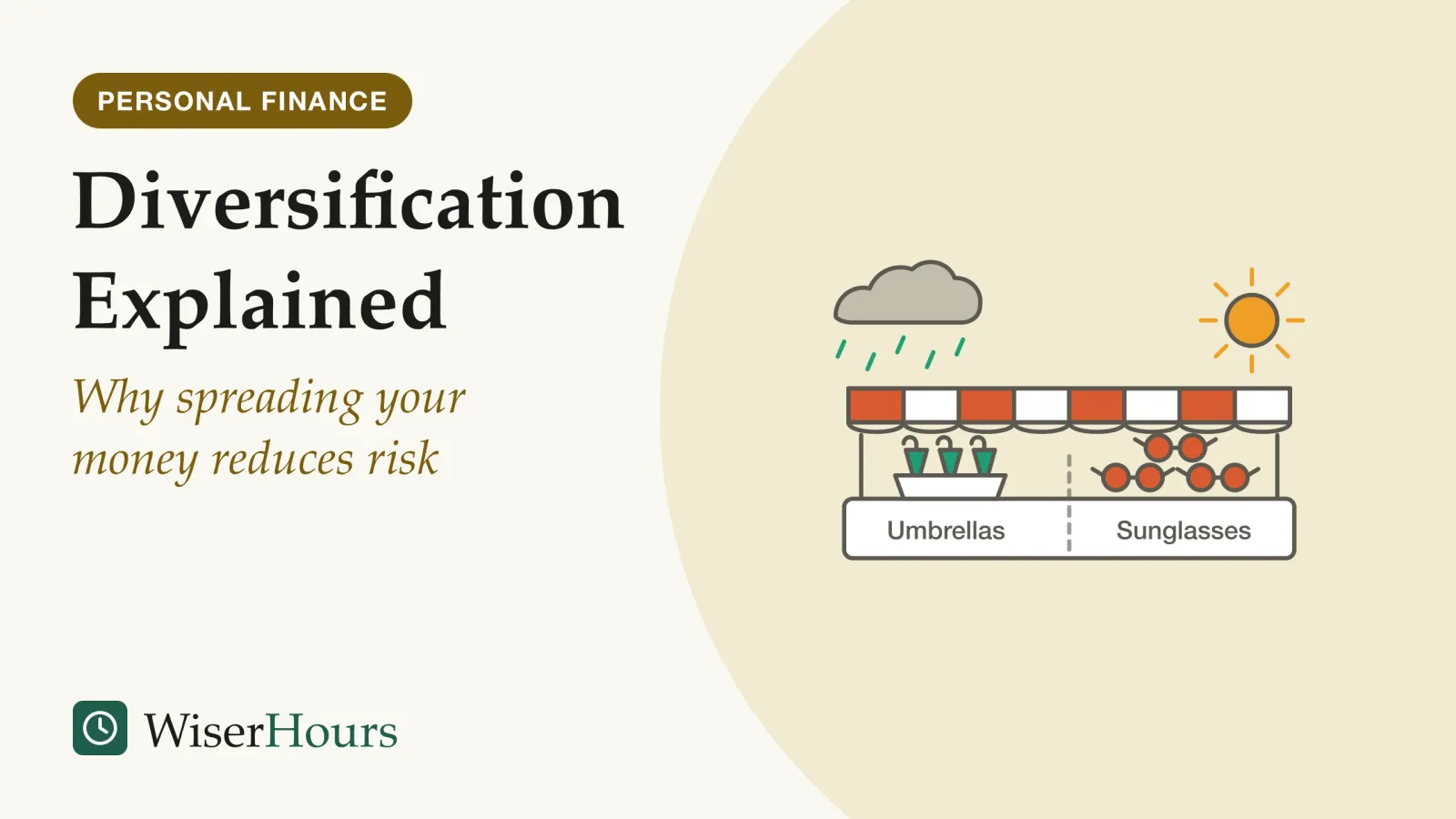
A street vendor with nothing but umbrellas struggles to make sales on a sunny day. The US Securities and Exchange Commission’s beginners’ guide pictures a vendor who sells sunglasses as well: people almost never buy both at the same time, so selling both reduces the vendor’s risk of losing money on any given day.1
Diversification applies the same idea to money. It is the practice of spreading money among different investments to reduce risk, in the SEC’s words, in the hope that losses in one holding are made up by others.2 The UK’s Financial Conduct Authority, in investor guidance last updated in 2025, describes it as choosing investments that don’t rely on the same things to do well at any one time, and states the limit plainly: spreading your money dilutes the effect of any single investment performing badly, but it cannot totally eliminate risk.3 So the useful test for any portfolio is not how many holdings it has but how many separate things would have to go wrong to hurt it badly. Spreading money widely is step five of seven in our step-by-step guide to investing for beginners, after an emergency fund and clearing expensive debt.
Two places to spread: between kinds of asset and within them
The SEC’s beginners’ guide says a diversified portfolio is spread at two levels: between asset categories, such as stocks, bonds and cash, and within each category, across many companies in different industry sectors. Spreading between categories helps because, historically, the returns of stocks, bonds and cash have not moved up and down at the same time.1
Definition
Diversification is spreading money across different investments, both within and between kinds of asset, so that no single company, industry, country or market decides how the whole portfolio does.
Spreading within a category works on the same logic at a smaller scale. Ten technology companies are ten holdings, but they are close to one bet on one industry: news that hurts the industry reaches all ten at once. Choosing how much to put in each category is a separate decision, asset allocation, and the guide points out that it does not diversify you by itself: a young saver entirely in stocks has an allocation, but no spread across kinds of asset.1
What this means for you: sort your holdings by what drives them (the industry, the country, the kind of asset) and count the groups rather than the names.
Why diversification reduces risk: holdings that don’t move together
Diversification reduces risk because a portfolio’s ups and downs depend not only on how risky each holding is but on how the holdings move in relation to one another. Harry Markowitz, looking back in his 1990 Nobel lecture on portfolio theory, said risk and return should be measured for the whole portfolio rather than for each investment alone.4
It seemed obvious that investors are concerned with risk and return, and that these should be measured for the portfolio as a whole.
A stock’s price moves for two kinds of reasons. Some news touches nearly every company, such as a recession; other news belongs to one company alone, such as a failed product or a lawsuit. Researchers call the second kind company-specific risk (or idiosyncratic risk). An investor who holds only one stock bears the full risk of that stock, while one who holds enough stocks bears only market risk, as John Campbell and colleagues put it in a 2001 study. The measure of how closely two holdings move together is their correlationcorrelation: A measure of how closely two things move together, running from minus one, where one rises as the other falls, through zero, meaning no link, to plus one. It says how strong the relationship is, not what causes it, and it is not a percentage.Full entry in the glossary. The lower it is, the more one holding’s bad day can be cushioned by another’s ordinary one, which is why declining correlations among stocks increase the benefits of diversification.5
An illustration, not a real portfolio: one investor holds shares in a single airline, and another holds twenty companies across different industries, that airline among them. When the airline has a terrible quarter, the first investor takes the whole hit and the second takes a small slice of it. When the whole market falls, both portfolios fall.
Nearly all models of how stocks are priced assume investors demand little or no extra reward for carrying company-specific risk, because it can be diversified away, William Goetzmann and Alok Kumar note.6 By that logic, concentrated company risk is risk that earns little or no extra reward in those models.
How many holdings does it take to spread risk?
No number of stocks makes a portfolio diversified for good: how many you need depends on how much individual companies swing around, and that changes over time. A 2001 Journal of Finance study by John Campbell and three colleagues showed the number creeping up over more than three decades of US data.5
The study
Moderate evidence
A count that kept climbing: Campbell, Lettau, Malkiel and Xu, 2001
Company-level swings grew relative to the market’s over the period, so stocks moved together less. The volatility of a typical two-stock portfolio rose from below 30 percent in the early 1960s to almost 50 percent in 1997. Getting company-specific risk down to the same level took about 20 stocks in the earlier decades but about 50 in 1986 to 1997.5
The logic is arithmetic. Each added holding dilutes the company-level swings of the others, so when those swings grow larger, it takes more holdings to dilute them to the same level. Any rule of thumb about how many stocks you need is therefore a snapshot of the market it was measured in, and this trend did not last. Revisiting the question in 2022 with data through 2021, the same authors reported that company-level volatility dropped sharply after 2001, then jumped again during the 2008-2009 financial crisis and the COVID-19 pandemic. Campbell discloses a partnership in an asset management firm that, he says, has no direct interest in the paper.7
The SEC’s beginners’ guide, an undated US investor-education sheet rather than a rule, gives a lower count without citing a study: it says four or five individual stocks will not diversify you and that at least a dozen carefully selected ones are needed. The two are not directly comparable, since the guide speaks of stocks picked with care and the researchers of stocks picked at random, but they agree on the part that matters: a handful is not enough. A total stock market index fund owns stock in thousands of companies, the SEC notes, which answers the counting question but not the market-wide risk described below.1 Our explainer on what an index fund holds and how it copies a market covers the trade-offs of that route.
The practical reading: any count you hear is a finding from one era and one way of measuring, not a target to hit. Twelve stocks from a single industry would meet the SEC’s number and still miss its point.
What diversification cannot protect you from
Diversification cannot protect you from a fall in the whole market. However many stocks a portfolio holds, market risk remains: the risk that nearly everything falls together.5
Spreading across countries does not fully solve this, and it may help least in the slumps investors fear most. In a 2001 study of monthly stock index returns for five countries (the US, the UK, France, Germany and Japan) from 1959 to 1996, François Longin and Bruno Solnik found that the correlation between markets increases in bear markets but not in bull markets.8 As an illustration, someone holding a US fund, a European fund and a Japanese fund may feel spread three ways, yet in a broad sell-off the three can fall together, just when the cushion is wanted. The study covered stock markets only, not other kinds of asset.
That is why the FCA’s picture of full diversification adds cash and bonds to shares from several markets, smoothing performance across several types of investment. The regulator also warns that there will always be times when diversification does not pay off in the short term, and a single company’s shares can do as well as a spread portfolio, then just as easily drop after bad news.3
Spreading has a price as well. As you add more investments, the SEC warns, you’ll likely pay additional fees and expenses, which lower your returns.1
| Where you spread | What it can cushion | What it leaves you exposed to |
|---|---|---|
| Across many companies | One company’s bad news | A fall in the whole stock market5 |
| Across countries’ stock markets | A slump in one country | Broad bear markets, when markets tend to move more alike8 |
| Across kinds of asset (stocks, bonds, cash) | Poor returns in one kind of asset | Some risk always remains; it is reduced, not removed3 |
What to expect, then: a spread portfolio still falls in a broad slump. What spreading buys is less exposure to the losses that one company, one industry or one country can cause on its own.
Why so many portfolios are less spread than they look
Many investors are less diversified than their number of holdings suggests, and one large US study linked this to choosing stocks without asking how they move together. Studying more than 40,000 accounts at a large US discount broker from 1991 to 1996, Goetzmann and Kumar’s 2001 working paper found that the average investor held about four stocks, and that investors knew spreading helps but chose stocks without giving proper weight to how they moved in relation to each other, a pattern the authors called naive diversification. The data come from one broker’s clients about three decades ago, and the authors allow that the sample may over-represent speculators.6
A related shortcut shows up in workplace retirement plans. Shlomo Benartzi and Richard Thaler reported in 2001 that some savers follow a “1/n” rule, dividing their contributions evenly across the funds the plan offers, and that the share invested in stocks depends strongly on the share of stock funds in the plan.9 Worked through with made-up numbers, a saver who splits evenly across four stock funds and one bond fund ends up with 80 percent in stocks; the same habit on a menu of two stock funds and three bond funds gives 40 percent. The menu set the risk, not a decision.
Funds can hide the same problem. A mutual fund or ETF won’t necessarily diversify you, especially if it is narrowly focused on one industry sector, and even several funds may overlap, which is why the SEC suggests checking each fund’s top holdings to make sure they are different.2
- Myth
- Owning several funds means your money is well spread.
- Fact
- Funds can hold the same large companies, and a fund focused on one industry won't necessarily diversify you. The SEC suggests comparing each fund's top holdings.
Concentration also arrives through work. Many investors have large holdings of individual stocks, Campbell and colleagues note, sometimes because their holdings are restricted by corporate compensation policies.5 Holding a lot of your own employer’s shares is the most personal form of it. The pattern to watch for is the same each time: several holdings that answer to one boss, whether that is one industry, one fund menu or one employer.
Questions that show how spread out your money is
Statements and fund factsheets let you check both levels the SEC describes, between kinds of asset and within each kind. The SEC also notes that many fund companies’ websites let customers run a portfolio analysis showing whether their investments are diversified.1 The questions are for understanding what you hold; they do not tell you to buy or sell anything.
A self-check from your own statements
- Put the largest holdings listed on each fund’s factsheet side by side: does any company appear on more than one list?
- Is any fund focused on a single industry, theme or country?
- How much of your money rides on one company, counting any shares from your employer?
- Is your money spread across kinds of asset as well as within them, and what are the extra funds costing you?
The answers will not tell you what mix is right for you; they show where your money is bunched.
Checking an adviser, and when your situation needs one
These routes are arranged by timing. The first two come from the regulator named in each; the yearly check is this article’s suggestion, not a regulator’s.
- Before acting on anyone’s advice: check who is giving it. The SEC’s standing advice is to always check the background of any financial professional to make sure the person is licensed, and Investor.gov has a search tool for doing so in the US.10 The British equivalent, the FCA’s Firm Checker, reports whether a firm is authorised and has permission for the product or service it is offering, and the regulator says to avoid dealing with a firm that does not.11 In other countries, start from the national regulator that licenses investment firms.
- Soon, if a decision turns on your situation, such as a large sum, a big holding in one company or the tax cost of selling: the SEC’s beginners’ guide suggests you may want a financial professional’s help to set your mix, after checking their credentials and disciplinary history.1
- Once a year: rerun the self-check above against fresh factsheets, since a fund’s top holdings can change.
The bottom line
Diversification works because holdings that go wrong for different reasons partly cancel each other out, and it stops working where those reasons are shared: a fall in the whole market removes the cushion. No number of stocks settles it for good, and more funds is not the same as more spread. Judge your own portfolio by asking what single piece of bad news could reach most of it, and check the costs of any spreading you add.
This article is general education, not financial advice. For decisions about your own money, speak to a qualified, regulated adviser.
Frequently asked questions
Does diversification lower your returns?
It gives up the chance that one pick carries the whole portfolio, in exchange for not depending on it. The US Securities and Exchange Commission says the right group of investments may limit losses and reduce the swings in returns without sacrificing too much potential gain. The UK Financial Conduct Authority adds that a single company can do just as well in the short term, and just as easily drop after bad news.
Is diversification the same thing as asset allocation?
No. Asset allocation is the choice of how much to put in each kind of asset, such as stocks, bonds and cash; diversification is spreading money so no single holding or market decides the result. The US SEC's beginners' guide notes that an allocation entirely in stocks, or entirely in cash, can be reasonable in some circumstances but does not reduce risk by holding different kinds of asset.
Can you be too diversified?
You can pay too much for it. The US SEC's beginners' guide warns that as you add more investments you will likely pay additional fees and expenses, which lower your returns, so it suggests weighing those costs when deciding how to diversify. Several funds that hold the same large companies can add cost without adding much spread, which is why the SEC also suggests comparing their top holdings.
Sources
- Beginners' Guide to Asset Allocation, Diversification, and Rebalancing. US Securities and Exchange Commission, Office of Investor Education and Advocacy, Investor.gov, accessed 24 September 2026
- Asset Allocation and Diversification. US Securities and Exchange Commission, Investor.gov, accessed 24 September 2026
- Diversification. Financial Conduct Authority (UK), InvestSmart, first published 6 October 2021, last updated 16 May 2025
- Foundations of Portfolio Theory (Nobel Lecture, 7 December 1990). Markowitz, H. M. (1990). The Nobel Foundation
- Have Individual Stocks Become More Volatile? An Empirical Exploration of Idiosyncratic Risk. Campbell, J. Y., Lettau, M., Malkiel, B. G. & Xu, Y. (2000). NBER Working Paper 7590; published in The Journal of Finance, 56(1), 2001
- Equity Portfolio Diversification. Goetzmann, W. N. & Kumar, A. (2001). NBER Working Paper 8686; published in Review of Finance, 12(3), 2008
- Idiosyncratic Equity Risk Two Decades Later. Campbell, J. Y., Lettau, M., Malkiel, B. G. & Xu, Y. (2022). NBER Working Paper 29916; published in Critical Finance Review, 12(1-4), 2023
- Extreme Correlation of International Equity Markets. Longin, F. & Solnik, B. (2001). The Journal of Finance, 56(2)
- Naive Diversification Strategies in Defined Contribution Saving Plans. Benartzi, S. & Thaler, R. H. (2001). American Economic Review, 91(1)
- Check Out Your Investment Professional. US Securities and Exchange Commission, Investor.gov, accessed 24 September 2026
- How to check a firm or individual is authorised. Financial Conduct Authority (UK), first published 20 March 2023, last updated 22 September 2026
How we researched this
Sources were gathered and read in September 2026: the US Securities and Exchange Commission's investor pages and beginners' guide on diversification, the UK Financial Conduct Authority's InvestSmart guidance, Harry Markowitz's 1990 Nobel lecture, and peer-reviewed and working-paper studies of US stock volatility, international market correlations and individual investors' portfolios, found through Crossref and NBER. The oldest is from 1990, the newest regulator page was updated in 2026. The research describes past, mostly US, markets, which is its main limitation: it cannot say how any portfolio will behave next.
Keep reading
Dollar-Cost Averaging vs. Lump Sum: What the Research Says
Dollar-cost averaging vs lump sum: why investing each paycheck is a different question, and what Vanguard and research since 1979 found about windfalls.
Bear Markets Explained: What They Are and How Long They've Lasted Historically
A bear market is usually a fall of 20% or more, a convention rather than a rule. US bear markets since 1929 fell for 1 month to about 2.5 years.
The Behavior Gap: How Investors End Up Earning Less Than Their Own Funds
Fund investors often earn less than their funds report. How the behavior gap is measured, why estimates range from about 8.5 points to 0.1, and what to do.
What Is an Index Fund? How Tracking a Market Index Works
An index fund copies a market index instead of trying to beat it. How tracking works, why the copy is never exact, and 5 questions to ask before you buy.