The True Cost of an Interruption: What Happens in Your Brain
An interruption costs you 3 ways: a slower restart, more slips and drift. What happens in your brain, and what research says cuts the cost.

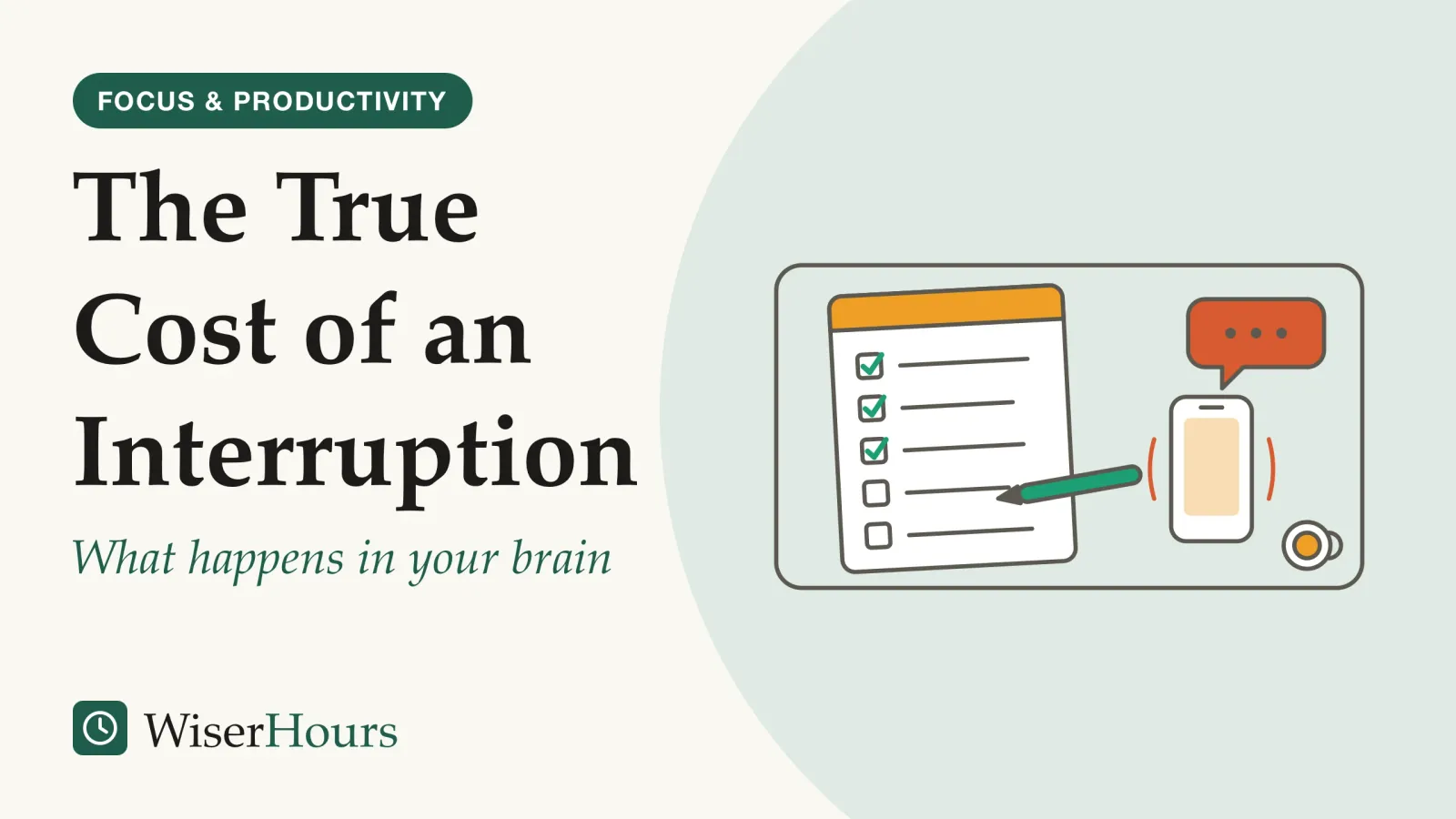
An interruption costs more than the time it takes, and the part of the cost of interruptions that is easiest to miss is losing your place. In two lab experiments published in 2014, interruptions lasting only a few seconds were enough to make students lose their place in a memorized routine more often.1
The habits this research suggests are small: leave a mark before you look away, keep the interrupted task in sight, and check the last step you finished when you come back. The sections below give the reasoning behind each and say how far the evidence goes. They sit alongside the broader routines in how to focus through a working day, such as checking messages at set times.
What happens in your brain when you are interrupted
When an interruption needs your attention, your brain stops holding the task you were doing and has to bring it back afterward. In two small brain-imaging experiments published in 2010 by a team at the University of California, San Francisco, young adults let go of an image they were keeping in mind while they dealt with an interruption, and reactivated it once the interruption was over; those who reactivated it most strongly remembered it best. Working memory, the mental workspace that holds what you are doing right now, runs on limited resources, and an interruption that demands attention claims them.2
Erik Altmann and Gregory Trafton’s memory-for-goals model, published in 2002, explains what happens to the task you left. It treats your current goal as a memory that fades unless it keeps being used. A goal you have set aside is found again most easily through a cue: something linked to the goal when you left it, and in front of you when you return.3
- Working: your place in the task is held in mind as you go
- Interrupted: attending to something else lets that place fade
- Back: a mark you left before switching can help you find it again
Say you are checking a supplier’s invoice against a purchase order, line by line, when a colleague leans over with a question about Friday’s meeting. Half a minute later you look back at the page and have to hunt for the last line you checked. The hunt is your brain rebuilding a goal that faded while the meeting had your attention.
Attention residue runs in the opposite direction, with the old task trailing into the new one. The cost here is what the old task loses while you are gone.
A mark before you look away
The cheapest protection is a cue left before you look away, such as a tick on the last line, a finger on the page or the cursor parked mid-sentence. It takes a moment, and it hands your memory the thing it needs to find its way back.
The hidden cost of interruptions is mistakes, not minutes
Brief interruptions cost accuracy more than time. In lab experiments by Erik Altmann, Gregory Trafton and David Hambrick, people who were briefly interrupted were more likely to skip a step or repeat one when they resumed, while slowing down only slightly, if at all. The authors’ explanation is a chain: while you do one step of a routine, the next one is kept primed, and an interruption breaks the chain so the next step fades. That is why the mistake is easy to miss: people came back without obvious hesitation and landed one step off.1
The study
Moderate evidence
Seven memorized steps and a few seconds' break: two Michigan State experiments, 2014
Participants ran through a seven-step routine, keeping track of where they were, and every few trials had to stop and type a short code. Interruptions that lasted about as long as one step of the routine doubled the rate of skipped or repeated steps on the next trial, and slightly longer ones tripled it. Mistakes in carrying out a step correctly did not rise.1
The routine was artificial and the participants were students, so the exact multipliers will not carry over to your inbox. What carries over is where the damage fell: on memory for where you were, not on skill at each step.
Longer interruptions made it worse. In a 2017 follow-up with interruptions of up to about half a minute, the same team found that these place-losing errors rose with the length of the interruption, steeply at first and then more slowly, the curve ordinary forgetting follows.4
Outside the lab, the evidence is observationalobservational study: A study in which researchers record what people already do or are exposed to, rather than assigning anyone to anything. It can show that two things go together, not that one causes the other, because the groups being compared may differ in other ways as well.Full entry in the glossary and mixed. In a 2010 study of nurses giving medicines in two Sydney teaching hospitals, about a quarter of doses given without interruption had at least one clinical error, such as a wrong dose, compared with nearly 2 in 5 of those interrupted three times.5 A link like that does not prove cause, and in a secondary analysis of a 2021 trial in four French hospitals, interruptions were not clearly linked to errors.6
Picture entering expenses from a pile of receipts when a chat message pops up. You reply, come back and carry on without a pause, and the receipt you were holding goes in twice or not at all.
So distrust the feeling of picking up where you left off. On step-by-step work, such as data entry, a checklist or a code review, check the last step you finished before you do the next one.
- Myth
- A quick interruption is harmless if you get straight back to work.
- Fact
- In lab studies, interruptions of a few seconds made people more likely to skip or repeat a step, even though they resumed without obvious hesitation.
Longer, harder interruptions take longer to recover from
The time it takes to restart grows with how long and how demanding the interruption was. Researchers call that restart the resumption lag: the pause between finishing an interruption and your first action back on the task. In three small experiments published in 2008, Christopher Monk, Gregory Trafton and Deborah Boehm-Davis found that it rose steeply over the first several seconds of an interruption and leveled off after roughly 15 to 25 seconds.7
Demanding interruptions lengthened it further, which the authors attribute to rehearsal: an easy interruption leaves room to keep repeating your goal to yourself, and a demanding one does not. By that reasoning, waiting for a file to upload should leave your place in better shape than a colleague’s tricky question of the same length; in the experiments, the easy condition was simply a blank screen. The participants were small groups of students, 60 in all, programming a simulated video recorder.7
- Alerta ping, a knock, a question
- Interruption lagthe moment to mark your place
- Interruptionyour place in the main task fades
- Resumption lagfinding where you were
Real offices add a bigger time cost: drift. In a two-week field study of 27 people at the authors’ own organization, published in 2007 by Shamsi Iqbal of the University of Illinois and Eric Horvitz of Microsoft Research, people who switched to an email or chat alert often wandered through several other windows before returning, and more than a quarter of the alerts kept them away from what they had been working on for over two hours. Tasks whose windows stayed more visible on screen were returned to sooner. The study watched ordinary work in one organization rather than testing a change.8
One reply leads to a calendar invite, the invite to a shared document, and the report you were writing is three windows back and out of sight. The lesson is to keep the interrupted task in view: leave its window open on top, or the document on the desk. A visible task pulls you back; a minimized one waits to be remembered.
Further reading
Gloria Mark's workplace studies of how often people switch tasks and interrupt themselves, and what it costs them.
As an Amazon Associate WiserHours earns from qualifying purchases.
When an interruption lands changes what it costs
An interruption in the middle of a demanding step tends to cost more than one at a natural pause, though experiments disagree on where exactly the cheap moments are. Several earlier studies found interruptions at moments of high mental workload more harmful, Patricia Hirsch and colleagues at RWTH Aachen University note in a 2025 paper. One explanation is that the mental resources given to a step are briefly released before the next one starts, so less needs rebuilding. In their own experiment with psychology students, timing changed the cost, but the moment they expected to be cheapest, the break between the two halves of a six-step sequence, was not.9
Mid-step, you are holding things that exist nowhere else: the running total, the half-built sentence. Someone who asks for a minute while you are adding up a column is asking for more than a minute. The same question just after you save the file is likely to cost less.
Software can do the waiting for you, with modest results. In a small 2008 study, Shamsi Iqbal and Brian Bailey had software hold notifications until people reached a breakpoint in their work, on average for under 90 seconds. Only the people editing diagrams, and only at one of the three kinds of breakpoint studied, were less frustrated than when notifications arrived at once; for programmers the difference was not clear, and the delay did not measurably speed anyone’s return to their own work.10
When you can choose, finish the step you are on before you turn around. When you are the one interrupting, asking whether this is a good moment is more than politeness.
Interrupting yourself is not free either
Self-interruptions, such as opening your inbox on impulse, carry a cost of their own. In two experiments published in 2016, a University of Groningen team led by Ioanna Katidioti found that people finished an email-answering task more slowly when they chose when to break off for chat messages than when the chat interrupted them at similar moments. Pupil measurements suggested why: each decision to switch took about a second. The forced interruptions mostly arrived at easy moments, so the authors caution that not every outside interruption is gentler, and the samples were a few dozen young adults.11
Frequent interruptions also change how you work between them. In a 2026 experiment with 97 university students in Germany, people who were interrupted often resumed faster and more accurately than those interrupted rarely, but those interrupted most often worked more slowly on the stretches where nobody interrupted them. The authors read this as a shift into a more braced, prepared way of working that helps at the interruption and costs you in between.12
If you check messages every few minutes just in case, you pay for the decision each time, and you may be working braced even in the quiet stretches. Decide in advance when you will check, so the decision is made once rather than dozens of times a day.
What reduces the cost, and what is still unproven
Tested fixes help in the lab, and evidence from real workplaces is thin. A 2021 systematic reviewsystematic review: A review that fixes its question and its rules for including studies in advance, then searches out every study that fits and weighs them together. Some systematic reviews pool the results into a meta-analysis; others describe what the studies found without combining the numbers.Full entry in the glossary and meta-analysismeta-analysis: A study that combines the results of earlier studies on the same question into one overall estimate. Pooling makes the estimate more precise, but it cannot repair the studies it pools: a meta-analysis of surveys is still survey evidence.Full entry in the glossary of 33 laboratory experiments by University of Hong Kong researchers led by Jingya Guo found that interventions to soften interruptions, taken together, improved accuracy on the interrupted task and shortened the resumption lag, with effects that varied by the kind of intervention and the kind of task. We read only the review’s abstract.13
Asking not to be interrupted is less proven. In a 2017 feasibility trial in an Adelaide hospital, wards whose nurses wore “Do not interrupt” vests on medication rounds, backed by education and reminders, saw about a third fewer unrelated interruptions, but many nurses found the vests hot and cumbersome, and errors were not measured.14 In the larger 2021 French trial, the vest made no clear difference to either interruption rates or error rates.6
The office versions of the vest are headphones, a closed door or a busy status in chat. The nurse trials do not show that these are useless, but they are a warning that a sign asking for quiet is not the same as protected work. If you use one, agree on a time when people can reach you, so their questions have somewhere to go.
| What was tested | What the best evidence found | Evidence |
|---|---|---|
| A few seconds away from a memorized routine | More skipped or repeated steps afterward, with little slowing | Lab experiments, moderate: US undergraduates1 |
| Longer interruptions | More place-losing errors, rising fastest over the first seconds | Lab experiments, moderate: the same team4 |
| Interruptions on hospital medication rounds | Linked to more clinical errors in one study; no clear link in a later trial’s secondary analysis | Observational, mixed56 |
| Practice on the routine | Faster and more accurate overall, but more errors just after interruptions | Lab experiment, limited: abstract only15 |
| Interrupting mid-step rather than at a pause | Timing changed the cost; the predicted best moment was not the cheapest | Lab experiment, limited: psychology students9 |
| Choosing when to break off | Slower overall than being interrupted at similar, easy moments | Lab experiments, limited: a few dozen adults11 |
| Interventions tested in the lab | More accurate and quicker to resume, varying by intervention and task | Meta-analysis of lab experiments: abstract only13 |
| “Do not interrupt” vests for nurses | Fewer interruptions in one trial, no change in another; no fall in errors shown | Cluster randomized trials, mixed146 |
Until workplace trials catch up, the safest bets follow from the mechanism: help your memory find its place, and choose when you switch.
The bottom line
An interruption keeps costing you after it ends. Your brain lets go of your place while you deal with it; in lab studies, even a few seconds away made a skipped or repeated step more likely, and longer or more demanding interruptions cost more. You cannot stop every interruption, but you can leave a mark before you turn away and check your last finished step before you carry on.
Frequently asked questions
Is an interruption the same as a distraction?
Not quite. A distraction is something you try to ignore; an interruption is something you have to deal with. In 2010 brain-imaging experiments by Wesley Clapp, Michael Rubens and Adam Gazzaley at the University of California, San Francisco, interruptions hurt young adults' short-term memory more than distractions did, and only interruptions made the brain let go of what it was holding and reactivate it afterward.
Is being interrupted a form of multitasking?
Researchers often treat it as one. Ioanna Katidioti's team at the University of Groningen, drawing on Dario Salvucci and Niels Taatgen, describe interruptions as sequential multitasking: rather than doing two things at once, you set one task aside, deal with another and come back. The costs described here come from that return, so they apply even if you never try to do two things at the same moment.
Does experience protect you from mistakes after an interruption?
Not reliably. In a 2010 observational study of 98 nurses in two Sydney teaching hospitals, led by Johanna Westbrook, more experienced nurses were no less likely to make a clinical error. In a 2017 lab study, Erik Altmann and David Hambrick found that practice made people faster and more accurate overall but more error-prone just after an interruption. We read only the abstracts of both studies.
Sources
- Momentary interruptions can derail the train of thought. Altmann, E. M., Trafton, J. G. & Hambrick, D. Z. (2014). Journal of Experimental Psychology: General, 143(1)
- Mechanisms of working memory disruption by external interference. Clapp, W. C., Rubens, M. T. & Gazzaley, A. (2010). Cerebral Cortex, 20(4)
- Memory for goals: an activation-based model. Altmann, E. M. & Trafton, J. G. (2002). Cognitive Science, 26(1)
- Effects of interruption length on procedural errors. Altmann, E. M., Trafton, J. G. & Hambrick, D. Z. (2017). Journal of Experimental Psychology: Applied, 23(2)
- Association of interruptions with an increased risk and severity of medication administration errors. Westbrook, J. I., Woods, A., Rob, M. I., Dunsmuir, W. T. & Day, R. O. (2010). Archives of Internal Medicine, 170(8)
- Effectiveness of a ‘do not interrupt’ vest intervention to reduce medication errors during medication administration: a multicenter cluster randomized controlled trial. Berdot, S., Vilfaillot, A., Bezie, Y., et al. (2021). BMC Nursing, 20, 153
- The effect of interruption duration and demand on resuming suspended goals. Monk, C. A., Trafton, J. G. & Boehm-Davis, D. A. (2008). Journal of Experimental Psychology: Applied, 14(4)
- Disruption and recovery of computing tasks: field study, analysis, and directions. Iqbal, S. T. & Horvitz, E. (2007). Proceedings of CHI 2007
- Opportune moments for task interruptions: examining the cognitive mechanisms underlying interruption-timing effects. Hirsch, P., Moretti, L., Leichtmann, B., Koch, I. & Nitsch, V. (2025). Frontiers in Psychology, 15, 1465323
- Effects of intelligent notification management on users and their tasks. Iqbal, S. T. & Bailey, B. P. (2008). Proceedings of CHI 2008
- Interrupt me: External interruptions are less disruptive than self-interruptions. Katidioti, I., Borst, J. P., van Vugt, M. K. & Taatgen, N. A. (2016). Computers in Human Behavior, 63
- Opposite effects of interruption frequency on performance in interrupted and uninterrupted multistep task. Radović, T., Hirsch, P., Koch, I. & Schubert, T. (2026). Psychological Research, 90(2), 60
- Effects of interventions to reduce the negative consequences of interruptions on task performance: A systematic review, meta-analysis, and narrative synthesis of laboratory studies. Guo, J., Chen, T., Xie, Z. & Or, C. K. (2021). Applied Ergonomics, 97, 103506
- Effectiveness of a ‘Do not interrupt’ bundled intervention to reduce interruptions during medication administration: a cluster randomised controlled feasibility study. Westbrook, J. I., Li, L., Hooper, T. D., Raban, M. Z., Middleton, S. & Lehnbom, E. C. (2017). BMJ Quality & Safety, 26(9)
- Practice increases procedural errors after task interruption. Altmann, E. M. & Hambrick, D. Z. (2017). Journal of Experimental Psychology: General, 146(5)
How we researched this
Sources were located in September 2026 through PubMed, Crossref and OpenAlex plus ordinary web searches for experiments, field studies, trials and systematic reviews of task interruption, with controlled designs and full texts preferred. Publication years span 2002 to 2026. Limits: most experiments put students through artificial lab tasks, workplace evidence is mostly observational, and for three sources only the abstract was available.
Keep reading
Attention Residue: Why Switching Tasks Leaves You Foggy
Switching tasks leaves part of your mind behind. What research since 2009 shows about attention residue, and a 3-line plan that reduces it.
Is Your Attention Span Really Shrinking? What the Research Says
The 8-second goldfish attention span was never measured. Decades of concentration tests show no decline in adults; what changed is how we use screens.
Does Listening to Music Help You Focus? What Studies Show
Does music help you focus? On dull tasks it can, but lyrics disrupt reading about as much as speech, a 2018 review of 65 studies found.
Deep Work for Beginners: How to Start With Just One Hour a Day
Deep work for beginners in 5 steps: one protected hour a day, a task chosen the night before, an if-then start, alerts off and a closing note on your next move.