Monk Mode: What It Is and Whether It Helps You Focus
Monk mode has no research of its own. Nearby studies back its focus parts and warn against cutting out people. Includes a 2-week plan that keeps friends.
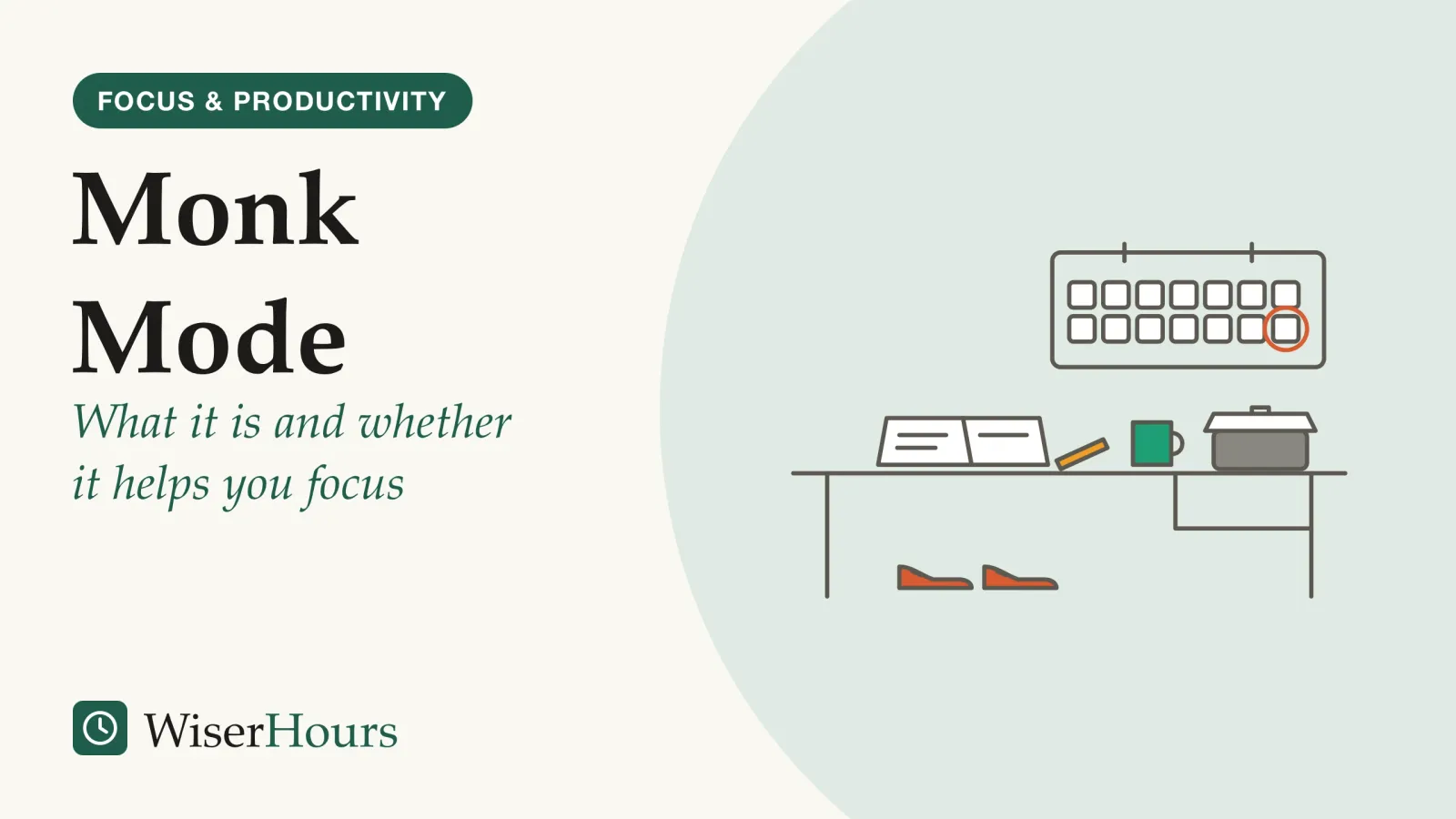
Monk mode is a self-imposed stretch, often weeks or months, in which you cut distractions, social media and most social plans to work on one goal. It spread on TikTok as a productivity trend, and no study has tested monk mode itself. Research on its separate parts gives a split verdict.
Narrowing your work to one goal, guarding blocks of time and cutting back on feeds all have some support, though the gains from leaving social media are small. Cutting out friends and family is the part the evidence warns against, along with trading sleep and exercise for extra hours. The version worth trying lasts about two weeks: one goal, one or two focus blocks a day, feeds logged out, and your usual sleep, a daily walk and a weekly plan with friends left in place. A day-by-day plan closes the article, and the wider set of habits monk mode borrows sits in the hub guide to focusing better at work and study.
What is monk mode?
Monk mode is a loose label for a period of strict focus on a single goal, with distractions removed and most leisure and social life put on hold. Business Insider traced the phrase in 2023 to entrepreneurs and self-help writers over at least two decades, with a viral run on TikTok and a rise that a social media analytics firm said may coincide with Jay Shetty’s 2020 book Think Like a Monk.1
The rules depend on who is posting. In the same report, one creator’s version was 12-hour workdays for two months straight; another’s had three fixed rules, daily meditation, daily exercise and no alcohol or drugs. The author Greg McKeown wrote a book in a long morning block, five days a week, with an automatic reply letting people know he was working.1 The National, a newspaper in the United Arab Emirates, described the trend as stepping away from apps such as TikTok and Instagram to concentrate on one task, suggested app blockers for those who find willpower is not enough, and passed on tips such as waking early, exercising and eating well.2
Definition
Monk mode is a self-chosen period, often weeks or months, of cutting distractions, social media and social plans to work on one goal. It is an online trend with no fixed rules and no research of its own.
That spread matters when you judge it. “Monk mode” can mean a sensible two-week push on a thesis chapter or a two-month retreat from everyone you know. Before copying a creator’s version, split it into its rules and check each one on its own evidence.
Does monk mode work? The focus parts have the best support
The strongest case for monk mode is single-tasking. Sophie Leroy, a business researcher, reported two experiments in 2009. In them, people who left a task unfinished kept thinking about it and did worse on the task that came next.3 She called the leftover pull attention residueattention residue: Thoughts about one task that linger after you switch to another and take attention away from it. Sophie Leroy named it; in her experiments it was stronger when the first task was left unfinished, and a brief plan for how to resume it reduced it.Full entry in the glossary, and the explainer on how attention residue builds up between tasks covers it in full.
An open task keeps running in the background, so every switch hands the next job a share of your attention that is still busy elsewhere. Someone juggling a side project, a course and a job search gets that cost several times a day. Someone with one goal for two weeks gets it far less often.
A designer preparing a portfolio is a fair example. Spread across six small projects, each evening starts with ten minutes of remembering where she left off. With one project, the work picks up from the last note. Leroy’s evidence comes from short lab experiments, so nobody has measured how much one goal helps across weeks of real work.
Fixed blocks with alerts off, the other habit monk mode borrows from focus research, get a full walkthrough in the beginner’s plan for starting deep work with one hour a day. Choose one goal you can state in a sentence, and let the rest wait for the end date.
Cutting social media: small mood gains and time handed back
Leaving social media for a few weeks lifts mood only slightly on average, but it does hand back time. The best test is a 2018 US randomized controlled trialrandomized controlled trial: A study that assigns participants to the treatment or the comparison group at random, so the groups start out alike and a difference in what happens next can be put down to the treatment. Random assignment makes the two groups comparable; it does not make the people in the trial representative of anyone else.Full entry in the glossary by the economists Hunt Allcott, Luca Braghieri, Sarah Eichmeyer and Matthew Gentzkow, funded by the Sloan and Knight foundations.4
The study
Moderate evidence
Four weeks off Facebook before the 2018 US midterm elections
The team recruited 2,743 US Facebook users through ads and randomly assigned those willing to quit for less than $102 to deactivate for four weeks or carry on as usual; 1,661 made up the main sample. Deactivation freed about an hour a day for the average person, and that time went to solo activities such as watching TV and to time with friends and family. A self-rated wellbeing index rose by 0.09 standard deviations, which the authors put at about 25 to 40 percent of the typical effect of psychological interventions, including self-help therapy, group training and individual therapy. Weeks later, the group still reported using the Facebook app less.4
An effect that size is real across a crowd and hard to notice in one person. The participants used Facebook more than 15 minutes a day, skewed young, well educated and left-leaning, and rated their own mood during an election season, which the authors note could make the results differ from other times.4
The wider evidence is mixed. Pooling 10 studies of social media breaks from the US, Europe, Australia, the United Arab Emirates and Hong Kong, Laura Lemahieu and colleagues at Ghent University and the University of Antwerp in Belgium found no clear effect on positive mood, negative mood or life satisfaction. Their meta-analysismeta-analysis: A study that combines the results of earlier studies on the same question into one overall estimate. Pooling makes the estimate more precise, but it cannot repair the studies it pools: a meta-analysis of surveys is still survey evidence.Full entry in the glossary appeared in 2025. Most breaks lasted about a week, and the studies varied widely in method, a limit the authors flag themselves.5 A second 2025 meta-analysis, led by Kaitlyn Burnell, pooled randomized trials from 32 articles that asked people to limit or stop social media, and found a small gain in wellbeing that its authors call only weak support for restricting use.6 Our summary of that review comes from its abstract.
The part of the Facebook result that matters for monk mode is where the freed hour went: partly to friends and family. A plan that closes the feeds and also cancels every dinner removes the activity that may have done the most good. Give the freed time a destination, and let some of it be people. How to step back from specific platforms is covered in how to quit social media, and the brain-chemistry claims behind similar resets in the dopamine detox explainer.
Further reading
Deep Work: Rules for Focused Success in a Distracted World
The fullest case for the protected focus blocks that monk mode borrows, written for people who still keep jobs and relationships.
As an Amazon Associate WiserHours earns from qualifying purchases.
Cutting people out is the risky part
Withdrawing from friends and family for weeks is the one monk mode rule that nearby research advises against. In a 2025 report, the WHO Commission on Social Connection said that loneliness and social isolation increase the risk of stroke, heart disease, diabetes, cognitive decline and early death, and it linked loneliness to an estimated 871,000 deaths a year worldwide.7
Those figures describe loneliness and isolation that last, and the WHO reports most of them as links, so they say little about a fortnight of quiet you chose yourself. They do show which way the risk runs. The WHO separates social isolation, an objective lack of enough social connections, from loneliness, the painful gap between the connection you want and the connection you have.7 A monk mode that starts as chosen solitude can drift into both, especially for someone who lives alone or has just moved.
- Myth
- Monk mode only works if you cut off your social life completely.
- Fact
- We found no study showing that isolation improves focus, and the WHO links loneliness and isolation to worse health. Chosen, limited time alone is a different thing.
Short, chosen solitude looks different. In a 2018 set of four experiments, the psychologists Thuy-vy Nguyen, Richard Ryan and Edward Deci found that time alone dampened both excited and anxious feelings, and led to relaxation and less stress when people had chosen to be alone. Our summary comes from the abstract only.8 The finding concerns short sessions people picked themselves, which looks more like a quiet evening than a month of turning down every invitation. The guide to loneliness explains the signs that being alone has stopped helping.
What are the rules of monk mode?
Monk mode has no official rules, so each common rule is best judged on the research behind it. The table weighs them one by one, with sleep and exercise added because the harder versions squeeze them.
| Common rule | What nearby research found | Evidence |
|---|---|---|
| One goal at a time | Unfinished tasks pulled attention and hurt the next task | Lab experiments, limited3 |
| Weeks off a social platform (US, 2018) | Small rise in self-rated wellbeing; about an hour a day freed | Trial, moderate4 |
| Full breaks, pooled | Mood and life satisfaction did not clearly change; most breaks about a week | Meta-analysis, mixed5 |
| Short, chosen time alone | Calmer mood and less stress when solitude was chosen | Experiments, limited; abstract only8 |
| Cutting social contact for weeks | Loneliness and isolation linked to worse health and early death | Observational, WHO review7 |
| Skipping sleep for work | Up to 48 hours awake hurt simple attention most; reasoning barely changed | Meta-analysis, moderate9 |
| Daily exercise | Regular activity linked to better mental health, thinking and sleep | WHO guidance10 |
The last two rows matter because some versions, such as 12-hour workdays for two months, leave little room for sleep or exercise.1 In Julian Lim and David Dinges’s 2010 meta-analysis of 70 articles on staying awake for up to 48 hours, lapses in simple attention showed the largest effect, and simple attention is the skill a focus block depends on; accuracy on reasoning tasks showed no clear change.9 For adults, the WHO advises a weekly total of at least 150 minutes of moderate activity.10 A brisk half-hour walk on five days covers it and fits around focus blocks.
How long should you do monk mode?
No research sets a length for monk mode, and the closest evidence gives no reason to go long. In the 2025 meta-analysis of social media breaks, which ran from a day to four weeks, longer breaks were not clearly better for mood than shorter ones.5
That leaves the choice to the goal. Two weeks is long enough to finish a real chunk of work, such as a draft chapter, a portfolio or a first pass through an exam syllabus, and short enough to tell people “back on the 24th”. The two-month and nine-month versions in the press coverage came from people whose work or money allowed it.1 If two weeks goes well, you can choose to run another round with what you learned.
A two-week monk mode plan
A two-week plan keeps the parts with support and sets an end date from day one. The plan below is the editors’ suggestion, assembled from the studies above; no study has tested it as a whole.
- Before day 1, write the goal in one sentence and the end date beside it. Tell the people you live and work with what is changing, and when you will be back.
- Pick your inputs: log out of the feeds or use a blocker, keep messaging for family and work, and turn off alerts during focus blocks.
- Plan one or two focus blocks a day at the same times, as long as you can already hold attention; an hour is a sensible start.
- Keep your usual sleep window, walk or move for about half an hour on most days, and put one social plan in each week.
- On day 7, check progress on the goal and adjust block length or inputs. Keep the social plan even if work is behind.
- On day 14, note what you finished, then decide which habits to keep. A useful end point is often a lighter version, such as feeds on weekends only.
- Turn down: feeds, alerts and side projects, for a set period with an end date
- One goal: a single aim you can state in a sentence, worked on in fixed focus blocks
- Keep: your usual sleep, daily movement and at least one plan a week with someone
Laid out on a calendar, the fortnight has one checkpoint in the middle and a fixed finish on day 14.
- Day 0Goal, end date, people told
- Days 1-6Focus blocks, feeds off, daily walk
- Day 7Review; keep the social plan
- Days 8-13Same routine, adjusted
- Day 14Stop and choose what stays
Two weeks also absorbs a lost day. If a family emergency or an urgent deadline eats one, start again the next morning at your usual hour and leave the end date where it is.
Before your two weeks start
When time alone starts to weigh on you
Low mood or loneliness that builds during monk mode is a reason to stop early and talk to someone. The order below is ours, built from WHO and NIMH advice.
- Now: if you think you are in immediate danger of harming yourself, the WHO’s 2026 depression fact sheet says to contact any available emergency services or a crisis line, so call your local emergency number first.11 In the US, for example, NIMH lists 911 for life-threatening situations and the 988 Suicide & Crisis Lifeline, by call, text or online chat.12 Readers elsewhere should use their own country’s emergency number and crisis line.
- Soon: the same fact sheet describes a depressive episode as low or empty mood, or lost interest, lasting most of the day, nearly every day, for at least two weeks, and lists seeking help from a healthcare provider among its steps.11
- Routine: for loneliness that outlasts the fortnight, the WHO’s 2025 social connection release says finding out about local support and services matters when the problem is more serious.7
The bottom line
Monk mode is a bundle of habits with no research of its own, and the useful ones are the least dramatic: one goal, set focus blocks, fewer feeds and a fixed end date. Keep your sleep, a daily walk and at least one plan a week with someone you like. Write the goal and the end date down today and start with two weeks.
This article is general information, not medical advice. If you're worried about your health, talk to a doctor or another qualified professional.
Frequently asked questions
Can you do monk mode with a full-time job?
Yes, in a smaller form. Greg McKeown, as Business Insider reported in 2023, wrote his book Essentialism from 5 a.m. to 1 p.m. on five days a week for nine months, an unusual setup most jobs will not allow. A version that fits a job keeps the one goal and the end date, and moves the focus blocks to hours you control, such as early mornings or a meeting-free afternoon.
Does monk mode mean giving up your phone completely?
Not in most versions. The National, a UAE newspaper, described monk mode in 2023 as stepping back from apps such as TikTok and Instagram, and suggested blocking apps such as Freedom, Cold Turkey or Forest for people who find willpower alone is not enough. The large US trial of a Facebook break let people keep Messenger. Calls, maps and messages to the people you live and work with can stay.
Should you tell people before you start monk mode?
It helps. McKeown set an automatic email reply letting people know he was working, according to Business Insider. Telling friends and family how long the period lasts, and booking a time to see them, keeps the social contact the WHO counts as protective. The WHO's own small steps include putting your phone away so you are fully present when you do meet.
Sources
- What is 'monk mode': How the viral productivity hack works — and how CEOs and entrepreneurs use it. Nguyen, B. (2023, February 8). Business Insider, republished by Yahoo News
- What is monk mode, the viral trend that promotes a mindful break from social media? Bedirian, R. (2023, October 8). The National (UAE)
- Why is it so hard to do my work? The challenge of attention residue when switching between work tasks. Leroy, S. (2009). Organizational Behavior and Human Decision Processes, 109(2), 168-181
- The Welfare Effects of Social Media. Allcott, H., Braghieri, L., Eichmeyer, S. & Gentzkow, M. (2020). American Economic Review, 110(3), 629-676
- The effects of social media abstinence on affective well-being and life satisfaction: a systematic review and meta-analysis. Lemahieu, L., Vander Zwalmen, Y., Mennes, M., Koster, E. H. W., Vanden Abeele, M. M. P. & Poels, K. (2025). Scientific Reports, 15, 7581
- The effects of social media restriction: Meta-analytic evidence from randomized controlled trials. Burnell, K., Meter, D. J., Andrade, F. C., Slocum, A. N. & George, M. J. (2025). SSM - Mental Health, 7, 100459
- Social connection linked to improved health and reduced risk of early death. World Health Organization (2025, June 30). News release on the report of the WHO Commission on Social Connection
- Solitude as an Approach to Affective Self-Regulation. Nguyen, T. T., Ryan, R. M. & Deci, E. L. (2018). Personality and Social Psychology Bulletin, 44(1), 92-106
- A meta-analysis of the impact of short-term sleep deprivation on cognitive variables. Lim, J. & Dinges, D. F. (2010). Psychological Bulletin, 136(3), 375-389
- Physical activity (fact sheet). World Health Organization (checked 7 November 2026)
- Depressive disorder (depression) (fact sheet). World Health Organization (2026, September 11; checked 7 November 2026)
- Help for Mental Illnesses. National Institute of Mental Health, National Institutes of Health (US) (reviewed April 2026; checked 7 November 2026)
How we researched this
We searched news archives, Google Scholar, Europe PMC, Crossref, WHO and NIMH pages in November 2026 for descriptions of monk mode and for trials, reviews and official guidance on the parts it combines: single-tasking, social media breaks, solitude, social isolation, sleep and exercise. Sources date from 2009 to 2026. Main limitation: no study has tested monk mode as a whole, so each verdict rests on research about one part, and four papers were read as abstracts only.
Keep reading
How to Increase Your Attention Span: The Five-More Rule and Other Small Stretches
How to increase attention span in 6 small steps: time your baseline, do five more when you want to stop, hide the phone, move on breaks, protect sleep.
Focus Meditation: A 10-Minute Practice for Sharper Concentration
A 10-minute focus meditation, minute by minute, with desk variations and an honest look at what research says it does for concentration.
Ultradian Rhythms: Working With Your Brain's Natural Cycles
Ultradian rhythms repeat many times a day. The 90-minute sleep cycle is well documented; a 90-minute focus cycle while awake is not. How to test your own.
Best Time of Day to Focus: Finding Your Peak Hours
The best time of day to focus depends on your body clock and your age. How to find your peak hours in 1 to 2 weeks, and why off-peak hours may suit insight.