Ultradian Rhythms: Working With Your Brain's Natural Cycles
Ultradian rhythms repeat many times a day. The 90-minute sleep cycle is well documented; a 90-minute focus cycle while awake is not. How to test your own.

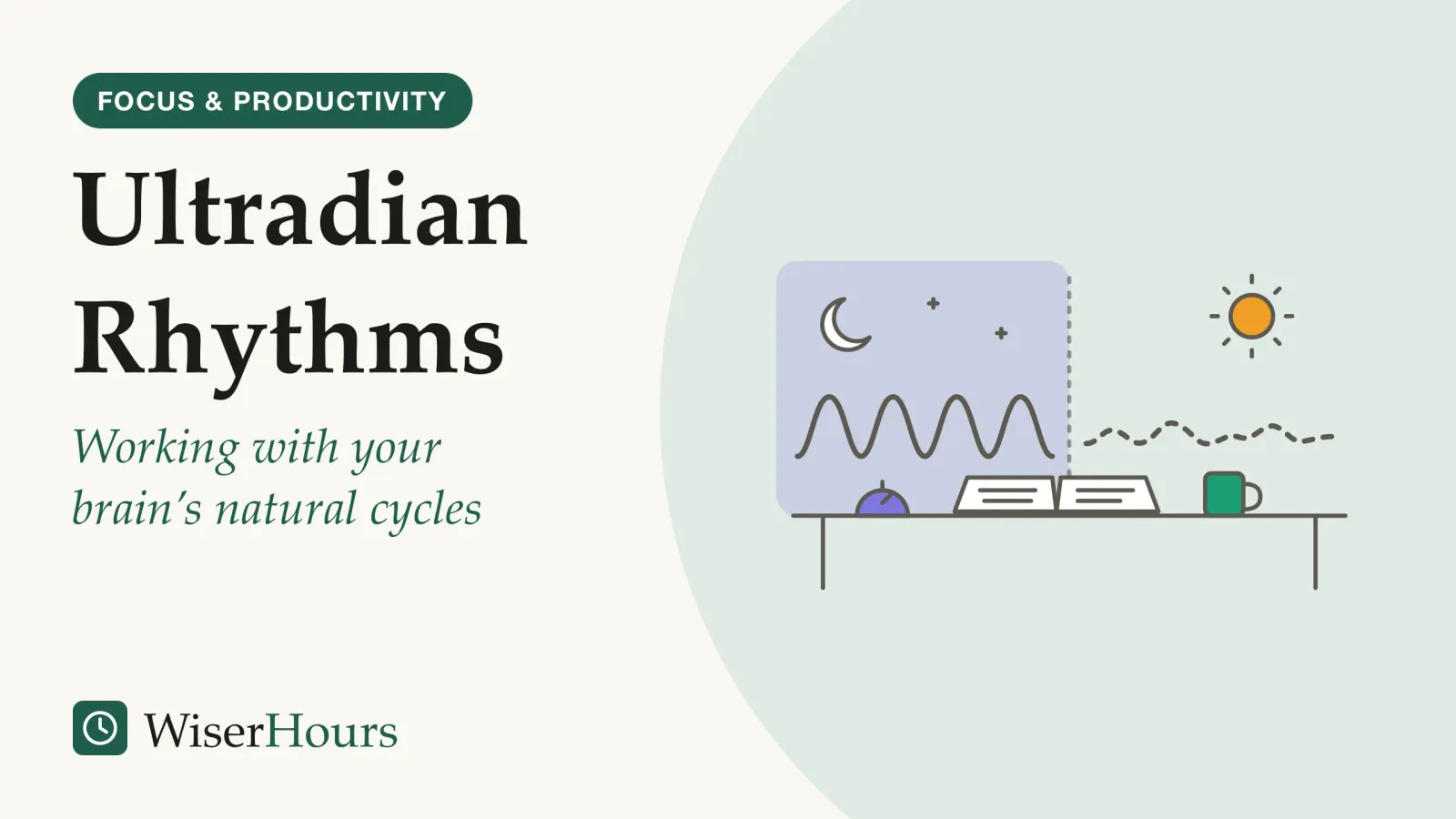
Ultradian rhythms are the body’s cycles that repeat more than once a day, and the work advice built on them claims far more than the research behind it. Productivity writing often says the brain runs in 90-minute waves from morning to night, so you should work for an hour and a half and then rest for 20 minutes.
The best-documented ultradian rhythm is the sleep cycle, which averages about 90 minutes. Sleep researcher Nathaniel Kleitman proposed that a similar cycle continues while we are awake, but lab studies since the 1970s disagree on whether it does: the rhythm is well documented in sleep and unproven while awake. A work block of an hour or so, followed by a real break, is a sensible experiment to run on yourself.
The experiment is simple. Start a demanding task, write down the minute your attention first slips, stop by the 90-minute mark at the latest and leave your desk for a few minutes. Two weeks of those notes tell you more about your own working rhythm than any fixed rule. The wider set of habits that help attention is in six simple steps for steadier concentration.
Ultradian rhythms, and the one measured best
An ultradian rhythm is any biological cycle that repeats more than once a day, and the Wikipedia entry on them lists examples from heart rate and hormone release to appetite and arousal. Circadian rhythms complete one cycle a day, and infradian rhythms, such as the menstrual cycle, take longer than a day.1
Definition
An ultradian rhythm is a biological cycle shorter than a day, so it repeats several times within 24 hours. The sleep cycle is the best-known example.
Advice often blurs the two. Your circadian rhythm is why you feel sharper at some hours than others, which is the subject of how your daily peak shapes concentration. An ultradian rhythm, if one runs while you work, would add shorter waves on top of that daily curve, so an afternoon dip could come from either.
Sleep shows the pattern most clearly. Over a night you pass through several rounds of light sleep, deep sleep and REM sleep, the stage when most dreaming happens. The Sleep Foundation’s guide puts the average cycle at about 90 minutes, with four to six cycles in a typical night. The cycles are not identical: the first is often shorter, later ones run longer, and the share of each stage changes as the night goes on.2
So even the best-documented ultradian rhythm is an average with a spread. When an app or article gives a cycle an exact number of minutes, read it as a rough midpoint.
What is the basic rest-activity cycle?
The basic rest-activity cycle is Nathaniel Kleitman’s proposal that the sleep cycle is one face of a rhythm that runs all day and night. Kleitman, who co-wrote the 1953 Science paper on REM sleep with his student Eugene Aserinsky, described the cycle as shorter in infants, lengthening to roughly an hour and a half in adults.3
- Asleep: light, deep and REM sleep repeat in cycles that average about 90 minutes, four to six a night
- Awake: some lab studies report swings of an hour or two in alertness or performance; others find no cycle at all
In a 1961 talk Kleitman suggested that during wakefulness the cycle is hidden by the brain’s higher activity, but that it might show up in swings of alertness, in drowsiness after a big meal and in the relief some people get from short naps. He repeated the idea in the 1963 second edition of his book Sleep and Wakefulness and urged researchers to study waking rhythms as well as sleep.3
It was a hypothesis, and a fruitful one, but the sleep half and the waking half rest on very different evidence. The REM cycle can be measured night after night with brain recordings. A 1980 review of fragmented-sleep studies by L. C. Johnson concluded that the REM cycle is governed mainly by a sleep-dependent process, and questioned whether a waking cycle is an extension of it.4
If a waking cycle exists, nobody should expect it to tick as regularly as the night’s. Someone who feels drowsy an hour or so into a meeting may be seeing an ultradian dip, a dull meeting or the effect of a short night, and nothing in Kleitman’s idea tells those apart.
Is the 90-minute focus cycle real?
Evidence for a 90-minute cycle in waking focus is mixed and mostly small. Several lab studies between 1979 and 1994 reported swings of an hour or two in alertness or performance, while others, including a careful 1995 study in Austria, found no such rhythm. Peretz Lavie, a sleep researcher who reviewed the evidence in 1989, concluded in a 2024 memoir that there is no single cycle.
- 1953REM sleep reported by Aserinsky and Kleitman
- 1961Kleitman proposes a cycle that also runs by day
- 1979A Science paper reports cycles in waking task scores
- 1995A study in Graz finds no 90-minute cycle
- 2024Lavie: several waking rhythms, no single cycle
On the positive side, a 1979 Science paper by Klein and Armitage of Dalhousie University in Canada reported testing people on verbal and spatial matching tasks repeatedly across a working day, and found significant oscillations of 60 to 100 minutes.5 Lavie, at the Technion in Israel, reviewing such studies in 1989, wrote that waking arousal shows spontaneous cycles of about an hour and a half, but that they are of low amplitude and easily masked by other conditions.6 A small Japanese study of male students found a cycle of about two hours in performance and in how the students rated their own work.7
The study
Mixed evidence
A nine-hour test day in Graz, Austria, with no 90-minute wave
Sixty people at the University of Graz did a short sentence-checking task every 10 minutes for 9 hours, rated their alertness and mood, and had their heartbeat recorded. Using conservative statistics, the researchers found no significant 90-minute rhythm in any measure; slower, longer swings explained most of the variation. Reanalysing their data with other methods, they suggested several earlier positive reports may reflect looser statistics.8
The Graz result is not alone. Recording movement of the head, wrists and ankle in a small group of healthy people, Daniel Kripke’s group in San Diego, California, found no rhythm near 90 minutes.9 A study in Barcelona, Spain, timed people’s reactions over a long session and found no significant cycle in that range.10
Why would careful labs disagree? A weak wave is hard to find. Lavie’s 1989 review described the waking cycles as low in amplitude and easily masked by the conditions of an experiment.6 The Graz team pointed to a second reason: some positive findings may reflect looser statistics.8 Lavie, looking back in 2024, described waking rhythms in many body systems as several oscillators, a sort of “biological hour”, rather than the single cycle Kleitman proposed.3
For planning a workday, that leaves a modest conclusion. Any waking wave is too faint and too disputed to schedule by the clock, so a timer set to the minute is a guess about your body. A designer who keeps notes for two weeks on when her attention fades, on ordinary days with ordinary interruptions, ends up with a better guide than that guess.
| What it is | What the best evidence found | Evidence |
|---|---|---|
| Sleep cycle | Repeating cycles of about 90 minutes on average, four to six a night, varying in length | Sleep guide summarizing sleep-lab research, consensus2 |
| Kleitman’s waking cycle | Proposed in 1961 as a continuation of the sleep cycle into the day | Hypothesis, expert opinion3 |
| Swings in waking performance | Oscillations of about 1 to 2 hours in some lab tasks | Small lab studies, abstracts only, limited5 7 |
| No 90-minute cycle | No rhythm in that range in performance, alertness, mood, movement or reaction time | Lab studies of 10 to 60 people, abstracts only, limited8 9 10 |
| One cycle or several | Several waking oscillators, not one basic cycle | A leading researcher’s retrospective, expert opinion3 |
Where the 90-on, 20-off rule comes from
The popular work rule mixes Kleitman’s hypothesis with a misreading of a study of violinists. A 2010 HuffPost essay by Tony Schwartz, who runs a consulting firm on workplace energy, wrote that Kleitman found the body runs on the same 90-minute rhythm by day, and that the best young violinists practiced in sessions of no more than an hour and a half.11
The rest period is harder to trace. The Wikipedia entry on the basic rest-activity cycle says brainwaves slow in a cycle’s last 20 minutes, without a source for that sentence.12 None of the waking-cycle studies above reports a fixed rest phase of any set length.
- Myth
- Your brain runs in 90-minute focus cycles followed by a 20-minute crash.
- Fact
- Sleep cycles average about 90 minutes. Lab studies of awake adults disagree on whether any such cycle exists, and none sets a 20-minute rest.
The violinist study, by Anders Ericsson and colleagues in 1993, followed students at a West Berlin music academy through a week of diaries. Uninterrupted solo practice lasted between an hour and an hour and a half a session, and the authors read that limit as a sign of how effortful deliberate practice is; they made no link to an ultradian rhythm. Session length did not separate the best players from the rest: sessions averaged about 80 minutes with no reliable difference between groups, and the two best groups simply practiced in more sessions and napped more in the afternoon than the future music teachers did.13
The lesson from the violinists is about effort. In the authors’ reading, hard, concentrated practice is limited to an hour or so at a time by the effort it takes, and the best violinists spread it across the day with rest in between. That holds whether or not a biological wave sets the timing.
How long should you work before taking a break?
No study sets one right length for a work block, and the evidence points to a range. Effortful practice in Ericsson’s violinists lasted an hour to an hour and a half a session, and a 2022 meta-analysismeta-analysis: A study that combines the results of earlier studies on the same question into one overall estimate. Pooling makes the estimate more precise, but it cannot repair the studies it pools: a meta-analysis of surveys is still survey evidence.Full entry in the glossary of short breaks linked them to people feeling more energetic and less tired, with a smaller and uncertain effect on how much they get done.
That 2022 review, by Patricia Albulescu and colleagues in Romania, pooled experiments and quasi-experiments on micro-breaks lasting up to 10 minutes. Breaks were linked to a small rise in vigor and less fatigue, but the effect on overall performance was not statistically clear, and in a subgroup analysis it showed up only for less demanding tasks. Longer breaks went with larger gains in performance, which led the authors to suggest that recovering from very draining work may need more than 10 minutes.14
A report writer who works through the first part of the morning, then walks to get water and looks out of a window for a few minutes before starting again, is following both findings: a block in the range people sustain for effortful work, and a break that leaves the desk behind. If the work was heavy, a longer pause before the next hard block is reasonable.
How to test your own working rhythm
Because any waking cycle is weak and disputed, a record of your own days tells you more than a borrowed rule. The four steps below have never been trialled together; each one borrows a single finding from the research above.
1. Note when your attention dips for a week
Each time you notice yourself rereading a line, checking your phone or reaching for a snack during focused work, jot the time and how long you had been working. After a week, look for a typical gap between starting and drifting. Kleitman named drowsiness and a pull toward a nap as the signs he expected, so note those too.3
2. Try blocks of an hour to an hour and a half
Set a block within the range Ericsson’s violinists sustained for effortful practice, and stop when it ends or when your dip arrives, whichever comes first.13 If you slip into deep, absorbed flow near the end of a block, keep going; a test schedule should not interrupt your best work.
3. Make the break a change of activity
Stand, move or look at something other than a screen. The micro-break review found the clearest benefits in how energetic and tired people felt, so judge a break by how you feel when you return to work.14
4. Compare and adjust
After two weeks, compare days with planned blocks to your usual days on the work you finished and how tired you felt by late afternoon. Keep the block length that suited you, even if it is shorter or longer than the range above.
A two-week rhythm test
The bottom line
The roughly 90-minute rhythm is real in sleep and uncertain while you are awake, so a fixed timetable of work and rest has no strong biology behind it. Start with blocks of an hour to an hour and a half for hard work, take breaks that get you away from the screen, and spend two weeks noting when your attention dips before you settle on your own block length.
Frequently asked questions
Do ultradian rhythms change with age?
The sleep cycle does. Nathaniel Kleitman described a basic cycle of about 50 to 60 minutes in infants that lengthens to about 80 to 90 minutes in adults, as Peretz Lavie recounts in his 2024 memoir of the field in Sleep Advances. Whether a waking version changes with age has not been well measured, because the waking cycle itself is disputed.
Should I plan my sleep in exact 90-minute blocks?
Treat 90 minutes as an average. The Sleep Foundation's guide to sleep stages, updated in 2025, says the first cycle of the night often runs 70 to 100 minutes and later cycles 90 to 120, and that cycles change in make-up as the night goes on. A count of exact 90-minute blocks will drift from what your brain is doing.
Where does the 20-minute ultradian break come from?
No study we found sets it. The Wikipedia entry on the basic rest-activity cycle says brainwaves slow and the body feels tired in a cycle's last 20 minutes, but gives no source for that sentence, and the lab studies that found waking cycles report periods of roughly 1 to 2 hours without fixing a rest phase of any set length. In our search it turned up in popular articles and in none of the lab studies.
Sources
- Ultradian rhythm. Wikipedia (accessed 2026-10-24)
- Stages of Sleep: What Happens in a Normal Sleep Cycle? Suni, E. (updated 2025). Sleep Foundation
- My voyage in the enchanted world of sleep. Lavie, P. (2024). Sleep Advances, 5(1), zpae027
- The REM cycle is a sleep-dependent rhythm. Johnson, L. C. (1980). Sleep, 2(3), 299-307
- Rhythms in human performance: 1 1/2-hour oscillations in cognitive style. Klein, R. & Armitage, R. (1979). Science, 204(4399), 1326-1328
- Ultradian rhythms in arousal: the problem of masking. Lavie, P. (1989). Chronobiology International, 6(1), 21-28
- Ultradian rhythms in task performance, self-evaluation, and EEG activity. Hayashi, M., Sato, K. & Hori, T. (1994). Perceptual and Motor Skills, 79(2), 791-800
- Ultradian rhythms in cognitive performance: no evidence for a 1.5-h rhythm. Neubauer, A. C. & Freudenthaler, H. H. (1995). Biological Psychology, 40(3), 281-298
- No basic rest-activity cycle in head, wrist or ankle. Okudaira, N., Kripke, D. F. & Webster, J. B. (1984). Physiology & Behavior, 32(5), 843-845
- Ultradian cyclicity in auditory and visual reaction time during long performance. Almirall, H., Ferrer, R. & Sànchez-Turet, M. (1988). Perceptual and Motor Skills, 66(2), 571-577
- The 90-Minute Solution: How Building in Periods of Renewal Can Change Your Work and Your Life. Schwartz, T. (2010). HuffPost
- Basic rest–activity cycle. Wikipedia (accessed 2026-10-24)
- The role of deliberate practice in the acquisition of expert performance. Ericsson, K. A., Krampe, R. T. & Tesch-Römer, C. (1993). Psychological Review, 100(3), 363-406
- "Give me a break!" A systematic review and meta-analysis on the efficacy of micro-breaks for increasing well-being and performance. Albulescu, P., Macsinga, I., Rusu, A., Sulea, C., Bodnaru, A. & Tulbure, B. T. (2022). PLOS ONE, 17(8), e0272460
How we researched this
We searched PubMed, Crossref and Europe PMC in October 2026 for studies of ultradian or 90-minute cycles in waking alertness and performance, and read the main popular sources of the 90-minute work rule. Sources run from 1979 to 2025. Eight sources were read as abstracts only, so nothing beyond their abstracts is used. Main limitation: most waking-cycle studies are small, decades old and tested people in labs for a single day, so how they apply to office work is unmeasured.
Keep reading
Best Time of Day to Focus: Finding Your Peak Hours
The best time of day to focus depends on your body clock and your age. How to find your peak hours in 1 to 2 weeks, and why off-peak hours may suit insight.
How to Increase Your Attention Span: The Five-More Rule and Other Small Stretches
How to increase attention span in 6 small steps: time your baseline, do five more when you want to stop, hide the phone, move on breaks, protect sleep.
Focus Meditation: A 10-Minute Practice for Sharper Concentration
A 10-minute focus meditation, minute by minute, with desk variations and an honest look at what research says it does for concentration.
Why Multitasking Doesn't Work: The Evidence in Plain English
Your brain takes turns on 2 thinking tasks, and each switch costs time. What the research shows, why hands-free doesn't help, and when multitasking is fine.