The 12 Week Year Method: Does a Shorter "Year" Get Better Results?
The 12 week year swaps annual goals for 12-week cycles scored weekly. No trial tests it; one of its parts, tracking progress, has good evidence.

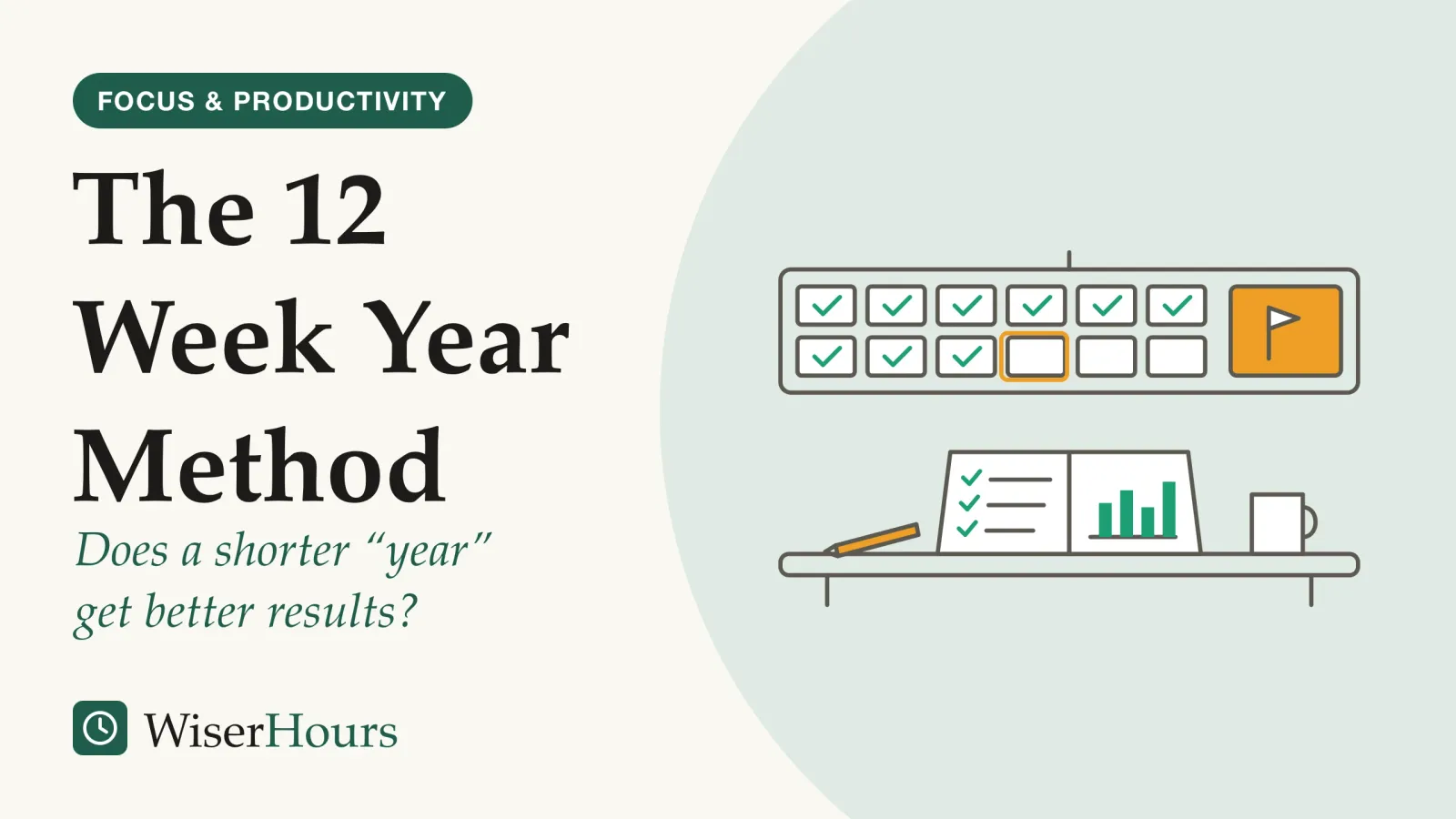
Most people plan a year as if it were long, and that is the problem the 12 week year sets out to fix. Brian Moran and Michael Lennington, who described the method in a 2013 book, call it annualized thinking: the quiet belief that there is plenty of time left, which lets real effort bunch up near the deadline. Their answer is to make every year-end arrive four times a year.1
The 12 Week Year is a planning method that replaces annual goals with twelve-week cycles: one to three goals, a plan of weekly actions, and a weekly score for how many of those actions you finished. A cycle takes five steps to set up:
- Start with a vision that covers more than work
- Choose one to three goals for the twelve weeks
- Break each goal into weekly tactics
- Plan each week, protect the time and score it
- Use the thirteenth week to review, rest and replan
We found no published study of the full method. Some of its parts, above all keeping a written record of progress, have good experimental support; others, including its best-known number, rest on the authors’ experience. The habits that help under any planning system are covered in the evidence on setting goals.
Prefer to watch? The video covers the same ground as this article.
What is the 12 Week Year method?
The 12 Week Year is an execution system created by Brian P. Moran and Michael Lennington of The Execution Company, a consultancy, and published by Wiley in 2013. It treats twelve weeks, not twelve months, as the planning year, on the argument that a near deadline brings the focus people usually find only in December.1
The book frames the problem as doing rather than knowing: most people already know what would move their goals forward, the authors argue, but fall short in carrying it out. Their system rests on five disciplines, which they name as vision, planning, process control, measurement and time use.1
Picture an annual goal to finish a short online course and build a portfolio piece. In March, December feels far away, so the course waits. Set as a twelve-week goal, it becomes “finish modules one to four and draft the portfolio brief by the end of week 12”, and this week’s tactic is already due on Friday.
The official site sells training, coaching, certification and a store alongside free templates, so most material about the method comes from the business built on it.2 Like personal OKRs, it runs in cycles of about a quarter. The difference is what it scores: OKRs grade the results you reached, while the 12 Week Year scores whether you did the actions you planned.
How do you plan a 12 Week Year?
You plan a 12 Week Year by writing a long-term vision, choosing one to three goals that serve it, breaking each goal into weekly tactics, and then running a short weekly routine of scoring, planning and checking in, the order the book’s Part II follows.1
- Vision: a few sentences about the life you want, the filter for everything below it
- One to three goals: specific enough to check on the last day of the twelve weeks
- Weekly plan and score: the share of planned tactics done each week; the 85% line is the authors’ rule of thumb, not tested in any study we found
- The thirteenth week: review the scores and results, rest, then plan the next cycle from what actually happened
1. Start with a vision that covers more than work
The book treats vision as the starting point of all high performance and asks you to rate your satisfaction in seven areas of life, from family and physical health to community and business, before choosing where to focus.1 It is close to the wheel of life exercise, used as a filter rather than a portrait.
The authors’ reason is practical. They describe a stage in any change, which they call the valley of despair, when the costs are felt and the benefits still seem far away, and they argue that a vision you care about is what carries people through it. Write a few sentences about the life you want in a few years, then circle the life areas, two at most, where a twelve-week push would matter most.
2. Choose one to three goals for the twelve weeks
The authors ask for the one to three goals with the greatest impact, written to be specific and measurable, because a vague goal produces a vague plan.1 Their stated aim is to be great at a few things instead of mediocre at many.
A goal such as “get fitter” fails this test. “Run a 5 km route without stopping by week 12” passes, because you will know on the last day whether you did it. If you have more than three candidates, park the rest for the next cycle; the short horizon means “not now” is only weeks away.
3. Break each goal into weekly tactics
Tactics are the actions that produce the goal, and the 12-week plan lists every one of them, assigned to the week when it is due.1 The book also asks for both kinds of measure: lag indicators, such as income or weight, which show the end result, and lead indicators, such as sales calls made, which are the activities that produce it.
For the running goal, tactics might be three runs a week, a long run on Sundays and new shoes by week 2. The book’s advice for team plans applies to personal ones too: keep the plan lean, and spread the actions across the twelve weeks instead of front-loading them.1
4. Plan each week, protect the time and score it
The weekly routine has three steps in the book: score last week, plan this week, and meet briefly with a small accountability group. The authors suggest 15 to 20 minutes at the start of each week for the first two.1 They also recommend blocking time: a weekly strategic block of about three hours with no calls, messages or visitors for the most important work, buffer blocks for email and small tasks, and breakout blocks away from work altogether. The general technique is called time blockingtime blocking: Planning the day by giving each task a fixed slot on the calendar, rather than working down a list. The plan is meant to be redrawn when the day changes, not followed at any cost.Full entry in the glossary.
The group meeting can look optional, yet reporting progress to others has some of the firmer evidence in the next section.
5. Use the thirteenth week to review, rest and replan
The book closes with a chapter on the thirteenth week, and the authors’ instruction for the end of each cycle is to take a break, celebrate and reload, whether that means a long weekend or a full week off.1
The reason to review before replanning is the planning fallacyplanning fallacy: The tendency to underestimate how long your own tasks will take, even when you know similar tasks ran late before. Estimating from your track record on past tasks, rather than from the plan, tends to correct it.Full entry in the glossary. In a series of 1994 studies, people’s predictions of how long their own tasks would take were too optimistic, and in one of them the bias disappeared when people were asked to connect relevant past experiences to their forecast.3 Week 13 is that connection, built into the calendar: set your last twelve weekly scores beside the new plan, and cut tactics until the plan fits the weeks you had.
Set up your first cycle
What is the execution score in the 12 Week Year?
The execution score is the percentage of the tactics on your weekly plan that you completed that week. It measures what you did, not what you achieved. The book’s target is 85 percent: the authors write that people who complete that share of their weekly tactics will most likely reach their objectives.1
That target is the authors’ rule of thumb from their client work. The parts of the book we read give no study, sample or data for it, and our searches found none. The same book also says a score below the line is not necessarily bad and that a score rising from week to week is a good sign, which is the more useful way to read it.
A worked week
Suppose this week’s plan lists eight tactics across two goals and you complete seven. Your execution score is seven divided by eight, or 88 percent. If you finish six, it is 75 percent, and the useful question is which two slipped and why.
Scoring actions has a sound basis in research, with one catch.
The study
Moderate evidence
Progress monitoring in 138 randomized studies: a Sheffield-led meta-analysis, 2016
Benjamin Harkin of the University of Sheffield and his colleagues combined 138 randomized studies covering 19,951 people; most dealt with health goals such as weight and physical activity. Prompting people to track their progress made them more likely to reach their goals, and the benefit grew when people physically recorded their progress or shared it with others. The target of tracking mattered: monitoring a behavior improved that behavior with no clear effect on outcomes, while monitoring an outcome improved the outcome.4
For the 12 Week Year, that pattern cuts both ways. The execution score tracks behavior, so it should help you do your tactics. It cannot tell you whether those tactics move the result, because the authors of the meta-analysis found the two kinds of tracking worked on different targets.4 Most of their studies concerned health goals, so for work goals the finding is borrowed.
Does the 12 Week Year work?
Nobody can yet say whether the 12 Week Year works better than annual planning, because no study we found has compared the two. Our searches of OpenAlex, Crossref and the web in October 2026 found no trial or survey of the method. The book promises to show readers how to increase their results by four times or more, but its support is client stories, with no comparisons.1
What can be tested is each part, and the results are mixed. The case for near goals rests on an old and striking study. In a 1981 experiment by Albert Bandura and Dale Schunk, children who struggled with arithmetic and showed little interest in it worked through a self-directed program with near subgoals, one distant goal or no goal. Those with near subgoals progressed rapidly and grew more confident and interested; the distant goal had no demonstrable effect.5 We read only the published summary, and the study involved children, not adults planning a year. Even a twelve-week goal, then, needs a target for this week.
A larger body of work is less clear. When Tracy Epton, Sarah Currie and Christopher Armitage pooled randomized goal-setting tests in 2017, goals to be met within a couple of weeks did not clearly outperform goals set further out.6 And one experiment often cited for the power of deadlines, a 2002 Psychological Science paper on self-imposed deadlines by Dan Ariely and Klaus Wertenbroch, was retracted by the journal in 2026, so this article leaves it out.7
- Myth
- Research shows that 12-week goals beat annual goals.
- Fact
- No published study we found has put the two side by side. A 2017 meta-analysis found no clear difference between goals due within a couple of weeks and later ones.
Week 13 also hands you a fresh start, an idea with partial support. Using real-world records in three studies, Hengchen Dai, Katherine Milkman and Jason Riis (2014) saw US Google searches for dieting, visits to a US university gym and goal commitments rise after calendar landmarks such as a new week, month or year, a birthday or a new semester. They propose that a landmark lets people assign past failures to an old period.8 Twelve-week cycles add more such markers. Timing alone may not be enough, though: in a 2017 randomized trial in the US, run by some of the same researchers and funded by the health insurer Humana, sending medication reminders just after fresh-start dates did not increase adherence.9 Treat each new cycle as a window for a better plan, a point also made in why New Year’s resolutions fade.
| Piece of the 12 Week Year | What the best evidence found | Evidence |
|---|---|---|
| A twelve-week year | No study compares it with annual planning | Gap: authors’ experience only1 |
| Near subgoals | Children learning arithmetic did better with near subgoals than with one distant goal | One experiment, limited5 |
| Short versus longer deadlines | No clear difference across randomized goal-setting tests, few of which set longer goals | Meta-analysis, moderate6 |
| Weekly scoring, written down and shared | Tracking progress helped people reach goals; tracking actions changed actions more than results | Meta-analysis, moderate (borrowed from health goals)4 |
| The 85 percent target | Stated by the authors; no data published | Expert opinion, gap1 |
| A fresh start every cycle | Goal-related activity rose after calendar landmarks; one trial of timed reminders found no gain | Records and one trial, mixed89 |
Who the 12 Week Year suits less
The 12 Week Year assumes you control much of your week. The method’s own tools, a three-hour block with no calls or visitors and a weekly plan you set yourself, come from a book with many sales and financial-advice examples, and they fit people whose time is largely their own.1
That leaves out many people. Shift workers whose rota arrives a week ahead, parents and carers whose days are set by someone else’s needs, and employees whose manager fills the calendar may find a weekly score measures their circumstances more than their effort. Our reading is that a smaller plan fits better there: one goal, two or three tactics a week and no protected block, scored the same way.
Some goals also outlast the cycle. A degree or a career change takes longer than twelve weeks, and twelve-week pieces can lose sight of the whole, which is why the book insists that each plan serve the long-term vision. Constant urgency has a cost too. The authors build in breakout time and a thirteenth week off, and in our reading those are the parts to protect first when a cycle gets crowded.
The bottom line
No study we found tests the 12 Week Year itself, and its 85 percent target is the authors’ own rule; its strongest part is the weekly written record. If you try one cycle, score your tactics every week, track one result beside them, and use the thirteenth week to plan the next cycle from what actually happened, cutting tactics until the plan fits the weeks you had.
Frequently asked questions
What happens if my execution score is below 85 percent?
Not much, on the authors' own terms. In The 12 Week Year, Brian Moran and Michael Lennington say a weekly score under 85 percent is not necessarily bad and that a score that rises from week to week is a good sign. Because the 85 percent line comes from their experience and no study we found tests it, read a low week as a prompt to check whether the plan was too full.
Do you need the book, an app or a coach to run a 12 Week Year?
No. The method needs a written vision, a 12-week plan, a weekly plan and a scorecard, which a notebook or a spreadsheet can hold. The official 12 Week Year site offers free printable planning templates and sells training, coaching and certification, so most material about the method comes from the company that sells it.
Can a team use the 12 Week Year?
The authors say so: the 2013 book presents the system as working for individuals and organizations, and it gives advice for team plans, such as keeping a team plan short and spreading its actions across the 12 weeks instead of front-loading them. As with the personal version, no study we found compared teams using it with teams that did not.
Sources
- The 12 Week Year: Get More Done in 12 Weeks than Others Do in 12 Months. Moran, B. P. & Lennington, M. (2013). Wiley
- 12 Week Year (official site). The 12 Week Year (accessed 11 October 2026)
- Exploring the planning fallacy: Why people underestimate their task completion times. Buehler, R., Griffin, D. & Ross, M. (1994). Journal of Personality and Social Psychology, 67(3)
- Does monitoring goal progress promote goal attainment? A meta-analysis of the experimental evidence. Harkin, B., Webb, T. L., Chang, B. P. I., et al. (2016). Psychological Bulletin, 142(2)
- Cultivating competence, self-efficacy, and intrinsic interest through proximal self-motivation. Bandura, A. & Schunk, D. H. (1981). Journal of Personality and Social Psychology, 41(3)
- Unique effects of setting goals on behavior change: Systematic review and meta-analysis. Epton, T., Currie, S. & Armitage, C. J. (2017). Journal of Consulting and Clinical Psychology, 85(12)
- Retraction: Procrastination, deadlines, and performance: Self-control by precommitment. Psychological Science (2026), retraction notice for Ariely, D. & Wertenbroch, K. (2002)
- The fresh start effect: Temporal landmarks motivate aspirational behavior. Dai, H., Milkman, K. L. & Riis, J. (2014). Management Science, 60(10)
- Effectiveness of medication adherence reminders tied to “fresh start” dates: A randomized clinical trial. Dai, H., Mao, D., Riis, J., et al. (2017). JAMA Cardiology, 2(4)
How we researched this
We read the publisher's excerpts and contents page of the 2013 book, readers' published highlights of it and the official 12 Week Year site, then searched Crossref, OpenAlex and the web in October 2026 for studies of the method and of its parts: near-term subgoals, deadlines, progress tracking, fresh starts and planning bias. Sources date from 1981 to 2026. Main limitation: we found no study of the method itself.
Keep reading
The Wheel of Life: A Balanced Approach to Goal Setting
How to draw and score a wheel of life in 5 steps, turn the lowest areas that matter into goals, and what research on life areas does and does not support.
OKRs for Your Personal Life: A Practical Guide
Personal OKRs in 5 steps, each checked against goal research. A 2024 review mapped 47 OKR studies, mostly in companies; none we found tested personal use.
Shiny Object Syndrome: How to Stop Switching Goals
Shiny object syndrome: 4 forces that pull you to the next new goal, 4 fixes that keep the current one alive, and a test for a healthy pivot.

Goal-Setting Worksheets and Templates
A goal setting worksheet in 7 boxes, from the goal to a review date, with the research behind each box and three shorter variants for different needs.