The Wheel of Life: A Balanced Approach to Goal Setting
How to draw and score a wheel of life in 5 steps, turn the lowest areas that matter into goals, and what research on life areas does and does not support.

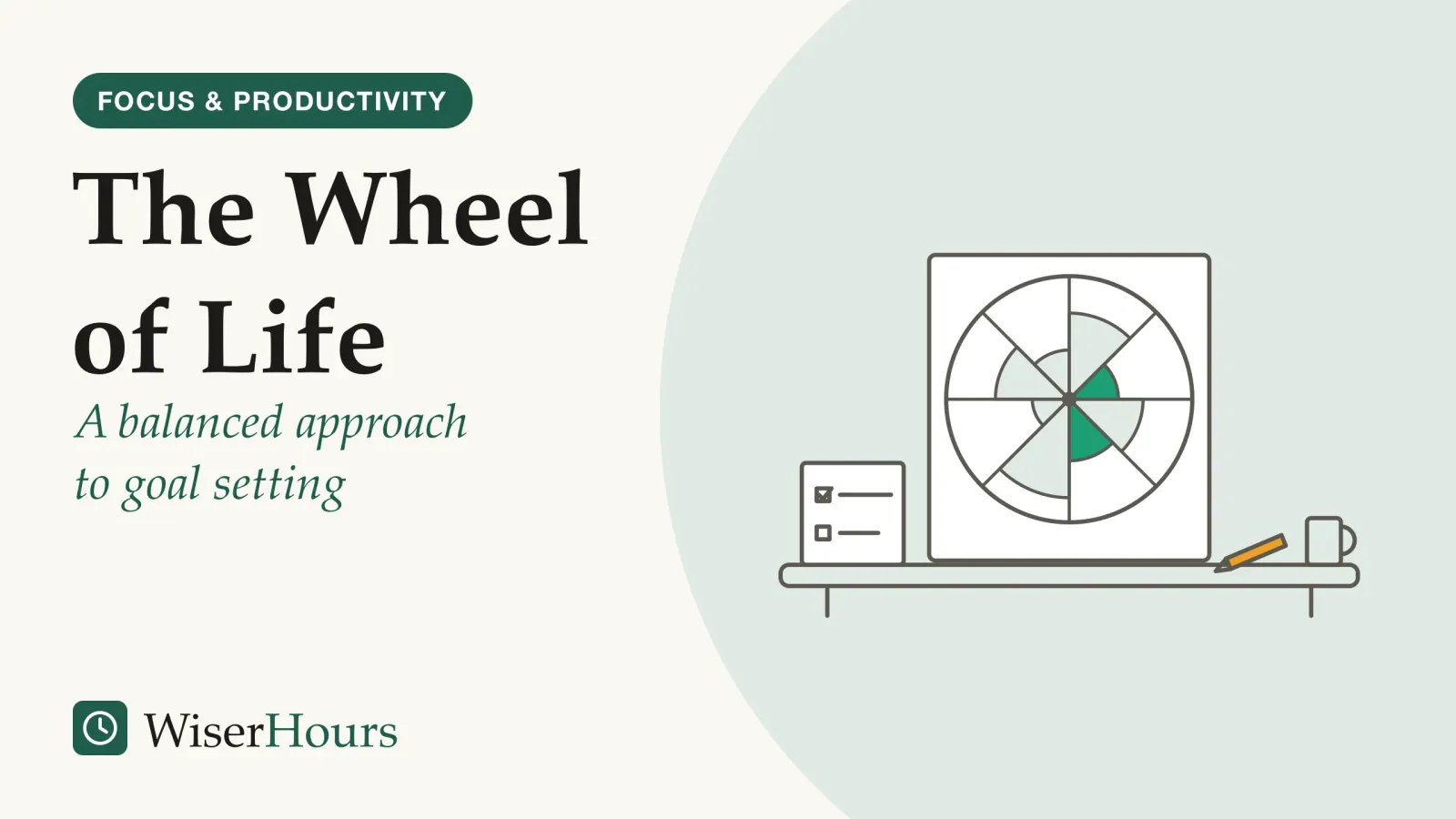
On a wheel of life, the lowest slice is the one everyone notices, and it is often the wrong place to start. The drawing takes five minutes; the decision after it matters more, and most templates skip it.
A wheel of life is a circle divided into about eight areas of your life, each scored for how satisfied you are with it, so you can compare them and decide where to aim your next goals. To use it for goal setting:
- Choose your eight areas
- Score each area from 1 to 10
- Pick one or two areas to raise
- Turn each area into a goal and a first step
- Score the wheel again every few months
The wheel tells you where to aim; the full goal-setting method, from first draft to follow-through deals with writing and keeping the goals themselves. Below: where the wheel came from, how to read it honestly, and what research on life areas supports.
Prefer to watch? The video covers the same ground as this article.
What is the wheel of life?
The wheel of life is a self-rating exercise from life and management coaching: you list the main areas of your life, rate your satisfaction with each, and use the uneven shape to decide where to put your effort. Coaches use it to set priorities with clients.1
Coaching guides usually give it eight to ten areas, such as money, career, health, fun, home, community, family and friends, partner and personal growth, each scored for satisfaction on a scale of one to ten.2
The bumps are the point. Asked about life as a whole, you may answer from whatever is on your mind that week; asked about eight areas in turn, you notice the ones you had stopped thinking about. Read your first wheel as a list of places to look, not as a grade.
Draw one in five minutes
On a blank page, draw a large circle and divide it into eight slices like a pie. Write one life area at the edge of each slice. Treat the centre as zero and the rim as ten, and shade each slice out to your score.
Who created the wheel of life? Attribution versus record
The wheel of life is usually credited to Paul J. Meyer, the US businessman who founded the Success Motivation Institute and Leadership Management, and who died in 2009.3 Coaching sites, PositivePsychology.com among them, date it to the 1960s without giving a source.2 The earliest dated record we found is a 1996 US trademark.
Meyer founded Leadership Motivation Inc., later Leadership Management International, in 1966.4 A 1960s start is plausible, but we found no 1960s document that shows it.
What is documented is a US trademark filed in 1996 by Success Motivation, Inc., one of Meyer’s companies, for a “Total Person Wheel of Life” on personal-development books and manuals, claiming first use that year. Its wheel had six areas, not eight: financial and career, mental and educational, physical and health, social and cultural, spiritual and ethical, and family and home.5 A second registration for the plain words “Wheel of Life” was filed in 2009 and is still active under Leadership Management International.6
The name is older still. “Wheel of life” more often refers to the Bhavacakra, a teaching image in Buddhism, which has nothing to do with scoring satisfaction.1
The wheel is attributed to Meyer, documented from 1996, and spread by coaches who redrew the slices. You need not keep his areas; change them freely.
Is the wheel of life evidence-based?
Not as a tool: no trial has tested whether drawing a wheel of life helps people set better goals or feel better. In a 2013 Danish systematic review of life coaching in health care, the wheel appeared only as one tool among several inside larger coaching programs, so its own effect cannot be separated out.7
The review kept only five studies; in one, coaches used the wheel with people with diabetes to explore values, set priorities and choose goals.7 That is not evidence that the wheel works: the review makes no claim about the wheel on its own, and its authors stress how few solid studies of life coaching exist.
A 2026 online survey of 35 coaches in the Middle East did not find statistically significant support for the idea that the wheel brings life balance and better client outcomes, and called for cultural changes to the tool.8
A tool without a trial can still help, much as a packing list does: it makes you look at everything before you decide. Use the wheel as a prompt. What large surveys have studied is the idea underneath it: that how people rate life as a whole is tied to how they rate its separate areas.
How satisfaction with life areas adds up
Satisfaction with separate life areas goes a long way toward explaining how people rate life as a whole, according to large surveys in several countries. The areas do not count equally, as a long-running UK household survey shows.
The study
Moderate evidence
Do eight life areas add up to a whole life? A UK household survey, 2005 to 2006
Antonio Malvaso and Weixi Kang analyzed ratings from 5,928 people aged 16 and over in a representative UK household survey. Satisfaction with eight areas of life explained about half of the variation in overall life satisfaction, and satisfaction with a spouse or partner carried the most weight, while satisfaction with the amount of leisure time carried the least.9
For your own wheel, this means the scores say something real about how life feels overall, but a point gained in one area is not worth the same as a point in another. Because each person answered once, in one survey wave, the data show links, not what would follow from raising a score.9
The pattern holds outside the UK. The Personal Wellbeing Index, a rating of seven life areas refined by an international group of researchers from dozens of countries, reports that its areas typically account for around half of the variation in satisfaction with life as a whole.10 The rest lies in things a wheel does not ask about.
Weights also differ between people. A 1999 study led by Shigehiro Oishi found that the area most closely tied to overall satisfaction differed between individuals, in line with what each valued.11 Your wheel needs your own weights.
How to use the wheel of life for goal setting, step by step
Using the wheel of life for goal setting takes a single sitting: choose your areas, score satisfaction, add a second score for importance, pick one or two areas, and turn each into a goal with a first step. The first two steps follow survey practice; the last three are reasoned advice that nobody has tested on the wheel itself.
- 1Choose areas
- 2Score satisfaction
- 3Weigh importance
- 4Set one or two goalseach with a first step
- 5Rescorein a few months
Then repeat from “Choose areas”
1. Choose your eight areas
Start from a common set and change anything that does not fit your life. Meyer’s registered wheel had six areas.5 The international wellbeing index uses seven, including safety and community.10 Eight is a convenient number.
A workable set is health, work, money, partner, family and friends, personal growth, fun and rest, and home. Swap in faith, caring for a relative, community or study if they shape your weeks, and keep each area broad enough to last for years.
2. Score each area from 1 to 10
Rate how satisfied you are with each area right now, from not at all to completely, on the same one-to-ten scale coaching templates use. The wellbeing index uses zero to ten with only the ends labelled, which its authors chose because it is simple to understand and lets people make fine distinctions.10 Either works if you use the same scale every time.
Score fast, then write one sentence beside each number saying why. “Work: 4, because I dread Mondays” will be more useful in three months than the 4.
3. Pick one or two areas to raise
Before choosing, add a second score for each area: how much it matters to you. Then look for areas that are both low in satisfaction and high in importance. Those are your candidates; choose one or two, not all of them.
- The lowest score: worth a look, but not automatically the area to work on first
- A low score in an area that matters: the better choice: rate importance as well as satisfaction, and pick one or two areas
- A goal and a first step: for each chosen area, with the first step on this week’s calendar
- Score it again: in about three months, before looking at the old wheel, then choose again
The second score guards against a known trap. In a 1998 US study, David Schkade and Daniel Kahneman found that students expected Californians to be more satisfied with life than Midwesterners, a gap traced to climate and cultural opportunities, though both groups rated their own lives the same; easily observed differences got more weight in the judgment than they would have in reality.12 A wheel puts your lowest slice in plain view in the same way. It deserves a look before you act on it.
4. Turn each area into a goal and a first step
For each chosen area, write one goal and one action you can take this week. “Health: 4” becomes “Walk to work three days a week for the next six weeks,” and the first step is “Find a route on Sunday and set out shoes by the door.” If you want a template for the wording, use SMART goal examples written letter by letter.
Add an if-then planimplementation intention: A plan in if-then form that ties a specific action to a specific situation, such as 'if it is nine o'clock, then I open the report.' It hands the decision about when and where to act to the situation itself.Full entry in the glossary for the likeliest obstacle (“If it rains, I take the bus one stop and walk the rest”), so you leave with something on next week’s calendar, rather than only a shaded circle.
5. Score the wheel again every few months
How often should you do a wheel of life assessment? No study has tested an interval. Every three months is a reasonable default: long enough for a goal to move a score, short enough to catch a shift in what matters. Coaching guides simply advise repeating it at regular intervals.2
Score the new wheel before looking at the old one, then compare: did the areas you worked on move, and did any you ignored slip? Then choose again.
Your wheel of life session
A worked example: Amira’s wheel
This example is illustrative, not a real case. Amira, a project manager with two children, scores her wheel and adds an importance score beside each area.
| Area | Satisfaction (1 to 10) | Importance (1 to 10) | Decision |
|---|---|---|---|
| Health | 4 | 9 | Choose: low and important |
| Work | 7 | 7 | Keep as it is |
| Money | 6 | 6 | Keep as it is |
| Partner | 6 | 9 | Choose: middling but very important |
| Family and friends | 5 | 6 | Watch next quarter |
| Personal growth | 3 | 4 | Leave for now, by choice |
| Fun and rest | 5 | 7 | Folded into the health goal |
| Home | 4 | 3 | Leave: low, but she does not mind |
Her lowest score is personal growth, but it matters little to her this year, so she leaves it. She chooses health, low and important, and her relationship, which scores higher but matters most. Her goals: two evening runs a week, the first booked for Tuesday, and one phone-free evening a week with her partner, starting Thursday.
Balance does not mean equal time
A balanced wheel of life does not require equal hours or equal scores in every area. In a 2010 set of studies with US and Indian samples, Kennon Sheldon, Robert Cummins and Shanmukh Kamble measured balance two ways, as evenly spread time and as a small gap between the time people actually spent and the time they wanted to spend, and both were linked to well-being.13
The second definition is the one a wheel can serve. A parent of a newborn will not spend equal time on fun and work, and should not try; the question is whether your weeks are close to the mix you would choose. In one of the four studies, people given a month-long goal of improving their balance who achieved it also gained in well-being, though the abstract we read reports no effect size.13
Felt balance also varies widely by country. In the Global Flourishing Study, which asked over 200,000 people in 22 countries how often the aspects of their lives were in balance, the share answering often or always ranged from 83 percent in Israel to 44 percent in Tanzania.14 Judge your wheel against the mix you would choose for this season of life, not against a perfect circle.
- Myth
- A balanced wheel of life means giving every area the same time and the same score.
- Fact
- Researchers also define balance as spending your time close to how you would want to spend it, and that version was linked to well-being too.
The wheel, piece by piece, against the evidence
The wheel itself is untested; the research beneath it is survey evidence about life areas and well-being, mostly showing links.
| What it is | What the best evidence found | Evidence |
|---|---|---|
| The wheel as a goal-setting tool | No trial found; in reviewed coaching programs it was one tool among several | Gap; systematic review of coaching, limited7 |
| Origin with Paul J. Meyer | Widely attributed; earliest dated record is a 1996 US trademark with six areas | Documented from 1996; 1960s date unsourced5 |
| Rating separate life areas | Areas were closely linked to overall satisfaction in a UK survey, with unequal weights | One large cross-sectional survey, moderate9 |
| Rating life areas in many countries | Seven areas typically account for around half of the variation in life satisfaction | International survey index, moderate10 |
| Weighing areas by what you value | The area most tied to overall satisfaction differed with people’s values | One study, abstract read, limited11 |
| Balance as close to your ideal mix | Both even time and a small actual-to-ideal gap were linked to well-being | Four studies, abstract read, limited13 |
The bottom line
A wheel of life is a quick way to look at every part of your life at once, and research on life areas suggests the scores reflect something real. Its weak spot is the step after the drawing. Score importance as well as satisfaction, choose one or two areas where a better score would matter most, give each a goal and a first step this week, and score again in about three months.
Frequently asked questions
Should I rate how important each area is, as well as how satisfied I am?
Yes, as a second, separate column. A 1999 study by Shigehiro Oishi and colleagues found that people differ in which life area is most closely tied to their overall satisfaction, in line with what they value. Rating importance stops you from spending a quarter on an area you scored low but do not care much about.
Can a team or a couple use a wheel of life together?
They can, as long as each person scores their own wheel first and then compares. The wheel measures one person's satisfaction, so an averaged team wheel hides who is struggling. For couples, comparing two wheels can start a useful conversation about time and shared plans; no study has tested the wheel for this, so treat it as a prompt, not a verdict.
Is a wheel of life better on paper or in an app?
Either works, because the exercise is the scoring and the choice that follows, not the drawing. Paper makes it easy to keep old wheels side by side and see change over time; an app or spreadsheet makes the comparison automatic. No research we found compares the two, so pick the format you will still have in three months.
Sources
- Wheel of life (disambiguation). Wikipedia (accessed 2026-10-06)
- The Wheel of Life: How to Apply It in Coaching. Sutton, J. (2020, updated 2026). PositivePsychology.com
- Paul J. Meyer, Baylor Alumnus Honoris Causa, Passes Away. Baylor University Media Communications (2009, October 26)
- Our Founder. Leadership Management International (accessed 2026-10-06)
- TOTAL PERSON WHEEL OF LIFE (US Serial No. 75109189, Registration No. 2052693). United States Patent and Trademark Office, TSDR record (accessed 2026-10-06)
- WHEEL OF LIFE (US Serial No. 77779648, Registration No. 3918518). United States Patent and Trademark Office, TSDR record (accessed 2026-10-06)
- Can life coaching improve health outcomes? A systematic review of intervention studies. Ammentorp, J., Uhrenfeldt, L., Angel, F., Ehrensvärd, M., Carlsen, E. B. & Kofoed, P. (2013). BMC Health Services Research, 13, 428
- Cultural challenges and effectiveness in adapting the Wheel of Life for coaching in the Middle East. Elrouby, H. Z. E. (2026). International Journal of Evidence Based Coaching and Mentoring, 24(1)
- The relationship between areas of life satisfaction, personality, and overall life satisfaction: An integrated account. Malvaso, A. & Kang, W. (2022). Frontiers in Psychology, 13, 894610
- Personal Wellbeing Index: Adult (PWI-A), 5th Edition, Manual. International Wellbeing Group (2013). Australian Centre on Quality of Life, Deakin University
- Value as a moderator in subjective well-being. Oishi, S., Diener, E., Suh, E. & Lucas, R. E. (1999). Journal of Personality, 67(1), 157-184
- Does living in California make people happy? A focusing illusion in judgments of life satisfaction. Schkade, D. A. & Kahneman, D. (1998). Psychological Science, 9(5), 340-346
- Life balance and well-being: Testing a novel conceptual and measurement approach. Sheldon, K. M., Cummins, R. & Kamble, S. (2010). Journal of Personality, 78(4), 1093-1134
- Demographic variation in balance in life across 22 countries: A cross-national analysis of the Global Flourishing Study. Lomas, T., Padgett, R. N., Ritchie-Dunham, J. L., Pawelski, J. O., Shiba, K., Johnson, B. R. et al. (2025). Applied Research in Quality of Life, 20(3), 1011-1036
How we researched this
In October 2026 we traced the wheel of life's origin through US trademark records, obituaries and coaching sources, and searched OpenAlex, PubMed and the web for any test of the tool. We then read surveys of life-domain satisfaction from 1998 to 2026. Main limitation: no trial tests the wheel, and several key papers were available to us only as abstracts.
Keep reading
The 12 Week Year Method: Does a Shorter "Year" Get Better Results?
The 12 week year swaps annual goals for 12-week cycles scored weekly. No trial tests it; one of its parts, tracking progress, has good evidence.
OKRs for Your Personal Life: A Practical Guide
Personal OKRs in 5 steps, each checked against goal research. A 2024 review mapped 47 OKR studies, mostly in companies; none we found tested personal use.
Shiny Object Syndrome: How to Stop Switching Goals
Shiny object syndrome: 4 forces that pull you to the next new goal, 4 fixes that keep the current one alive, and a test for a healthy pivot.

Goal-Setting Worksheets and Templates
A goal setting worksheet in 7 boxes, from the goal to a review date, with the research behind each box and three shorter variants for different needs.