The GROW Model Explained: A Simple Coaching Framework for Managers
The GROW model runs a coaching talk in 4 stages: Goal, Reality, Options, Will. Questions for each stage, a worked one-on-one and the evidence behind it.

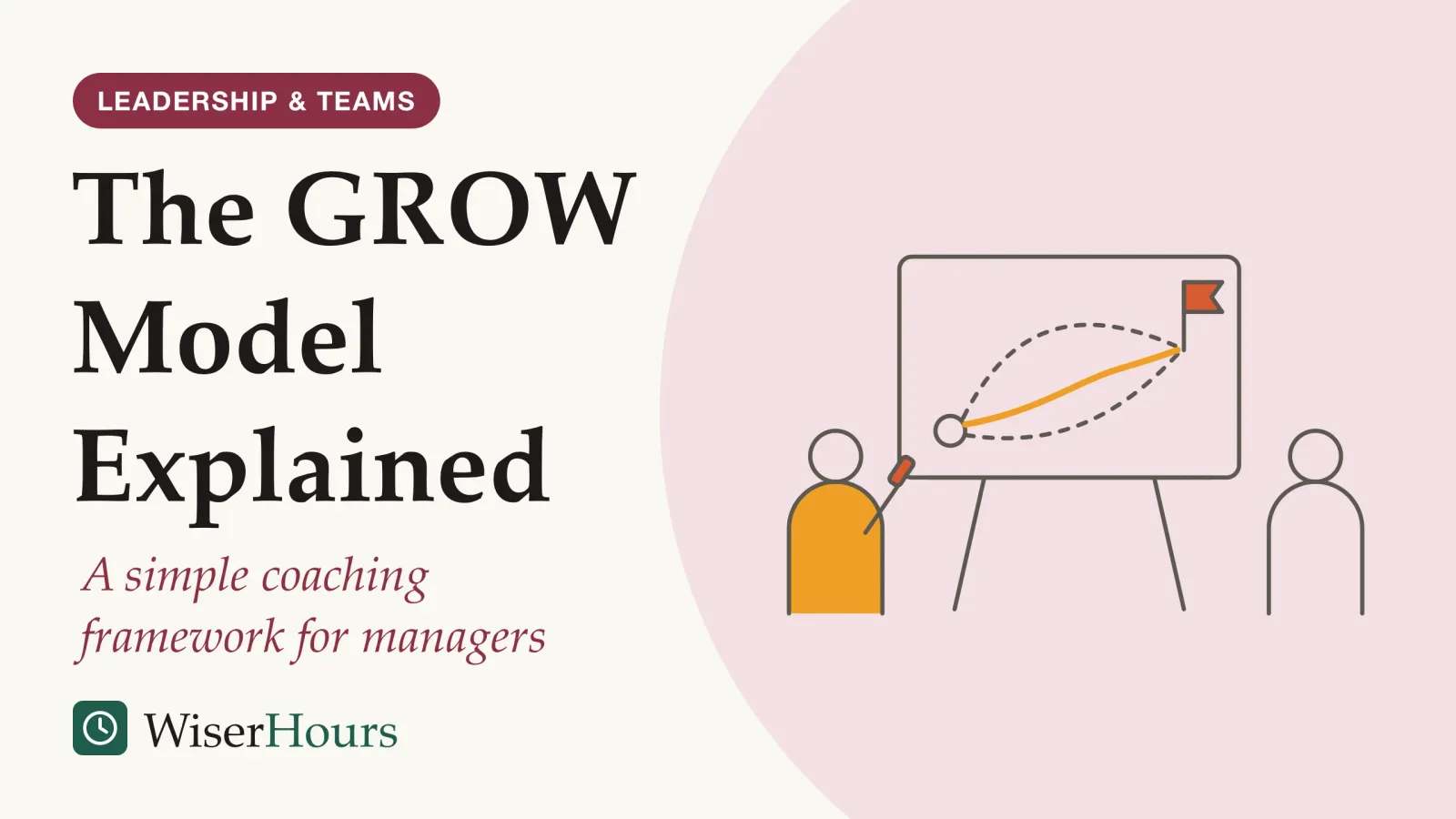
John Whitmore, whose 1992 book made the GROW model famous, wrote in 2009 that he had not invented it and that, on its own, it says nothing about coaching. In his account, the letters only give a conversation its order; the coaching lies in raising the other person’s awareness and sense of responsibility.1
The GROW model is a four-stage structure for a coaching conversation: agree the Goal, look honestly at the current Reality, generate Options, then settle the Will, or way forward. Managers use it to help someone think a problem through instead of handing over the answer. Workplace coaching has support from meta-analysesmeta-analysis: A study that combines the results of earlier studies on the same question into one overall estimate. Pooling makes the estimate more precise, but it cannot repair the studies it pools: a meta-analysis of surveys is still survey evidence.Full entry in the glossary, including a 2016 review of 17 studies led by Rebecca Jones with Stephen Woods and Yves Guillaume, but those studies used coaches rather than the person’s own manager, and GROW itself has had little direct testing.2 It sits alongside the other tools in the leadership and management library, and in a one-on-one it comes down to four moves:
- Agree the goal for this conversation.
- Get the facts of where things stand.
- Generate options before choosing one.
- Settle the next step, a date and the commitment.
The GROW model’s four stages, and why the goal comes first
The GROW model runs Goal, Reality, Options and Will, in that order, and John Whitmore argued in 2009 that the only part a newcomer would not guess is that the goal comes before the reality. Start with the present situation, he wrote, and people drift toward small remedial fixes; start with the goal, and the talk turns to how to get there from here.1
The goal is defined clearly enough that the person would know when they had reached it. The reality is where they are now: the facts, the starting point and how far off the goal they are. Some versions split the O into obstacles and options, because without something in the way the person would already be at the goal.3 The will turns a chosen option into specific actions, a timeframe and a way of checking progress.4
- Goal: the flag: what they want, defined clearly enough to recognize when they get there. It comes first
- Reality: the pin: where things stand now, the facts and what is in the way
- Options: the routes: several ways across, listed before any is judged
- Will, or way forward: the marked route: one action, a date and a commitment
The order changes a conversation. A team lead says, “I’m drowning in email.” Start with reality and you get a tour of the inbox, then a filing rule. Start with the goal, say two clear mornings a week for the hiring plan, and the options widen: hand off a recurring thread, move a meeting, or ask whether the plan needs a co-owner.
- 1Goalwhat they want, clear enough to recognize
- 2Realitythe facts, what has been tried, what is in the way
- 3Optionsseveral routes before judging any
- 4Willone action, a date, a check
The order is a default, not a rule. The Performance Consultants guide notes that real conversations move back and forth between stages as new things come up.4 Ask the goal question first even when the problem seems obvious, and go back to it whenever the reality turns out to be a different problem.
Who created the GROW model?
The GROW model was developed in Britain, spread through corporate coaching from the late 1980s and grew out of Timothy Gallwey’s Inner Game method, and who deserves the credit is still disputed. Gallwey was a tennis coach who saw that telling players what they were doing wrong rarely produced lasting change.3
In one example, instead of “keep your eye on the ball”, he asked players to say “bounce” when the ball bounced and “hit” when they struck it, and their play improved without the instruction. He moved from giving instructions to asking questions that helped players find out for themselves what worked.3
Whitmore trained with Gallwey, set up the Inner Game in Britain in 1979, and in the early 1980s founded Performance Consultants with partners, carrying the approach from sport into business.5 Fine worked with Alexander and Whitmore in the late 1970s using the same method,6 and his 2010 book claimed that he had co-developed GROW.3 Whitmore’s own account is that Max Landsberg of McKinsey coined the name in a conversation with Graham Alexander, and that Whitmore was the first to publish it, in Coaching for Performance in 1992.1
For a manager, the history comes down to one instruction. The questions exist so that the other person finds the answer. If you already know where you want them to land, say so directly rather than steering them there one question at a time.
Will, way forward or wrap-up: the versions of the W
Published versions of the GROW model mostly agree on the first three letters and differ on the last. Whitmore’s W is will, Fine’s is way forward, and others use wrap-up, according to Wikipedia’s survey of the published versions, which also lists books that read the O as obstacles and options.3
| Version | What changes |
|---|---|
| John Whitmore, Coaching for Performance | W covers the action, its timing, who does it, and the will to follow through3 |
| Alan Fine, You Already Know How to Be Great | W is the way forward3 |
| Max Landsberg, The Tao of Coaching | W is the wrap-up3 |
| Some later books | O covers obstacles as well as options3 |
| Anthony Grant, RE-GROW (2011) | A variant that explicitly links session structure to self-regulation theory7 |
The letters matter less than what the last stage produces. Whichever word you use, the conversation should end with an action, a date and an honest answer about commitment. Performance Consultants suggests asking the person to rate their commitment from 1 to 10.4 A low number is useful news, not a failure: it tells you the option is wrong, or something in the reality has not been said yet.
What questions do you ask in the GROW model?
Good GROW questions are open, short and about the other person’s thinking rather than yours. The wordings below are WiserHours examples; Performance Consultants publishes a similar list for each stage.4 Pick one or two per stage, not all of them, and let the answers decide the next question.
1. Agree the goal for this conversation
Ask what they want from the issue and from the next 20 minutes. “What would a good result look like?” “How will you know you have got there?” “What would make this conversation worth the time?” If the goal is vague, stay here until it is not.
2. Get the facts of where things stand
Ask for specifics, not opinions. “What is happening now, in numbers or examples?” “What have you tried, and what happened?” “What is in the way?” Hold back your own reading: the point is that they see the situation clearly.
3. Generate options before choosing one
Ask for a list before judging any item on it. “What could you do?” “What else?” “What would you try if time were not the constraint?” “Who could help?” If they stall, ask whether you may add an idea, put it on the list as one option among several, and let them weigh it.
4. Settle the next step, a date and the commitment
Ask them to pick, then to make the pick concrete. “Which option will you start with?” “What exactly will you do, and when?” “What might get in the way, and what will you do then?” “From 1 to 10, how committed are you?”
Pinning down when and where has research of its own behind it. A 2006 meta-analysis by Peter Gollwitzer and Paschal Sheeran pooled 94 tests of plans that spell out when, where and how to act, called implementation intentionsimplementation intention: A plan in if-then form that ties a specific action to a specific situation, such as 'if it is nine o'clock, then I open the report.' It hands the decision about when and where to act to the situation itself.Full entry in the glossary, and found a medium-to-large positive effect on goal attainment.8 Those studies did not involve coaching, so treat it as a reason to pin down the date rather than proof that GROW works.
Ready to close the conversation?
How do you use the GROW model in a one-on-one?
Use the GROW model on a single issue the employee raises during a one-on-one with their manager, not as a script for the whole meeting. Here is an invented example, shortened, between Daniel, a manager, and Amara, a product designer whose finished designs keep coming back from engineering for rework.
Goal. Daniel: “What would you like to get out of this?” Amara: “Designs that engineering can build from the first handoff, without a second round.” Daniel: “How would you know it is fixed?” Amara: “Three handoffs in a row with no rework requests.”
Reality. Daniel: “Walk me through the last one.” Amara: “The engineers saw it for the first time at handoff, and they found two cases I hadn’t designed for, like an empty account.” Daniel: “What have you tried?” Amara: “Longer specs. Nobody reads them.”
Options. Daniel: “What could you do differently?” Amara: “Show rough sketches to an engineer earlier. Keep a list of edge cases to check. Pair with one engineer for a sprint.” Daniel: “Anything else?” Amara: “Ask Kofi, who has reviewed the most handoffs.” Daniel: “May I add one? Ask the engineering lead for a 15-minute check halfway through each design.”
Will. Amara: “I’ll invite Kofi to Thursday’s sketch review and draft the edge-case list before then.” Daniel: “How committed, 1 to 10?” Amara: “Seven. I’m not sure Kofi has the time.” That answer opens a short return to reality, about who else could stand in for Kofi, before they close.
Notice what Daniel did not do. He offered one idea, after hers, and asked permission first. The action, the date and the doubt all came from Amara, so the fix is hers to own.
Does the GROW model work?
No study we found tests the GROW model on its own against another way of structuring a conversation, so the evidence is for coaching in general, and it is encouraging but indirect. A 2014 meta-analysis by Tim Theeboom, Bianca Beersma and Annelies van Vianen reported positive effects of workplace coaching on performance and skills, well-being, coping, work attitudes and goal-directed self-regulation.9 Jones and colleagues later noted that its effects were larger in before-and-after studies than in designs with a comparison group.2 A 2023 meta-analysis of 37 randomized trials by Erik de Haan and Viktor Nilsson also found a moderate positive effect, with signs of publication bias and larger effects on self-reported than observed outcomes.10
The study
Limited evidence
Seventeen workplace studies, and no line managers among the coaches
Pooling 17 studies of employees coached by internal or external coaches, the meta-analysis found positive effects on learning and performance outcomes overall, and the largest on individual results at work. Coaching by internal coaches showed stronger effects than coaching by external ones, though only three studies used internal coaches. The authors excluded coaching by a person’s line manager and called the number of studies small.2
That last exclusion is the main caveat for managers: the authors set coaching by line managers apart, noting the power a line manager holds over the person being coached, which an independent coach lacks.2 The studies also tested whole programs, and the authors list GROW as part of the approach in three of the 17, including a small Australian randomized trial led by Anthony Grant.2 There, 41 executives at a public health agency who received a short coaching program reported better goal attainment, resilience and workplace well-being than controls.11
| What it is | What the best evidence found | Evidence |
|---|---|---|
| Coaching at work, any model | Positive effects on performance, well-being, coping, attitudes and self-regulation; larger in before-and-after designs | Meta-analysis; abstract read, design detail from Jones and colleagues92 |
| Workplace coaching from internal or external coaches | Positive effects overall, strongest on individual results; line managers excluded | Meta-analysis of 17 studies (limited)2 |
| A coaching program using GROW in its sessions | Better goal attainment and well-being than controls, in 41 executives | Small randomized trial, abstract read211 |
| Naming when, where and how to act | A medium-to-large positive effect on goal attainment, in studies outside coaching | Meta-analysis, abstract read8 |
Read the evidence as support for skilled coaching, with GROW as a sensible frame for it. A manager who uses it is doing something close to what was studied, but not the same thing, so judge your own conversations by what you can see: whether the person took the step they chose, by the date they chose.
What are the limitations of the GROW model?
The GROW model’s main limitations are that it assumes a clear goal, that it supplies structure without skill, and that a manager is not a neutral coach. Jonathan Passmore and Stefan Cantore argued in 2012 that GROW suits goal-directed work in sport and business better than open questions such as career direction or fit with a role; Whitmore and colleagues replied in 2013 that the model had grown to take in broader, transpersonal goals.3
The skill point is Whitmore’s own.
GROW is no more than a useful chronological sequence for a coaching conversation that could equally be used in a command and control situation
The four questions can be asked in a tone that makes the answer obvious, and the report will hear an instruction dressed as a question. The power point follows from the evidence above: someone who knows you write their review may name the goal they think you want.
- Myth
- Working through the four stages in order is coaching.
- Fact
- Whitmore described GROW as a sequence only. Coaching, in his account, means raising the other person's awareness and responsibility; the stages just give that an order.
Two habits reduce both problems. Ask the goal question out of real curiosity about what they will say. And notice when coaching is the wrong tool: someone new to a task may need clear direction first, which is the central idea of situational leadership.
When the goal is not theirs to choose
A deadline or a performance standard is set by the job, not by the conversation. Say so plainly, then coach on how they will meet it: the reality, options and will stages still belong to them.
The bottom line
The GROW model is a reliable order for a conversation, not a method with its own evidence. Set the goal before the facts, collect options before choosing, and do not close until there is an action, a date and an honest commitment score. Then judge each conversation by two things: who did most of the talking, and who owns the next step.
Frequently asked questions
How long does a GROW conversation take?
There is no set length. Performance Consultants, the firm John Whitmore founded, says even five minutes of structured questioning can produce useful insight. A small, specific problem can fit inside a regular one-on-one, while a bigger question, such as a career decision, may need several conversations, each ending with its own next step.
Can you use the GROW model on yourself?
Yes. Performance Consultants lists self-coaching among its uses, and the four questions work on paper: what do I want, what is actually happening, what could I do, and what will I do by when. On paper it is easier to catch yourself jumping into solutions too quickly, which the firm lists as a common mistake.
Can a team use the GROW model?
It can. Wikipedia's account of the model notes that a group working on the same problem or goal can use it, and coaching researchers Saul Brown and Anthony Grant adapted it for group coaching in 2010. With a team, agree the goal out loud first, collect options from everyone before discussing any, and give each action a named owner.
Do you need permission to use the GROW model?
The sources differ. In 2009 John Whitmore wrote that GROW was not copyrighted, definitive or exclusive. Performance Consultants, the firm he founded, now marks it GROW with a trademark sign and says using its original GROW model and materials needs a licence, for example in a coaching program, book or course. If you plan to reuse its materials, ask the firm first.
Sources
- The Impact of the Inner Game and Sir John Whitmore on Coaching: A Commentary. Whitmore, J. (2009). International Journal of Sports Science & Coaching, 4(Suppl. 2), Annual Review of High Performance Coaching & Consulting, 23-28
- The effectiveness of workplace coaching: A meta-analysis of learning and performance outcomes from coaching. Jones, R. J., Woods, S. A. & Guillaume, Y. R. F. (2016). Journal of Occupational and Organizational Psychology, 89(2), 249-277
- GROW model. Wikipedia (accessed 11 October 2026)
- The GROW Model: A Complete Guide to Goals, Reality, Options and Will. Performance Consultants International, the coaching firm founded by John Whitmore (accessed 11 October 2026)
- John Whitmore (racing driver). Wikipedia, section on his later career in business and coaching (accessed 11 October 2026)
- Alan Fine (writer). Wikipedia (accessed 11 October 2026)
- Is it time to REGROW the GROW model? Issues related to teaching coaching session structures. Grant, A. M. (2011). The Coaching Psychologist, 7(2), 118-126
- Implementation intentions and goal achievement: A meta-analysis of effects and processes. Gollwitzer, P. M. & Sheeran, P. (2006). Advances in Experimental Social Psychology, 38, 69-119
- Does coaching work? A meta-analysis on the effects of coaching on individual level outcomes in an organizational context. Theeboom, T., Beersma, B. & van Vianen, A. E. M. (2014). The Journal of Positive Psychology, 9(1), 1-18
- What can we know about the effectiveness of coaching? A meta-analysis based only on randomized controlled trials. de Haan, E. & Nilsson, V. O. (2023). Academy of Management Learning & Education, 22(4), 641-661
- Executive coaching enhances goal attainment, resilience and workplace well-being: a randomised controlled study. Grant, A. M., Curtayne, L. & Burton, G. (2009). The Journal of Positive Psychology, 4(5), 396-407
How we researched this
We read John Whitmore's own 2009 account of the model, Wikipedia's survey of published versions and history, the Performance Consultants guide, and two widely cited meta-analyses of workplace coaching (2014 and 2016) with a 2023 one limited to randomized trials, plus one small randomized trial and a meta-analysis on action planning, searched in October 2026. Its main weakness: none of the studies we found compares GROW alone with another structure, so the evidence covers coaching in general, and five of them, the 2014 and 2023 meta-analyses included, were open to us only as abstracts.
Keep reading
How to Run One-on-One Meetings That Employees Actually Value
One-on-one meetings make up nearly half of all workplace meetings, yet a 2023 review found no empirical research on them as a topic.
How to Manage Managers: What Changes When You Lead Leaders
How to manage managers: 5 changes for skip-level leaders, from delegating problems to judging yourself by your managers' teams. Practitioner evidence.
The Change Curve Explained: How People React to Workplace Change
The change curve turns Kübler-Ross's 1969 stages of dying into 4 or 5 workplace stages. What research found, and what managers can do at each point.
Theory X and Theory Y: What McGregor's Idea Still Teaches Managers
Theory X and Theory Y are a manager's assumptions about people, not two styles. What McGregor argued in 1960, the thin evidence and how to spot X habits.