How to Manage Managers: What Changes When You Lead Leaders
How to manage managers: 5 changes for skip-level leaders, from delegating problems to judging yourself by your managers' teams. Practitioner evidence.

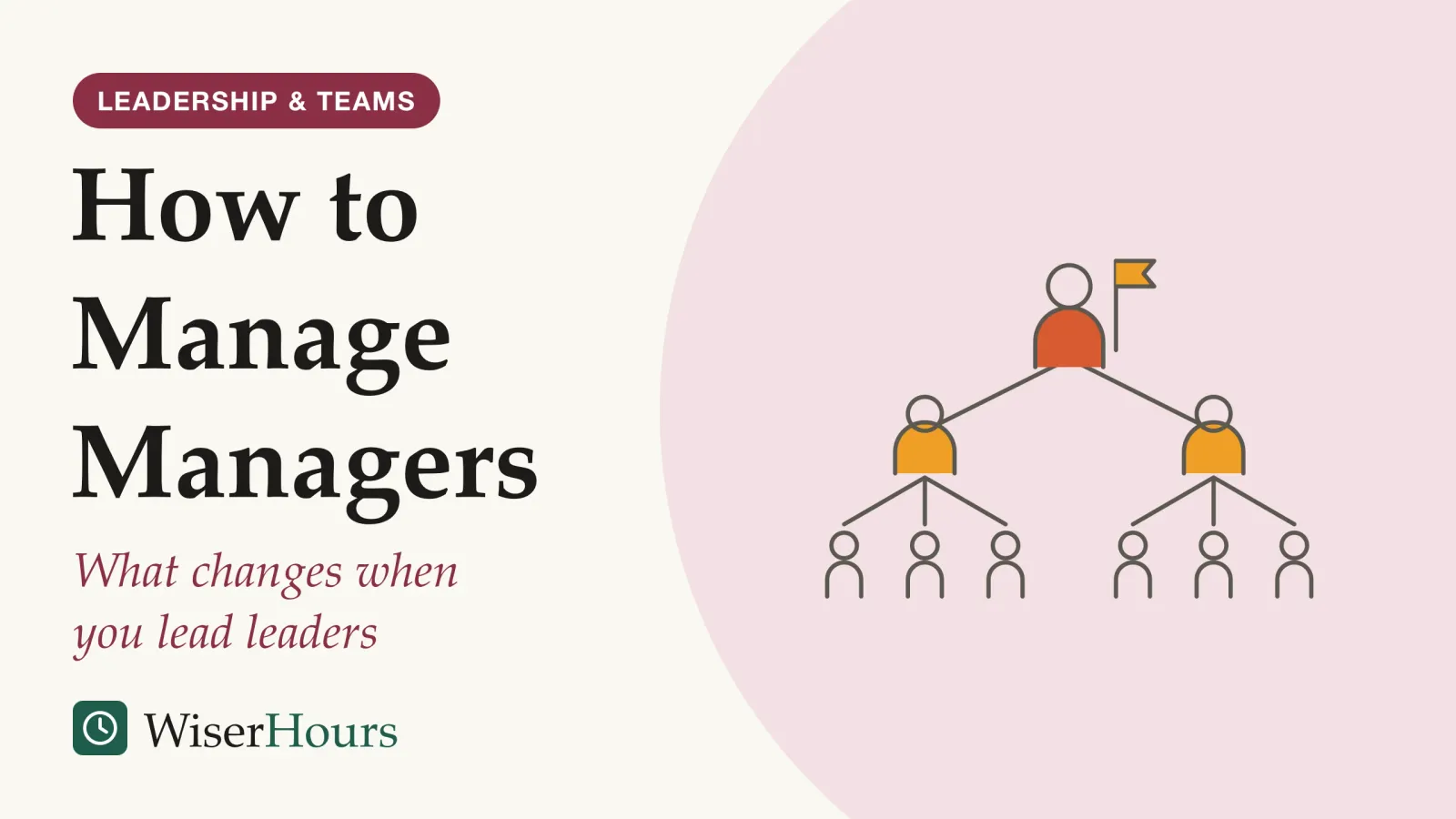
Learning how to manage managers means giving up the habits that got you promoted. In The Leadership Pipeline, Ram Charan, Stephen Drotter and James Noel describe every step up an organization as a change in how a leader spends time, which skills they need and what they value at work.1 At this step, what you are measured on moves one level away from you, into how your managers lead their teams.
The shift is easier to make on purpose than by accident. Five changes carry most of it:
- Set the destination and let your managers plan the route.
- Delegate problems, matched to each manager’s experience.
- Coach managers on how they manage.
- Meet their teams without going around them.
- Guard time for the managing work.
The first-line basics live elsewhere in our leadership guides; everything below is for a leader whose direct reports now run teams of their own.
How managing managers differs from managing individual contributors
Managing managers differs from managing individual contributors because your output becomes someone else’s management. In the Leadership Pipeline’s account of this passage, as a consultancy’s summary of the book puts it, accountability shifts from individual work to “the quality of management that their managers provide to their staff”, and individual contributor work shrinks even further than it did at the first promotion.2
The reason is reach. A first-line manager can still fix a broken report on a Friday night and save the deadline. Two levels up, the same rescue pulls you into a team that has its own manager, teaches that manager to wait for you, and leaves every other team without you for the evening. Executive coach Muriel Wilkins described this pattern in a 2021 Harvard Business Review coaching session with a leader managing managers for the first time: he had been rewarded all his career for parachuting into problems, and the new role needed him to stop.3
Your job is to mind the forest, they’re chopping the wood.
The middle layer has a name on most org charts. Wikipedia’s entry describes middle management as the intermediate level of a hierarchy, with line managers reporting to middle managers.4 What the title hides is that the skills change with the level, and at least one study has tested that directly.
The study
Limited evidence
Plus at one level, minus at another: ratings of 2,175 US managers
Robert Kaiser and S. Bartholomew Craig compared ratings of seven kinds of managerial behavior, given by each manager’s own staff, with their bosses’ ratings of overall effectiveness, in a sample of 2,175 supervisors, middle managers and executives from 15 industries in the United States. The behaviors linked to effectiveness differed by level, and some reversed: a behavior that predicted effectiveness at one level could predict the opposite at another.5
It is one study, read here only in its abstract, which names no specific behavior that flipped. Its value is as a warning that the habits that made you a strong team manager may not carry over one level up, and some may work against you. In your first months, list the habits that won you the promotion and ask which of them your managers should now be doing instead.
Managing a team Managing managers
- Where your time goes
- Your team, plus some of the work yourself
- Your managers, the links between teams and the wider business
- What you need to be good at
- Assigning, checking and coaching the work
- Developing, coaching and measuring managers
- What you value
- Work done well by your team
- Teams led well by your managers
- What you are judged by
- Your team’s results
- Your managers’ teams’ results
Judge yourself by your managers’ teams
A manager of managers is measured on two things at once: the work your managers produce, and how well they support their teams. Amy Gallo, writing for Harvard Business Review in 2016, framed the job that way, noting that a leader may know how to do the first and be less sure how to do the second.6
Company research suggests why the second matters. Google’s Project Oxygen analyzed over 10,000 data points from performance reviews and feedback surveys, plus notes from interviews with staff, and the company says the teams of its highly effective managers tended to get better results, be happier and lose fewer people. Google adds that its own managers report more positive work experiences when their managers perform well.7 Gallup’s 2025 State of the Global Workplace report, based on its World Poll, attributes 70 percent of team engagementemployee engagement: A term with two main meanings: in research, a positive state of energy, dedication and absorption in one's work; in workplace surveys such as Gallup's, the conditions thought to produce it. Figures from the two kinds of measure are not interchangeable.Full entry in the glossary to the manager and reports that manager engagement worldwide fell from 30 to 27 percent in 2024.8 Both are companies studying the question with their own data and methods, not peer-reviewed work, and Gallup also sells manager training.
Taken together, the figures put the weight of your role in the middle layer. If a team’s managers are strained or poorly supported, a manager of managers is the one person placed to change that.
Rebuild your own scorecard to match. Wilkins asked her client what would appear on a personal dashboard for the new role, and his answers were about time with his managers, the topics they brought him, the risks his team caught early and how other teams saw his group.3
Draft your scorecard
For the next quarter, write three lines per manager: how their team is doing, whether the manager is growing, and which problems reached you that should have been solved a level down.
How to manage managers in five steps
The five habits come from practitioner writing and coaching cases, with the best-supported first. No controlled study has examined them, so adapt them to your organization as informed practice.
1. Set the destination and let your managers plan the route
Your first job is the clarity only your level can provide: what the group is for and what success looks like. In the HBR session, Wilkins told her client that only a manager of managers can set that bigger-picture direction, and that his managers would struggle to be clear with their teams until he was clear with them.3
A project plan does not count as a destination. “Ship the new billing system by March” is a route. “Cut the time customers wait for a correct invoice” is a destination, and it lets each manager decide what their team should do about it. Write the destination in two sentences, share it with your managers, and ask each one to tell you how their team’s plan fits under it.
2. Delegate problems, matched to each manager’s experience
Hand your managers problems, and let them choose the steps. Andy Grove, Intel’s former chief executive, argued in High Output Management that how closely to manage depends on a person’s task-relevant maturity: hands-on training when someone is new to a task, delegation when they are experienced in it, as Ben Horowitz summarized in his 2015 foreword.9 The ordinary pulls that make letting go hard are covered in why managers struggle to delegate.
At this level the “task” is often managing itself. A manager who has run a team for five years can take “turnover on your team is rising; find out why and bring me a plan” and run with it. A manager in their first year may need the same problem broken into a first step and a date to talk it through. Same problem, different amount of support, and the support shrinks as they show they can carry it. Support that never shrinks turns into the pattern described in micromanagement from the manager’s side.
- Myth
- When a team is struggling, the fastest fix is to step in and run it yourself.
- Fact
- Stepping in solves this week and teaches the team's manager to wait for you. Wilkins called doing the work for someone a form of control, the opposite of developing them.
3. Coach managers on how they manage
Your one-on-ones with managers should spend more time on their team than on their tasks. The Leadership Pipeline passage, as Wilkins summarized it at the end of her 2021 session, asks managers of managers to let go of individual tasks and to focus on measuring their reports’ progress as managers and coaching them in that area.3 How to run the meeting itself is covered in our guide to one-on-one meetings.
In practice this means asking different questions. “Is the launch on track?” checks the work. “Who on your team is struggling, and what have you tried?” checks the managing. Coaching in Wilkins’s sense means helping the manager name the goal, see their options and pick an action, and it is one style among several: when something is on fire, a direct instruction is the right call.3
4. Meet their teams without going around them
A skip-level meeting is a one-on-one between a team member and their manager’s manager. Steven Rogelberg, an organizational psychologist at UNC Charlotte, describes in Glad We Met, his book on one-on-ones, how such meetings can serve feedback, trust and the sharing of information, show people they are worth a senior leader’s time, and give you insight into your direct reports as managers, provided they are run in ways that do not undermine those managers.10
No study has tested specific rules for that, so the ones below follow from the aim Rogelberg names: get the insight without taking the manager’s place.
A useful test is what happens next. If a team member raises a scheduling problem in a skip-level and the fix arrives from you, the team learns to come to you. If it arrives from their manager a week later, the team learns their manager listens, which is the point of the meeting.
5. Guard time for the managing work
Your calendar is where the new role either happens or does not. The Leadership Pipeline’s authors argue that time must be spent differently at each level and that the work values needed for success must change with it.1 Grove’s version, in Horowitz’s summary, is that a manager’s skills are only worth something when they raise what their people produce.9
No study gives the right split for a manager of managers, so start from what has to happen every week: a one-on-one with each manager, one meeting with all of them together, a few skip-levels on a rotation, and time on the links between your group and the rest of the business. Block those first. Hands-on work goes into the hours left over, and anything that does not fit is a candidate to hand to one of your managers.
Your first month as a manager of managers
| Habit | What the sources report | Evidence |
|---|---|---|
| Treat the step as a new job | Behaviors linked to effectiveness differed by level, and some reversed, in one US sample of supervisors, middle managers and executives | One survey study, abstract read (observational)5 |
| Judge yourself by your managers’ teams | Google reports teams with highly effective managers had better results, more happiness and lower turnover | Company research, not peer-reviewed7 |
| Delegate problems, matched to experience | Grove’s task-relevant maturity: hands-on for new tasks, delegation for experienced people | Practitioner book (expert opinion)9 |
| Coach managers on managing | The Leadership Pipeline asks this level to measure and coach reports as managers | Practitioner book and coaching case (expert opinion)3 |
| Run skip-levels without undercutting | Skip-levels can build trust and insight into your managers if run so they do not undermine them | Practitioner book chapter, abstract read (expert opinion)10 |
How do you deal with an underperforming manager?
An underperforming manager needs the same fair process as any struggling employee, with one difference: what you diagnose is the managing, and the best evidence often sits with their team. The general steps (a clear expectation, a diagnosis, a shared plan and a review date) apply as they do when managing an underperforming employee; with a manager, the harder part is knowing what to look for.
Start by separating three problems that look alike from above. Some managers are still doing the work: the client Wilkins coached described a new manager on his own team who struggled to let go because they were so good at the technical work.3 Some are managing poorly, which shows up as people leaving, problems that never get raised, or a team that waits for instructions. Some have a team that is short of people or saddled with an unclear goal, which is your problem to fix, since the destination is your job.
Skip-levels and the team’s own results are where the evidence comes from, and Rogelberg’s point about insight into your managers applies most here.10 Look for patterns across several conversations before you act, because one unhappy team member is a data point and five saying the same thing is a finding.
Then make the expectation about management. “Your team missed the date” is about the work. “Two people on your team told me they didn’t know the date had moved, and I’d like your plan for keeping everyone current” is about the managing, and it gives the manager something to change. Resist taking over the team while they work on it, since that repeats the problem you are trying to fix, and agree when you will review progress together.
The bottom line
As a manager of managers, your results arrive through how your managers lead, so most of your week should go on building them. This week, write the destination for your group in two sentences, give one manager a problem to own, and spend your next round of one-on-ones on how each manager’s team is doing.
Frequently asked questions
What is a manager of managers called?
Titles vary by organization, and Wikipedia's entry on middle management lists division, plant and department managers among them. The Leadership Pipeline by Ram Charan, Stephen Drotter and James Noel calls the level manager of managers, and org charts usually place it in middle management, between first-line managers and executives.
Should a manager of managers still do hands-on work?
A little, at most, and never the work your managers need to learn to hand on. The Leadership Pipeline treats letting go of individual tasks as the main shift at this level. Keep only work that no one below you can do yet, and plan who will take it over.
How many managers should a new manager of managers start with?
No study gives a number for this level. What matters more is the mix: a brand-new first-line manager needs far more of your coaching time than an experienced one, so a small group with two new managers can be harder than a larger group of seasoned ones. Plan your week around who needs you most.
Sources
- The Leadership Pipeline: How to Build the Leadership Powered Company, 2nd edition (publisher's description). Charan, R., Drotter, S. & Noel, J. (2011). Jossey-Bass; the 2nd edition's description, on a LeadershipNow listing now headed for the 2024 3rd edition
- Leadership Pipeline (book summary). Transformation Management LLC (n.d., accessed 24 October 2026); a consultancy's summary of Charan, Drotter and Noel's book
- How Do I Manage Other Managers? (Coaching Real Leaders, Season 2, Episode 4). Wilkins, M. (27 October 2021). Harvard Business Review, HBR Presents; transcript
- Middle management. Wikipedia (accessed 24 October 2026)
- Do the behaviors related to managerial effectiveness really change with organizational level? An empirical test. Kaiser, R. B. & Craig, S. B. (2011). The Psychologist-Manager Journal, 14(2)
- How to Manage Managers. Gallo, A. (29 August 2016). Harvard Business Review
- Following the data: the research behind great managers. Calderon, S. & Newhouse, D., Google (August 2025). re:Work
- State of the Global Workplace: 2025 Report. Gallup (2025). Gallup World Poll, 2024 data
- Andy (foreword to High Output Management). Horowitz, B. (13 November 2015). Andreessen Horowitz; foreword to Andrew S. Grove's High Output Management (Vintage, 2015 edition)
- Wait, There Are Skip-Level 1:1s? Rogelberg, S. G. (2023). In Glad We Met: The Art and Science of 1:1 Meetings, chapter 14. Oxford University Press
How we researched this
We read the publisher's description of The Leadership Pipeline and a summary of its manager-of-managers passage, Google re:Work's Project Oxygen guide, Ben Horowitz's foreword to High Output Management, an HBR coaching episode, Gallup's 2025 global workplace report and one empirical paper on how manager behaviors change by level, dated 2011 to 2025, in October 2026. Main limitation: most of the evidence is practitioner and case-based, and two sources could be read only as abstracts or introductions.
Keep reading
Matrix Management: How to Lead When People Report to Two Bosses
Matrix management gives people two bosses. A 2015 US Gallup survey linked it to weaker role clarity; 5 practices help the two managers agree who decides what.

The Change Curve Explained: How People React to Workplace Change
The change curve turns Kübler-Ross's 1969 stages of dying into 4 or 5 workplace stages. What research found, and what managers can do at each point.

Theory X and Theory Y: What McGregor's Idea Still Teaches Managers
Theory X and Theory Y are a manager's assumptions about people, not two styles. What McGregor argued in 1960, the thin evidence and how to spot X habits.
The GROW Model Explained: A Simple Coaching Framework for Managers
The GROW model runs a coaching talk in 4 stages: Goal, Reality, Options, Will. Questions for each stage, a worked one-on-one and the evidence behind it.