Comprehensible Input Explained: Can You Learn a Language by Listening?
Comprehensible input, Krashen's 1982 idea, builds vocabulary and listening skill, but speaking with feedback adds what input alone rarely gives.

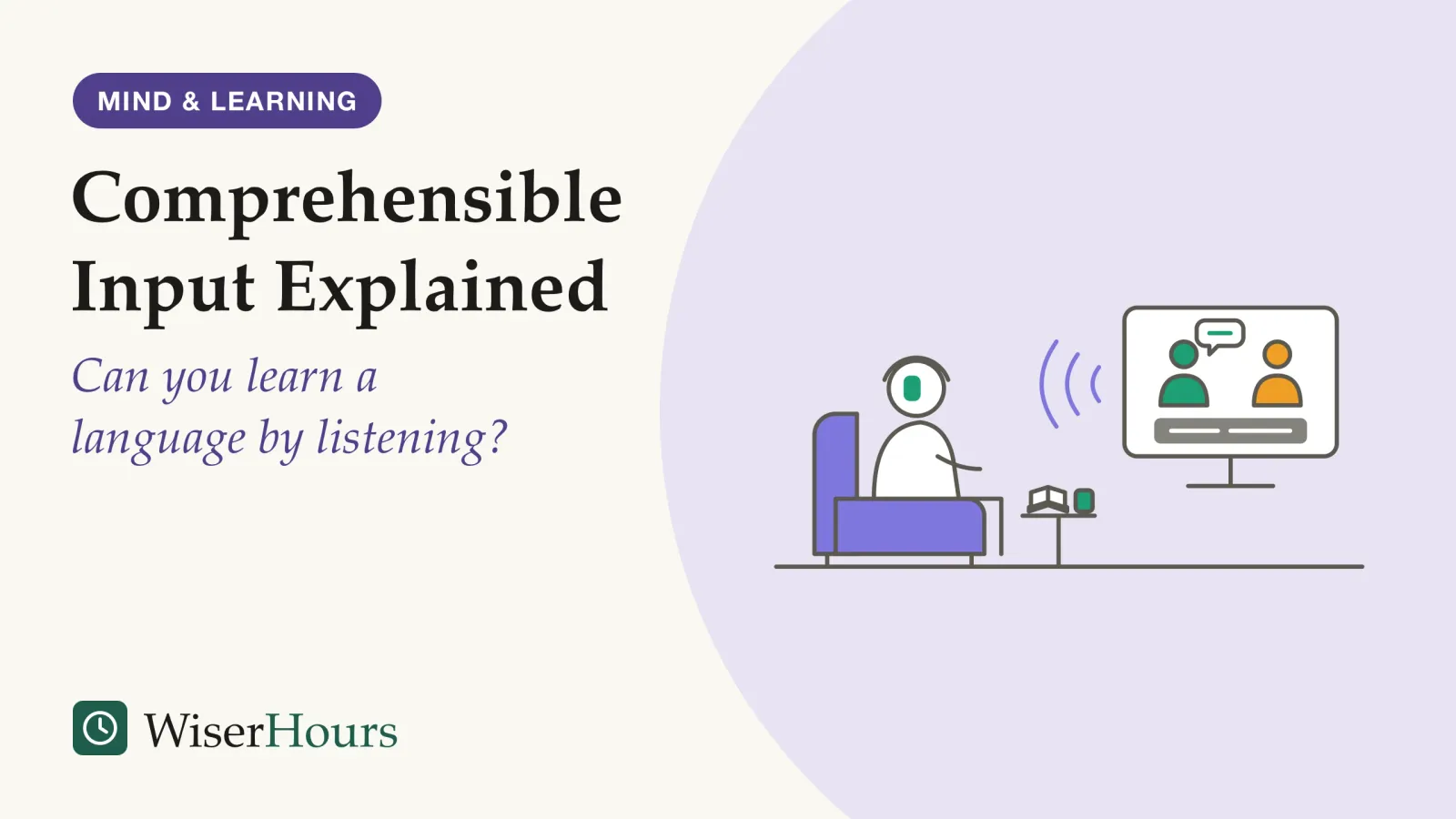
Comprehensible input is language you can follow even though it contains words and structures you have not learned yet, because the situation, the pictures or what you already know fill the gaps. The linguist Stephen Krashen made it the center of his input hypothesis, and in his 1982 book he argued that understanding such messages is how people acquire a language.1
Listening does teach, then, but more slowly and less completely than the popular “just watch and listen” methods suggest. In a 2026 meta-analysis, learners made small gains across language skills after watching uncaptioned video, and listening teaches a share of new words. Speaking accurately seems to need more: noticing how the language is built, trying to say things, and having someone react. For day-to-day practice, that points to material you can mostly follow, captions in the language you are learning or slower audio when you get lost, and a regular conversation with someone who corrects you.
What comprehensible input means in Krashen’s theory
In Stephen Krashen’s 1982 book Principles and Practice in Second Language Acquisition, comprehensible input is language a learner understands, with help from context, that contains structure a little beyond their current level. He named the amount of such input a learner understands, together with the learner’s openness to it (the affective filter), as what drives progress.1
Definition
Comprehensible input is spoken or written language a learner mostly understands, with context filling the gaps, that also contains some words or structures just beyond their current level.
The theory rests on a split Krashen drew between acquisition, which happens without awareness while you follow meaning, and learning, the conscious study of rules. In his account, learned rules only serve as an editor that checks what you say when you have time to think. He also held that speaking ability cannot be taught directly and emerges on its own once enough has been understood.1 Wikipedia’s entry on the hypothesis notes that in this view output has no direct effect on a learner’s ability.2
A dinner table shows how context does the work. Someone asks, in Spanish, for the salt and points at it; you hear an unknown verb form, but the gesture makes the meaning clear, and the form has now passed through your ears with its meaning attached. Krashen’s claim is that thousands of moments like this, and little else, build the grammar.
He did not expect early speech to be correct, either.
Early speech, moreover, is typically not grammatically accurate. Accuracy develops over time as the acquirer hears and understands more input.
Today’s input-based programs carry these ideas over almost intact. The method page of Dreaming, the company behind Dreaming Spanish, says progress is measured by the time you spend understanding real language and that speaking comes out naturally when it is time.3 Refold’s roadmap reaches speaking only in Phase 4, after phases on foundations, comprehension and listening at natural speed, and follows it with a phase that uses writing to clean up grammar.4 Our guide to learning a language as an adult places input alongside grammar study, apps and spaced review; the sections below test the input claims themselves.
What is Krashen’s i+1, and why is it hard to test?
Krashen’s i+1 is his shorthand for input one step past what a learner has acquired so far, where i is the current level and +1 the next structure. Critics, summarized in Wikipedia’s entry on the input hypothesis, argue that his hypotheses are untestable and that the line between acquisition and learning has not been shown to exist.2
Part of the difficulty is built into the claim. Krashen wrote that teachers should not aim at i+1 on purpose: if a learner understands the input and gets enough of it, the next structure will be in there automatically.1 That leaves no agreed way to measure a learner’s “i” or to say in advance what the “+1” is. By our reading, a learner who stalls can always be told the input was not understood or there was not enough of it, which makes the hypothesis hard to prove wrong.
For a learner, i+1 still works as a rule of thumb. Material sits at the right level when you follow what is happening and meet a few new things along the way. A podcast you can follow only by pausing every sentence is above it, and a children’s show where nothing is new is below it.
Can you learn a language just by listening?
Yes, to a degree. Studies of learners who only watch or listen report gains in vocabulary and listening, and a smaller number report gains in grammar, pronunciation and speaking. The strongest summary is a 2026 meta-analysis of video viewing by Dru Sutton and Stuart Webb, education researchers in Canada.5
The study
Moderate evidence
What uncaptioned video taught learners across 56 experiments
The researchers pooled 75 results from 56 experiments with 1,954 learners who watched video in the language they were learning, without captions or subtitles. Average gains were small but clear, and they appeared in vocabulary, grammar, pronunciation, speaking and listening alike. Most participants were learning English, few studies involved beginners, and the analysis compared scores before and after viewing rather than against a group that watched nothing, an approach the authors note tends to inflate effects; the subset of studies with a no-viewing group gave a similar answer.5
Most of the exposure in these studies was short: 46 of the 75 results came from a single viewing session. “Long” viewing in the analysis meant 31 minutes or more in total, and long viewing showed no clear advantage over short, which leaves a year of evenings untested.5
Vocabulary gives a sense of the rate. A 2023 meta-analysis by Stuart Webb, Takumi Uchihara and Akifumi Yanagisawa found that learners picked up about 15 percent of unfamiliar target words from listening on immediate tests, and less from viewing alone.6 By our arithmetic, an episode with 20 new words would leave you knowing about 3 of them straight afterward, which is why the same words need to come back many times.
Listening alone builds understanding, and it builds it slowly. Choose input where the same topics recur (a series rather than random clips, one podcast host rather than many) so that new words return before you forget them.
Is comprehensible input enough without speaking practice?
Probably not, if the goal is speaking accurately. Research in Canadian French immersion schools, where children learned school subjects in French for years, found graduates who still made grammatical errors after many years of immersion, and Merrill Swain argued that input on its own is not enough.7
- Myth
- If you listen to enough comprehensible input, you will start speaking fluently on your own.
- Fact
- Listening builds understanding and vocabulary, but immersion research found students with years of input still made lasting errors when they spoke.
In a 1988 paper, Swain reported that in the immersion classes her team recorded in Ontario, only about one student turn in seven in teacher-led grade 6 lessons was longer than a single clause once reading aloud was set aside, and grade 3 looked much the same. Her explanation was that you can understand a message without precise grammar, but you cannot produce it accurately without precise grammar.8 Listening lets you skip the details; speaking forces you to choose a tense, an ending, a word order.
Two other lines of research point the same way. Michael Long’s interaction hypothesis holds that learners progress when a conversation breaks down and both sides work to repair it, with clarification requests and confirmation checks. A 2018 review by Shawn Loewen and Masatoshi Sato of research on this approach concluded that interaction is effective for language development, while many factors shape how well it works.9 Richard Schmidt’s noticing hypothesis, set out in 1990, held that input becomes intake only when the learner notices it, and that adults may need to pay attention to acquire grammatical features that carry little meaning of their own.10
- Input you mostly understand: Krashen’s starting point (1982): meaning first, with context filling the gaps
- Noticing: Schmidt (1990): input turns into learning once the learner notices it
- Output: Swain (1985): trying to say something shows you what you cannot yet say
- Feedback: Long’s interaction hypothesis: a partner who signals confusion or reformulates
A learner of Spanish who follows a telenovela easily but still says yo va instead of yo voy shows the gap. The verb ending carries almost no meaning when the subject is obvious, so input lets you ignore it until you have to produce it yourself.
Choosing input at the right level
Studies point to a few conditions under which input works better: material you mostly understand, support such as captions, a speed you can follow, and some speaking on top. Each one turns more of what you hear into language you can use. The steps below name what was tested, which is narrower than what method guides promise.
1. Pick material you can follow without a dictionary
Choose material where you follow the gist and can guess most unknown words from context. A quick check is to watch or read for a few minutes and then retell what happened: if you can, the level suits you, and if you spent the time decoding single words, step down. Graded readers, books written in a limited vocabulary for learners, were used in most of the extensive-reading programs that Sangers and colleagues pooled in 2025, and programs showed larger effects when learners’ choice of texts was limited and they had to account for their reading in some way.11
2. Turn on captions in the language you are learning
Captions in the target language help with vocabulary. A 2025 meta-analysis of 49 experiments by Kurokawa, Hein and Uchihara found a medium effect of captioned viewing on vocabulary learning compared with uncaptioned viewing.12 In the 2026 video meta-analysis, educational videos such as documentaries and talks produced larger gains than TV series and movies, and the authors suggest captions when watching entertainment.5
3. Slow the audio when speech runs ahead of you
Native speech can outrun a learner’s processing. In a 1997 study published in Applied Linguistics, Zhao gave students control over the speed of recorded speech and concluded that their comprehension improved, and that they got there by slowing it down.13 The study measured understanding in the moment, so treat slower playback as a way to make input comprehensible, and move back toward normal speed as it gets easier.
4. Add short bursts of speaking with correction
Speaking and writing add accuracy that listening rarely provides, as the immersion and interaction research above suggests. In the 2026 video analysis, viewing combined with other activities showed larger average gains than viewing alone, but the test comparing the two was not statistically significant.5 Retelling an episode to a tutor or language partner, and asking them to flag what they could not follow, puts the new words to work.
A week of input at the right level
How many hours of input does fluency take?
Nobody has measured it. Krashen himself wrote in 1982 that “how much input?” remains an empirical question research could probably answer, and he could offer only rough clues.1 Dreaming measures progress by the time spent understanding the language, but a log of hours records effort, and no study has tied a given number of hours to a level.3
Krashen’s clues were modest. He reported that students taught through Total Physical Response, a method built on obeying spoken commands, were generally ready to start speaking after about ten hours of it, and that children who move to a new country may say little for as long as six months. For higher levels he pointed to US Foreign Service Institute estimates of classroom hours, which count class time rather than understood input.1 None of these figures measures fluency reached through input.
Most of the results behind the viewing findings came from a single session, and the longest studies ran for weeks or months.5 Our searches turned up no controlled study following learners through hundreds or thousands of hours of input, so any hour count quoted for fluency is an estimate rather than a finding.
Hours are still worth counting if the count keeps you going. Judge progress by what you can do instead: follow a news item on a familiar topic, explain your weekend without stopping, read a short chapter without a dictionary.
Which input claims the evidence supports
Input-based learning rests on solid ground for understanding and vocabulary, and on weak ground for its strongest claims: that input is all you need and that a set number of hours delivers fluency.
| Claim | What studies found | Evidence |
|---|---|---|
| Input is needed | Every major theory treats input as necessary | Expert consensus in reviews9 |
| Watching video builds skills | Small gains across skills after short viewing | Meta-analysis, moderate5 |
| Listening teaches new words | A minority of unfamiliar words learned per exposure; more from listening and reading than from video alone | Meta-analysis, moderate6 |
| Extensive reading builds skills | Small to medium gains; bigger with limited text choice and some accountability | Meta-analysis, moderate11 |
| Captions in the target language | More vocabulary than viewing without captions | Meta-analysis, moderate (abstract read)12 |
| Speech emerges from input alone | Immersion students with years of input kept making errors | Observational and expert, contested7 |
| A set number of hours brings fluency | Never measured in a controlled study | Gap1 |
The bottom line
Comprehensible input is the raw material of a language, and the research supports spending a lot of time with it. It does not show that listening alone will make you speak well. Spend most of your hours on material you mostly understand, with captions or slower audio when you need them, and book one conversation a week where someone corrects you.
Frequently asked questions
Is comprehensible input the same as immersion?
Not quite. Immersion means being surrounded by a language, at school, at work or abroad, and much of what you hear may be too hard to follow. Comprehensible input is the part you understand. Stephen Krashen argued in 1982 that early classroom teaching can help most by supplying understandable input, which later lets a learner profit from the wider environment.
What is the silent period in language learning?
The silent period is a stretch at the start of learning when a learner listens but says little. Krashen described it in children who move to a new country, writing that it may last as long as six months, and treated it as a time of building competence by listening. He noted that adults and classroom learners are usually not given one.
Do subtitles in your own language count as comprehensible input?
They help you follow the story, but the research summarized here mostly tested something else: captions in the language you are learning. A 2025 meta-analysis by Kurokawa, Hein and Uchihara found that such captions led to more vocabulary learning than watching without them. How native-language subtitles compare is a separate question this review does not settle.
Does Krashen's affective filter hold up?
The idea that anxiety and low confidence block learning fits common experience, and Krashen linked it to studies relating motivation, self-confidence and anxiety to success. Critics summarized on Wikipedia's input hypothesis entry argue that his hypotheses are hard to test. Treat it as a sensible reason to choose low-pressure practice, rather than a measured mechanism.
Sources
- Principles and Practice in Second Language Acquisition. Krashen, S. D. (1982). Pergamon Press; internet edition on the author's website
- Input hypothesis. Wikipedia (accessed 2026-10-24)
- How Our Method Works. Dreaming (maker of Dreaming Spanish), company method page (accessed 2026-10-24)
- Refold Roadmap. Refold, company method page (accessed 2026-10-24)
- The effects of audiovisual input on second language learning: A meta-analysis. Sutton, D. & Webb, S. (2026). Studies in Second Language Acquisition, 48(2), 571-595
- How effective is second language incidental vocabulary learning? A meta-analysis. Webb, S., Uchihara, T. & Yanagisawa, A. (2023). Language Teaching, 56(2), 161-180
- Merrill Swain. Wikipedia (accessed 2026-10-24)
- Manipulating and Complementing Content Teaching to Maximize Second Language Learning. Swain, M. (1988). TESL Canada Journal, 6(1), 68-83
- Interaction and instructed second language acquisition. Loewen, S. & Sato, M. (2018). Language Teaching, 51(3), 285-329
- The Role of Consciousness in Second Language Learning. Schmidt, R. W. (1990). Applied Linguistics, 11(2), 129-158
- Learning a Language Through Reading: A Meta-analysis of Studies on the Effects of Extensive Reading on Second and Foreign Language Learning. Sangers, N. L., van der Sande, L., Welie, C., Dobber, M. & van Steensel, R. (2025). Educational Psychology Review, 37(4), 96
- Incidental Vocabulary Acquisition Through Captioned Viewing: A Meta-Analysis. Kurokawa, S., Hein, J. & Uchihara, T. (2025). Language Learning, 75(4), 939-987
- The Effects of Listeners' Control of Speech Rate on Second Language Comprehension. Zhao, Y. (1997). Applied Linguistics, 18(1), 49-68
How we researched this
We read Stephen Krashen's 1982 book on his website, Wikipedia's input hypothesis entry and method pages from two input-based programs, then searched OpenAlex and Crossref in October 2026 for meta-analyses on viewing, listening, reading and captions, and reviews of output and interaction research. Sources date from 1982 to 2026. Main limitation: most studies test students learning English over short periods, from one session to a school year.
Keep reading
How to Learn a Language as an Adult: What the Research Supports
Adults can learn a language well, but slowly: US government trainees study 24 to 88 weeks full-time. Five research-backed steps, and what apps can do.
How to Use Dual Coding: Combining Words and Visuals When You Study
Dual coding pairs words with a visual of the same idea, giving a memory two routes back. 5 steps to use it when you study, and when pictures backfire.
The Four Stages of Competence: From Clueless to Automatic
The four stages of competence, best known from a 1969 column (not Maslow), with what skill research adds and why experts find their own skills hard to teach.
How to Study for an Exam: A Research-Backed Plan
How to study for an exam in 5 steps, working back from the date: map the syllabus, space sessions, test yourself, mix topics, then review.