The Four Stages of Competence: From Clueless to Automatic
The four stages of competence, best known from a 1969 column (not Maslow), with what skill research adds and why experts find their own skills hard to teach.

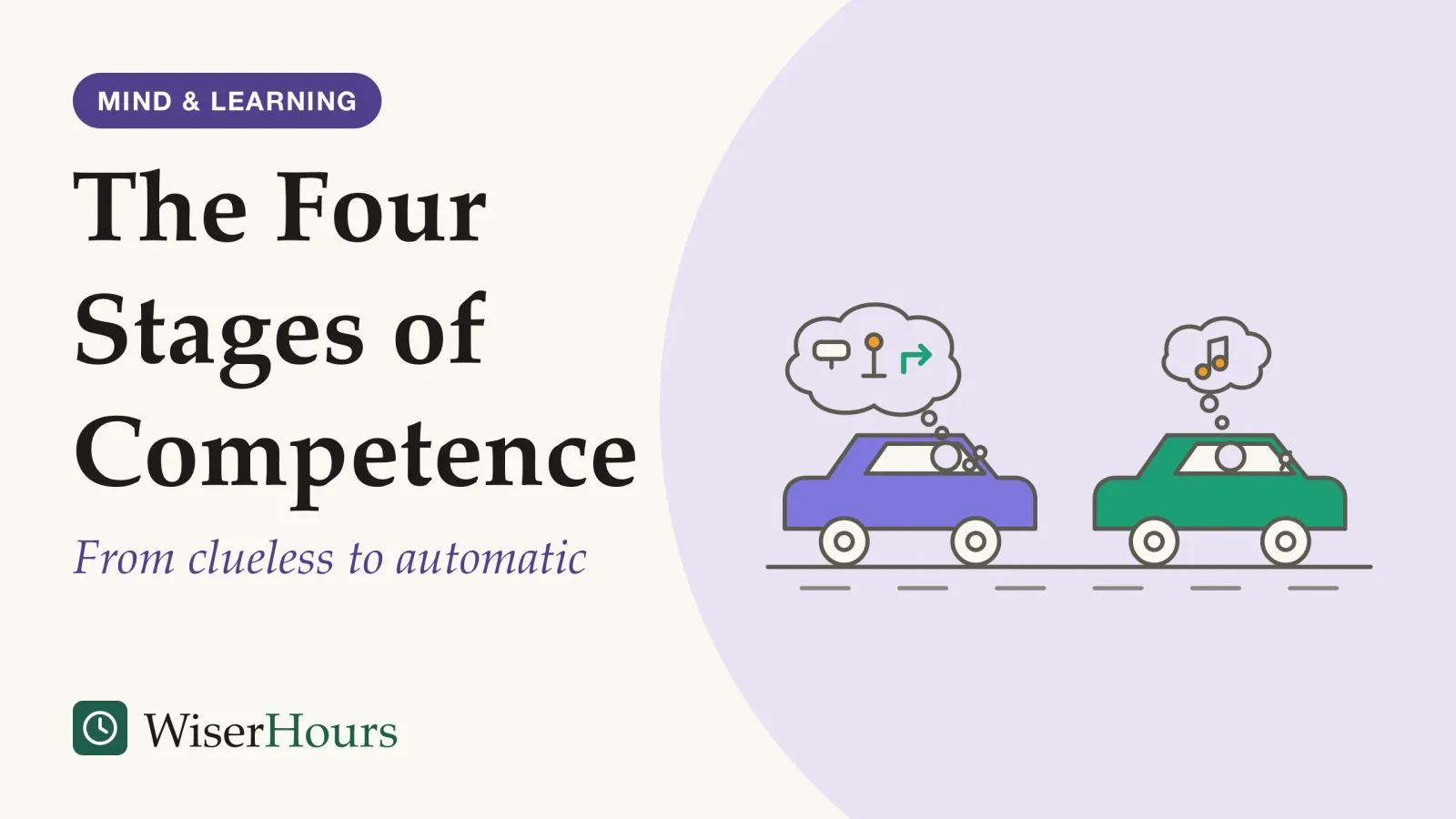
An experienced driver can pull up at home with no memory of the last few turns, while a learner in the next lane is still running through mirror, signal, gear. The four stages of competence describe the road between those two drivers: unconscious incompetence (you do not know what you are missing), conscious incompetence (you see the gap), conscious competence (you can do it, with effort and attention) and unconscious competence (it runs on its own).
Abraham Maslow’s name is often attached to the model, yet it does not appear in his major works.1 One of its earliest documented versions is a 1969 column on teaching in a church magazine, written by a management trainer named Martin Broadwell.2 It is a teaching framework whose four-stage sequence has not been tested, but research on how skills become automatic fits its later stages well.
Naming your stage for one skill tells you what to do next: at stage two you need instruction and patience, at stage three focused practice with feedback, and at stage four an occasional slow check of your own habits. That self-check belongs to learning how to learn. The model also explains a puzzle most workplaces know: the best performer on a team is often a poor person to train the newcomer.
What are the four stages of competence?
The four stages of competence combine two questions: can you do the skill, and do you know how good you are at it? Gordon Training International, the US training firm that spread the model in the 1970s, labels them unconsciously unskilled, consciously unskilled, consciously skilled and unconsciously skilled.3 Driving and a new manager learning to give feedback make good illustrations of each.
Unconscious incompetence is not knowing what you cannot do. A child in the back seat assumes driving is mostly steering. A newly promoted team lead thinks feedback means listing what people did wrong, and does not connect it with the team going quiet in meetings. Gordon’s own example is leaders who damage working relationships through how they talk, without being aware of it.3 Stage one overlaps with the research on how poor performers misjudge their own skill, though the model was not built on it.
Conscious incompetence is seeing the gap. The learner driver stalls at the first junction and finds that mirrors, clutch and indicator all need attention at once. The team lead reads an anonymous survey and sees that their feedback leaves people defensive. Making mistakes can be an integral part of learning at this stage, and the learner now sees the value of the new skill.1 This is the stage that feels worst, and it is also the first one where improvement is possible: noticing the gap is the monitoring half of metacognition, the skill of judging your own learning.
Conscious competence is doing it right with full concentration. The driver passes the test but turns the radio off at roundabouts. The team lead prepares every feedback conversation, follows a structure and, as Gordon puts it, may feel a little phony doing it.3
Unconscious competence is doing it without thinking. The driver arrives home with no memory of the route; the team lead gives a clear, fair comment in a corridor without rehearsing. At this stage the skill can run while you do something else.1
- 1Unconscious incompetencedriving looks easy; feedback means listing faults
- 2Conscious incompetencestalls at the junction; sees the survey results
- 3Conscious competenceradio off at roundabouts; every talk rehearsed
- 4Unconscious competencehome without noticing; feedback in passing
Use the stages on single skills rather than whole jobs. A driver can change gear at stage four and merge onto a fast road at stage two, and a manager can run meetings without thinking while still struggling through hard conversations.
Who created the four stages of competence model?
No single person created the four stages of competence. A widely credited early version is Martin Broadwell’s “four levels of teaching”, published in February 1969, which uses names close to today’s.2 Wikipedia’s history adds that the four stages had already appeared in a 1960 training textbook by three New York University management professors, and that a 1923 article in a speech journal described similar stages.1
Broadwell’s column closed a 16-part series on improving teaching in church classes, and his levels described teachers.2 Noel Burch of Gordon Training International generalized it around 1970 into a model for learning any new skill. Gordon’s own article credits Burch, and a 2025 paper by the Hungarian education researchers Fanni Biró and Csaba Csíkos treats Burch’s version as the step that widened Broadwell’s teaching model to any skill.4
- Myth
- Abraham Maslow developed the four stages of competence.
- Fact
- The model appears in training writing from the 1960s and 1970s and does not appear in Maslow's major works.
Broadwell did not treat his top level as the goal. His unconscious competent teacher is good by nature, gets results without knowing why, and would probably fail at the one task of teaching others how to teach. The conscious competent teacher, who knows why their methods work, was the one he thought would make a good teacher trainer.2
That idea still holds up when you choose who should train a newcomer. Look for someone who can say why they do each step, which is often a colleague who learned the job recently.
A useful framework that has not been tested as a theory
The four stages of competence are a description that trainers found useful, not a theory that researchers built and tested. Biró and Csíkos call Broadwell’s original a speculative model of skill development, and they note that interest in it has grown sharply since the 2010s.4
Medical education has taken it up widely. Lane and Roberts, two Australian medical educators, describe it in 2022 as one of the most referenced learning frameworks in healthcare education, then list what it leaves out: whether a learner is ready to learn, whether they keep learning, and whether they retain what they learned.5 Biró and Csíkos point to a few studies that link single stages, mostly the second, to data.4 Beyond those, our searches turned up papers that use the model as a teaching frame, but none that checked whether learners move through the stages in the stated sequence or measured when one stage ends and the next begins.
The model works best as a shared vocabulary between a learner and a coach. “I am at conscious incompetence on pivot tables” is a useful thing to say out loud, because it tells the other person you need instruction and patience. It does not tell either of you how long the next stage will take.
What skill research says about the later stages
The last three stages line up closely with a standard model from skill research: Paul Fitts and Michael Posner’s 1967 account of three overlapping stages of skill learning, called cognitive, associative and autonomous. A 2016 review of novice driving by two US driving-safety researchers, Bruce Simons-Morton and Johnathon Ehsani, uses it to explain how learners improve. In the cognitive stage you build explicit knowledge of what to do; in the associative stage you work out the details and order of the steps under varied and harder conditions; the autonomous stage comes only after substantial practice, when you respond without consciously thinking about it.6 Cognitive learning carries you out of conscious incompetence, associative learning is conscious competence, and autonomous performance is the fourth stage.
Conscious competence is demanding because a new skill takes most of your mental capacity, leaving a novice little for anything else; in simulator studies, novice drivers’ performance fell when they were given demanding memory tasks. Crash rates trace the same learning curve: they are highest just after licensing, drop fastest over roughly the first six months of independent driving, then keep falling slowly for years, in the Australian (Queensland) crash data the review reproduces.6 If you are at conscious competence in any skill, protect your attention while you practice: no phone, no side conversation, one new demand at a time.
Reaching automaticityautomaticity: How far a behavior runs by itself, triggered by a familiar context with little thought or effort. Habit researchers use it to measure how strong a habit has become, usually by asking people to rate it.Full entry in the glossary also changes how attention affects performance, as two experiments with golfers and footballers found.
The study
Moderate evidence
When thinking about each step helps a player, and when it gets in the way
Experienced golfers putted more accurately while doing a second, distracting task than when they were prompted to attend to each step of their stroke. In a second experiment, experienced footballers dribbling with their stronger foot also did better when distracted, but with their weaker foot they did better when attending to the steps, and novices did better with step-by-step attention whichever foot they used. The authors concluded that step-by-step attention helps beginners and the less practiced skills of experts, while it harms high-level performance.7
That result fits the gap between stages three and four, with two limits: the tasks were short sports skills in a lab, and only the paper’s summary was open to us. Once you perform a skill well, avoid talking yourself through the mechanics in the moment, since the experienced players did worse when prompted to attend to each step.7
How do you move from conscious to unconscious competence?
You move from conscious to unconscious competence by practicing the correct version of a skill many times, under conditions that become gradually harder, until it no longer needs your attention. Simons-Morton and Ehsani describe the autonomous stage as something that comes only after substantial practice and experience.6 How much practice, and of what kind, is the subject of the long argument over the 10,000-hour rule.
Feedback is worth most while the skill still feels effortful, since that is when step-by-step attention helps performance.7 Difficulty should rise in steps, from quiet roads to busy ones, or from feedback on a small task with a friendly colleague to a harder conversation, because the associative stage is about handling varied and tougher conditions.6 The test for the finish line is doing the skill while something else is going on, which is the mark of the fourth stage.
Why experts struggle to teach what they do automatically
People who know something well find it hard to imagine not knowing it, an effect the economists Colin Camerer, George Loewenstein and Martin Weber named the curse of knowledge in 1989. In their experiments, better-informed people could not ignore their private information when predicting the judgments of less-informed people, even when doing so would have paid.8
For teaching, a direct test came from the US researcher Pamela Hinds in 1999. In two studies, people with more expertise were worse at predicting how long novices would take on a complex task, underestimated the time, and resisted techniques designed to correct the error. Hinds suggested that people with intermediate expertise may predict novices’ performance more accurately.9
Hospital interviews point the same way. When researchers talked with nine novice and nine expert anaesthetists at a German university hospital, the experts no longer seemed to remember how much the complexity of routine tasks had challenged them as novices.10 A related finding, which a 2003 review by Australian education researchers calls the expertise reversal effect, runs the other way: instruction that helps beginners can lose its value, or even backfire, for learners with more experience, so teaching has to match the learner’s stage.11
A senior analyst training a new hire might describe the monthly report as “pull the numbers, check them, send it”, leaving out a dozen clicks and checks they no longer notice making. If you are the expert, do the task slowly once while writing down every step, then watch a beginner follow your notes without helping. Pairing with someone who learned the task recently brings back the steps you skip.
Is there a fifth stage of competence?
There is no fifth stage in Broadwell’s or Burch’s versions, but trainers and educators have proposed several. Lane and Roberts list them in their 2022 paper: reflective competence, re-conscious competence and chosen conscious competence, each describing someone who does a skill fluently and can still step back, explain it and check it. The first of these starts from the problem Broadwell spotted, that it is hard to teach what you do unconsciously. Another proposal uses a driving comparison: unconscious competence is fine for changing gear but not for passing through a green light. Lane and Roberts add a safety concern from medicine: calling stage four mastery suggests there is nothing left to learn, and a clinician who grows complacent can fall behind as practice changes.5
Whichever name you prefer, the practical version is a routine check. Every so often, slow down a skill you do on autopilot, explain it to someone, or ask an observer what they see, and compare your method with current guidance in your field.
How much of the four-stage model rests on evidence?
The four-stage sequence itself is untested. The parts with experimental support are the ones the model shares with skill and expertise research, and those come from lab tasks and a few studies.
| What it is | What the best evidence found | Evidence |
|---|---|---|
| The four stages in order | Described as a speculative model; no test of the sequence found | Expert opinion, gap4 |
| Attention at stages three and four | Step-by-step attention helped novices and hurt experienced performers | Two lab experiments, moderate (abstract read)7 |
| Experts predicting novices | More expertise went with worse predictions of novice task times | Two studies, moderate (abstract read)9 |
Use the stages to say where you are with a skill, and lean on the attention and expertise findings when you decide how to practice or how to teach it.
The bottom line
The four stages of competence are an untested teaching framework from the 1960s, and they are most useful applied to one sub-skill at a time. Pick a skill you are building, name its stage, and practice it with feedback until it runs while you think about something else. If you already do it on autopilot and have to teach it, watch a beginner try before you explain.
Frequently asked questions
What is an example of conscious incompetence?
A new driver who stalls the car at the first junction and realizes how much there is to coordinate is in conscious incompetence. So is a new manager who reads a team survey and sees that their feedback leaves people defensive. In both cases the gap is now visible, which Gordon Training International, the firm that spread the model, describes as the point where learning starts.
How long before a skill reaches unconscious competence?
There is no general figure, because it depends on the skill, the practice and the person. For driving, a 2016 review by the US researchers Bruce Simons-Morton and Johnathon Ehsani describes crash rates that fall fastest over roughly the first six months of independent driving and keep improving for years, and it places the autonomous stage only after substantial practice and experience.
Can you lose unconscious competence?
Yes. Wikipedia's entry on the four stages says many skills need practice to stay at a high level. In a 2022 paper, the Australian medical educators Andrew Lane and Chris Roberts argue that calling the fourth stage mastery is risky in medicine, where knowledge and practice keep changing, because a clinician who grows complacent can lose that mastery.
Sources
- Four stages of competence. Wikipedia (accessed October 2026)
- Teaching for learning (XVI). Broadwell, M. M. (1969). The Gospel Guardian, 20(41), 1-3, 20 February 1969
- Learning a new skill is easier said than done. Adams, L. Gordon Training International (US), undated web article
- The Broadwell-Burch four-stage model of competence development and the mathematics teaching profession. Biró, F. & Csíkos, C. (2025). Mathematics Teaching Research Journal, 17(3), 5-25
- Contextualised reflective competence: a new learning model promoting reflective practice for clinical training. Lane, A. S. & Roberts, C. (2022). BMC Medical Education, 22, 71
- Learning to drive safely: Reasonable expectations and future directions for the learner period. Simons-Morton, B. & Ehsani, J. P. (2016). Safety, 2(4), 20
- When paying attention becomes counterproductive: Impact of divided versus skill-focused attention on novice and experienced performance of sensorimotor skills. Beilock, S. L., Carr, T. H., MacMahon, C. & Starkes, J. L. (2002). Journal of Experimental Psychology: Applied, 8(1), 6-16
- The curse of knowledge in economic settings: An experimental analysis. Camerer, C., Loewenstein, G. & Weber, M. (1989). Journal of Political Economy, 97(5), 1232-1254
- The curse of expertise: The effects of expertise and debiasing methods on prediction of novice performance. Hinds, P. J. (1999). Journal of Experimental Psychology: Applied, 5(2), 205-221
- How novice and expert anaesthetists understand expertise in anaesthesia: a qualitative study. St. Pierre, M. & Nyce, J. M. (2020). BMC Medical Education, 20, 262
- The expertise reversal effect. Kalyuga, S., Ayres, P., Chandler, P. & Sweller, J. (2003). Educational Psychologist, 38(1), 23-31
How we researched this
We read Martin Broadwell's 1969 article, Gordon Training International's account and Wikipedia's history of the model, then searched OpenAlex, Europe PMC and PubMed (October 2026) for research on stages of skill learning, automatic performance and the curse of knowledge. Sources run from 1969 to 2025. Main limitation: none of the papers we found tested the four-stage sequence itself, and four sources were available to us as abstracts alone.
Keep reading
How to Use Dual Coding: Combining Words and Visuals When You Study
Dual coding pairs words with a visual of the same idea, giving a memory two routes back. 5 steps to use it when you study, and when pictures backfire.
How to Study for an Exam: A Research-Backed Plan
How to study for an exam in 5 steps, working back from the date: map the syllabus, space sessions, test yourself, mix topics, then review.
Metacognition Explained: How to Think About Your Own Learning
What is metacognition? Its 2 parts: judging what you know and changing how you study. Judging later, with the answer hidden, makes the first far sharper.
Test Anxiety: Why Your Mind Goes Blank and What Helps
On average across OECD countries, 55% of 15-year-olds in PISA 2015 felt very anxious before tests even when prepared. Why minds go blank, and what helps.