How to Use Dual Coding: Combining Words and Visuals When You Study
Dual coding pairs words with a visual of the same idea, giving a memory two routes back. 5 steps to use it when you study, and when pictures backfire.

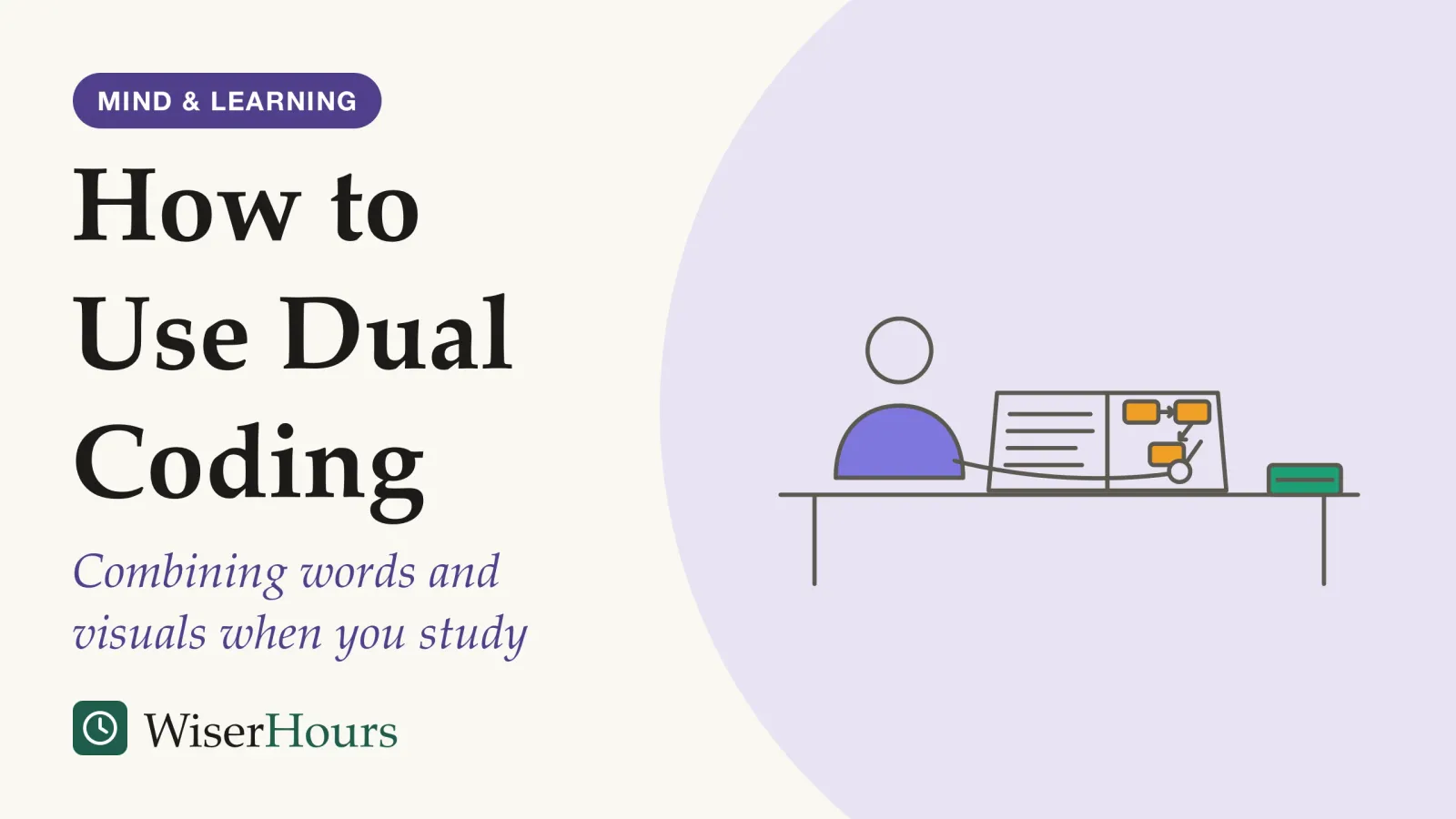
A page of notes on how a law gets passed reads much the same the third time through. Redrawn as a flowchart, with a box for each stage and an arrow for each vote, the same page gives memory a second thing to hold. That is dual coding: studying an idea in words and in a visual that shows the same thing, so the memory has two routes back instead of one.
A 2018 review of study strategies by the psychologists Yana Weinstein, Christopher Madan and Megan Sumeracki counts dual coding among six strategies with decades of research behind them. It also adds two warnings: the pictures must be relevant to what you are learning, and every extra representation adds to what your mind has to hold at once.1
Pasting clip art into notes is decoration. Dual coding turns the notes themselves into a shape you can see and redraw, in five steps:
- Find the structure in what you are studying
- Turn your notes into a timeline, flowchart, diagram or table
- Explain the visual in words, then the words as a visual
- Draw it again from memory, then check it against the source
- Cut decoration and any text that only repeats
The method sits best on top of self-testing and spaced review, the habits laid out in how to learn more effectively.
What is dual coding in learning?
Dual coding is a study strategy built on dual coding theory, which the psychologist Allan Paivio proposed in 1971. The theory holds that the mind keeps two linked kinds of representation, one verbal and one for images, and the 1991 review by James Clark and Paivio applied it to classroom learning, memory and teaching.2
The theory grew partly out of the picture superiority effect: pictures are remembered better than words. Paivio and Csapo proposed in 1973 that the verbal and image codes add to each other, so an item stored both ways is easier to recall than one stored once.1
A word such as “spoon” shows how this works. You can hold it as letters and sound, as the shape of a spoon, and even as the movement of stirring. Weinstein and colleagues use this very example, and they note that physical actions can add a third, motor code.1 When you later try to recall the idea, any one of those routes can bring back the rest.
For study, the useful part is the pairing. A diagram of the heart next to a paragraph on blood flow gives two codes for one idea; the same paragraph read twice gives one code twice. Choose a visual that says what the words say.
Is dual coding the same as learning styles?
Dual coding and learning styles make different claims. Learning styles says each person should be taught in a preferred format; dual coding says that adding a matching visual to words helps learners in general, whatever they prefer.1
Weinstein, Madan and Sumeracki draw the line explicitly in their 2018 review. One study it describes found that people who scored as “visualizers” or “verbalizers” did no better when the task matched their preference. Another found that studying in a preferred style raised people’s sense of how well they had learned, with no matching gain in test scores.1 The case against matching is set out in our article on why learning styles are a myth.
- Myth
- Dual coding is for visual learners; people who prefer words can skip it.
- Fact
- Dual coding means adding a matching visual for every learner. Teaching people in a preferred style has not been shown to improve learning.
Someone who calls themselves “not a visual person” has no reason to skip the method. A flowchart of a grant application process is as useful to a lawyer who loves text as to a designer who sketches all day, because the process has a shape either way. Let the material choose the visual: a sequence, a process, a set of parts or a contrast.
How do you use dual coding when revising?
Dual coding in revision follows a simple loop: build the visual from your notes, explain it, then rebuild it from memory and check it. The Learning Scientists set out this sequence in a 2016 guide for students by Megan Smith (now Sumeracki) and Yana Weinstein.3
1. Find the structure in what you are studying
Before you draw, ask what shape the material has. Events in order suit a timeline; a process or chain of causes suits a flowchart; parts of a whole suit a labelled diagram; things you tend to confuse suit a comparison table. The Learning Scientists give two pairings: a timeline for history and a diagram for biology.3
- Timeline: for events or steps in order, such as a period of history
- Flowchart: for a process, a decision or a chain of causes
- Labelled diagram: for the parts of a whole, such as a cell or a machine
- Comparison table: for two or more things you tend to mix up
2. Turn your notes into a timeline, flowchart, diagram or table
Redraw a page of notes as one visual, using the words of the notes as labels. A project manager revising for a certificate might turn three pages on change control into a flowchart of five boxes with a branch for rejected requests. Your drawing can be rough and need not copy the textbook’s version; it only has to show what the words describe.3
The same move works in any subject. A student of economics can put the causes of a recession in a flowchart, a language learner can sketch the meaning of each new verb beside it, and someone studying for a driving theory test can draw a junction with the right of way marked in arrows.
3. Explain the visual in words, then the words as a visual
Work in both directions. Compare a textbook figure directly with the text and ask how each describes the other; then look only at the visual and explain it in your own words.3 Where you cannot explain a part, you have found a gap.
4. Draw it again from memory, then check it against the source
Close the book and the notes, and draw the visual again from a blank page, writing the explanation beside it. Then compare it with the source and mark what you missed. This is active recall in visual form, and the Learning Scientists treat it as the step that follows dual coding.3 Weinstein and colleagues describe studies in which concept maps drawn from memory helped later recall more than maps drawn with the textbook open.1
5. Cut decoration and any text that only repeats
Before you keep a visual, remove anything that does not carry content: icons, colour for its own sake, photos that only set a mood, and sentences that copy what the labels already say.4 If a picture is interesting but off topic, leave it out.
One round of dual coding
Why do words and pictures work better together?
Words and pictures work better together because the learner can link each to the other, according to the theory of Richard Mayer of the University of California, Santa Barbara, whose lab has tested it in more than 200 experiments. In a 2024 review of four decades of work, Mayer reports that people learned better from words and pictures than from words alone.4
The study
Moderate evidence
Fifteen design principles, tested in more than 200 experiments
In Mayer’s summary of research by his colleagues and himself, learners did better from words with pictures than from words alone (effect size 1.35 across 13 tests). Removing extraneous material helped (0.86, 19 tests), and so did prompting learners to generate something such as a summary or drawing (0.71, 44 tests). Adding printed text to graphics and narration gave no real benefit (0.10, 12 tests).4
Most of these tests ran in one research group, and Mayer stresses that each principle has limits on who it helps, for which lessons and under what circumstances.4
His explanation rests on three assumptions. People have separate channels for words and for pictures, each channel holds only a few pieces at a time in working memoryworking memory: The small mental workspace that holds and handles the information you are using right now, such as a phone number you are about to dial. Its capacity is limited, which is why juggling several things at once quickly overloads it.Full entry in the glossary, and meaningful learning happens when you select what matters, organize it, and connect the words and pictures with each other and with what you already know.4
- 1Selectattend to the words and parts of the picture that matter
- 2Organizearrange them into a verbal model and a picture model
- 3Integratelink the two models and connect them to what you know
That account explains why the visual has to match the words. A nurse learning how a drug moves through the body gains from a diagram whose arrows follow the text, because she can link each sentence to a part of the picture. An unrelated photo of a pharmacy gives her nothing to connect, while still taking a share of her limited attention. Before you add a picture to your notes, check that you could point to the part of it each sentence describes.
Does drawing help you remember?
Drawing what you are learning has helped memory in lab experiments, often more than writing it out. Across 7 experiments, Jeffrey Wammes, Melissa Meade and Myra Fernandes of the University of Waterloo in Canada found drawn words were recalled better than written ones, even with less time per word and longer lists.5
The team tested and ruled out simpler explanations: deeper thinking about meaning, mental imagery, and the memorability of pictures alone could not account for the gain. They propose that drawing ties together what a thing means, what it looks like and the hand movements that made it.5 A 2018 summary by the same group reports that drawing beat writing, visualizing and even tracing, and extended to textbook definitions as well as single words.6
The evidence has clear limits. Most of these experiments used lists of words or short definitions, so they say little about whether sketching a chapter beats other strategies for a whole course. Mayer’s generative activity principle points the same way for multimedia lessons: people learned better when they were guided to produce something, such as a drawing or a summary, during the lesson.4 Until better classroom tests exist, draw the key parts of an idea and treat the drawing as practice for recall.
When visuals get in the way
Visuals backfire when they add something to process without adding meaning. A 2020 meta-analysis by NarayanKripa Sundararajan and Olusola Adesope found that interesting but irrelevant material in a lesson, which researchers call seductive details, can hinder learning.7
Mayer’s coherence principle points the same way: people learned better when extraneous words and pictures were removed.4 Weinstein and colleagues describe a study in which students given visually rich examples did worse than students given no visual example at all, and they warn that each extra representation adds to mental load.1
The second trap is repeating yourself on screen. Mayer’s redundancy principle finds that adding printed text to graphics and narration does not help when the lesson is fast-paced, and his modality principle finds that graphics with narration beat graphics with on-screen text.4 If you record yourself explaining a diagram, or present one to colleagues, speak over the picture and keep the slide to labels.
The third trap is swapping words for pictures. Weinstein and colleagues discuss a classroom case where pictures replaced single words in a lab report. Other teachers objected that this left one representation instead of two, and the review notes that the practice has not been tested, presumably because no benefit would be expected.1 Keep both the words and the visual.
Which parts of dual coding have the firmest support?
The core idea, that words paired with a matching visual are learned better than words alone, rests on many experiments. The finer points, such as drawing for whole courses or the best kind of visual for each subject, rest on fewer studies, mostly short lab experiments with students. Weinstein and colleagues say dual coding still needs a clearer definition and more classroom research.1
| What it is | What the best evidence found | Evidence |
|---|---|---|
| Words with pictures | Learners did better than with words alone across 13 tests | Experiments, mainly one lab; moderate4 |
| Drawing to remember | Drawn words were recalled better than written words across 7 experiments | Lab experiments with word lists; moderate (abstract read)5 |
| Decorative or off-topic material | Interesting but irrelevant details can hinder learning | Meta-analysis; moderate (abstract read)7 |
| Text repeating narration | Adding printed text to graphics and narration gave little benefit | Experiments, mainly one lab; moderate4 |
| Drawing from memory | Concept maps built from memory beat maps built with the book open | Earlier studies summarized in a 2018 review; limited1 |
| Matching a learning style | No benefit from teaching to a preferred format | Experiments summarized in a 2018 review; moderate1 |
The bottom line
A visual earns its place in your notes when it shows what the words say, because then the idea has a second route back. Take one page of notes this week, turn it into a timeline, flowchart, diagram or table, and a day later redraw it from memory and check it against the source.
Frequently asked questions
Do you need to be good at drawing to use dual coding?
No. The Learning Scientists' 2016 student guide to dual coding, by two of the authors of a major review of study strategies, advises against trying to reproduce the exact visuals in your course materials and asks only that your drawing shows what the words describe. That leaves room for boxes, arrows, stick figures and simple tables, as long as each mark stands for part of the idea.
Can you use pictures from your textbook or the web instead of drawing your own?
Yes, as a first step. The Learning Scientists suggest comparing a ready-made visual directly with the words and explaining it in your own words before drawing your own version. Choose images that carry the content, such as a labelled diagram or a chart. A 2018 review by Weinstein, Madan and Sumeracki warns that visually rich or ambiguous images can distract.
Is a mind map a form of dual coding?
It can be. The Learning Scientists count graphic organizers among the visuals students can pair with words, and a map of linked ideas fits that description. A 2018 review by Weinstein, Madan and Sumeracki describes studies in which concept maps built from memory helped later recall more than maps built with the textbook open.
Does dual coding help with vocabulary in a new language?
Vocabulary is one of the main areas where pairing words with pictures has been applied, according to a 2018 review of learning strategies by Weinstein, Madan and Sumeracki. A simple sketch of a word's meaning gives the word a second route back.
Sources
- Teaching the science of learning. Weinstein, Y., Madan, C. R. & Sumeracki, M. A. (2018). Cognitive Research: Principles and Implications, 3, article 2
- Dual coding theory and education. Clark, J. M. & Paivio, A. (1991). Educational Psychology Review, 3(3), 149-210
- Learn how to study using... dual coding. Smith, M. & Weinstein, Y. (2016). The Learning Scientists
- The past, present, and future of the cognitive theory of multimedia learning. Mayer, R. E. (2024). Educational Psychology Review, 36, article 8
- The drawing effect: Evidence for reliable and robust memory benefits in free recall. Wammes, J. D., Meade, M. E. & Fernandes, M. A. (2016). Quarterly Journal of Experimental Psychology, 69(9), 1752-1776
- The surprisingly powerful influence of drawing on memory. Fernandes, M. A., Wammes, J. D. & Meade, M. E. (2018). Current Directions in Psychological Science, 27(5), 302-308
- Keep it coherent: A meta-analysis of the seductive details effect. Sundararajan, N. & Adesope, O. (2020). Educational Psychology Review, 32, 707-734
How we researched this
We searched Crossref, Europe PMC, journal sites and the web in October 2026 for reviews and experiments on dual coding, multimedia learning and drawing to learn, and read full texts where they were openly available. Sources date from 1991 to 2024. Main limitation: four sources were read in abstract only, and most of the experiments were short lab studies with students.
Keep reading
The Feynman Technique: Learn a Topic by Explaining It in Plain Words
The Feynman technique in 4 steps: explain a topic aloud in plain words, find where you stall, then fix it. What research on learning by explaining supports.

The Four Stages of Competence: From Clueless to Automatic
The four stages of competence, best known from a 1969 column (not Maslow), with what skill research adds and why experts find their own skills hard to teach.
How to Study for an Exam: A Research-Backed Plan
How to study for an exam in 5 steps, working back from the date: map the syllabus, space sessions, test yourself, mix topics, then review.
Metacognition Explained: How to Think About Your Own Learning
What is metacognition? Its 2 parts: judging what you know and changing how you study. Judging later, with the answer hidden, makes the first far sharper.