Learning How to Learn: A Research-Backed Guide for Beginners
Learning how to learn: a 2013 review rated only 2 of 10 study techniques highly useful, self-testing and spacing. How beginners can use them, step by step.

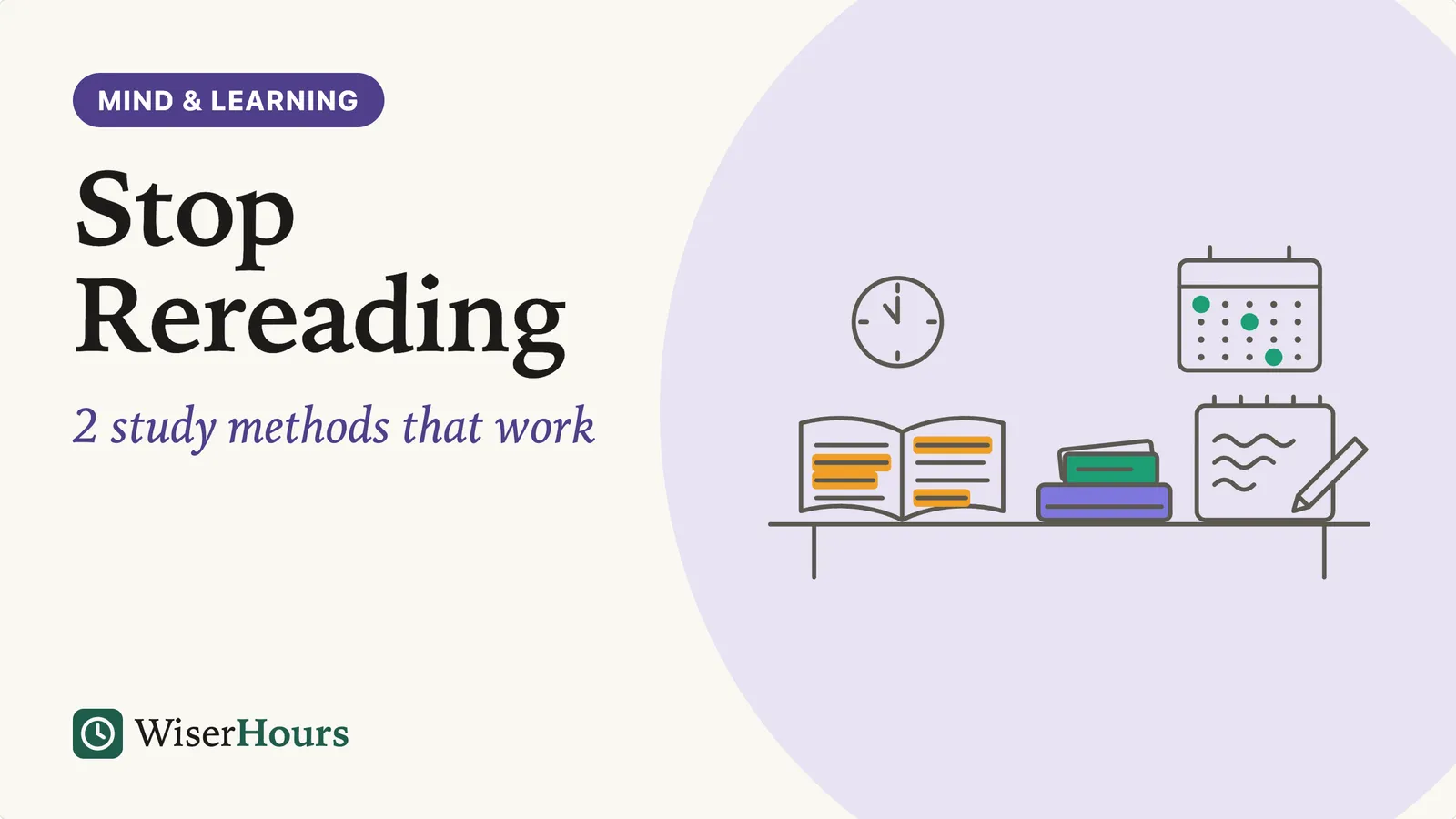
In a 2006 experiment with 180 undergraduates at Washington University in St. Louis, students who spent four short sessions reading a science passage remembered more of it on a test five minutes later than students who read it once and spent three sessions writing down what they could recall. On a test a week later, the result flipped: the recallers remembered 61 percent of the passage’s ideas and the rereaders 40 percent. The rereaders had read the passage about 14 times to the recallers’ 3, and they had felt more confident they would remember it.1
Learning how to learn means choosing study methods by what lasts, not by what feels productive. Six habits, ordered by the weight of evidence behind them:
- Test yourself instead of rereading
- Space out your study sessions
- Mix problem types once you know each one
- Study solved examples before solving alone
- Explain the material to yourself
- Check what you know after a delay
Learning how to learn is two skills: choosing methods and judging progress
Learning how to learn means two things, according to a 2013 Annual Review of Psychology article by psychologists Robert Bjork, John Dunlosky and Nate Kornell: knowing which study activities build lasting knowledge, and accurately monitoring how much you have learned so you can adjust. They call it a critical survival tool now that more learning happens outside classrooms and across a lifetime. The difficulty, they write, is that people often hold a faulty mental model of how they learn, which leads them to misjudge and mismanage their own studying.2
The techniques themselves have been graded. In a 2013 review of 10 easy-to-use study techniques, John Dunlosky of Kent State University and four colleagues rated only 2 as high utility: practice testing and distributed practice, meaning study spread out over time. They rated rereading and highlighting, which most students report using, as low utility because neither consistently improved performance.3
A 2021 meta-analysis of 242 studies by Gregory Donoghue and John Hattie of the University of Melbourne found the largest average effects for the same two techniques.4
Familiar is not the same as learned
Rereading makes material feel familiar, and Bjork, Dunlosky and Kornell’s 2013 review explains why that feeling misleads: conditions that make performance rise quickly during study can fail to produce long-term retention, while conditions that slow study down can improve it. Spacing, mixing topics and testing yourself are what they call desirable difficulties, because they make practice feel harder but strengthen long-term learning.2
The word desirable matters for beginners. Elizabeth and Robert Bjork of the University of California, Los Angeles, stress that a difficulty helps only if you have the background knowledge or skill to respond to it successfully; otherwise it becomes an undesirable one.5
Most students still study the easy way. In a 2009 survey of 177 undergraduates at Washington University in St. Louis, rereading was the most common strategy and 55 percent named it their first choice, while few said they practiced recalling what they had studied.6
These students were a select group, with average SAT scores above 1400, so habits elsewhere may differ.6 Roediger and Karpicke suggest why the habit persists: students tend to judge a strategy by the quick gains it produces, and rereading produces them.1
Start with self-testing and spacing, then add four more habits
Testing yourself and spacing out your sessions come first in this guide because they are the two techniques John Dunlosky’s 2013 review rated high utility.3 The other four have good support that depends more on the learner and the material, as each step below explains.
1. Test yourself instead of rereading
Retrieval practice means pulling information out of memory instead of reading it again.7 Dunlosky’s review counts practicing recall with flashcards, answering end-of-chapter questions and taking practice tests as forms of it.3
The study
Strong evidence
Regular quizzes versus none, measured in real classrooms
Chunliang Yang of Beijing Normal University, David Shanks of University College London and three colleagues pooled 573 results from classroom studies comparing students who took regular quizzes with students who were quizzed less or not at all. Quizzed students scored higher on later tests and exams by a medium amount (g = 0.50), and quizzing beat restudying the same material by a smaller margin (g = 0.33).7
For a beginner, that makes closing the book and testing yourself one of the most dependable ways to make material stick. The caveat for working adults: only 6 of the 573 results came from continuing-education courses for professionals, all of them single workshops, and their pooled effect was not statistically clear.7
Check your answers afterwards: in the same review, quizzes followed by corrective feedback were linked to larger gains than quizzes without it.7
One limit is still argued over. In a 2015 journal special issue, Tamara van Gog and John Sweller argued that the benefit of testing shrinks, and may disappear, as material gets more complex, meaning it has many elements that must be understood together.8 Jeffrey Karpicke and William Aue replied that the studies without a benefit used unsuitable recall tasks, and that practicing retrieval still helps with complex material.9
- 1Read oncea section, a chapter or a video
- 2Close itnothing in view
- 3Recallwrite or say what you remember
- 4Checkfix gaps and errors
- 5Wait, then repeatdays later, not minutes
Then repeat from “Read once”
2. Space out your study sessions
Cramming beats not studying at all in the short term, but the same study time spread across days or weeks does more for long-term memory, Dunlosky’s review concludes. It rated this distributed practice highly because it worked for learners of different ages, with many kinds of material and over long delays.3
Further reading
Make It Stick: The Science of Successful Learning
A readable book on self-testing, spacing and interleaving, co-written by Roediger, whose testing experiment opens this article.
As an Amazon Associate WiserHours earns from qualifying purchases.
How far apart should sessions be? In a 2008 online experiment by Nicholas Cepeda, Harold Pashler and colleagues, 1,354 volunteers aged 18 to 72 learned 32 obscure facts, reviewed them in one session after a gap of up to 105 days, and took a final test up to a year after the review. The best gap grew with the time until the test, and reviewing straight away did worse than the best gap at every delay:10
| Test came this long after the review | Best gap tested between learning and review | Recall compared with reviewing straight away (relative increase) |
|---|---|---|
| 1 week | 1 day | 10 percent higher |
| 5 weeks | 11 days | 59 percent higher |
| 10 weeks | 3 weeks | 111 percent higher |
| 1 year | 3 weeks | 77 percent higher |
For material needed 5 to 10 weeks after the review, then, the best review in this study came 11 days to 3 weeks after first learning it, not the next day. The facts were trivia and there were only two study sessions, but the volunteers were adults of many ages rather than only students.10
- Crammed: every session back to back, just before the test
- Spaced: the same sessions and the same total time, spread out
- Self-test first: each session opens by recalling what you learned last time
- Gaps: the longer you need to remember something, the longer the best gap
3. Mix problem types once you know each one
Interleaving means mixing different kinds of problems in one practice session, so that you have to choose the right method for each problem instead of repeating one method in a block. In a 2020 randomized trial with 787 students in 54 seventh-grade math classes in Florida, classes given mostly mixed practice assignments for four months scored 61 percent on a surprise test a month later, against 38 percent for classes given mostly blocked practice. The authors caution that mixed practice takes longer and may work less well without some blocked practice when a skill is new.11
Mixing is not a universal fix. A 2019 meta-analysis of 59 studies by Matthias Brunmair and Tobias Richter of the University of Würzburg found the clearest benefits when learners had to tell similar categories apart, such as painters’ styles, and a smaller benefit for math, while blocked study worked better when the material was words.12
Interleaving mixes problem types within one practice session, which is not the same as leaving an unfinished task for an unrelated one. That kind of switch carries its own cost, which Sophie Leroy’s 2009 experiments named attention residue.13
4. Study solved examples before solving alone
Worked examples, problems solved step by step, helped learners in a 2023 meta-analysis of 55 experimental and quasi-experimental studies by Christina Barbieri and colleagues: learners who studied them did better in math by a medium amount (g = 0.48), in studies ranging from elementary school to university.14
The help should shrink as you improve. A 2025 meta-analysis of 60 experiments with 5,924 participants, by Leonard Tetzlaff of the DIPF Leibniz Institute in Frankfurt and colleagues, found that learners with little prior knowledge learned more from instruction with extra guidance, while learners who already knew the subject did better with less, a pattern known as the expertise reversal effect. The authors found the evidence less clear for younger students and for languages and the humanities.15 So lean on solved examples while a topic is new, then switch to solving problems yourself.
5. Explain the material to yourself
Asking why a fact is true (elaborative interrogation) and explaining how new information connects to what you know, or why each step of a solution works (self-explanation), both earned moderate ratings in Dunlosky’s review. Both helped across ages and materials but had not been tested enough in real classrooms, self-explanation takes a fair amount of time, and asking why may help less when you know little about the subject.3
One caution when combining habits: in Barbieri’s meta-analysis, adding self-explanation prompts to worked math examples reduced their benefit.14
6. Check what you know after a delay
Judge your learning some time after studying, not straight away. A 2011 meta-analysis by Matthew Rhodes of Colorado State University and Sarah Tauber, covering 4,554 participants, found that people were much better at predicting which items they would later remember when they made the prediction after a delay rather than immediately after study (g = 0.93). Judging after a delay also brought a small memory benefit of its own.16
Bjork, Dunlosky and Kornell argue that accurate monitoring should decide what you study next; it is the monitoring half of learning how to learn. Test yourself cold, then spend the next session on what you missed.2
Your next study session
Popular ideas with weak evidence
Studying in your supposed learning style, visual or auditory for example, is a popular study idea with weak support. A 2008 review by Harold Pashler of the University of California, San Diego, and three colleagues found that people readily state such preferences, but almost no well-designed experiment showed that matching teaching to them improves learning, and several contradicted the idea.17
- Myth
- You learn best when material matches your learning style, such as visual or auditory.
- Fact
- A 2008 review found virtually no sound evidence for this, and a 2024 meta-analysis judged any benefit too small and too infrequent to justify widespread use.
The belief is widespread: in a 2017 online survey of 3,045 US adults with at least some college education, 93 percent endorsed the statement that people learn better when they receive information in their preferred learning style.18 A 2024 meta-analysis of 21 studies by Virginia Clinton-Lisell and Christine Litzinger of the University of North Dakota did find a small average benefit of matching (g = 0.31), but only about a quarter of the outcomes showed the pattern the theory predicts, mostly in studies that fell short of quality standards.19
Rereading and highlighting are weak rather than useless. Dunlosky’s review found that rereading helped more when it was spaced out, while highlighting did little in most studies and may even hurt performance on tasks that require drawing inferences.3
Testing and spacing lead the evidence; learning styles trail it
Testing yourself and spacing your sessions have the strongest evidence of the techniques in this guide, from meta-analyses and large experiments such as Yang’s 2021 review of classroom quizzing and Cepeda’s 2008 spacing study; mixing problems, solved examples and explaining are supported but depend more on the material, and matching study to a learning style has the least support.710
| What it is | What the best evidence found | Evidence |
|---|---|---|
| Testing yourself | Quizzed students scored higher on exams by a medium amount (g = 0.50) across 222 classroom studies; quizzing beat restudying by less (g = 0.33) | Meta-analysis, strong for students7 |
| Spacing sessions | Largest average effect of 10 techniques (d = 0.85); the best review gap grew with the delay before the test | Meta-analysis and trial, strong410 |
| Mixing problem types | 61 vs 38 percent on a surprise math test a month later; helps most with similar categories, while blocked study did better for words | Trial and meta-analysis, moderate1112 |
| Studying solved examples | Medium benefit in math (g = 0.48); more guidance helps novices, less helps experts | Meta-analyses, moderate1415 |
| Explaining why and how | Moderate utility; benefits across ages, few classroom tests | Expert review of trials, moderate3 |
| Delayed self-checks | Much better at predicting which items you will remember when judging after a delay (g = 0.93) | Meta-analysis, moderate16 |
| Rereading, highlighting | Low utility; benefits inconsistent | Expert review of trials, limited3 |
| Learning-style matching | Small average effect (g = 0.31), rarely the predicted pattern, mostly weak studies | Meta-analysis, limited19 |
One limit applies to most of this research: it measures simple learning soon afterwards. In Donoghue and Hattie’s meta-analysis, 93 percent of outcomes measured surface learning, such as recall of facts, and 74 percent of final tests came within a day of the technique being used.4
If you run training for a team
In Yang’s review of classroom quizzing, gains grew with the number of quiz occasions and with the length of the program.7 Together with the spacing research, that argues for several short quizzes spread over weeks rather than one workshop with a test at the end.
The bottom line
Testing yourself and spreading the same study time across days or weeks are the only 2 of 10 easy-to-use techniques a 2013 review judged high utility.3 Both feel slower and harder than rereading, so swap some rereading for them and judge your progress with a delayed self-test, not by how familiar the page looks.2
Frequently asked questions
Do these study techniques work for older adults?
As far as they have been tested, yes. The 2013 review by John Dunlosky and colleagues cites studies showing benefits of practice testing in middle-aged and older adults, and notes that older adults learning word pairs benefited from spacing as much as young adults did. Most of the research, though, involves school and university students, so the evidence for older learners is thinner.
How many times should you test yourself on the same material?
More than once. In a 2021 review of classroom studies by Chunliang Yang and colleagues, the benefit of quizzing grew with the number of times the same content was quizzed, and it was largest when students could retake quizzes as often as they liked. Spread those tests across days or weeks rather than repeating them in one sitting, as the spacing research in this guide suggests.
Is it bad to get answers wrong when you test yourself?
No. Wrong answers are part of the process, as long as you look up the right answer afterwards. In a 2006 Washington University experiment, recall tests improved memory a week later even though students got no feedback at all. A 2013 review by Robert Bjork, John Dunlosky and Nate Kornell urges learners to treat errors and mistakes as an essential part of learning rather than a sign that they are poor learners.
Do flashcards count as retrieval practice?
Yes, if you try to recall each answer before you turn the card over. The 2013 review by John Dunlosky and colleagues lists practicing recall with paper or digital flashcards as one form of practice testing, alongside end-of-chapter questions and practice tests. In a 2009 survey of 177 US undergraduates, 40 percent said they used flashcards when they studied.
Sources
- Test-Enhanced Learning: Taking Memory Tests Improves Long-Term Retention. Roediger, H. L., III & Karpicke, J. D. (2006). Psychological Science, 17(3)
- Self-Regulated Learning: Beliefs, Techniques, and Illusions. Bjork, R. A., Dunlosky, J. & Kornell, N. (2013). Annual Review of Psychology, 64
- Improving Students' Learning With Effective Learning Techniques: Promising Directions From Cognitive and Educational Psychology. Dunlosky, J., Rawson, K. A., Marsh, E. J., Nathan, M. J. & Willingham, D. T. (2013). Psychological Science in the Public Interest, 14(1)
- A Meta-Analysis of Ten Learning Techniques. Donoghue, G. M. & Hattie, J. A. C. (2021). Frontiers in Education, 6, 581216
- Making Things Hard on Yourself, But in a Good Way: Creating Desirable Difficulties to Enhance Learning. Bjork, E. L. & Bjork, R. A. (2011). In Psychology and the Real World: Essays Illustrating Fundamental Contributions to Society, pp. 56-64. Worth Publishers
- Metacognitive strategies in student learning: Do students practise retrieval when they study on their own? Karpicke, J. D., Butler, A. C. & Roediger, H. L., III (2009). Memory, 17(4)
- Testing (quizzing) boosts classroom learning: A systematic and meta-analytic review. Yang, C., Luo, L., Vadillo, M. A., Yu, R. & Shanks, D. R. (2021). Psychological Bulletin, 147(4)
- Not New, but Nearly Forgotten: the Testing Effect Decreases or even Disappears as the Complexity of Learning Materials Increases. van Gog, T. & Sweller, J. (2015). Educational Psychology Review, 27(2)
- The Testing Effect Is Alive and Well with Complex Materials. Karpicke, J. D. & Aue, W. R. (2015). Educational Psychology Review, 27(2)
- Spacing Effects in Learning: A Temporal Ridgeline of Optimal Retention. Cepeda, N. J., Vul, E., Rohrer, D., Wixted, J. T. & Pashler, H. (2008). Psychological Science, 19(11)
- A randomized controlled trial of interleaved mathematics practice. Rohrer, D., Dedrick, R. F., Hartwig, M. K. & Cheung, C.-N. (2020). Journal of Educational Psychology, 112(1)
- Similarity matters: A meta-analysis of interleaved learning and its moderators. Brunmair, M. & Richter, T. (2019). Psychological Bulletin, 145(11)
- Why is it so hard to do my work? The challenge of attention residue when switching between work tasks. Leroy, S. (2009). Organizational Behavior and Human Decision Processes, 109(2)
- A Meta-analysis of the Worked Examples Effect on Mathematics Performance. Barbieri, C. A., Miller-Cotto, D., Clerjuste, S. N. & Chawla, K. (2023). Educational Psychology Review, 35, 11
- A cornerstone of adaptivity – A meta-analysis of the expertise reversal effect. Tetzlaff, L., Simonsmeier, B., Peters, T. & Brod, G. (2025). Learning and Instruction, 98, 102142
- The influence of delaying judgments of learning on metacognitive accuracy: A meta-analytic review. Rhodes, M. G. & Tauber, S. K. (2011). Psychological Bulletin, 137(1)
- Learning Styles: Concepts and Evidence. Pashler, H., McDaniel, M., Rohrer, D. & Bjork, R. (2008). Psychological Science in the Public Interest, 9(3)
- Dispelling the Myth: Training in Education or Neuroscience Decreases but Does Not Eliminate Beliefs in Neuromyths. Macdonald, K., Germine, L., Anderson, A., Christodoulou, J. & McGrath, L. M. (2017). Frontiers in Psychology, 8, 1314
- Is it really a neuromyth? A meta-analysis of the learning styles matching hypothesis. Clinton-Lisell, V. & Litzinger, C. (2024). Frontiers in Psychology, 15, 1428732
How we researched this
We looked for systematic reviews, meta-analyses and randomized trials on study techniques through web searches in September 2026, preferred reviews to single studies, read the full text wherever it was openly available, and checked every DOI on Crossref for corrections and retractions. Sources date from 2006 to 2025. Main limitation: most studies involve school and university students learning facts, tested soon after study.
Keep reading
The 10,000-Hour Rule: What the Original Research Really Found
The 10,000-hour rule began as an average from one 1993 violin study. Later research finds practice matters but explains far less than the rule implies.
Test Anxiety: Why Your Mind Goes Blank and What Helps
On average across OECD countries, 55% of 15-year-olds in PISA 2015 felt very anxious before tests even when prepared. Why minds go blank, and what helps.
How to Learn a Language as an Adult: What the Research Supports
Adults can learn a language well, but slowly: US government trainees study 24 to 88 weeks full-time. Five research-backed steps, and what apps can do.
The Feynman Technique: Learn a Topic by Explaining It in Plain Words
The Feynman technique in 4 steps: explain a topic aloud in plain words, find where you stall, then fix it. What research on learning by explaining supports.