Communities of Practice: How Colleagues Teach Each Other
Communities of practice are groups that learn a shared craft by meeting regularly. The 3 elements, a classic example, and 6 steps to start one at work.

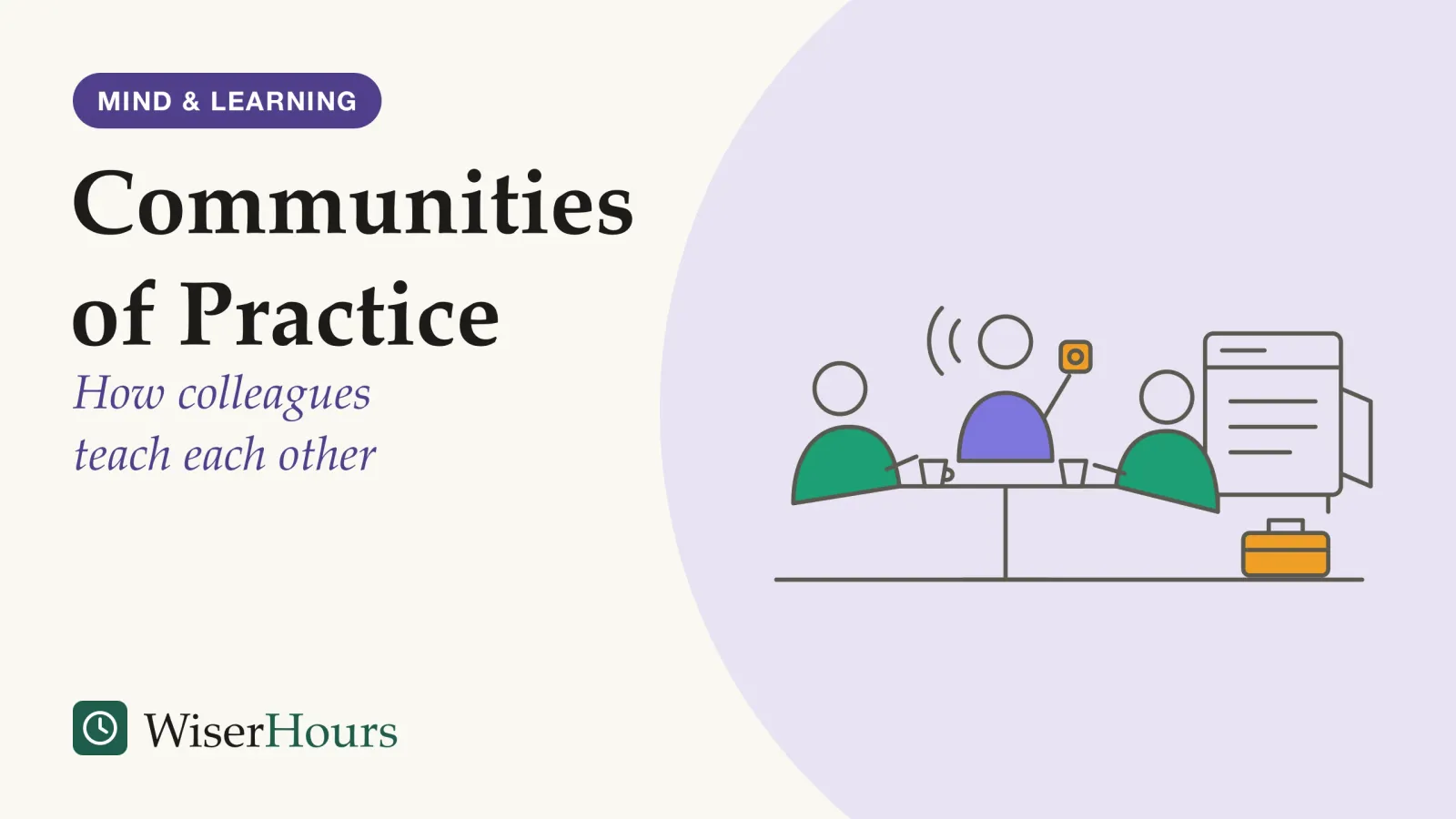
Engineers who keep a shared file of tricks and first-time managers who meet to help each other cope both belong to communities of practice, as Etienne and Beverly Wenger-Trayner describe them. Such groups share a concern or a passion for something they do and learn to do it better by interacting regularly. Three things make one: a shared domain of work, a community whose members interact and help each other, and a practice, the stock of stories, tools and fixes the members build up together.1
To start one at work, pick a narrow problem colleagues already share, find one person to coordinate, meet on a steady rhythm and write down what the group works out. How much such groups change results is still open: reviews of health care studies found the concept widely promoted, with little firm evidence on outcomes, mainly because few studies could separate a community’s effect from everything else going on.2
Communities of practice are one of the best-known forms of learning from colleagues, the part of learning how to learn well that happens with other people.
What is a community of practice?
A community of practice is a group whose members learn a shared craft from each other through regular contact, an idea set out by the anthropologist Jean Lave and the computer scientist Etienne Wenger in their 1991 book Situated Learning. They argued that learning is a social process: newcomers learn by taking part in a community of practitioners and moving, over time, toward full participation.3
Lave and Wenger called that movement legitimate peripheral participation. The examples they drew on included midwives in Yucatán, tailors in Liberia, navy quartermasters and meat cutters.4 An apprentice tailor starts with hems and simple jobs, watching how the experienced tailors work, and takes on harder garments as they go. The Wenger-Trayners add that apprentices learn mostly from journeymen and more advanced apprentices, not only from a master: the community, they write, acts as a living curriculum.1
- 1Newcomer at the edgewatches and does simple, real tasks
- 2Growing participanttakes on harder work with help from others
- 3Full participantdoes the craft and helps the next newcomers
Wenger’s later books moved the idea from apprentices toward organizations. A 2009 critique by Linda Li and colleagues in Canada traces the change: his 1998 book focused on how a person’s participation and identity grow within a group, and the 2002 book Cultivating Communities of Practice, written with Richard McDermott and William Snyder, treated communities as something organizations could deliberately cultivate to manage knowledge.5 Most workplace advice, including the steps below, comes from that 2002 version, so it carries a manager’s aims as well as a learner’s.
Communities of practice are groups of people who share a concern or a passion for something they do and learn how to do it better as they interact regularly.
The edge-to-centre path shows up in offices too: a new analyst first sits in on reviews, then drafts sections, then runs reviews and coaches the next hire. Give newcomers real but small pieces of the work early, because watching from the edge is where this kind of learning starts.
The three elements: domain, community and practice
The three elements of a community of practice, in the Wenger-Trayners’ account, are a domain, a community and a practice, and a group needs all three at once. A shared interest without regular contact is not one, and neither is regular contact without a body of shared know-how that grows over time. The domain is the area of work members care about getting better at, which gives the group its identity. The community is the contact itself: joint activities, discussions, help and shared information. The practice is what accumulates: experiences, stories, tools and ways of handling recurring problems.1
Claims processors in a large insurer have the same job, but unless they interact and learn together they are not a community of practice. Hospital nurses who talk over cases at lunch may be one without knowing it, because those conversations have given them a shared repertoire of stories and cases.1
- Domain: a shared area of work that members care about doing better
- Community: people who meet, help each other and learn together
- Practice: a growing stock of stories, tools and fixes they share
- All three at once: only where they overlap is it a community of practice
A company chat channel called “data science” has a domain and maybe some members, but if nobody asks or answers questions there, it has no community, and if nothing useful collects there, it has no practice. The Wenger-Trayners make the same point about websites: a forum, they write, is simply a forum until a community of practice moves in.1 Before launching anything new, check which of the three elements your existing groups are missing.
How a community of practice differs from a team, a project group or a course
A community of practice exists to look after what its members know, while a team or project group exists to deliver a defined piece of work. Wenger, McDermott and Snyder distinguish communities from project teams partly because members choose to join and take part voluntarily, according to Li and colleagues, who note that the line is blurrier than the book suggests.5
A rough comparison, our own simplification of the Wenger-Trayners’ introduction, the critique by Li and colleagues and Wikipedia’s summary:
| Group | What it is for | Who belongs and when it ends |
|---|---|---|
| Team | Delivering ongoing work set by the organization | Assigned under the organization’s control; lasts as long as the work does4 |
| Project group | Finishing one defined task | Assigned for the project; ends when it is done5 |
| Training course | Passing on knowledge someone has already set out | Enrolled learners; ends with the last session1 |
| Community of practice | Getting better at a shared domain of work | Mostly self-selected; lasts while members find it useful5 |
The overlap is in the people. The Wenger-Trayners stress that communities do not replace teams, and that the same people sit in both, which is what links what members learn to how the teams perform.1 A software tester on a product team might also belong to a testing community that spans several teams. The team decides what she tests this sprint; the community is where she finds out how another team caught the bug she keeps missing. When work needs a deadline and an owner, set up a team; when the same question keeps coming up across teams, that is a sign a community may be worth growing.
Example of a community of practice: the Xerox copier technicians
The classic workplace example is Julian Orr’s study of photocopier repair technicians at Xerox, published in 1996 as Talking About Machines. Orr, an anthropologist at Xerox’s Palo Alto Research Center, found that technicians solved hard problems largely by talking to each other and passing on what Orr called war stories.6
The stories were short accounts of how a technician had worked through a baffling fault. The company’s manuals offered fixed decision trees for finding faults, which Orr concluded were not designed to help technicians reason about a machine. Technicians filled that gap by eating together whenever they could and trading diagnoses; in a summary by John Seely Brown and Paul Duguid that Stewart Brand quotes, a quick breakfast could be worth hours of training. Orr judged that circulating stories was the main way the technicians kept up with how the machines behaved in the field.6
Orr himself used the term occupational community, but his study became a standard illustration of a community of practice.5 Researchers at the Palo Alto center built Eureka, a database of tips written by technicians themselves, checked by a local expert on the topic before it was shared, with the author’s name attached.6
Communities of practice also cross borders and employers. One the Wenger-Trayners describe brought public-sector internal auditors from countries in Eastern Europe and Central Asia together for years to compare how each country handled internal audit and to write manuals they felt their profession was missing.1 Explaining a fix to a colleague also teaches the person explaining, the reason the Feynman technique works by teaching, so the storyteller learns along with the listener. When a colleague cracks a hard problem, ask them to tell the story at the next meeting and write it down where others will look.
How do you start a community of practice at work?
Starting a community of practice at work comes down to four choices made before anyone meets: a narrow domain with a problem people already share, one person whose job is to keep it going, a fixed rhythm, and a place to store what the group learns. The steps below draw on practitioner guidance from Wenger, McDermott and Snyder and from the Wenger-Trayners, so treat them as advice from experience rather than tested recipes.
1. Pick a narrow domain around a real shared problem
A domain must be relevant and a priority to members, or they will not come, the Wenger-Trayners write.1 “Customer experience” is too broad. “Handling refund disputes that cross two countries’ rules” is narrow enough that everyone in the room has a story and a question. A handful of people who already ask each other about it is enough to begin; five to ten is our suggestion, not a researched number.
That question is a good candidate domain.
2. Find a coordinator
Someone has to book the room, invite people and keep conversations moving.
- Myth
- A real community of practice organizes itself and needs no leader.
- Fact
- Some do, but the Wenger-Trayners find most need cultivation, and someone has to coordinate.
The Wenger-Trayners call the idea that true communities have no leaders mostly false: whether you call them coordinators or stewards, someone needs to do it, and the role deserves recognition.1 The 2002 book also describes a champion, a respected figure who spreads the word, recruits members and finds resources, as Li and colleagues summarize it.5 Ask a manager to count the coordinator’s hours as real work.
3. Set a regular rhythm
Creating a rhythm for the community is one of the seven design principles in Cultivating Communities of Practice.7 A fixed slot of your choosing, such as a 45-minute session every second Thursday with one member bringing a live problem, is easier to keep than an open invitation to meet when useful.
4. Keep what you learn somewhere members use
The practice is the stock of what the group knows, so it needs a home: a shared document of fixes, a short case write-up after each session, a tagged channel. Let members write the entries themselves, as the Xerox technicians did for Eureka. The Wenger-Trayners say they have yet to find one technology that is best for every community; a tool is only as good as it is useful to its users.1
5. Keep it voluntary, and make it worth the time
Wenger and colleagues describe a core group that leads, an active group that takes part regularly, and a larger peripheral group that mostly watches and still learns.4 Let people sit at the edge. The organization should still recognize the value of taking part, or members will not bother, the Wenger-Trayners warn, and they say a group with no disagreement at all may be sliding into groupthink.1 Disagreement only helps if people feel safe to voice it, the condition that research on psychological safety at work examines.
6. Judge it by what members do differently
Every few months, ask members for one thing they now do differently because of the group, and check a sample: a template that is now used, a fault fixed faster, a mistake not repeated. Health care reviewers apply the same test, counting only a demonstrated change in work practice rather than members saying they had changed.2 If nobody can name anything after two or three rounds, narrow the domain or let the group close.
Before the first meeting
Wenger and colleagues describe communities passing through stages, from potential and coalescing to maturing, stewardship and transformation.7 A group that has lost its purpose can be closed and its notes kept.
Do communities of practice improve work? The evidence is thin
Communities of practice are widely promoted, but there is little firm evidence that they improve outcomes. Systematic reviews of health care found few studies able to credit a change in practice to the community itself.2
The study
Limited evidence
Many health care communities described, few shown to change care
Researchers in Sydney, Australia, reviewed 31 studies of communities of practice in health care, most of them qualitative. Earlier studies described groups set up to share knowledge; later ones used them to improve clinical practice. Efforts to measure their effect were growing, but the communities were usually part of complex, many-sided programs, which made it hard to credit any change to the community itself.2
An earlier review by Li and colleagues, covering business and health care, found no health care study that met its criteria for measuring effects, so it judged effectiveness unclear.8 A 2023 review in health care by Alexander Noar and colleagues found 50 studies but only one randomized trial. In that US trial across Veterans Affairs hospitals, hospitals approached through an existing community were far more likely to join a new heart care program than hospitals reached by the usual announcements, though the trial measured sign-up, not patients’ health. One of the review’s authors co-founded a company that hosts online communities of practice.9
Two lessons follow. First, a community of practice is a cheap way to spread know-how that comes with no proof it will pay off, so keep the first version small. Second, keep the measure on behavior, as the reviewers did; the Wenger-Trayners likewise suggest building the case by tracing how members change their practice.1
The bottom line
Colleagues who do the same work already teach each other, and a community of practice gives that habit a time, a coordinator and a place to keep what they learn. The evidence that formal ones improve results is thin, so start small and cheap. Pick one question your colleagues already ask each other, find someone to coordinate a meeting every two weeks, write down what the group works out, and after three months ask what members now do differently.
Frequently asked questions
Can a community of practice work online?
Yes. Etienne and Beverly Wenger-Trayner note that some communities meet mainly face to face and some mostly online. The 2011 health care review by Geetha Ranmuthugala and colleagues found groups that met solely or largely online and still functioned well, while another study found face-to-face meetings kept a group's energy up. What suits a group seems to depend on its members and goal.
How big should a community of practice be?
There is no set size. The Wenger-Trayners describe communities that are quite small and others that are very large, often with a small core group and many peripheral members. The core keeps things moving; the peripheral members mostly watch and learn. A new community is easier to start with a handful of committed people and grow from there.
Is a community of interest the same as a community of practice?
Not quite, in the Wenger-Trayners' definition. A community of interest is a group of people who share a taste, for example in films. Members of a community of practice are practitioners who do the work and build a shared stock of experience, tools and ways of handling recurring problems. Some researchers treat the line between the two as blurry.
Sources
- Introduction to communities of practice: a brief overview of the concept and its uses. Wenger-Trayner, E. & Wenger-Trayner, B. (2015). wenger-trayner.com
- How and why are communities of practice established in the healthcare sector? A systematic review of the literature. Ranmuthugala, G., Plumb, J. J., Cunningham, F. C., Georgiou, A., Westbrook, J. I. & Braithwaite, J. (2011). BMC Health Services Research, 11, 273
- Situated Learning: Legitimate Peripheral Participation. Lave, J. & Wenger, E. (1991). Cambridge University Press
- Community of practice. Wikipedia (accessed November 2026)
- Evolution of Wenger's concept of community of practice. Li, L. C., Grimshaw, J. M., Nielsen, C., Judd, M., Coyte, P. C. & Graham, I. D. (2009). Implementation Science, 4, 11
- The Soul of Maintaining a New Machine (Chapter 3, Communities of Practice). Brand, S. Maintenance: Of Everything. Books in Progress, Works in Progress (draft chapter)
- Cultivating Communities of Practice: A Guide to Managing Knowledge (book review). Cuddy, C. (2002). The Bottom Line, 15(2); review of Wenger, E., McDermott, R. & Snyder, W. M. (2002), Harvard Business School Press
- Use of communities of practice in business and health care sectors: a systematic review. Li, L. C., Grimshaw, J. M., Nielsen, C., Judd, M., Coyte, P. C. & Graham, I. D. (2009). Implementation Science, 4, 27
- The aims and effectiveness of communities of practice in healthcare: A systematic review. Noar, A. P., Jeffery, H. E., Subbiah Ponniah, H., et al. (2023). PLOS ONE, 18(10), e0292343
How we researched this
In November 2026 we searched three research databases (Europe PMC, Crossref and OpenAlex) and ran web searches to find the founding books on communities of practice, practitioner guidance from Etienne and Beverly Wenger-Trayner, accounts of Julian Orr's study and systematic reviews of their effects. Every systematic review was read in full, and the research sources date from 1991 to 2023. We could not read the founding books or Orr's book directly and relied on publishers' pages, reviews and later accounts of them, which is the main limitation.
Keep reading

How to Prepare for the TOEFL While Working Full Time
How to prepare for the 2026 TOEFL on 6 to 10 hours a week: a full mock first, practice on your weakest task types, a second mock, then rest.
Comprehensible Input Explained: Can You Learn a Language by Listening?
Comprehensible input, Krashen's 1982 idea, builds vocabulary and listening skill, but speaking with feedback adds what input alone rarely gives.

How to Use Dual Coding: Combining Words and Visuals When You Study
Dual coding pairs words with a visual of the same idea, giving a memory two routes back. 5 steps to use it when you study, and when pictures backfire.
The Four Stages of Competence: From Clueless to Automatic
The four stages of competence, best known from a 1969 column (not Maslow), with what skill research adds and why experts find their own skills hard to teach.