How Much Do Meetings Really Cost? A Simple Way to Calculate It
Cost of meetings, step by step: attendees times hourly pay plus benefits times hours, plus prep and recovery. Six people for an hour: about $400 (US, 2026).

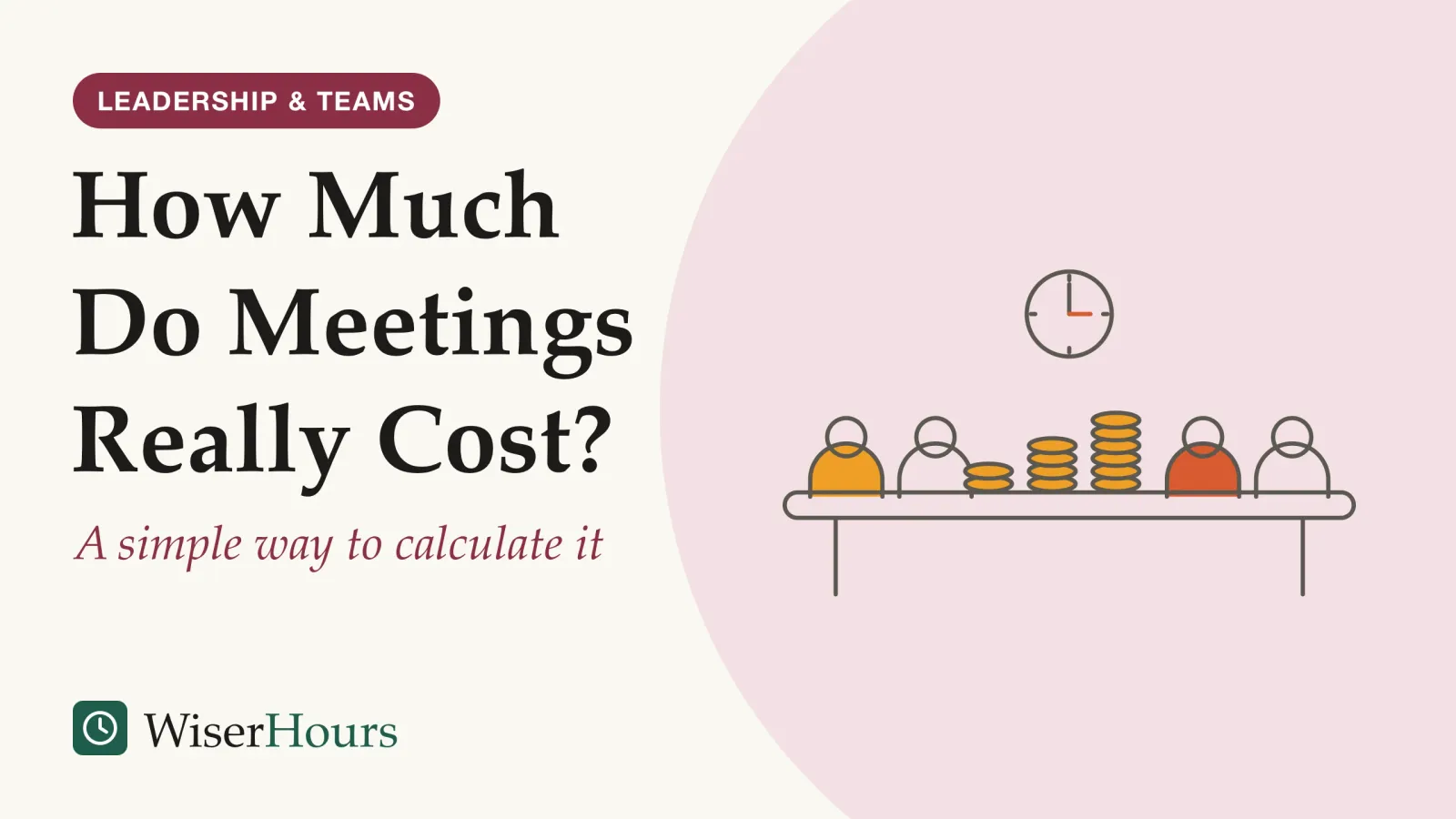
Monday’s planning call has six names on the invite and a one-hour slot. The organizer spent part of the morning on the agenda, two people skimmed last week’s notes, and afterward everyone takes a while to settle back into their own work. The calendar shows one hour. The employer pays for far more.
The cost of meetings is simple to estimate for your own team: multiply the number of attendees by each person’s hourly cost to the employer and by the meeting’s length, then add preparation and recovery time. Official US labor statistics show that employers pay a large share on top of wages for every hour worked, so an estimate built on salary alone understates what a meeting costs.1 The steps:
- Count the attendees and the booked time
- Put an hourly cost on each person
- Add preparation and recovery time
- Multiply by how often the meeting runs
- Set the total against what the meeting produces
This guide prices the meetings on your own calendar. Headline totals for whole economies, such as billions lost each year, are a separate question, and the guide to why meetings fail and which meeting statistics hold up traces where those figures come from.
The cost of meetings starts with person-hours
A meeting’s basic cost is measured in person-hours: the number of people multiplied by the time they spend in it. Rogelberg, Kreamer and Gray’s 2026 review of three decades of meeting science describes the typical workplace meeting as scheduled in advance and lasting half an hour to an hour on average, so small changes in either number move the total quickly.2
The reason is plain arithmetic, but it is easy to miss because a calendar shows a meeting as one block of time. The organizer sees a half-hour slot. The employer pays for that half-hour once for every attendee, whether each person speaks, listens or answers email under the table.
Consider a half-hour project check-in with eight people. It looks like a short meeting. It is four person-hours, the same as one person spending half a working day on the project. Cut two people who only need the notes and you free an hour and a half of paid time every time it runs, without shortening the meeting at all.
Before you book a meeting, multiply the attendees by the length and look at the result in hours. If that number surprises you, the invite list or the length deserves a second look before pay even enters the sum.
Worked example: pricing one recurring hour
A one-hour meeting of six people, held every week, costs about $400 each time on round US figures for 2026 once preparation and recovery are counted. The five steps below show where that number comes from, so you can repeat them with your own meeting.
The inputs are illustrative: six people, one hour a week, and a pay-plus-benefits cost of about $50 an hour, the rounded US average for June 2026 from the BLS survey explained in the next section.1 A recurring meeting is the best one to start with, because whatever it costs, it costs again next week.
1. Count the attendees and the booked time
Six people for one hour is six person-hours. Include the organizer, anyone who joins by video, and the person taking notes.
2. Put an hourly cost on each person
At about $50 an hour each (US, June 2026), the meeting itself costs about $300. If attendees include managers or specialists, use a higher figure for them rather than one average for everyone.
3. Add preparation and recovery time
Assume ten minutes of preparation and ten of recovery per person. That is two more person-hours, or about $100, which brings the meeting to about $400. These allowances are assumptions: ask your team what they actually spend, because an organizer who writes the agenda and the notes may spend far longer.
4. Multiply by how often the meeting runs
A meeting held in 45 weeks of the year comes to about $18,000 on these assumptions. Small weekly costs add up over a year, which is why a standing slot deserves more scrutiny than a one-off.
People: 6
everyone in the room or on the call
Per hour: $50
pay plus benefits per person (US average, June 2026, rounded)
Length: 1 hr
the booked time: $300 so far
Extra time: +$100
10 minutes of preparation and 10 of recovery per person: 2 more person-hours
One meeting: $400
about $18,000 if it runs in 45 weeks of the year
To price one of your own meetings, change the inputs below. The calculator starts from the same example, so its first result matches the sum above.
Meeting cost calculator
- Person-hours
- 6 booked, 8 with preparation and recovery
- Booked time
- about $300
- With preparation and recovery
- about $400
- A year, at 45 meetings
- about $18,000
An estimate of paid time, not money saved, and not a verdict on whether the meeting is worth it. Preparation and recovery are assumptions: ask your team what they really spend.
5. Set the total against what the meeting produces
The price says nothing about value on its own. Write down what the meeting decided, unblocked or prevented in the last month, then ask whether that was worth the money, or whether some of it could have happened in writing.
Price one recurring meeting this week
Why salary alone understates the hourly cost
The hourly cost to use is what the employer pays for an hour of work, not the salary divided by the hours in a year. The US Bureau of Labor Statistics (BLS) measures exactly this in its Employer Costs for Employee Compensation survey, which adds benefits such as paid leave, insurance, retirement contributions and legally required payments to wages.1
The study
Strong evidence
BLS employer costs, June 2026: pay plus benefits per hour worked
In June 2026, US civilian employers paid an average of $49.46 per hour worked in wages and benefits combined. In private industry, benefits made up 30 percent of employer costs, and for management, professional and related jobs the total was $78.88 an hour.1
Two details matter for meetings. The cost is per hour worked, so paid holidays and sick days are spread across the hours people are actually at work, which is when meetings happen. And the averages hide wide differences between jobs: in the same survey, an hour of management and professional work cost private employers roughly twice an hour of office and administrative support work.1 A meeting of five managers and one assistant is priced very differently from the reverse.
UK readers can build a similar figure from two Office for National Statistics (ONS) sources. Its annual earnings survey put median hourly pay for full-time employees, excluding overtime, at £19.67 in April 2025.3 In the UK national accounts, employers’ social contributions cover their payments into employees’ pension schemes and their National Insurance contributions.4 By our calculation from two ONS series, those contributions added about 23 percent on top of wages and salaries across the economy in 2025.5 Applying that economy-wide share to median pay suggests roughly £24 an hour for a full-time employee (UK, 2025), a rough guide rather than an official statistic, because an individual employer’s pension and National Insurance costs can sit above or below the average. Elsewhere, your national statistics office is the place to look.
In practice, price each attendee at pay plus employer costs. If you only know salaries, treat the result as a floor. Where you do not know individual pay, and often should not, an average for the kind of work people do is accurate enough for the decisions this number supports.
The time before and after a meeting counts too
A meeting also costs the time people spend preparing for it and the time they need afterward to get back into their own work. Neither has a standard measured value, but both are real, and the organizer usually carries most of the first.
Preparation is what makes a meeting worth having. The 2026 review reports that meetings are more effective when attendees come prepared, and that managers say they spend more time preparing for and leading meetings than on any other work activity.2 Company data shows the same last-minute rush: Microsoft, which sells the Teams meeting software, reported from anonymized Microsoft 365 data in 2025 that PowerPoint edits more than doubled in the final minutes before meetings.6
Recovery is the other end. In an online survey of 195 US full-time employees whose most recent meeting had been virtual, run in April 2020 and published in 2022, Joseph Allen’s team found that those who rated that meeting less satisfying reported a greater need to recover before moving on, and the link depended on how relevant the meeting was to them.7 The study was a single snapshotcross-sectional: Describes a study that measures everyone in its sample at a single point in time. Because the possible cause and the outcome are recorded together, it can show that two things occur together but not which of them came first.Full entry in the glossary, so it cannot say whether unsatisfying meetings drain people or already-tired people rate their meetings lower. The drop in focus after switching tasks, known as attention residue, may be one reason the gap between meetings is rarely fully productive.
Take a manager with meetings at ten, eleven and two o’clock. The half-hours in between look free on the calendar, but most of each goes on reading the next agenda and recovering from the last meeting. That time belongs in the cost.
The review’s own advice fits this: block short recovery breaks after meetings rather than booking them back to back.2
Why published meeting-time figures may not fit your team
Estimates of how many hours people spend in meetings vary widely, because they depend on who was asked, how and by whom. For your own cost figure, your team’s calendar, plus the calls that never reach it, is a better input than any published average.
Two surveys show the spread. In a 2022 report that Otter.ai, a maker of AI meeting-transcription software, produced with Steven Rogelberg, 632 volunteers reported spending 18 hours a week in meetings on average.8 The report priced those hours from each person’s salary, so by the BLS measure it leaves out benefits. The Allen study’s online sample of full-time US employees, surveyed in April 2020, reported about 4 hours a week.7 Both rely on people’s own estimatesself-report: A measure in which people describe their own behavior, feelings or circumstances, usually by answering a questionnaire. When the same person supplies both of the things being compared, shared habits of answering can make the link between them look stronger than it is.Full entry in the glossary, and neither sample represents all workers.
Calendars miss a lot too. In usage data Microsoft published in 2025, more than half of meetings were ad hoc calls without a calendar invitation, so a count of scheduled meetings alone would understate the time involved.6 Company calculators share the limit of their company’s data. Shopify built one into its employees’ calendar app in 2023 that priced meetings of three or more people from the company’s own average pay data by role, Fortune reported; its figures describe Shopify’s workforce, not yours.9
What to do instead: take one ordinary week from your own calendar, add the unscheduled calls you remember, and use that total. It will fit your team better than any survey figure.
What a cost figure can and cannot tell you
A meeting’s cost is a floor on what the employer pays for it, not a verdict on whether it is worth holding. It measures paid time, not cash: cancelling a meeting frees hours for other work but does not by itself lower the wage bill. A two-hour planning session that stops a team building the wrong thing for a month is cheap; a weekly status round that repeats what is already written down is expensive at any length.
The number is most useful for comparisons. Set a meeting against its alternatives: a shorter slot, fewer attendees, or a written update with a smaller decision meeting afterward. It also helps a manager explain why a recurring meeting is changing, in terms everyone understands.
Evidence that putting a price on meetings changes behavior is thin. Shopify’s calculator was part of a wider push to cut meetings, so any change cannot be credited to the price display alone, and we could not locate a controlled test of the display itself.9 Treat the cost as a prompt for a conversation about purpose and attendees, not as a proven fix.
Keep individual pay out of the invitation
A cost figure built from each attendee’s actual salary can reveal confidential pay to everyone who sees it. Averages by job type give a good enough estimate without that risk.
Each input to the formula rests on evidence of a different strength.
| Input | What the best evidence found | Evidence |
|---|---|---|
| Hourly cost, US | Employers pay benefits on top of wages for every hour worked; costs vary widely by occupation | Official statistics, national employer survey (observational, strong)1 |
| Hourly cost, UK | Median pay is published by occupation; employers’ social contributions add a little over a fifth on top | Official statistics (observational, strong)35 |
| Preparation time | Recommended for effective meetings; managers report it as a large part of their week; no standard measured amount | Narrative review (expert, limited)2 |
| Recovery time | Less satisfying meetings went with a greater need to recover, depending on relevance | One cross-sectional survey of 195 US employees (observational, limited)7 |
| Time in meetings | Self-reported averages range from about 4 to 18 hours a week across samples | Two self-report surveys, one produced by a software company (observational, limited)78 |
| Unscheduled calls | More than half of meetings in company data had no calendar invite | Company telemetry, not peer-reviewed (observational, limited)6 |
The bottom line
A meeting’s price is its head count times its length times what an hour of each person’s work costs the employer, plus the time spent getting ready and getting back. Use pay plus benefits rather than salary, your own calendar rather than published averages, and state your assumptions next to the result. Then weigh the total against what the meeting produces, because the cheapest meeting is not always the one worth keeping.
This article is general education, not financial advice. For decisions about your own money, speak to a qualified, regulated adviser.
Frequently asked questions
How do I estimate a meeting's cost if I don't know colleagues' pay?
Use published averages for the kind of work people do. In the US, the Bureau of Labor Statistics publishes employer costs per hour worked by occupational group, benefits included. In the UK, the Office for National Statistics publishes hourly pay by occupation in its annual earnings survey, to which you add employer costs such as pension and National Insurance contributions. Label the result as an estimate.
Should the organizer count their own time?
Yes. The organizer is an attendee with extra work before the meeting starts. A 2026 review of meeting science by Steven Rogelberg and colleagues reports that managers say they spend more time preparing for and leading meetings than on any other work activity, so the organizer's preparation time belongs in the estimate.
Do meeting cost calculators make meetings shorter?
The evidence is thin. Some companies, Shopify among them in 2023, have built cost estimates into their calendar apps, but we could not locate any controlled study of whether seeing a price changes how long or how often people meet. Treat a calculator as a prompt for a conversation about purpose and attendees, not as a proven way to cut meeting time.
Is a video call cheaper than meeting in person?
Only by the travel it saves. Each attendee's paid time costs the same on a screen as in a room, so the core formula does not change. Preparation and recovery still apply: a study published in 2022 of US employees whose last meeting was virtual found that less satisfying meetings went with a greater need to recover afterward.
Sources
- Employer Costs for Employee Compensation - June 2026 (news release USDL-26-1494, with technical note and Table 4). US Bureau of Labor Statistics (2026). Economic News Release, 9 September 2026
- Thirty Years of Meeting Science: Lessons Learned and the Road Ahead. Rogelberg, S., Kreamer, L. M. & Gray, J. (2026). Annual Review of Organizational Psychology and Organizational Behavior, 13
- Employee earnings in the UK: 2025. Office for National Statistics (2025). Annual Survey of Hours and Earnings statistical bulletin, 23 October 2025
- Regional accounts methodology guide: June 2019 (section on social contributions). Office for National Statistics (2019). Methodology guide
- HH & NPISH: Employers' social contribution (D.12), current prices, series ROYK (with wages and salaries, series ROYJ). Office for National Statistics (2026). UK Economic Accounts time series, released 30 June 2026
- Breaking down the infinite workday. Microsoft WorkLab (2025). Work Trend Index special report, 17 June 2025; Microsoft 365 telemetry
- Why Am I So Exhausted?: Exploring Meeting-to-Work Transition Time and Recovery From Virtual Meeting Fatigue. Allen, J. A., Thiese, M. S., Eden, E. & Knowles, S. E. (2022). Journal of Occupational and Environmental Medicine, 64(12)
- The Cost of Unnecessary Meeting Attendance. Otter.ai with Steven G. Rogelberg (2022). Company-funded survey report
- Shopify's CFO explains how its new meeting cost calculator works, and how it will cut 474,000 events in 2023: 'Time is money'. Estrada, S. (2023). Fortune, 14 July 2023
How we researched this
We used official labor-cost statistics published by the US Bureau of Labor Statistics and the UK Office for National Statistics, a 2026 review of meeting science, a peer-reviewed survey on meeting recovery, and company research from Microsoft and Otter.ai, which the text identifies as company research. Sources span 2019 to 2026 (the 2019 item is an ONS definitions guide) and were searched in September 2026. Main limitation: preparation and recovery time have no standard measured values, so the worked example uses stated assumptions.
Keep reading
Why Meetings Fail: What the Research on Meeting Science Shows
Why meetings fail: in 92 videotaped team meetings, complaining was more strongly linked to poor outcomes than problem-solving talk was to good ones.
How to Get Quiet People to Speak Up in Meetings
How to get quiet people to speak up in meetings: 6 steps from research on why employees stay silent, from the decision rule to a private second route.
How to Run a Daily Stand-Up That Takes 15 Minutes, Not 45
A daily stand-up earns its 15 minutes when teammates plan today and raise blockers instead of reporting yesterday. Six steps from research on real teams.