False Memories: Why You Remember Things That Never Happened
False memories can feel as certain as real ones. How they form, what makes them likelier, the Mandela effect and 5 ways to check a memory.

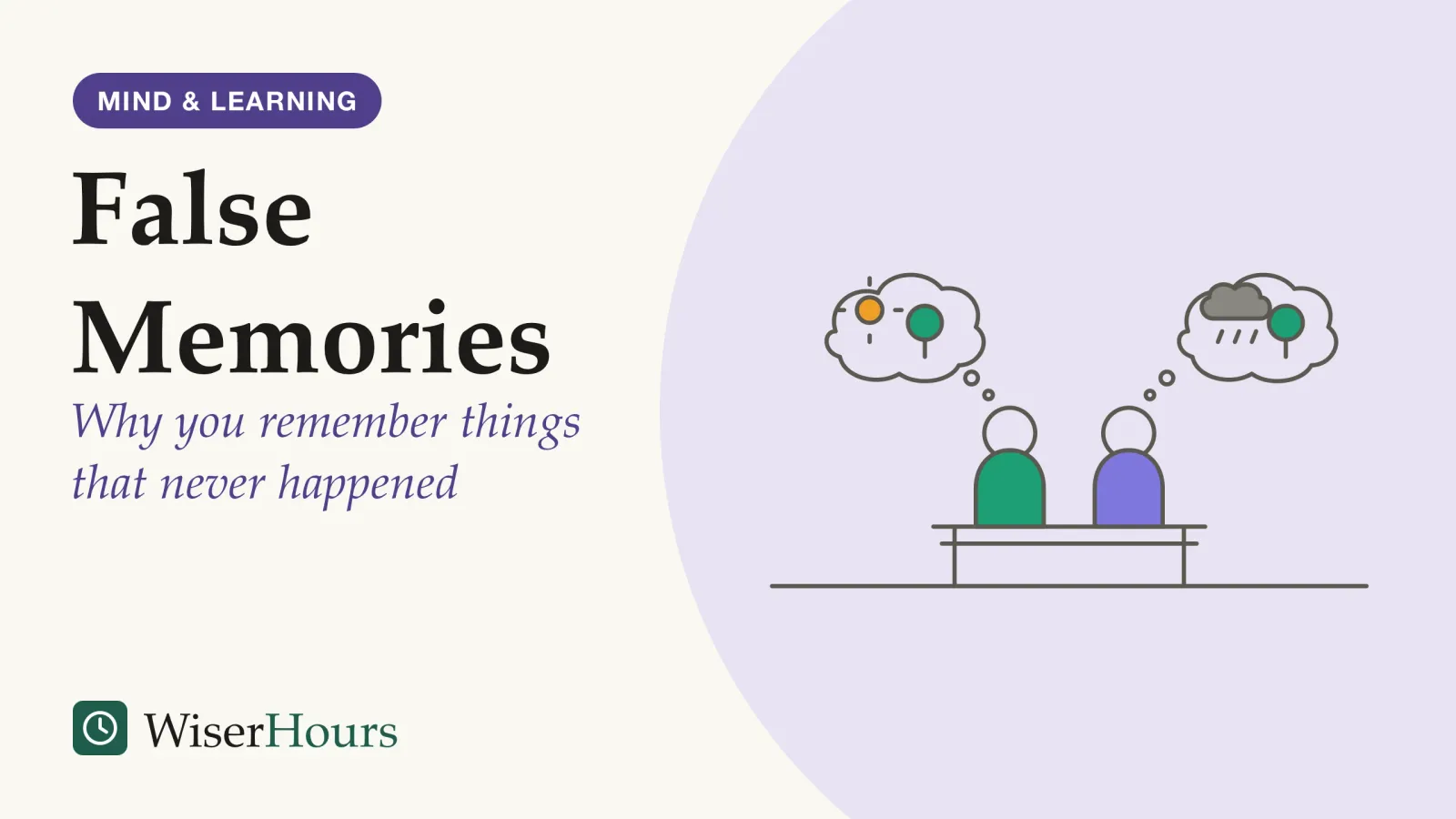
Feeling sure you remember something says surprisingly little about whether it happened. False memories are recollections of events that never happened, or that happened differently, and they arrive with the same vivid, confident sense of “I remember this” as true ones. Across eight studies that tried to plant a childhood event, a 2017 mega-analysis led by Alan Scoboria classed about 3 in 10 participants’ accounts as false memories.1
The reason lies in how recall works: the brain rebuilds each memory from fragments, general knowledge and whatever it has heard since, the step explained in why recall rebuilds a memory instead of replaying it. Usually the rebuild is close enough. So when a memory matters, check it against a record made at the time instead of how certain you feel.
Prefer to watch? The video covers the same ground as this article.
Why a false memory feels exactly like a real one
A false memory is a memory of an event, detail or word that was never there, held with the same feeling of remembering as a real one. Henry Roediger and Kathleen McDermott showed how easily it forms in a 1995 word-list experiment, now called the DRM task, with undergraduates at Rice University in the US.2
False memory, in one sentence
A false memory is a recollection of something that did not happen, or did not happen the way it is recalled, experienced as a genuine memory rather than a guess.
The students heard lists such as bed, rest, awake, tired and dream, every word linked to one word that was never read out: sleep. Asked to write down what they had heard, they included the missing word on 40 percent of the lists. On a later recognition test they picked it out almost as often as words that really were read out, and in a second experiment most who picked it said they could remember hearing it, not just that it seemed familiar.2
The authors’ explanation is simple. Each related word brings “sleep” to mind, and later you cannot tell a word you thought of from a word you heard. Psychologists call this a source monitoring error: the content is real, but its origin is misfiled.2 You meet it at work when you are sure a colleague raised a point in a meeting that you only thought of, or when a story someone told you turns into something you “saw”.
An excellent memory offers no protection. In a 2013 US study led by Lawrence Patihis, people with highly superior autobiographical memory, who can retrieve their own past in unusual detail, fell for the word-list illusion, as did age- and sex-matched controls.3 So read your own certainty as a measure of how easily a memory comes back, not of whether it is accurate.
- Myth
- If I remember it vividly and feel sure, it happened.
- Fact
- False memories can come with vivid detail and certainty, and even people with exceptional autobiographical memory form them.
Whole childhood events can be planted too
Researchers can lead adults to recall entire childhood events that never happened, using a family story and a few interviews. Elizabeth Loftus and Jacqueline Pickrell first showed it in their 1995 “lost in the mall” study, and a 2023 preregisteredpreregistration: Filing a study's hypotheses and analysis plan publicly before the data are collected or examined. It stops a planned test from being rewritten once the results are in, so a reader can tell a real confirmation from a hunt through the data.Full entry in the glossary replication in Ireland found the effect again with five times as many people.4
The method is low-tech. A relative supplies three true stories from the participant’s childhood, and the researchers add a fourth, invented one: getting lost in a shopping mall, being found by an older person and reunited with the family. Participants write about all four, then talk them over in two interviews.
The study
Moderate evidence
Lost in the mall, 28 years on: the Irish replication
Gillian Murphy’s team at University College Cork and University College Dublin repeated the original study with 123 adults aged 18 to 57. Coders judged that 35% formed a full or partial false memory of being lost in a mall, against 25% of 24 people in the 1995 original. Asked directly before the debrief, 14% said they remembered the fake event and a further 52% said they believed it had happened. In an extension, about 1,000 online mock jurors who read interview extracts were generally inclined to believe the invented event had happened.4
The jurors matter more than the exact rate: ordinary readers tended to accept a planted memory as real, going by how it sounded. Two limits apply. Most participants were recruited through the student researchers’ personal networks, and, as the authors note, getting lost in a mall is quite a common event, so some participants may really have been lost as children.
How often suggestion yields a full false memory remains disputed. Chris Brewin and Bernice Andrews, pooling implantation studies in their 2017 systematic reviewsystematic review: A review that fixes its question and its rules for including studies in advance, then searches out every study that fits and weighs them together. Some systematic reviews pool the results into a meta-analysis; others describe what the studies found without combining the numbers.Full entry in the glossary, found some recollection of the suggested event in about half of participants on average, but in only about 15 percent were the experiences likely to be rated full memories, and they concluded that susceptibility appears more limited than has been suggested.5 Both camps agree on the core point: suggestion repeated by a trusted source can produce a memory that feels real.
Doctored photos and imagined scenes
Pictures and imagination can do the work of a family story. In a 2002 study led by Kimberley Wade at Victoria University of Wellington in New Zealand, 20 participants saw a doctored photo of themselves as children on a hot air balloon ride and tried to recall it with guided imagery over three interviews; half created a complete or partial false memory of the ride.6
Imagination carries much of the effect. Brewin and Andrews’s review found that imagining a childhood event raises belief that it happened by a small amount, so the event still seems unlikely.5 In the 2017 mega-analysis, the rate of false memories was higher when the suggestion carried personal details and an imagination exercise and, perhaps surprisingly, when no photo of the event was shown.1
In daily life, an old photo you have seen many times can stand in for the day itself, and an edited or misdated image can carry a memory along with it. When a memory rests mainly on a picture, or on a scene you have often replayed, treat it as a reconstruction until something else confirms it.
What causes false memories, and what makes them more likely?
False memories come from the brain filling gaps with related knowledge, suggestion and imagination, then losing track of where each piece came from. Several conditions raise the odds, and nearly all of them are part of ordinary life.
| Condition | What the research found | Evidence |
|---|---|---|
| Related ideas | Words linked to an unheard word led people to recall and recognize it | US lab experiments with students, 19952 |
| Misleading information after the event | Exposure to misleading details impairs memory of the original; warnings help only under limited conditions | Review of three decades of studies, 20057 |
| Repeated suggestion from a trusted source | A relative’s invented story plus interviews produced full or partial false memories in a minority | Preregistered replication, Ireland, 20234 |
| Imagining the event | Imagination raised belief in a suggested event a little and was linked to more implanted memories | Systematic review and mega-analysis, 201751 |
| Sleep loss while taking the event in | On a misinformation task, 24 hours without sleep increased false memories when people were deprived while taking in the event, with no clear effect when it came after | US lab experiments, 20148 |
Look at how everyday these are. Talking an event over with someone who remembers it differently, reading coverage of it or replaying it in your head all supply material that can later feel like your own. Being badly short of sleep when something happens may add to the risk, and how much sleep adults need is a fair place to start if you often run short.
So when an event matters, such as an incident at work, a medical appointment or a dispute, write down what you saw before you discuss it with anyone else.
How can you tell if a memory is real?
From the inside, you often cannot. The American Psychological Association’s 1995 guidance on memories of childhood abuse states that, without other corroborating evidence, it is impossible to distinguish a true memory from a false one, and a 2009 review by Daniel Bernstein and Elizabeth Loftus notes that researchers’ techniques measure groups of memories, while police and lawyers must decide whether one person can be believed.910
That means the test lives outside your head. Suppose you are certain you sent a client the revised figures last Tuesday. Your sent folder settles it in seconds, and so does the file’s version history; a memory of clicking send is much weaker evidence than either.
5 ways to check a memory that matters
None of these steps makes a memory true or false. They tell you how much weight it can bear, and that is the question to settle before you act on it, argue about it or repeat it. These checks suit everyday memories; for a memory of abuse or trauma, support comes first, as the section on recovered memories explains.
What is the Mandela effect?
The Mandela effect is the name for a false memory that many people share, such as recalling that the Monopoly mascot wears a monocle when he never has. The name comes from paranormal researcher Fiona Broome’s memory, shared by others online, of Nelson Mandela dying in prison in the 1980s, which never happened. In 2022, Deepasri Prasad and Wilma Bainbridge of the University of Chicago put its visual form to the test.11
In the first of four experiments, 100 US adults recruited online saw three versions of each of 40 well-known logos and characters, one correct and two subtly changed, and chose the one they thought was right. For a handful of images, including Pikachu, C-3PO and the Volkswagen logo, people chose the same wrong version, confidently and despite rating the image as familiar. Later experiments found no sign that people looked at these images differently, and no clear difference in how often the wrong versions turn up online.11 An independent project, Transparent Replications, repeated the first experiment in 2024 and found the same seven images, plus one more.12
Agreement, then, is not proof. Many people recalling the same wrong detail feels like confirmation, yet it can simply mean everyone’s memory filled the gap in the same plausible way. The record-first checks above work here too: the logo itself settles the question in a second.
Recovered memories of abuse: what researchers and clinicians agree on
Recovered memories, memories of childhood abuse that a person says were forgotten and later remembered, sit at the center of a long dispute called the memory wars. The APA’s 1995 guidance, now archived on its website, sets out the shared ground: most people who were sexually abused as children remember all or part of what happened, a forgotten memory of early childhood abuse can, rarely, be remembered later, and convincing false memories of events that never occurred can also be created.9
Both things can be true at once, and neither cancels the other. Forgetting something and later remembering it when a reminder comes along is normal and needs no special theory. The live dispute is about repression: the idea that trauma can block a memory entirely for years. A 2019 review by Henry Otgaar and colleagues, including Loftus, called repression and its newer label, dissociative amnesia, scientifically controversial, and gathered clinician surveys from countries including Norway, South Africa, the Netherlands and the US showing that belief in it is still widespread. The same review notes that other researchers read the evidence the opposite way, so the dispute is not settled.13
The concern behind the research is specific. In the 1990s, some therapists used suggestive techniques to search for memories of abuse that patients did not recall, and early false-memory studies grew out of worries about those methods.13 That history concerns techniques, not people who disclose abuse, and it gives no grounds to doubt someone who has always remembered.
If a memory, or the possibility of one, is troubling you, the APA, a US body, advises seeing a licensed practitioner with training in the issue (licensing rules vary by country) and being wary of any therapist who offers an instant abuse explanation for current problems or who dismisses reports of abuse without exploring them. A competent therapist, it says, sticks to the facts as you report them and does not steer you toward a conclusion.9
When to talk to someone
A memory question becomes a health question when it is causing distress. Start with whichever of these three fits how you feel today.
- Now: if you are not safe, including from thoughts of ending your life or of hurting yourself, phone the local emergency number straight away. Free, confidential crisis lines in many countries are listed by Find A Helpline; two examples are 988 in the US and Samaritans (116 123) in the UK.141516
- Soon: if memories of past events, whether certain or uncertain, are disturbing your sleep, work or relationships, contact a doctor or a licensed mental health professional in your country.
- Routine: if a wrong memory leaves you curious or unsettled, ordinary adults form such memories throughout the research above; if memory errors seem frequent or worry people close to you, mention it at a routine doctor’s visit.
The bottom line
A memory that feels certain can still be a rebuild with borrowed parts, because the brain reconstructs the past each time and loses track of where the pieces came from. Suggestion, imagination, related ideas and misleading information all make false memories more likely, and in implantation studies roughly 3 in 10 accounts were classed as false memories. Certainty is a feeling, so when a memory matters, check it against a record made at the time.
This article is general information, not medical advice. If you're worried about your health, talk to a doctor or another qualified professional.
Frequently asked questions
Do false memories mean something is wrong with your memory?
No. False memories turn up in ordinary adults throughout the research, from word lists to planted childhood events. A 2013 US study led by Lawrence Patihis tested people with highly superior autobiographical memory, who recall their own past in unusual detail. Like matched controls, they fell for false word memories, and they showed more false memory for misleading details in one task.
Are memories of traumatic events more accurate than everyday ones?
Nobody knows for certain. The American Psychological Association's 1995 guidance notes that researchers cannot ethically put people through a traumatic event to test their memory of it, so whether trauma is stored differently has not been studied directly. Most people who were sexually abused as children remember all or part of what happened, according to the same APA guidance.
Does being warned about misleading information protect you?
Only partly. In a 2005 review of three decades of misinformation research, Elizabeth Loftus concluded that warnings sometimes reduce the effect of misleading information, but only under limited circumstances. A practical habit is to write down your own account before you hear anyone else's, so you have a record that later suggestions cannot change.
Sources
- A mega-analysis of memory reports from eight peer-reviewed false memory implantation studies. Scoboria, A., Wade, K. A., Lindsay, D. S., Azad, T., Strange, D., Ost, J. & Hyman, I. E. (2017). Memory, 25(2)
- Creating false memories: Remembering words not presented in lists. Roediger, H. L., III & McDermott, K. B. (1995). Journal of Experimental Psychology: Learning, Memory, and Cognition, 21(4)
- False memories in highly superior autobiographical memory individuals. Patihis, L., Frenda, S. J., LePort, A. K. R., Petersen, N., Nichols, R. M., Stark, C. E. L., McGaugh, J. L. & Loftus, E. F. (2013). PNAS, 110(52)
- Lost in the mall again: a preregistered replication and extension of Loftus & Pickrell (1995). Murphy, G., Dawson, C. A., Huston, C., Ballantyne, L., Barrett, E., Cowman, C. S., Fitzsimons, C., Maher, J., Ryan, K. M. & Greene, C. M. (2023). Memory, 31(6)
- Creating Memories for False Autobiographical Events in Childhood: A Systematic Review. Brewin, C. R. & Andrews, B. (2017). Applied Cognitive Psychology, 31(1)
- A picture is worth a thousand lies: Using false photographs to create false childhood memories. Wade, K. A., Garry, M., Read, J. D. & Lindsay, D. S. (2002). Psychonomic Bulletin & Review, 9(3)
- Planting misinformation in the human mind: A 30-year investigation of the malleability of memory. Loftus, E. F. (2005). Learning & Memory, 12(4)
- Sleep deprivation and false memories. Frenda, S. J., Patihis, L., Loftus, E. F., Lewis, H. C. & Fenn, K. M. (2014). Psychological Science, 25(9)
- Questions and answers about memories of childhood abuse. American Psychological Association (1995; archived page, checked 2026-10-06)
- How to Tell If a Particular Memory Is True or False. Bernstein, D. M. & Loftus, E. F. (2009). Perspectives on Psychological Science, 4(4)
- The Visual Mandela Effect as Evidence for Shared and Specific False Memories Across People. Prasad, D. & Bainbridge, W. A. (2022). Psychological Science, 33(12)
- Report #8: Replication of a study from The Visual Mandela Effect as Evidence for Shared and Specific False Memories Across People. Handley-Miner, I. & Metskas, A. (2024). Transparent Replications, Clearer Thinking
- The Return of the Repressed: The Persistent and Problematic Claims of Long-Forgotten Trauma. Otgaar, H., Howe, M. L., Patihis, L., Merckelbach, H., Lynn, S. J., Lilienfeld, S. O. & Loftus, E. F. (2019). Perspectives on Psychological Science, 14(6)
- Find A Helpline. Find A Helpline (accessed 2026)
- 988 Suicide & Crisis Lifeline. 988 Suicide & Crisis Lifeline, United States (accessed 2026)
- Contact Samaritans. Samaritans, United Kingdom (accessed 2026)
How we researched this
We searched PubMed, Europe PMC, Crossref and OSF in October 2026 for the classic false-memory experiments, their replications, a mega-analysis and a systematic review of implantation studies, and APA guidance on memories of abuse. We read the full text of the word-list study, the 2013 superior-memory study, the 2023 replication, the systematic review, the Mandela-effect preprint and replication report, and a 2019 review; five sources were read at abstract level. Main limitation: most studies are lab or online experiments with students or volunteers.
Keep reading

Is Photographic Memory Real? What Science Says
Is photographic memory real? No adult has passed repeated tests. Eidetic images appear in an estimated 2 to 10% of children; trained and rare memories are real.
The Types of Memory: Short-Term, Long-Term, Episodic, Semantic, and More
The main types of memory on one map: 3 stages, then long-term memory split into explicit and implicit kinds, with what each means and where experts disagree.

How to Improve Your Memory: What the Evidence Actually Supports
How to improve memory: 7 habits ranked by evidence, led by testing yourself and spacing reviews, and why brain games and supplements fall short.
How Memory Works: Encoding, Storage, and Retrieval Explained
How memory works in 3 stages: encoding, storage and retrieval. Why meaning helps words stick, why you hold about 4 chunks and why recall rebuilds.