The Types of Memory: Short-Term, Long-Term, Episodic, Semantic, and More
The main types of memory on one map: 3 stages, then long-term memory split into explicit and implicit kinds, with what each means and where experts disagree.

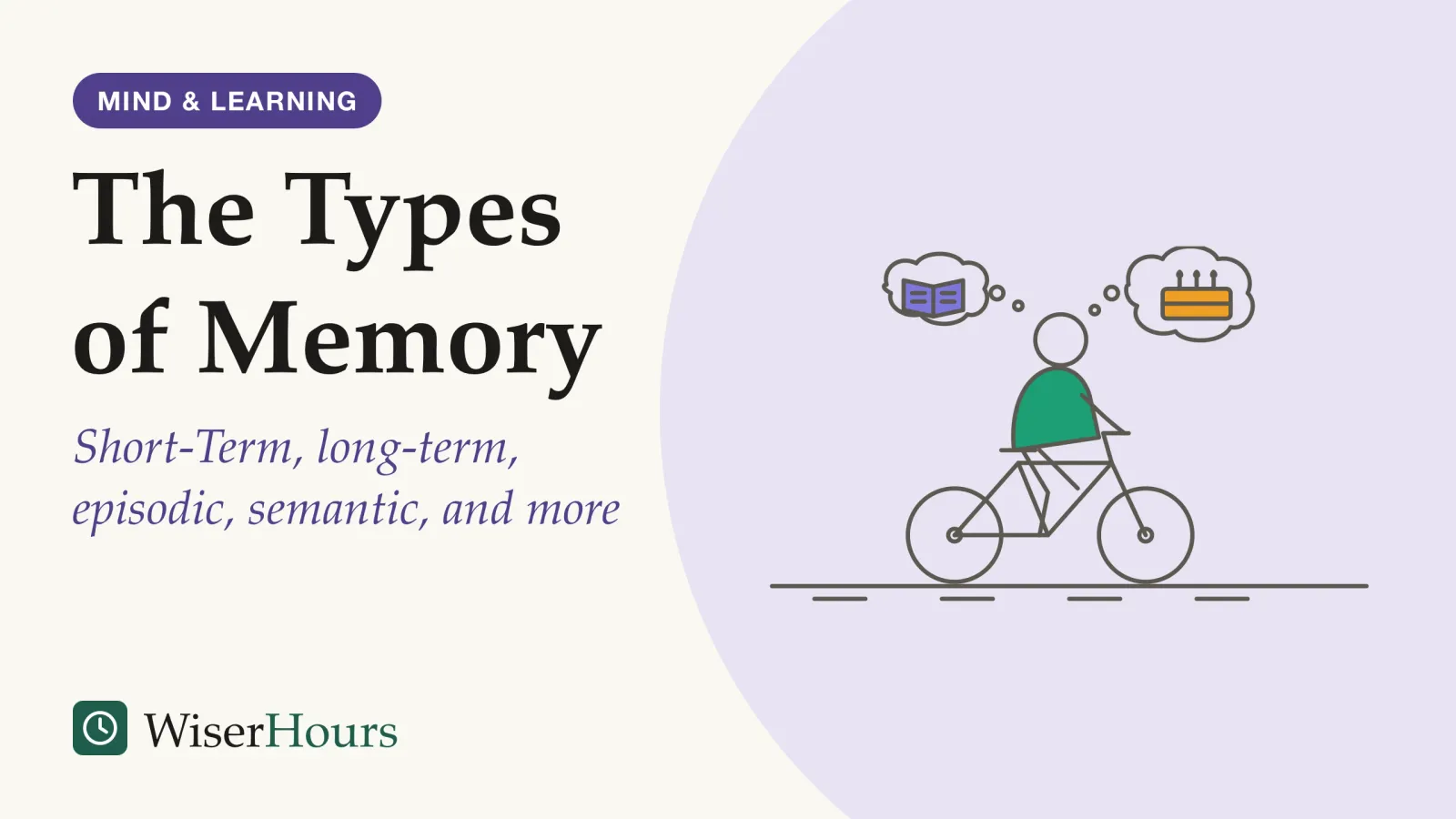
Psychologists sort the types of memory along two lines: how long information is kept, and whether you can recall it on purpose. By duration, there are three stages, following Richard Atkinson and Richard Shiffrin’s 1968 model: sensory memory, short-term memory (often discussed as working memoryworking memory: The small mental workspace that holds and handles the information you are using right now, such as a phone number you are about to dial. Its capacity is limited, which is why juggling several things at once quickly overloads it.Full entry in the glossary) and long-term memory. Long-term memory then divides into explicit memory, which you can bring to mind and put into words, and implicit memory, which shows up in what you do. Explicit memory holds episodic memory (events you lived) and semantic memory (facts and meanings); implicit memory holds procedural memory (skills), priming and conditioning.1
The way information travels between these stores, from encoding to retrieval, belongs to how memory works. This page maps the categories themselves, the evidence that separates them, and what each means for learning and daily life.
Prefer to watch? The video covers the same ground as this article.
What are the main types of memory?
The main types of memory form a simple map: three stages by duration (sensory, short-term and long-term memory), then a split of long-term memory into explicit kinds you can recall on purpose and implicit kinds that show in what you do.
- Sensory memory: a brief trace of what you just saw or heard
- Short-term and working memory: the few things you hold in mind right now, and use
- Long-term memory: everything kept for longer, split into explicit (teal panel) and implicit (purple panel)
- Episodic memory: events you lived through, with a when and a where
- Semantic memory: facts, word meanings and general knowledge
- Procedural memory: skills and habits, such as riding a bike
- Priming: an earlier exposure that shapes a later response without your noticing
- Conditioning: learned reactions, such as the feeling a familiar smell brings back
- Prospective memory: remembering to do something later; not a branch of the standard tree
The long-term branches follow the taxonomy of the memory researcher Larry Squire. In a 2004 review he traces the explicit and implicit split to evidence that converged around 1980 from healthy volunteers, patients with amnesia and animal studies: some memory is open to conscious recollection and some is not. Later work went beyond two boxes: Squire describes several separate systems that rely on different parts of the brain, among them the hippocampus and related structures, the amygdala, the neostriatum and the cerebellum.2
The map is useful because each type fails in its own way, and each failure has its own fix. Losing a phone number before you dial it is a short-term slip, so write it down before you look away. Forgetting how a meeting went is episodic, so jot two lines while it is fresh. Blanking on a colleague’s job title is semantic, so quiz yourself instead of rereading the org chart. The table near the end gives one such habit for every type.
Sensory memory holds a split-second copy of what you sense
Sensory memory is the first and briefest store: a trace of what you just saw, heard or felt. The OpenStax textbook describes it as storage of brief sensory events, lasting up to a couple of seconds, from which only information you treat as worth keeping moves on to short-term memory.1
The classic evidence is a 1960 experiment by George Sperling, as Nelson Cowan recounts in a 2008 review. People glimpsed a grid of characters and were then cued to report one row. With an immediate cue, they could report most characters in that row, so the whole grid was briefly available. With a cue delayed by about a second, most of the sensory information had decayed.3
A familiar moment may be the everyday version: you say “What?” to a question, then answer before it is repeated, as if the words were still briefly there. A detail you never looked at closely is unlikely to have been stored.1
Short-term and working memory hold the few things you are using now
Short-term memory keeps a small amount of information available for seconds, such as a code you read off one screen and type into another; the OpenStax textbook puts its duration at about 15 to 30 seconds. Working memory is the closely related idea of keeping information in mind while you work with it, such as a running total in your head.1
Early evidence that short-term and long-term memory differ came from H.M., a man whose 1953 brain surgery removed the inner part of both temporal lobes. Afterward he could chat normally, repeat back a string of digits and hold a number for many minutes by rehearsing it, yet the whole exchange was gone as soon as his attention shifted.4 The reverse pattern appeared in a patient described by Tim Shallice and Elizabeth Warrington in 1970, whose short-term memory span for spoken material was severely reduced without any obvious general loss of thinking ability.5
Is working memory the same as short-term memory? Not quite, and researchers draw the line differently. Cowan’s 2008 review found working memory defined in three slightly different ways: as short-term memory applied to tasks, as a system of several parts that holds and manipulates information, and as the use of attention to manage short-term memory. Whatever the definition, routine holding tasks track general cognitive ability less closely than tasks that demand attention while you hold.3 The models are covered in the explainer on working memory and its limits.
- Myth
- Short-term memory is what lets you remember what you did yesterday or last week.
- Fact
- In psychology, short-term memory lasts seconds. Anything you can recall from more than a few minutes ago is long-term memory.
When a name, figure or instruction has to survive an interruption, short-term memory is the wrong place for it.
Hold it outside your head
When you switch screens, rooms or conversations, jot down whatever you are holding in your head, or link it to something you already know well.
Long-term memory: explicit and implicit systems
Long-term memory is the lasting store, and its main division is between memory you can consciously recall and memory that shows only in performance. The first hint of this split came from H.M.: a man who could not form new memories of events learned a hand-eye skill over several days without any memory of having practiced it.4
The study
Moderate evidence
The skill H.M. learned but could not remember learning
Brenda Milner asked H.M. to trace the outline of a star while he could see his hand and the star only in a mirror. He improved over ten trials and kept the skill across three days of testing. Yet at the end he had no recollection of ever having done the task. Squire describes this 1962 finding as the first hint that the brain has more than one kind of memory.4
One patient is thin evidence, and for a while skills were treated as a special case. Squire calls recollection of facts and events declarative memory, the kind meant by “memory” in everyday language, and links it to the medial temporal lobe; nondeclarative memory is his umbrella term for several other systems. What made the split hold up, he writes, was the stream of later findings: patients with amnesia learned to read mirror-reversed words at a normal rate, showed normal priming and learned simple conditioned responses, even though their conscious memory of the material was poor.2
What is the difference between episodic and semantic memory?
Episodic memory holds events you experienced, tied to a time and place; semantic memory holds facts, meanings and general knowledge with no memory of when you learned them. The psychologist Endel Tulving proposed the distinction in a 1972 chapter, describing semantic memory as a mental thesaurus of words, concepts and rules. Your first day at a new job is episodic: the room, who greeted you, the coffee that went cold. Knowing your company’s address is semantic. Tulving also proposed that each retrieval from episodic memory feeds back in and changes what is stored, while semantic knowledge is less prone to that kind of change.6 That may be one reason detailed recollections drift, as the article on why false memories feel real explains.
Evidence that the two can come apart came from three patients described in 1997 by Faraneh Vargha-Khadem and colleagues, whose hippocampal damage occurred at birth or in childhood. They had pronounced amnesia for the events of everyday life, yet attended mainstream schools and reached low-average to average levels of language, literacy and factual knowledge. The authors concluded that the two systems are partly dissociable.7
Facts and experiences therefore need different care. For facts, practice pulling them from memory: in two 2006 experiments by Henry Roediger and Jeffrey Karpicke, students who took recall tests on a passage retained more of it days later than students who restudied it.8 The guide to active recall turns that finding into a routine. For events, a short note of what happened, when and with whom gives you cues for later; treat that as a sensible habit, not a proven one.
What is implicit memory?
Implicit memory is long-term memory that shapes what you do without your being aware of remembering, and it is measured through performance rather than recall. The OpenStax textbook lists three main kinds. Riding a bike is the classic example of procedural memory, the memory for how to do something: you wobbled at first, now stay upright without thinking, and could not explain exactly how you balance. Primingpriming: The finding that exposure to one thing, such as a word or image, can change how people respond to something that follows, often without their noticing. Priming of word recognition is well established, but many famous behavioral priming effects have failed to replicate.Full entry in the glossary is the effect of an earlier exposure on a later response: read about a picnic, then unscramble a set of letters, and you are more likely to produce a picnic word than a gardening one. Conditioning links a signal with a response, as when a smell or a song brings back a feeling you cannot trace to its source.1
All three can work without recollection. Squire describes patients with severe amnesia who showed fully intact priming while scoring at chance when asked to recognize the same items. He links habit learning to the neostriatum, a simple conditioned blink to the cerebellum and fear learning to the amygdala, and notes that trying to memorize what you are doing can interfere with human skill learning. The systems also run side by side: a child knocked down by a large dog may keep both a memory of the event and a lasting fear of dogs that feels like a personality trait rather than a memory.2
Skills need repetition with feedback. Reading about a tennis serve builds semantic memory about serves; only practice builds the serve. How repeated actions settle into routines is covered in how habits work.
Where prospective memory fits on the map
Prospective memory is memory for intentions: carrying out something you planned, such as replying to an email or taking a medicine on time. It is contrasted with retrospective memory, memory for things already encountered, and comes in two forms: event-based, cued by a situation, and time-based, due at a particular time.9 Neither the OpenStax map nor Squire’s taxonomy lists it as a branch, which is why it sits apart here; it gets a page of its own in this series.
Where the categories are debated
The standard map rests on real evidence, but its borders are less sharp than textbook diagrams suggest. Researchers still debate how far the short-term stores differ, how cleanly episodic and semantic memory separate, and whether “systems” is the right word.
On short-term memory, Cowan’s 2008 review found the two properties that would set it apart from long-term memory, decay over time and a limit on how many chunks it holds, both still controversial, though he judged the evidence encouraging for both.3 On episodic and semantic memory, Tulving himself was cautious. In 1972 he called the two “systems” mainly for convenience, not as a firm claim that they are separate in the brain, and noted that many memory tasks have both episodic and semantic features.6 A 2019 review by Louis Renoult and colleagues concluded that the two are intertwined, with considerable overlap in the brain, yet keep a measure of distinctiveness.10
Some psychologists go further and argue for a single memory system accessed in different ways. Squire’s reply is that such views make too little contact with biology: a conditioned blink can be learned and kept without the forebrain, while memory for facts needs it.2 For everyday purposes the debate changes little: the categories describe real differences in how things are learned and forgotten, even if the boxes overlap.
Each type of memory and what it means for you
Each type of memory suggests one practical habit. The habits below follow from the research cited but are suggestions, not tested programs.
| Type | What it holds | Everyday example | What it means for learning and daily life |
|---|---|---|---|
| Sensory | A brief trace of sights and sounds | The words you catch just after saying “What?” | Only what you attend to moves on, so look closely at what you need to keep1 |
| Short-term and working | A few items for seconds, while in use | A code typed from one screen to another | Do not trust it past an interruption; write the item down4 |
| Episodic | Events, with time and place | Your first day at a new job | Recollections change as you recall them, so note key details soon6 |
| Semantic | Facts, meanings, knowledge | Your company’s address | Practice recalling facts rather than rereading them8 |
| Procedural | Skills and habits | Riding a bike, typing | Practice with feedback; explanation alone does not build the skill2 |
| Priming and conditioning | Effects of earlier exposure; learned reactions | A picnic word coming to mind after reading about picnics; a smell that brings back a feeling | A reaction or a first thought can come from learning you do not recall1 |
| Prospective | Intentions for later | Replying to an email tomorrow | Tie the intention to a cue you will meet, like reaching your desk or a set hour9 |
The bottom line
Each type of memory fails in its own way and answers to a different habit: attention for sensory memory, writing things down for short-term memory, recall practice for facts and repetition for skills. The next time you forget something, work out which type it was and use the matching habit.
Frequently asked questions
How many types of memory are there?
There is no fixed number. The OpenStax Psychology 2e textbook names three stages (sensory, short-term and long-term memory) and splits long-term memory into explicit and implicit kinds. Larry Squire's 2004 taxonomy adds more branches under implicit memory. Longer lists usually split the same map more finely or add prospective memory.
What is autobiographical memory?
Autobiographical memory is your memory of your own life, and the OpenStax Psychology 2e textbook treats it as another name for episodic memory: memories of events you lived through, usually told as a story. Most people could not say what they wore on a given day five years ago; the textbook notes that only a few people, described as having highly superior autobiographical memory, can recall their days in that kind of detail.
Is muscle memory a real type of memory?
Muscle memory is the everyday name for procedural memory, the memory for skills such as typing or riding a bike. The learning is not stored in the muscles, though: Larry Squire's 2004 review links skill and habit learning to brain structures such as the neostriatum, and a simple conditioned reflex, the eyeblink, to the cerebellum.
Do animals have episodic memory?
Possibly, but it is hard to show. Larry Squire's 2004 review calls it an interesting question whether animals other than humans have a capacity for episodic memory, and notes that the idea is difficult to put to the test. For a relevant experiment he points to a 1998 study of episodic-like memory in scrub jays recovering food they had hidden.
Sources
- 8.1 How Memory Functions. Spielman, R. M., Jenkins, W. J. & Lovett, M. D. (2020). Psychology 2e. OpenStax, Rice University
- Memory systems of the brain: A brief history and current perspective. Squire, L. R. (2004). Neurobiology of Learning and Memory, 82(3)
- What are the differences between long-term, short-term, and working memory? Cowan, N. (2008). Progress in Brain Research, 169
- The Legacy of Patient H.M. for Neuroscience. Squire, L. R. (2009). Neuron, 61(1)
- The multicomponent model of working memory fifty years on. Hitch, G. J., Allen, R. J. & Baddeley, A. D. (2025). Quarterly Journal of Experimental Psychology, 78(2)
- Episodic and semantic memory. Tulving, E. (1972). In E. Tulving & W. Donaldson (Eds), Organization of Memory, pp. 381-403. Academic Press
- Differential effects of early hippocampal pathology on episodic and semantic memory. Vargha-Khadem, F., Gadian, D. G., Watkins, K. E., Connelly, A., Van Paesschen, W. & Mishkin, M. (1997). Science, 277(5324)
- Test-Enhanced Learning: Taking Memory Tests Improves Long-Term Retention. Roediger, H. L., III & Karpicke, J. D. (2006). Psychological Science, 17(3)
- Prospective memory. Wikipedia (accessed October 2026)
- From Knowing to Remembering: The Semantic-Episodic Distinction. Renoult, L., Irish, M., Moscovitch, M. & Rugg, M. D. (2019). Trends in Cognitive Sciences, 23(12)
How we researched this
We searched PubMed, Europe PMC, Crossref, open textbooks and the web in October 2026 for the reviews and original papers behind each split in the standard map of memory types, and read Squire's 2004 review, Tulving's 1972 chapter, Cowan's 2008 chapter, a 2025 review of Baddeley's model and the OpenStax textbook in full. Two papers were read at abstract level. Main limitation: much of the evidence comes from a small number of patients with amnesia.
Keep reading
Is Photographic Memory Real? What Science Says
Is photographic memory real? No adult has passed repeated tests. Eidetic images appear in an estimated 2 to 10% of children; trained and rare memories are real.
How to Improve Your Memory: What the Evidence Actually Supports
How to improve memory: 7 habits ranked by evidence, led by testing yourself and spacing reviews, and why brain games and supplements fall short.
False Memories: Why You Remember Things That Never Happened
False memories can feel as certain as real ones. How they form, what makes them likelier, the Mandela effect and 5 ways to check a memory.
How Memory Works: Encoding, Storage, and Retrieval Explained
How memory works in 3 stages: encoding, storage and retrieval. Why meaning helps words stick, why you hold about 4 chunks and why recall rebuilds.