How Memory Works: Encoding, Storage, and Retrieval Explained
How memory works in 3 stages: encoding, storage and retrieval. Why meaning helps words stick, why you hold about 4 chunks and why recall rebuilds.

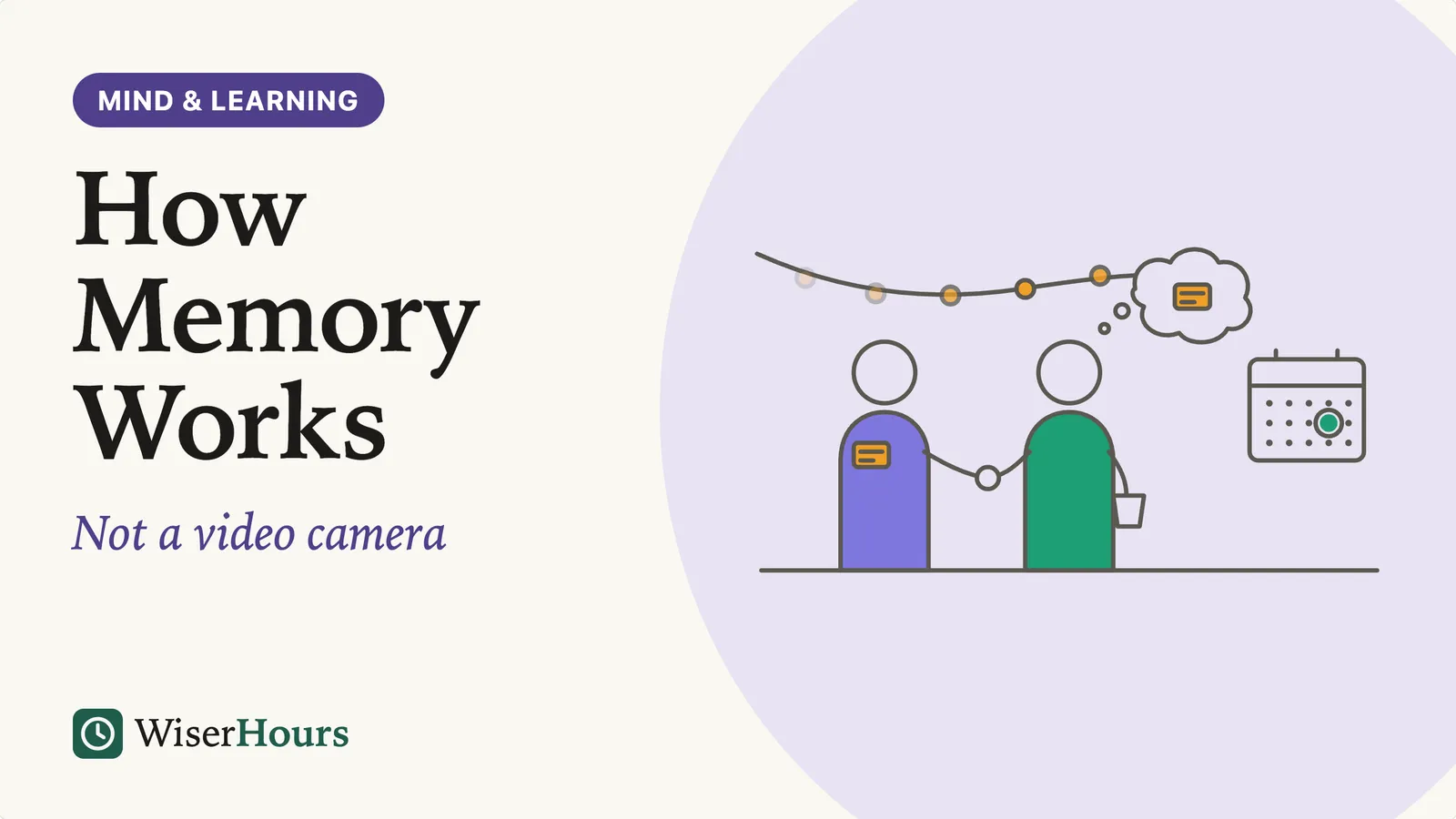
Most Americans picture memory as a video camera that records events for later playback; memory researchers do not. In a 2009 telephone survey of 1,838 US adults, weighted to match the population and published in 2011 by the psychologists Daniel Simons and Christopher Chabris, 63 percent agreed that human memory works like a video camera, recording events accurately for later review. All 16 senior memory researchers polled for the same study disagreed.1
How memory works, in short: the brain encodes what you attend to and think about, stores it by stabilizing the trace over time, and retrieves it by rebuilding the memory from cues each time, rather than replaying a recording. Psychologists call these stages encoding, storage and retrieval, and every act of remembering needs all three.2
Encoding, storage and retrieval: how memory works in three linked stages
Psychologists divide memory into three stages, encoding, storage and retrieval, a split that goes back to a 1963 paper by the psychologist A. W. Melton, according to a textbook chapter by Kathleen McDermott and Henry Roediger of Washington University in St. Louis. Encoding is the first learning of information, storage keeps it over time, and retrieval gets it back when you need it.2
Their example is a party. You meet someone and link her name to her face, which is encoding. You hold on to that link for a week, which is storage. When you see her again, her face has to act as the cue that brings back her name, which is retrieval. A failure at any stage ends the same way, with a blank or the wrong name, and the authors note that it is often hard to tell which stage failed. The stages also feed into each other, because each act of retrieval changes how the memory is remembered later.2
- 1Encodeattention and meaning decide what gets in
- 2Storethe trace stabilizes over time
- 3Retrievea cue rebuilds the memory
- 4Changeeach recall strengthens and edits it
Then repeat from “Encode”
Encoding: how you think about information shapes what sticks
Encoding depends less on how long you look at something than on how you think about it. The levels-of-processing framework, proposed by Fergus Craik and R. S. Lockhart in 1972, holds that a memory trace is a by-product of the mind’s work on information, and that the deeper the processing, meaning the more it engages with meaning, the more durable the trace.3
In a 1975 University of Toronto experiment with 20 college students, words that people had judged by their meaning were later recognized up to 96 percent of the time, against less than 20 percent for words judged only by their typeface.3
The study
Moderate evidence
One word, five kinds of question: Craik and Tulving's 1975 recognition test
Fergus Craik and Endel Tulving flashed a word for a fraction of a second after asking one of five kinds of question about it, among them whether it was printed in capital letters, whether it rhymed with a given word, whether it belonged to a category, or whether it fit a sentence. Nobody was told a memory test was coming. On the surprise test, recognition rose with each step toward meaning: 78 percent of words that rhymed as the question suggested were recognized, and 93 percent of words that fit the named category. Words met with a “no” answer were recognized less often.3
Even a minimal question about meaning left a stronger trace than a question about appearance. Meaning questions took slightly longer to answer, but in a later experiment in the same paper a slow, complex task about appearance still produced worse recognition than a quick question about meaning, so extra time did not explain the gap. The main caveat is the setting: students, single words and a test given shortly after the task. The authors also named the framework’s weak point: without an independent measure of depth, the argument risks going in a circle, because anything remembered well can be called deeply processed after the fact.3
Attention comes before any of this. McDermott and Roediger point out that everyday surroundings hold far too much to encode, that an event not encoded in some way will not be remembered later, and that distinctive events, such as a giraffe on a college campus, draw close attention and are remembered better. Their study advice follows from the encoding research: think about what new information means, relate it to what you already know, and turn it into vivid images.2 If distraction is the obstacle, practical ways to focus on one task at a time come first.
- Typeface: questions such as whether the word was in capital letters; few of these words were recognized later
- Sound: questions such as whether the word rhymed with another word
- Meaning: questions such as whether the word fit a sentence; these words were recognized most often
Short-term memory holds about four chunks, not seven
The part of memory that holds what you are thinking about right now can keep only about four meaningful chunks at once, according to a 2001 review by Nelson Cowan of the University of Missouri. Cowan argued that the famous figure of about seven, from Miller’s 1956 paper, was meant as a rough estimate and a rhetorical device rather than a real capacity limit.4
A chunk is a unit of meaning, not a fixed number of letters or digits. In a 2010 overview, Cowan put the central limit at 3 to 5 chunks in young adults and described how people stretch what they can hold: repeating items silently, or grouping several items into one chunk, such as picturing bread floating in peppery milk to remember bread, milk and pepper. Young adults could recall only 3 or 4 longer chunks such as idioms or short sentences, he wrote, citing earlier work. The limit matters because the same workspace is used to understand language, to solve problems, such as carrying a digit in mental arithmetic, and to plan the order of steps in a task.5 Our own suggestion, drawn from that limit rather than tested in these studies: when information arrives faster than you can group it, write the overflow down.
Not everyone counts capacity in fixed slots. A 2014 review by Wei Ji Ma, Masud Husain and Paul Bays describes a competing proposal: working memory as a limited resource spread flexibly across everything held, so that how precisely items are kept, rather than how many, limits performance.6
Further reading
Make It Stick: The Science of Successful Learning
Written with Henry Roediger, whose recall experiments this article cites, it turns the retrieval research into study habits.
The Seven Sins of Memory: How the Mind Forgets and Remembers
A memory researcher sorts everyday forgetting and misremembering into seven kinds, each tied to how memory is built.

As an Amazon Associate WiserHours earns from qualifying purchases.
Storage: new memories settle over time, partly during sleep
Storage is not a shelf where finished memories wait. New memories are stabilized gradually through consolidation, which McDermott and Roediger define as the neural changes after learning that create the memory trace of an experience.2
The clearest evidence that storage depends on particular brain structures comes from the patient known as H.M. In 1953, at 27, he had experimental surgery that removed structures in the medial temporal lobe on both sides of his brain, among them the hippocampus, to control severe seizures. Afterward he could hold a conversation and keep a number in mind by rehearsing it, yet forgot the whole episode once his attention moved on, Larry Squire of the University of California, San Diego recounted in a 2009 review.7
H.M.’s memories from long before the operation stayed largely available. Researchers usually read this as showing that the damaged structures are needed to form long-term memories and to maintain them for a time after learning, while gradual changes in the neocortex eventually let memories stand without them. Squire notes that the case still fuels debate about loss of older memories, and that the early findings could not show that the hippocampus alone mattered, because the surgery removed neighboring structures too.7
Sleep appears to help this settling. A 2013 review of more than a century of research by Björn Rasch and Jan Born concluded that sleep benefits the retention of memory, and argued that during deep, slow-wave sleep recently encoded memories are reactivated and reshaped for long-term storage. A classic 1924 study comparing forgetting across sleep and waking tested just two people, repeatedly, over almost two months.8 The size of the benefit is less settled. A 2021 review by Maren Cordi and Rasch reported that several key findings behind this account had not replicated or held only under certain conditions, suggesting that sleep’s effects on memory are smaller, more task-dependent and less tied to slow-wave sleep than once assumed.9 For the practical side, see these habits that help busy adults sleep better.
Storage also leaks, fastest at first. Ebbinghaus’s experiments on himself, published in 1885, produced the forgetting curve, in which forgetting is rapid in the first hours after learning and levels out after several days, as Rasch and Born summarize.8 In a 2015 replication at the University of Amsterdam, a single student spent about 70 hours learning lists and relearning them after delays from 20 minutes to 31 days, and his results were similar to the original.10
Retrieval rebuilds a memory from cues
Retrieval runs on cues, and it reconstructs rather than replays. A cue works to the extent that it matches the way the memory was encoded, a rule known as the encoding specificity principle, from a 1973 paper by Endel Tulving and D. M. Thomson. A song on the radio can bring back a party from years ago because it was part of that experience.2
Failing to recall something does not prove it is gone. McDermott and Roediger distinguish information that is available, meaning stored, from information that is accessible right now. Something that will not come back today may return with a different cue, and with current methods no one can tell how much of what was stored remains.2
The best-known evidence that place works as a cue did not hold up in a recent attempt to repeat it. In a 1975 experiment, Godden and Baddeley found that divers recalled words better in the setting where they had learned them, on land or underwater. In a 2021 replication with 16 divers, run in an indoor pool rather than the open water of the original, Jaap Murre of the University of Amsterdam found no such advantage. He notes that the effect of surroundings on free recall is well established but often weak, with an effect size of about 0.25, citing a 2001 meta-analysis.11 In a 2022 correction, after another researcher reanalyzed his data, Murre reported a statistically significant interaction but not the same-setting pattern of the original, and concluded that this only reinforced that the study was not a successful replication.12
Recall is also partly rebuilt each time. McDermott and Roediger describe retrieval of distant memories as reconstructive, with remembered fragments woven together with assumptions into a coherent story, and they note that every retrieval alters the memory.2
- Myth
- Memory works like a video camera: it records events accurately so you can play them back later.
- Fact
- Memories are rebuilt from fragments and cues each time you recall them, and information met afterward can add details that never happened.
What you hear afterward can change what you recall. In a 1974 experiment by Elizabeth Loftus and John Palmer of the University of Washington, 150 students watched a short film of a car accident. A week later, 16 of the 50 who had been asked how fast the cars were going when they “smashed” into each other said they had seen broken glass, compared with 7 of the 50 asked about cars that “hit” each other and 6 of the 50 not asked about speed. There was no broken glass in the film. The authors read this as the question reshaping the memory of the event itself; the participants were students watching a filmed crash, not witnesses to a real one.13
Retrieval has an upside too: pulling a memory out makes it easier to pull out again, which is called the testing effect.2 In a 2006 experiment with 180 Washington University undergraduates, students who read a science passage once and then practiced recalling it three times remembered 61 percent of its ideas a week later, against 40 percent for students who spent four short sessions reading it.14 The cost, McDermott and Roediger add, is that retrieving some information can make related information harder to recall, though that effect is often relatively small.2 The study routine that grows out of this, including how far apart to space reviews, is set out in the guide to learning how to learn with retrieval practice and spacing.
Using the three stages: one habit for each
Each stage of memory suggests a habit, and the evidence behind them ranges from single lab experiments to reviews of many studies. None of these experiments tested office workers remembering real work, so treat the table as principles to apply, not measured results for your job.
| Stage | Habit | What the best evidence found | Evidence |
|---|---|---|---|
| Encoding | Ask what new information means | Words judged by meaning were recognized far more often than words judged by typeface | Lab trial, moderate3 |
| Short-term holding | Group items into chunks; write down the overflow (our suggestion) | A central limit of about 4 chunks, though some researchers model capacity as a flexible resource; grouping and silent repetition stretch it | Reviews, mixed456 |
| Storage | Protect sleep after learning | Sleep benefits retention in lab studies, though a 2021 review found the effect smaller and less consistent than once assumed | Reviews of mostly lab studies, moderate89 |
| Retrieval | Practice recalling instead of rereading | 61 vs 40 percent of a passage’s ideas recalled a week later | Trial, moderate14 |
| Retrieval | Return to the place you learned | Often a weak effect; a 2021 repeat of the famous diver study found no advantage | Replication, mixed11 |
Try it with the next new name
When you meet someone, notice something about the name’s meaning or link it to someone you know, say it once in conversation a few minutes later, and recall it again the next day before you see the person. This applies the encoding and retrieval research above; it has not been tested as a method in its own right.
The bottom line
The practical point joins two stages: ask what new information means when you first meet it, and later practice recalling it instead of rereading it. Behind that pairing sits the three-stage model, in which what you encode depends on how you think about it, what you store settles over time, and what you retrieve is rebuilt from cues each time.
Frequently asked questions
Are memories permanent once they are formed?
No. In a 2009 survey of 1,838 US adults by Daniel Simons and Christopher Chabris, 48 percent agreed that a memory does not change once it is formed, but 15 of the 16 memory experts they polled disagreed and one was unsure. Kathleen McDermott and Henry Roediger's textbook chapter states that every time a memory is retrieved it is altered, and information met after an event can change what people recall of it.
Can you remember something you never paid attention to?
Generally not. Kathleen McDermott and Henry Roediger's textbook chapter on memory states that unless an event is encoded in some way, it will not be remembered later, and that everyday surroundings hold far too much for anyone to encode it all. Encoding is not a guarantee either: something encoded well can still be forgotten, which is why storage and retrieval matter too.
Where are memories stored in the brain?
Not in one spot. Larry Squire's 2009 review of the patient H.M. describes structures in the medial temporal lobe, among them the hippocampus, as important for forming long-term memories and keeping them for a time after learning, after which gradual changes in the neocortex are thought to let it hold them. H.M. also learned a drawing skill he could not remember practicing, a sign that skills rely on other brain systems.
Sources
- What People Believe about How Memory Works: A Representative Survey of the U.S. Population. Simons, D. J. & Chabris, C. F. (2011). PLoS ONE, 6(8), e22757
- Memory (Encoding, Storage, Retrieval). McDermott, K. B. & Roediger, H. L., III (2026). In R. Biswas-Diener & E. Diener (Eds), Noba textbook series: Psychology. DEF Publishers
- Depth of Processing and the Retention of Words in Episodic Memory. Craik, F. I. M. & Tulving, E. (1975). Journal of Experimental Psychology: General, 104(3)
- The magical number 4 in short-term memory: A reconsideration of mental storage capacity. Cowan, N. (2001). Behavioral and Brain Sciences, 24(1)
- The Magical Mystery Four: How is Working Memory Capacity Limited, and Why? Cowan, N. (2010). Current Directions in Psychological Science, 19(1)
- Changing concepts of working memory. Ma, W. J., Husain, M. & Bays, P. M. (2014). Nature Neuroscience, 17(3)
- The Legacy of Patient H.M. for Neuroscience. Squire, L. R. (2009). Neuron, 61(1)
- About Sleep's Role in Memory. Rasch, B. & Born, J. (2013). Physiological Reviews, 93(2)
- How robust are sleep-mediated memory benefits? Cordi, M. J. & Rasch, B. (2021). Current Opinion in Neurobiology, 67
- Replication and Analysis of Ebbinghaus' Forgetting Curve. Murre, J. M. J. & Dros, J. (2015). PLoS ONE, 10(7), e0120644
- The Godden and Baddeley (1975) experiment on context-dependent memory on land and underwater: a replication. Murre, J. M. J. (2021). Royal Society Open Science, 8(11), 200724
- Addendum to: Murre (2021). The Godden and Baddeley (1975) experiment on context-dependent memory on land and underwater: a replication. Murre, J. (2022). Royal Society Open Science, 9(1), 211924
- Reconstruction of Automobile Destruction: An Example of the Interaction Between Language and Memory. Loftus, E. F. & Palmer, J. C. (1974). Journal of Verbal Learning and Verbal Behavior, 13(5)
- Test-Enhanced Learning: Taking Memory Tests Improves Long-Term Retention. Roediger, H. L., III & Karpicke, J. D. (2006). Psychological Science, 17(3)
How we researched this
We searched PubMed, PMC, Crossref and the web in September 2026 for the classic experiments behind each stage of memory, recent replications of them and reviews by the researchers who did the work, and read the full text, or its relevant sections, for every source except three reviews read at abstract level. Sources date from 1974 to 2026. Main limitation: most of the experiments are short lab studies with students and word lists.
Keep reading
Do Brain-Training Games Work? What Large Studies Found
Do brain-training games work? From a 2010 BBC trial to 20 years of US data, large studies find they train the game, not everyday memory.
How to Remember Names: A Method That Works at Parties and Meetings
4 steps for remembering names, built on the best-tested one: recall a new name to yourself soon after you hear it, then again after longer gaps.
Dementia Risk Factors You Can Change: What Major Reviews Conclude
A 2024 Lancet Commission links 14 changeable dementia risk factors to about 45% of cases. What WHO's 2026 guideline and trials like FINGER add.
Mnemonics for Beginners: The Memory Techniques Worth Learning
4 mnemonics worth learning as a beginner, why they work, and where the evidence behind each one is solid, thin or surprisingly weak.