Tip-of-the-Tongue Moments: Why Words Go Missing and How to Find Them
Most adults get a word stuck on the tip of the tongue about once a week, more often with age. Why words hide, 4 ways to find them, when to get it checked.

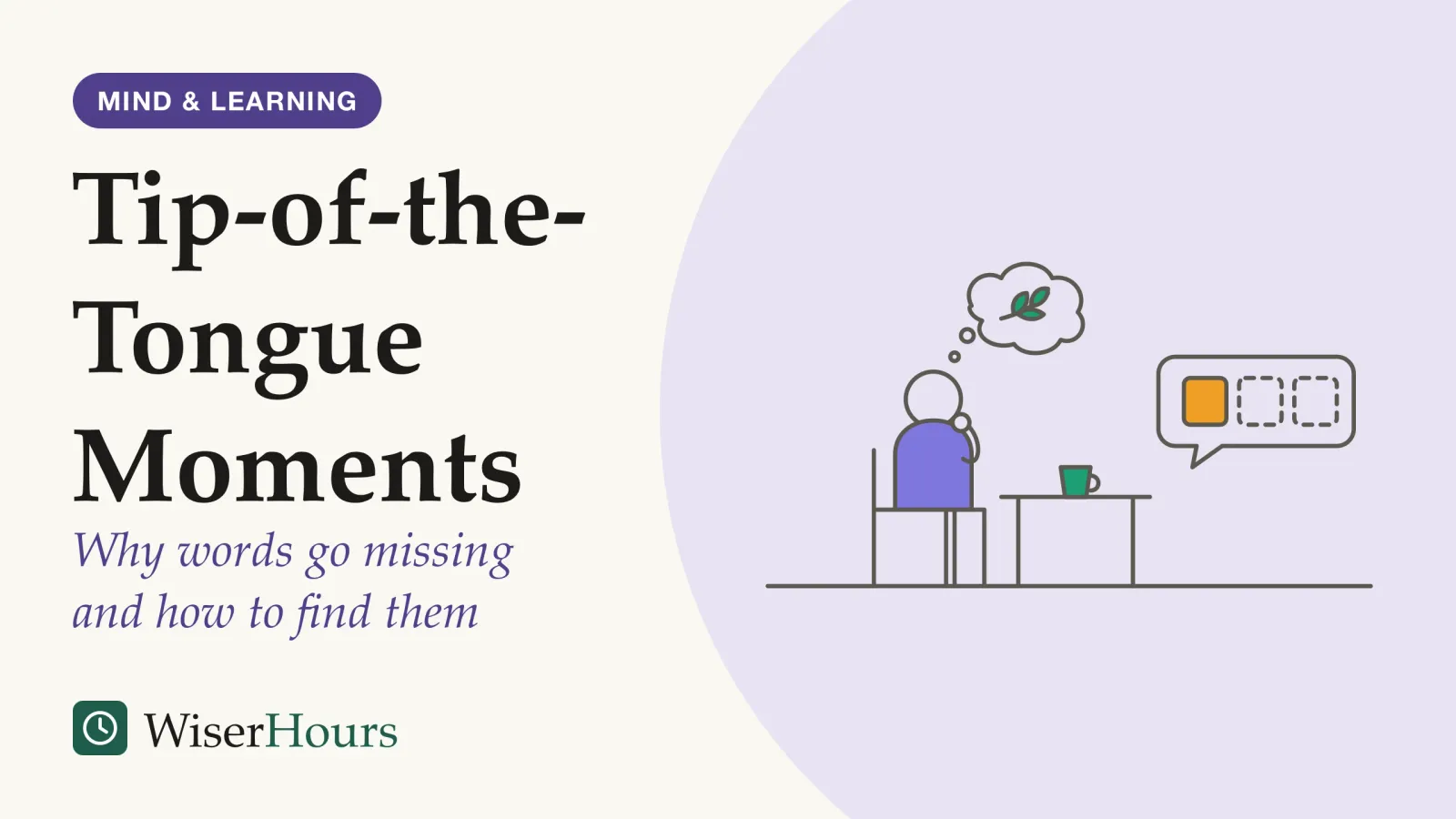
Mid-sentence, a word you use every week goes missing. You know what it means and roughly how long it is, maybe even how it starts, while a wrong word that sounds a bit like it keeps pushing in. An hour later, in the shower, it turns up unasked.
Having a word on the tip of the tongue means a temporary failure to reach the sound of a word you know, with partial recall and a strong sense that the word is close. Psychologist Alan Brown’s 1991 review of the research found that it happens to nearly everyone, about once a week, more often with age and often with names, and that about half of these moments resolve while the person is still searching.1 It is rarely a health warning on its own: the US National Institute on Aging counts sometimes forgetting which word to use as normal ageing.2 When a word sticks, the best-tested moves are to say sounds close to it and, if that fails, to switch to something else and let it surface.
The word has not been lost. Like many of the everyday slips in memory and brain performance, a tip-of-the-tongue moment is a failure to get stored information back out, and the weak point is the route from meaning to sound.
What happens when a word is on the tip of the tongue
In a tip-of-the-tongue moment the meaning of a word is available and its full sound is not, and Roger Brown and David McNeill of Harvard showed in 1966 that part of the sound is often there too. They read out definitions of uncommon words, and people who felt the answer was close already knew some of its letters, its number of syllables and where the stress fell, and could recall words of similar sound or meaning.3
That partial access explains the odd feeling of the state. Someone reaching for “basil” while cooking may already have the “b”, the two beats of the word and the near miss “basin”, which is far more than nothing. Alan Brown’s review notes that related words very often turn up during the search, and that the first letter is among the pieces people can most often reach.1
The experience seems to be shared across cultures. Bennett Schwartz’s 1999 review says it appears to be a universal experience that happens often in everyday life.4 A 2007 study of speakers of Q’eqchi’, a Mayan language of Guatemala that has no written tradition, found that most participants, including people who had never learned to read, recognised a description of the feeling, and that being given a word’s initials reliably helped them find it.5
Say aloud whatever fragment you have, whether a first letter, a rough length or a near miss, because each one is a clue to the sound you are after.
What causes tip-of-the-tongue moments?
The leading explanation, the transmission deficit model, holds that a word’s meaning is activated but too little of that activation passes on to its sound.6 Psychologists Deborah Burke and Meredith Shafto’s 2004 review of the model, which Burke developed with Donald MacKay and colleagues, names three things that weaken the links to a word’s sound: ageing, and a word not being used often or recently.7
Speaking runs in two steps: you select the word that fits the meaning, then assemble its sounds. A tip-of-the-tongue moment is a breakdown in the second step. A 2020 study from Renmin University in Beijing summarises the evidence that people in this state can often report a missing noun’s grammatical gender or whether it is singular or plural, all properties of the word itself, while its sounds stay out of reach.8
Names are frequent culprits. Brown’s review found that proper names often trigger the state.1 They slip for reasons of their own, which how to remember names explains along with the habit that makes new ones stick.
The feeling itself is a separate question from the failure. Bennett Schwartz and Janet Metcalfe’s 2011 review argues that the sense of a word being close is built from clues, such as partial and related information and how familiar the question seems, and that those clues predict whether the search will succeed.9 A strong tip-of-the-tongue feeling is therefore a fair sign that the word is in memory and worth a short search.
Why tip-of-the-tongue moments get worse with age
Tip-of-the-tongue moments become more frequent across adulthood, as Alan Brown’s review of the research found.1 In Deborah Burke and colleagues’ 1991 study, which combined a four-week diary studydiary study: A study in which people record what they do or feel repeatedly, often daily or when prompted at random moments, close to when it happens; the prompted form is called experience sampling. It relies less on memory, but it is still self-report.Full entry in the glossary of everyday slips with lab tests, older adults reported more of these moments than young adults. When stuck in the lab, older adults could report less of the missing word’s sound and fewer wrong words that kept pushing in, as Burke and Shafto’s review describes the results.7
The meanings themselves seem to hold up. In the Beijing study, older adults asked to name people from photos got stuck more often than young adults; their difficulty lay in reaching the sounds, while what they knew about each person stayed within reach.8 A retired teacher who can describe a film’s plot, its director’s other work and the year it came out, but not the lead actor’s name, fits that pattern.
Tiredness may add to them, though the support is mostly expert opinion. Karin Humphreys, a psycholinguist at McMaster University in Canada, told Mental Floss in 2015 that these moments often happen when people are tired; our searches found little research that tests this directly.10 More broadly, the National Institute on Aging lists sleep problems, stress, medication side effects and depression among the things that can affect memory apart from ageing.2
Bilingual speakers report more of these moments for everyday words. In a 2005 US study of Spanish-English bilinguals, they reported getting stuck on ordinary words more often than monolinguals did, but no more often, and sometimes less, on people’s names.11
Slips that bunch up on long, tired or stressful days fit the everyday factors the NIA lists, so judge your memory on a rested day before drawing conclusions.
How do you get a word off the tip of your tongue?
The best-tested way to get a word off the tip of your tongue is to feed the sound side of the link, by saying words that share sounds with the missing one, and the second is to stop searching for a while and let the word surface. In order:
- Use the clues you already have
- Say words that sound like the missing one
- Step away and let the word surface
- Close the loop when you find it
Use the clues you already have
Start with the fragments: say the first letter you suspect, tap out the number of beats, and run through the alphabet aloud if no first letter comes. Being given a word’s initials helped Guatemalan participants in the 2007 study find words they were stuck on, which makes a companion’s hint of the first letter or sound a good request.5
Say words that sound like the missing one
The study
Moderate evidence
Similar sounds helped young and older adults alike: James and Burke's 2000 lab study
Young and older adults answered general-knowledge questions. Reading aloud words that shared sounds with the answer cut tip-of-the-tongue moments, and when someone was already stuck, it raised the chance of recalling the word. The benefit was the same at both ages, and the similar-sounding words did not block the answer.12
In the lab, researchers chose words that shared syllables with an answer they already knew, which nobody can do for their own missing word. The everyday version is to try sounds before synonyms: if “basin” keeps coming, say “ba-”, “bas-” and a few rhymes aloud. The Beijing study likewise found that names sharing sounds with the target reduced these moments, more so for older adults; names related in meaning also helped there, though the authors note that earlier results for meaning cues are inconsistent.8 A thesaurus, which works on meaning, is the less proven tool.
Step away and let the word surface
A break helps more often than grinding on. In a 2005 lab study by Hyun Jin Choi and Steven Smith, questions people could not answer were more often solved after a break filled with unrelated questions than on an immediate retry, and stronger tip-of-the-tongue feelings benefited most.13
Long struggles also seem to train the error. When Warriner and Humphreys, at McMaster University, made people keep searching for 30 seconds rather than 10 before giving them the answer, the same word was almost twice as likely to stick again two days later.14
Close the loop when you find it
Resolving a tip-of-the-tongue moment makes it less likely to recur for that word. Across six experiments, D’Angelo and Humphreys found that people who resolved the state, whether on their own or after a spelling cue, were less likely to get stuck on the same word at a later test.15 When the word arrives, say it aloud and use it once in a sentence. If you need a prompt, a first-letter hint resembles the cues tested; whether reading the whole answer has the same effect is less clear.
All four tactics rest on lab evidence from healthy volunteers, and its strength varies. Word-finding trouble after a stroke or head injury, or with dementia, is a different problem for a doctor or speech and language therapist to assess.
| Tactic | Lab finding | Evidence |
|---|---|---|
| Being given the word’s initials | Reliably resolved stuck words, in readers and non-readers in Guatemala | Lab study, limited5 |
| Saying similar-sounding words | Fewer stuck moments and better recall, equally for young and older adults | Lab experiments, moderate12 |
| Taking a break | More stuck answers solved after a delay than on an immediate retry | Lab study, limited13 |
| Resolving the moment | Less likely to stick on the same word at a later test | Six lab experiments, moderate15 |
Every tactic in the table costs a few seconds. Persistence is the one with a catch: in the 2008 McMaster study, long, fruitless searches made the same word likelier to stick again.
When a word will not come
Is forgetting words a sign of dementia?
Forgetting a word now and then is not a sign of dementia by itself. The US Alzheimer’s Association lists sometimes having trouble finding the right word as a typical age-related change, and new problems with words in speaking or writing as a warning sign.16 Its examples of the second include losing the thread of a conversation, stopping in the middle of a conversation with no idea how to go on, struggling to name a familiar object and using odd substitutes, such as “hand-clock” for a watch.
Health services describe the same line. The UK’s NHS lists struggling to follow a conversation or find the right word among common early symptoms of dementia, alongside memory loss, trouble with familiar daily tasks, confusion about time and place and mood changes, and notes that these are often mild and worsen gradually.17 WHO includes trouble finding words among the early signs, next to forgetting recent events, getting lost and losing track of time.18
- Myth
- Losing words means dementia is starting.
- Fact
- Occasional word-finding slips are part of normal ageing in US health guidance. The concern is new, frequent trouble that disrupts conversations or comes with other changes.
Lab measures do pick up differences between groups. A Spanish study that followed about 250 older adults for roughly three years found that people with mild cognitive impairment did worse at reaching the sounds of famous people’s names than people who only felt their memory had slipped. Yet that ability declined over time in every group, with no clear difference in pace between them, including those whose condition got worse.19 Counting your own tip-of-the-tongue moments cannot tell you which group you are in. For a worry about longer-term risk, the health and lifestyle factors linked to dementia, from blood pressure to hearing, are set out with their evidence.
When word-finding trouble is worth a doctor’s visit
Health bodies sort word-finding trouble by how it starts and what comes with it. Sudden trouble speaking is an emergency; new or worsening trouble that affects everyday life deserves an appointment within weeks; occasional slips can wait for a routine check-up.
Now. Sudden difficulty speaking or thinking of words, slurred speech, a drooping face or weakness in one arm can be signs of a stroke. Ring your local emergency number without delay, even if the symptoms stop, and do not drive yourself to hospital; the NHS number for this in the UK is 999.20
Soon. Make a doctor’s appointment if word-finding trouble is new, frequent or getting worse, if it makes conversations hard, if family or colleagues have noticed, or if it comes with other changes. The National Institute on Aging names repeating the same questions, getting lost in familiar places and becoming more confused about time, people and places as reasons to talk with a doctor, and notes that treatable causes such as thyroid problems, low vitamin B12, depression and medication side effects can affect memory.2 The UK’s NHS advises talking to a GP sooner rather than later if you are worried.17
Routine. If ordinary tip-of-the-tongue moments simply bother you, mention them at your next routine appointment. Elsewhere, your own national health service’s guidance is the place to check.
A short note of when slips happened, what you were trying to say and what else was going on gives a doctor more to work with than a general worry.
The bottom line
A tip-of-the-tongue moment is a weak link between a word’s meaning and its sound, and it grows more common with age without being a disease. When a word sticks, try its first sound and a few similar-sounding words, then move on and say the word aloud once it returns. Save a doctor’s visit for slips that are new, frequent or disrupt conversations, and treat sudden trouble speaking as an emergency.
This article is general information, not medical advice. If you're worried about your health, talk to a doctor or another qualified professional.
Frequently asked questions
What is the word for when you can't think of a word?
Researchers call it a tip-of-the-tongue state, often shortened to TOT, and an older word for it is lethologica. When word-finding failures become frequent because of brain damage, for example after a stroke or head injury or with dementia, the clinical term is anomia or anomic aphasia, which a doctor or speech and language therapist assesses.
Do tip-of-the-tongue moments happen in every language?
As far as researchers have looked, yes. Bennett Schwartz's 1999 review says they appear to be a universal experience, and a 2007 study of speakers of Q'eqchi', a Mayan language of Guatemala with no written tradition, found that most participants, including people who could not read, recognised the feeling, and that being given the start of a word helped them find it.
Do bilingual people get more tip-of-the-tongue moments?
For ordinary words, they seem to. In a 2005 US study by Tamar Gollan and colleagues, Spanish-English bilinguals kept diaries and did naming tasks, and reported more of these moments than monolinguals for everyday words, but the same number or fewer for people's names. The authors link the difference to keeping two words for most meanings, which names largely avoid.
Sources
- A review of the tip-of-the-tongue experience. Brown, A. S. (1991). Psychological Bulletin, 109(2)
- Memory Problems, Forgetfulness, and Aging. US National Institute on Aging (content reviewed 2023)
- The "tip of the tongue" phenomenon. Brown, R. & McNeill, D. (1966). Journal of Verbal Learning and Verbal Behavior, 5(4)
- Sparkling at the end of the tongue: The etiology of tip-of-the-tongue phenomenology. Schwartz, B. L. (1999). Psychonomic Bulletin & Review, 6(3)
- Are tip-of-the-tongue states universal? Evidence from the speakers of an unwritten language. Brennen, T., Vikan, A. & Dybdahl, R. (2007). Memory, 15(2)
- Tip of the tongue. Wikipedia (accessed October 2026)
- Aging and Language Production. Burke, D. M. & Shafto, M. A. (2004). Current Directions in Psychological Science, 13(1)
- Aging Effects on Phonological and Semantic Priming in the Tip-of-the-Tongue: Evidence From a Two-Step Approach. Ouyang, M., Cai, X. & Zhang, Q. (2020). Frontiers in Psychology, 11
- Tip-of-the-tongue (TOT) states: retrieval, behavior, and experience. Schwartz, B. L. & Metcalfe, J. (2011). Memory & Cognition, 39(5)
- Why Do We Get Tip-of-the-Tongue Syndrome? Hullinger, J. (2015). Mental Floss
- Proper names get stuck on bilingual and monolingual speakers' tip of the tongue equally often. Gollan, T. H., Montoya, R. I. & Bonanni, M. P. (2005). Neuropsychology, 19(3)
- Phonological priming effects on word retrieval and tip-of-the-tongue experiences in young and older adults. James, L. E. & Burke, D. M. (2000). Journal of Experimental Psychology: Learning, Memory, and Cognition, 26(6)
- Incubation and the resolution of tip-of-the-tongue states. Choi, H. & Smith, S. M. (2005). Journal of General Psychology, 132(4)
- Learning to fail: reoccurring tip-of-the-tongue states. Warriner, A. B. & Humphreys, K. R. (2008). Quarterly Journal of Experimental Psychology, 61(4)
- Tip-of-the-tongue states reoccur because of implicit learning, but resolving them helps. D'Angelo, M. C. & Humphreys, K. R. (2015). Cognition, 142
- 10 Early Signs and Symptoms of Alzheimer's and Dementia. Alzheimer's Association (US)
- Symptoms of dementia. NHS (UK), page last reviewed 2023
- Dementia: fact sheet. World Health Organization (2026)
- Longitudinal Patterns of the Tip-of-the-Tongue Phenomenon in People With Subjective Cognitive Complaints and Mild Cognitive Impairment. Campos-Magdaleno, M., Leiva, D., Pereiro, A. X. et al. (2020). Frontiers in Psychology, 11
- Symptoms of a stroke. NHS (UK), page last reviewed 2024
How we researched this
Literature searches in October 2026 (PubMed, Europe PMC, OpenAlex and the wider web) started from the classic 1966 study, review articles by Alan Brown and Bennett Schwartz and Deborah Burke's work on ageing; current guidance from the US National Institute on Aging, the NHS, WHO and the Alzheimer's Association covered the health questions. For several papers only an abstract or a summary was available, as the editor's notes record. The main limitation is that the experiments are mostly brief laboratory sessions with students and healthy older volunteers.
Keep reading
How to Memorize a Speech Without Sounding Rehearsed
How to memorize a speech: learn the opening and close word for word, the middle as 3 to 5 points, and recite from memory on separate days instead of rereading.
Prospective Memory: How to Remember to Do Things Later
Prospective memory is remembering to act later. Why calls and errands slip, and 5 fixes, led by if-then plans and reminders placed where you will act.
How to Remember Names: A Method That Works at Parties and Meetings
4 steps for remembering names, built on the best-tested one: recall a new name to yourself soon after you hear it, then again after longer gaps.
Is Photographic Memory Real? What Science Says
Is photographic memory real? No adult has passed repeated tests. Eidetic images appear in an estimated 2 to 10% of children; trained and rare memories are real.