Prospective Memory: How to Remember to Do Things Later
Prospective memory is remembering to act later. Why calls and errands slip, and 5 fixes, led by if-then plans and reminders placed where you will act.

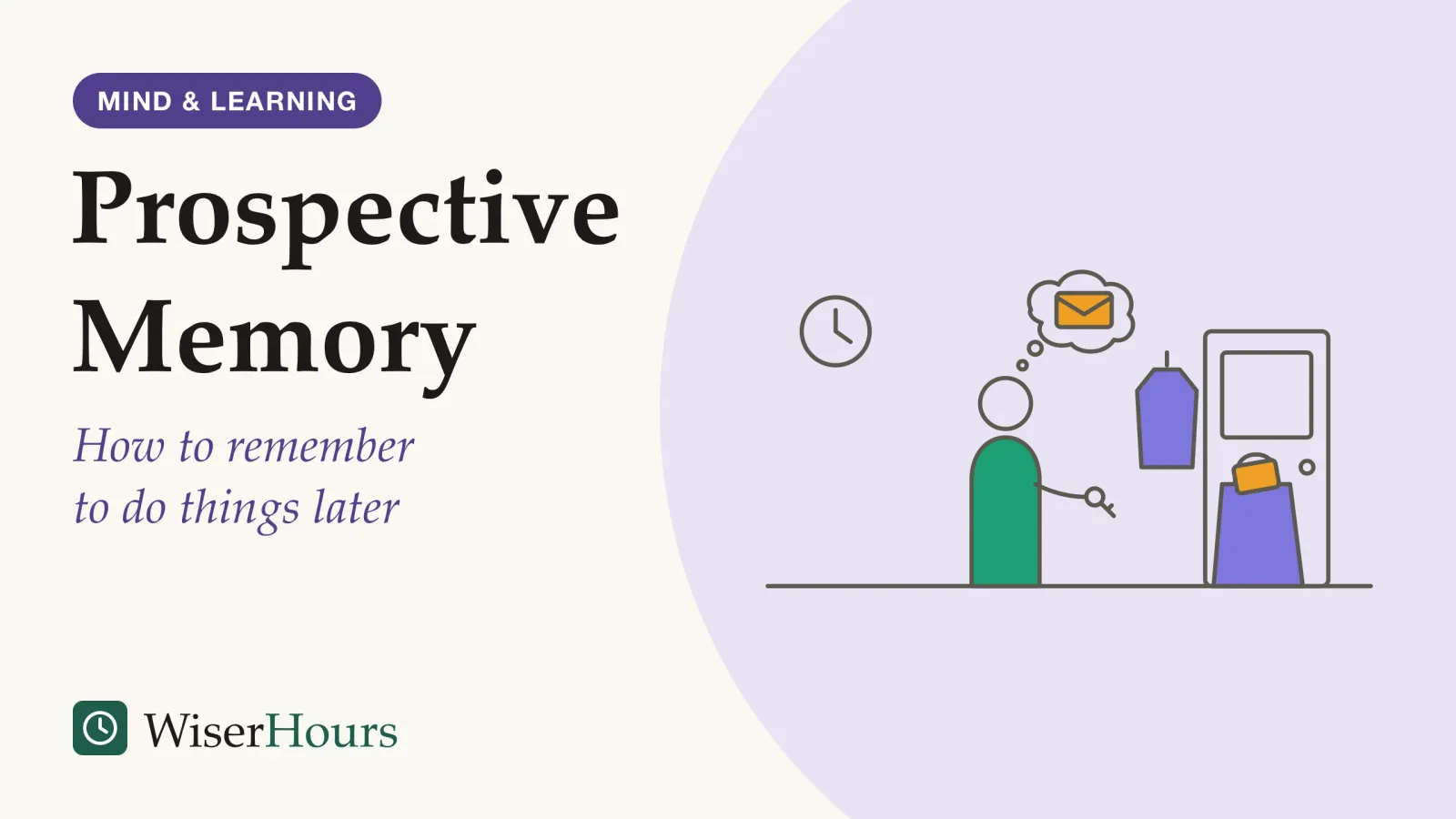
Most everyday forgetting is not about the past. It is the call you meant to return, the pill at lunch, the parcel still in the car. Psychologists call this kind of remembering prospective memory, and it fails for different reasons than forgetting a fact does.
Prospective memory is the ability to remember to carry out an intended action at the right moment later, without anyone asking you to. It depends on a cue bringing the plan back to mind, so it slips most when you are busy or interrupted. Five habits make that moment easier to catch, each explained further down with its evidence:
- Do it now if you can.
- Make an if-then plan.
- Put the reminder where the action happens.
- Turn a clock time into an event.
- Anchor regular medicines to a fixed routine.
Remembering facts and past events works differently, through stages set out in how memories are encoded, stored and retrieved. Here the subject is plans for later.
Prefer to watch? The video covers the same ground as this article.
What is prospective memory? Remembering the future
Prospective memory means remembering to perform a planned action at some future point, Wikipedia’s entry on the topic explains, while retrospective memory covers people, events and words met in the past.1 The difference is direction: one looks back, the other carries a plan forward until its moment comes.
Definition
Prospective memory is remembering to do something you planned, at the right time or in the right situation, without a prompt to search your memory.
The definition hides two jobs. You must remember that you have something to do when the moment comes, and what it was. The second part is ordinary memory; the first is what makes this kind hard. When you meet a friend you meant to pass a message to, nobody says “now try to remember something”; the plan has to surface while you are busy asking how she is.2
Everyday examples are easy to find: phoning the dentist after lunch, buying milk on the way home, taking a tablet with breakfast, attaching the file before you press send. The stakes can be high at work. Key Dismukes, a researcher at NASA’s Ames Research Center in the US, opens his 2010 review with examples based on real events, including an airline crew that taxied back for a repair and then took off without setting the wing flaps a second time.3
So when you forget to do something, it usually says little about your memory for facts. It says the moment arrived and nothing in it pointed back to the plan.
Time-based and event-based prospective memory
Researchers split prospective memory into two main kinds. Event-based intentions are tied to a situation, such as giving a friend a message when you next see her; time-based intentions are tied to a clock, such as taking the cookies out of the oven in 20 minutes, Dismukes’s review explains.3
The difference matters because events bring their own reminder. Seeing your friend can pull the message back into mind. A clock time has no such trigger, so you have to keep checking it yourself, which takes effort and is easy to forget while you work. In a 1997 field study in an office, described in the same review, people remembered an event-based task better than a time-based one, even though they thought about the time-based task more often.3
Give time-based plans an event to hang on. “Call the bank at 3” becomes “call the bank when the 2:30 meeting ends”, or an alarm that goes off at 3. Dismukes recommends exactly this conversion, from a time to a cue you are likely to meet.3
Why intentions slip when you are busy
Intentions come back to mind in two ways, according to the multiprocess framework that the US psychologists Mark McDaniel and Gilles Einstein proposed in 2000. Sometimes you keep the plan active and keep watching for your cue, which takes attention. Sometimes the cue itself triggers the plan, with no watching needed.2 In a 2005 review, the two argued that the mind relies on several processes, including spontaneous ones, rather than on watching alone.4
Watching has a price. In lab experiments, holding an intention while doing another task often slows people down on that task, a sign that some attention is being spent on looking out for the cue.2 In daily life that watching is one more thing to keep in mind alongside the work itself, a strain much like the one explained in how working memory holds information while you use it.
The spontaneous route works best when the cue is noticed as part of what you are already doing. McDaniel’s team calls such cues “focal”. If your task is deciding whether strings of letters are words, a particular target word is focal, while any word starting with the letter r is not. In one experiment their 2015 review describes, people remembered well with a focal cue even when they were not watching for it, and mostly forgot with a non-focal one.2
Interruptions and short delays are where plans get lost
Intentions can vanish within seconds when attention moves elsewhere. In three experiments published in 2003, Einstein, McDaniel and colleagues asked people to hold back a response until a task changed, 5, 15 or 40 seconds later; when the situation was demanding or they were interrupted, forgetting set in quickly, at levels the authors judged significant for real-world settings.5
Interruptions are a special trap. Dismukes describes experiments by Dodhia and Dismukes in which students answering multiple-choice questions were interrupted and had to remember, unprompted, to go back to the unfinished question. Three things helped: a reminder at the start of the interruption, a short pause before switching, and a clear signal that the interruption had ended. Think of being halfway through an expense claim when a colleague asks for a quick favor. The claim is still open, but nothing on your new screen points back to it. Before you turn to the favor, take a moment to say or note where you will return and when. Dismukes’s practical advice is the same: pause before dealing with an interruption and plan how you will get back.3
Five habits that help you remember to act
To improve your prospective memory, change the moment of action: each fix makes the cue harder to miss. Their support ranges from lab experiments and one meta-analysis to a field researcher’s practical advice, so think of them as reasonable habits rather than promises.
1. Do it now if you can
The simplest rule comes first in McDaniel and Einstein’s own advice, as Dismukes summarizes it: if an intention matters, do not delay it when you can avoid that, because people become vulnerable to forgetting as soon as their attention turns elsewhere.3 If the reply takes two minutes and the moment allows, send it now.
2. Make an if-then plan
An implementation intentionimplementation intention: A plan in if-then form that ties a specific action to a specific situation, such as 'if it is nine o'clock, then I open the report.' It hands the decision about when and where to act to the situation itself.Full entry in the glossary pairs a situation you expect with the action it should trigger: “if I pass the pharmacy, then I collect the prescription.” Social psychologists, notably Peter Gollwitzer, developed the idea, and studies outside the lab have linked it to better follow-through on exercise, medicines and homework, Dismukes’s review reports.3
The study
Moderate evidence
If-then plans help people remember to act
A 2015 systematic review and meta-analysismeta-analysis: A study that combines the results of earlier studies on the same question into one overall estimate. Pooling makes the estimate more precise, but it cannot repair the studies it pools: a meta-analysis of surveys is still survey evidence.Full entry in the glossary led by researchers at the Chinese Academy of Sciences in Beijing pooled 36 comparisons. For healthy young adults, forming an if-then plan had a medium-sized benefit for remembering to act, somewhat larger when the plan was both said and pictured. For older adults the benefit was medium to large.6
A medium effect means a difference you would notice across a group, not a guarantee for each plan. There is a limit too: the 2003 experiments found that if-then plans did not prevent forgetting over delays of a few seconds in demanding conditions.5 To make one, picture where you will be and what you will see, then say the plan in full: “When I put my coffee cup in the sink, I take my tablet.” Dismukes’s review gives a similar example of linking a daily medicine to brushing your teeth.3
3. Put the reminder where the action happens
A good reminder is distinctive, closely tied to the task and placed where you will be looking when it is time to act. The best ones physically block what you would do next: some pilots who pause a checklist wedge it between the throttle levers, so they cannot take off without seeing it, Dismukes reports.3
He also gives two warnings. A friend leaned a bag she needed against her usual door, then left by another one. And a sticky note on his own screen stopped working once he got used to seeing it. So put the bag in front of the door you will use, the keys on top of the file you must take, and change a reminder’s place once it starts to blend in. Phone alerts, a form of cognitive offloadingcognitive offloading: Using something outside your head, such as a note, a calendar alert, a search engine or a chatbot, to cut the mental work a task needs. It usually helps you do the task, though you may remember less of what you handed over.Full entry in the glossary, follow the same rule: no cue works, Dismukes notes, if what you are doing at the time does not draw your attention to it.3
4. Turn a clock time into an event
Because time-based plans have no natural cue, convert them: set an alarm, or attach the task to something you will be doing at that time.3 “Pay the invoice on Friday” works better as “pay the invoice right after Friday’s team call”, with the invoice open on the screen before the call starts.
5. Anchor regular medicines to a fixed routine
Taking a regular medicine at a fixed moment, such as breakfast or bedtime, gives the pill a cue that arrives every day on its own. Advice from the National Institute on Aging, a US government agency, notes that some people use meals or bedtime as reminders, and others use charts, calendars, weekly pill boxes, timers or reminder apps. The same page notes that some medicines need an empty stomach because food can affect how they work, so a meal is not the right anchor for every pill.7 Medicine schedules differ, so ask a pharmacist which aid suits yours, and do not change when you take a medicine without checking with them or your doctor.
Before you leave an intention for later
Which fixes have the strongest support?
Much of this work uses brief lab tasks, often with students, so the ratings below describe how well each idea is supported rather than how much it will change your own week.
| Fix | What the best evidence found | Evidence |
|---|---|---|
| Doing it at once | People can forget an intention within seconds when busy or interrupted | Lab experiments, moderate5 |
| If-then plans | Medium benefit in young adults, medium to large in older adults; in separate experiments, no help over seconds-long delays5 | Meta-analysis, moderate6 |
| Distinctive reminders in the action’s path | Distinct, closely linked cues work best; reminders can fail if not seen | Expert review, limited for daily life3 |
| Cues that fit the task at hand | Remembered well without watching; other cues mostly forgotten | Lab experiments, moderate2 |
| Pausing before an interruption | A reminder, a pause or a clear end signal helped people return | Lab experiments in one series, limited3 |
Is forgetting to do things a sign of ADHD or dementia?
Forgetting an errand or a call now and then is common, and a slip on its own diagnoses neither condition. The NHS in the UK notes that most people forget things from time to time, that memory problems are often nothing serious, and that common, treatable causes include stress, anxiety, depression and insomnia.8 Age alone is not the full story either. A 2004 meta-analysis found older adults did worse than younger ones on lab tasks but substantially better in naturalistic studies of remembering to act.9
Forgetfulness is one of the signs of ADHDADHD: Attention deficit hyperactivity disorder: a condition, usually present from childhood, marked by persistent inattention, hyperactivity or impulsiveness that affects daily life. In adults it can show up as disorganization or trouble finishing tasks, and a specialist makes the diagnosis.Full entry in the glossary the NHS lists for adults, alongside being easily distracted, finding it hard to organize time and often losing things like keys. The NHS adds that these symptoms usually start before the age of 12.10 What raises the long-term risk of dementia, and what may lower it, is covered in the dementia risk factors you can change.
Forgetting that should be checked
Now: if you or someone with you suddenly becomes confused, treat it as an emergency and use your local emergency number. British readers can dial 999 or make their way to A&E, the NHS says, but should not drive themselves.11 If low mood or stress comes with thoughts of suicide or self-harm, call your local emergency number or a crisis line. Find A Helpline lists free, confidential lines in over 175 countries12; in the US, the 988 Lifeline takes calls, texts and chats at any hour.13
Soon: see a doctor if memory problems keep coming back or make daily life harder, or if you are worried about an older relative who seems to forget more and more. The NHS advises against trying to work out the cause yourself, says any treatment may work better when started early, and suggests bringing someone who can help describe the problems.8
Routine: if long-standing forgetfulness, distraction and trouble organizing time affect work, study or relationships, raise it with a doctor, who may refer you for an ADHD assessment, as the NHS describes.10 Health services differ between countries, so check how yours handles referrals.
The bottom line
Do important things at once when you can. When you cannot, tie the plan to something you will see: an if-then plan, a reminder placed in the path of the action, or a clock time turned into an event. Before any interruption, note where you will pick up again.
This article is general information, not medical advice. If you're worried about your health, talk to a doctor or another qualified professional.
Frequently asked questions
Do phone reminders and sticky notes actually work?
They help, with limits. Key Dismukes's 2010 review of prospective memory research reports that electronic organizers improved remembering in everyday studies, but sometimes failed or were awkward to use, and that low-tech aids such as notes and calendars still have value. He also describes getting so used to a sticky note on his screen that he stopped seeing it, so move or refresh a reminder that has blended in.
Why do I forget whether I already took my pill?
That is a different slip from forgetting to take it. Key Dismukes's 2010 review notes that people sometimes forget whether they have already done a repeated task such as taking medication, a failure of ordinary memory rather than of remembering to act. The US National Institute on Aging lists weekly pill boxes, charts and calendars as aids, and a pharmacist can suggest one that suits your medicines.
Do older adults forget to do things more often?
In lab tests yes, in daily life often not. A 2004 meta-analysis led by Julie Henry at the University of Aberdeen in the UK found younger adults did better on lab tasks, while older adults did substantially better in naturalistic studies. Key Dismukes's 2010 review suggests that older adults may create more reminders for themselves and have less demanding days.
Sources
- Prospective memory. Wikipedia, accessed 11 October 2026
- Dual pathways to prospective remembering. McDaniel, M. A., Umanath, S., Einstein, G. O. & Waldum, E. R. (2015). Frontiers in Human Neuroscience, 9, 392
- Remembrance of Things Future: Prospective Memory in Laboratory, Workplace, and Everyday Settings. Dismukes, R. K. (2010). Reviews of Human Factors and Ergonomics, 6(1), 79-122, doi 10.1518/155723410X12849346788705; author manuscript, NASA Ames Research Center
- Prospective Memory: Multiple Retrieval Processes. Einstein, G. O. & McDaniel, M. A. (2005). Current Directions in Psychological Science, 14(6)
- Forgetting of intentions in demanding situations is rapid. Einstein, G. O., McDaniel, M. A., Williford, C. L., Pagan, J. L. & Dismukes, R. K. (2003). Journal of Experimental Psychology: Applied, 9(3)
- The effect of implementation intention on prospective memory: A systematic and meta-analytic review. Chen, X.-J., Wang, Y., Liu, L.-L., Cui, J.-F., Gan, M.-Y., Shum, D. H. K. & Chan, R. C. K. (2015). Psychiatry Research, 226(1)
- Taking Medicines Safely as You Age. National Institute on Aging, US National Institutes of Health, content reviewed 22 September 2022
- Memory loss (amnesia). NHS (UK), page last reviewed 9 October 2023
- A meta-analytic review of prospective memory and aging. Henry, J. D., MacLeod, M. S., Phillips, L. H. & Crawford, J. R. (2004). Psychology and Aging, 19(1)
- ADHD in adults. NHS (UK), page last reviewed 19 March 2025
- Sudden confusion (delirium). NHS (UK), page last reviewed 28 May 2024
- Find A Helpline. Find A Helpline (international directory), checked current 11 October 2026
- 988 Suicide & Crisis Lifeline. 988 Suicide & Crisis Lifeline (US), checked current 11 October 2026
How we researched this
We searched PubMed, OpenAlex, publisher sites and the web in October 2026 for reviews of prospective memory by the researchers who built the main theories, meta-analyses on if-then plans and on age, and official health pages on medicines, ADHD and memory loss. Sources run from 2003 to 2025; four were read as abstracts only. Main limitation: most experiments are short lab tasks with students.
Keep reading
Tip-of-the-Tongue Moments: Why Words Go Missing and How to Find Them
Most adults get a word stuck on the tip of the tongue about once a week, more often with age. Why words hide, 4 ways to find them, when to get it checked.
How to Memorize a Speech Without Sounding Rehearsed
How to memorize a speech: learn the opening and close word for word, the middle as 3 to 5 points, and recite from memory on separate days instead of rereading.
How to Remember Names: A Method That Works at Parties and Meetings
4 steps for remembering names, built on the best-tested one: recall a new name to yourself soon after you hear it, then again after longer gaps.
Is Photographic Memory Real? What Science Says
Is photographic memory real? No adult has passed repeated tests. Eidetic images appear in an estimated 2 to 10% of children; trained and rare memories are real.